Showing posts with label freaks. Show all posts

06 December, 2011

You're (Still) Going To Die In There: boring uses of clueless sensitivity

“If you like the jar with the baby’s leg, wait until you see the jar holding the baby’s head. If one actress with Down syndrome doesn’t provide enough Tod Browning-style otherness for you, don’t worry — there are two. If the line about snorting cocaine off a high school girl’s nipples doesn’t do it for you, maybe the scene of the sobbing naked man masturbating will.”

—New York Times American Horror Story review

One of these things is not like the others!

It’s perfectly reasonable for critics to take issue with portrayals of disabled characters that use them as a genre trope or try to shock the audience with the disabled character’s appearance. Lots of horror movies and TV shows do this.

(While we’re on the subject can I just show you my favorite horror DVD cover of all time:
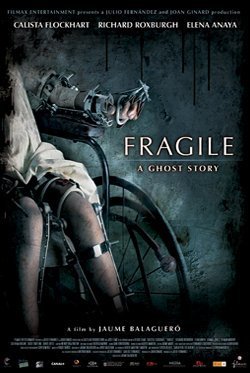


LOLOL. Terrifying.)

However, I really wish critics, in their rush to be sensitive about disability issues, would actually take a step back and look at what they’re saying. Which in this case, seems to boil down to the idea that a person with Down Syndrome is the same as a jar with part of a dead baby in it. And that an actor with a disability that affects their appearance would only be cast in a TV show or movie as a circus freak.

To be fair, I don’t really think this critic would be against an actor with Down Syndrome appearing in some kind of inspirational/depressing movie about the family of someone with a disability. I don’t think they would consider that a “freakish” performance. But in addition to the fact that you shouldn’t assume all disabled characters in the horror genre are functioning as freaks, I’m also not sure why critics are quick to jump all over the “insensitivity” of characters like Addie in AHS, when they don’t seem especially plugged in to notice what is wrong about more “tasteful” portrayals of disability—which in my opinion can be equally offensive.

I definitely don’t speak for all disabled people when I say this, but I prefer horror tropes of disability to tasteful tropes. Disabled horror characters have style—rusty, terrifying wheelchairs and braces more suited for steampunk conventions than actually helping someone get around. Their unsteady gait isn’t depressing, it stops you in your tracks with fear. If they’re bad, they kill people, and if they’re good, they can help you with their psychic powers. They’re not people to underestimate.

Of course they’re usually shitty characters, but as shitty characters go, I love them a lot. And because their very nature means they are not “tasteful,” they often become more human and likable than the disabled characters in a straight-faced portrayal of disability.

I wish that critics would wait to talk about disability until they’re ready to actually care about it and engage with it genuinely. The more I see people complain about Addie on AHS—in exactly the same way, and for some reason never mentioning other disabled characters on the show, like she’s the agreed-upon thing that’s offensive—the more it looks like they’re doing it to earn some kind of merit badge. “I’m sensitive to portrayals of disability in pop culture!” No, you’re not. Because if you were, you would care about things like whether disabled characters are unique, have realistic problems, are charismatic, are POV characters, and don’t tragically die at the end of the movie. Your primary focus wouldn’t be whether you can lazily compare Jamie Brewer to the actors in Freaks—which happens to be a great movie despite not being “tasteful” in the slightest.

As long as so few disabled characters are good, it’s really hard for them to be notably bad, and there’s something so clueless about condemning Addie Langdon when there are so many worse characters running around in this and other genres. In the end it doesn’t matter if the Burned-Face Man chokes you with a pillow in the attic, or a Lifetime mom ends your suffering in a more wholesome way—you’re going to die in there.

13 April, 2010

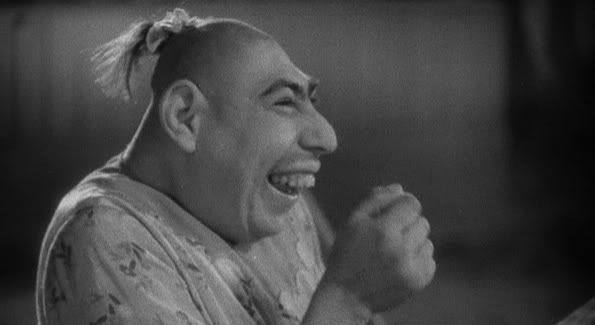
I don't feel sorry for Schlitzie Surtees


I mean: I feel sorry for him because his only options in life were to be a sideshow performer or live in an institution. Even though he liked performing, it should have been a choice. But I don't feel sorry for him because he had microcephaly.

A few weeks ago, Mike D'Angelo at the Onion AV Club wrote a piece on Freaks that makes me think he didn't get much out of the movie. Basically, he says it could never be made today (why not?) and that the presence of Schlitzie and other people with disabilities "gives the film an unavoidable skeeviness." Before a clip of the "one of us" sequence, D'Angelo announces, "If you can watch this sequence without experiencing conflicting emotions, you worry me."

That's right. I have something wrong with me because I think Schlitzie, Johnny Eck, et al. are really fantastic, and don't have a problem with Tod Browning including them in a movie.

This is a placeholder for a longer post about Freaks and the general idea that it's inappropriate to be interested in and/or pleased by disabled people, especially intellectually disabled people. Apparently D'Angelo thinks that the appropriate way to treat someone like Schlitzie is to avert your eyes as fast as possible. Except, he can't do that, because Schlitzie is awesome--but he takes care to emphasize that the way he feels, and the way Browning apparently felt, is REALLY FUCKED UP AND MYSTERIOUS. It's just one of those weird fucked-up things that people feel.

But it's not fucked up at all! What's wrong with liking Schlitzie?

I'm going to quit and come back to this later, but for the time being, this is a really brilliant and beautiful post by Shiva, another ASD person who likes Freaks: Freaks, Hercules, and the Hydra.

And another thing: it's a privilege to know Joe and Zach. They are interesting kids and I feel fond of them. If I hadn't, in movies and in real life, been exposed to people with microcephaly and other different-looking disabilities, I wouldn't be able to get to know Joe and Zach the way I am; the way they look would have been a distraction, instead of just a part of who they are.

At age twelve I became terrified when I was sitting near a very different-looking, very loud disabled kid in church. My reaction to her was horror and sadness. I started crying. I don't think this says anything about unusual-looking people. I think it says something about the idea that it's inappropriate for unusual-looking people to be in public or to be portrayed in art, and how dangerous that idea is.

16 February, 2010

catching signals that sound in the dark

Like most people, I love the Hensel twins, and have since I was little. I remember my dad bringing home the Life magazine cover for me. I just spent a lot of time looking at videos and pictures of them online. It's awesome to watch the way they move around. But it's also awesome to watch them asking questions in class and joking around with their friends, because this isn't a life that would have been available for them a hundred years ago.

One of the most obtuse passages I've ever read comes from the Wikipedia page for Schlitzie, my favorite circus freak:

Under the care of Surtees, Schlitzie continued performing the sideshow circuit until Surtees' death in the early 1960s, after which Surtees' daughter, who was not in show business, committed Schlitzie to a Los Angeles county hospital.

Schlitzie remained hospitalized for some time until he was recognized by sword swallower Bill Unks, who happened to be working at the hospital during the off-season. According to Unks, Schlitzie seemed to miss the carnival dearly, and being away from the public eye had made him very sad and depressed. Hospital authorities determined that the best care for Schlitzie would be to make him a ward of Unks' employer, showman Sam Kortes, and return him to the sideshow.


Okay, dude--I really like Schlitzie and would like to think that he lived a happy life. And from the way he comes across in Freaks, he seems like a sweet person who liked attention, so I'll totally buy that he was into being a sideshow performer, and that he felt sad when he stopped doing it.

BUT DON'T YOU THINK HE WAS ALSO SAD BECAUSE HE WAS LIVING IN A HOSPITAL? I mean, if I was living in a hospital for no reason, and someone encountered me there, I'd think it was really fucking weird if they were like, "Amanda seems really sad, she must want to be a sideshow performer." Maybe he just didn't like living in an institutional setting. You know, like almost every person who ever lived.

I am really into the show Carnivale, and one of my favorite things is a very minor aspect of the show. Ben's crush, Ruthie, is a middle-aged woman with an adult son, Gabriel, who is a pretty minor character. But we know that Gabe is intellectually disabled and performs in the carnival as a strongman, as well as helping set up rides and tents with the other young guys in the carnival. Ruthie used to be a snake charmer when she was younger, but now she's mostly the "barker" for Gabe's act. Since I am interested in the history of disabled people (especially intellectually disabled people) who worked as a sideshow performers, Ruthie and Gabe's story seems especially moving to me. I imagine Ruthie realizing that her child was intellectually disabled, and that he didn't have a disability that affected his appearance and could therefore be the basis of his act. I imagine her thinking about Gabe's options outside of the hospital--probably being locked away somewhere. But in the carnival, he could travel and be part of a community. As he got older, he turned out to be really big, and that turned into an act, which was great. And Ruthie doesn't have to worry about what will happen to Gabe when she dies, because he has things he's good at, and he's surrounded by people who have known him his whole life.

But obviously not every carnival was as friendly as the one portrayed in Carnivale. The only good thing that happened in the class I dropped was that we read a piece by Eli Clare, who is a queer trans guy with cerebral palsy. Part of the piece was about his interest in particular historical figures--disabled sideshow performers, and XX people who lived as men. But he admits that he doesn't know exactly why certain XX people lived as men, and that it isn't necessarily accurate for him to claim them as trans. And he admits that some of the sideshow performers may have been manipulated and abused, and felt that they had no choice but to be "freaks." I am interested in the same two groups of people, although I'm a lesbian instead of a trans guy, which proves how hard it is to identify who inverts "belong" to. The Well of Loneliness seems to me to be a story about deviant sexuality, but in the 1940s Michael Dillon, a trans man, identified Stephen Gordon as someone like him.

But I'm getting off topic. I was thinking about Amanda Palmer, who has been criticized at FWD/Forward for starting a band with her friend where they pretend to be a pair of conjoined twins. I don't think Amanda Palmer is coming from a typical ableist perspective, even though she is being ableist. I think she thinks of the idea of conjoined twins as just another part of the whole circus/carnival genre that she's always drawn from. I'm not super offended by Evelyn Evelyn, I don't think, but it does make me kind of uncomfortable. It just seems stupid (although I generally love AFP, don't freak out). However, I feel like if I think that this is really bad, then I have to think Neutral Milk Hotel is really bad, too. Although Jeff Mangum didn't pretend to be conjoined twins, he just wrote a song about them.

I mean, is it ever okay to view people with certain physical conditions as part of a genre? I don't think it's okay to go as far as Palmer has gone but is it okay to be into conjoined twins and make art about them when you aren't actually conjoined and don't know any people who are?

eta: I just deleted a little bit about whether ASD people are circus freaks in modern society, and whether Jeff Mangum can be considered a circus freak because of his mental illness and nonstandard body language--I need more time to write that than I have, because I was too brief and it came off like I was saying "Jeff Mangum and I can have circus freaks but Amanda Palmer can't" or something equally oversimplified and self-serving.