Showing posts with label relationships. Show all posts

13 June, 2015

Sensory Issues

Something like this happens:

1. I'm in college, in a psychology class, where the professor tells us that Autistic people don't care about other people. We only see them as objects to get something from. (She knows I'm Autistic and she's taught Autistic students before.)

2. A friend of my friend informs her that I will never care about her because I'm Autistic.

3. One of the most popular books in the world is about an Autistic character who doesn't care about people and wishes that everyone else in the world would die. I see people reading this book all the time, including people I'm close to, and it has been recommended to me so I can learn more about autism.

4. After a mass murder, I hear people speculating that the murderer must have been Autistic.

Something like this happens: my feathers are ruffled. I feel hopeless about life; I feel like I can't trust anyone. I want to confront the person who said something. I don't want to feel obligated to be nice to them. I feel betrayed if the person was someone I liked and trusted.

If I talk to anyone about this, most people respond calmly and cheerfully. Even close friends and family aren't hurt or angry on my behalf. They have no emotional reaction--they often seem a little bored that I've brought up something so trivial--and if they even intellectually condemn what happened, their focus is on telling me that it isn't so bad.

The person didn't mean it like that.

Well, a lot of people have that misconception about Autistic people. They just don't know any better.

I shouldn't be so sensitive. I should get over it.

They wouldn't think that if they got to know me.

Mysteriously, the last statement--a compliment--is the one that bothers me the most.

Why be modest? No one else is going to say anything good about me once they know I'm Autistic. So I'll admit that I'm a kind, caring person. It's certainly the way I am most often described by people who don't know I'm Autistic. As I leave a room I sometimes hear people exclaiming, "She is so sweet!" I always do my best to be kind and polite to everyone, I volunteer, and I've chosen to take care of other people for a living.

I'm pretty much as far from the Autistic stereotype as I could get. So yes, it is probably true that if certain people were forced to spend time with me, they would eventually have to admit that I care about other people, and maybe they'd even start to wonder if this is true for other Autistic people (but I doubt it; exceptionalism is a hell of a drug). Yet somehow this fact is completely inadequate and unsatisfying to me in every way.

For many people, there's a duality between disabled people--an abstract group--and the disabled person you know. People just cannot get their heads around the idea that ableism really does affect their disabled friend or family member. How can a nice pink-collar Manic Pixie Dream Girl like me possibly be affected by the idea that Autistic people are serial killers? I'm obviously not a serial killer if you get to know me!

The rub is obviously that most people don't know each other and that most acts of discrimination aren't committed between close friends or family members. I'm supposed to be comforted by the idea that my friends and family members know I care about other people, and completely desensitized to the fact that doctors, therapists, potential employers, police, judges, or jurors might think I don't.

Even if you put aside situations where I could be concretely hurt or disadvantaged because of those stereotypes, there's still the daunting task of having to convince new people in my life that I care whether they live or die. Specifically, the fact that it's completely horrible to assume I don't care about that; and the fact that I shouldn't have to prove something so simple; and the question of how, having proved I meet a minimum standard for decency, I'm supposed to settle down and be friends with someone who assumed I didn't.

I've been thinking about this whole thing a lot lately, and I do feel a lot more friendly toward these responses than I once did. I think, if people care about me, they think it is kinder and more comforting to believe that these things don't matter; that I'm just a cuddly Autistic snowflake floating around and those kind of ideas can't ever really hurt me. I am their friend, their family member. They know I'm a nice person (even if their ideas about Autistic people in general are negative) so everyone must know that I'm a nice person (even if their ideas about Autistic people in general are negative). I must be safe and equal; if someone cares about me, it feels nicer to think that I am just silly and oversensitive, than that I could actually face discrimination for being Autistic.

02 July, 2014

Compare and contrast

I just realized something weird about my feelings.  Actually, I'm guessing this is true of a lot of people and I'm going to write about in the second person, but there's always a possibility I'm just a huge freak.

Basically, things look better when you are comparing them to something worse.  This means that the worse someone is, the more their behavior can impress you.

For example, if your best friend usually criticizes you and insults everything you say, you will feel so special when he does tell you, "That was really smart."  He will seem really nice, and you'll feel like what he said was really meaningful because you waited such a long time to hear it.

If your boyfriend always hits you when he's mad, it will seem amazing if he gets mad and doesn't hit you.  It will seem like he's great for controlling himself, like he's really working hard to treat you well.

Actually neither of these people is nice!  It doesn't have to be this extreme.  But the point is you give more credit to people who deserve less credit.  Meanwhile, if someone is consistently kind to you, you never get the high of being shocked by an ordinary display of kindness.  Their kindness blends into itself and doesn't impress you as much as someone not hitting you 1% of the time.

I think I first got exposed to this idea in the form of a piece I read about being nostalgic for bad relationships.  It was basically about how bad relationships have some really exciting and good moments when your partner stops being awful for a minute and you're so excited about it.  Then you end up being nostalgic when you're in a relationship with a good person, because you don't get excited the same way. (If someone could find this piece, I'd love to link to it--I just couldn't find it.)

This is pretty obvious, I guess, but I was thrilled to notice myself having one of these reactions today because I could self-correct.  Here's to prioritizing people who are actually good to you most of the time.

25 January, 2014

Not Boundaries

I have been thinking about boundaries a lot and have a bunch of posts stewing.  Some of my posts are about having strong boundaries, but today I was thinking about what is not a boundary.  I guess I should stop using the word boundaries so much because it's kind of vague--I would define boundaries as things that a person has the right to control.

For example, a person should be able to control whether they have conversations with strangers.  If I try to talk to a stranger on the bus and she keeps ignoring me or she tells me she doesn't want to talk to me, then I should stop talking to her.  If I keep trying to talk to her, I'm coming up on violating her boundaries.  If I actually become aggressive or try to punish her for not talking to me, then my behavior is seriously wrong and abusive.

But not every preference is a boundary.  Let's say the same stranger not only doesn't want to have conversations on the bus, but doesn't want anyone to have a conversation on the bus.  She tells everyone on the bus to stop talking to each other.  That's not appropriate, I don't think.

There's some room for interpretation of what is or isn't a boundary.  What if people on the bus are having a very loud conversation that is hateful or sexually explicit?  A lot of people would feel it's within their rights to tell them to stop having that conversation in public.  Even though there are some gray areas, I think there's usually an answer to the question, "Is this a legitimate boundary?"

Yesterday I was at a restaurant with two friends.  I'm not in a really high-quality fake name headspace, let's call them Alice and Sebastian.  After I mentioned how anxious and stressed out I sometimes felt when people would sing loudly in public, the conversation eventually led to Alice and Sebastian both singing loudly in the restaurant.  I felt uncomfortable and wished they would stop.

I don't know what's up with this, because I'm sure I'm totally loud and weird in public sometimes.  But I often get really distressed when I'm with someone who is singing loudly, talking in a certain way (like putting on a fake accent), laughing loudly, or just talking really loudly in public.  I guess part of me feels scared that people will be upset with them and something bad will happen to them, or that I'll get in trouble for allowing this to happen.

Because these situations make me so uncomfortable, there have been many times when I demanded that someone stop singing in public and felt like the person was hurting me when they didn't stop.  Even last night, I thought of putting my money down on the table and saying, "Okay Alice and Sebastian, you're upsetting me and I'm going to leave."  I briefly felt like doing this would just be asserting my boundaries, even though I knew it would upset them too.

When I thought about it, though, I remembered what I've been thinking about lately--that just because you don't like something doesn't mean it's wrong for someone to do it.  There's nothing wrong with being irrationally bothered by stuff, but there is something wrong with expecting other people to always stop things that bother you.  There has to be some kind of limit when it comes to accommodation.

I know that sounds harsh, but things can go really wrong if you don't prioritize logic over emotional reactions.  Like, if someone gets suicidal every time someone criticizes her--that sucks for her and it's not her fault, but if people always prioritize that person's feelings, then that means they can't even tell her if she did something really bad to them.  She could be driving the wrong way on the highway and the other person in the car would be worrying about making her suicidal by telling her they're about to get in an accident.

I've been in situations pretty close to this, and it just is no good.  Sure, people can't help having mental health problems or reacting to stuff a certain way.  That doesn't mean that they should allow those problems to control other people's lives.  I've had really positive and really negative relationships with other mentally ill people, and the most negative things have happened when people have not been mindful and responsible about their mental illness.

I just waited it out with Alice and Sebastian--I was glad that I didn't end up being mean to them for singing, because they should sing if they want.  But I also felt dissatisfied with how things had gone, because I had to sit through something that upset me.  I thought about it more today and came up with a potential solution of leaving for a while, explaining why I'm leaving, but also being very clear that I don't think they're doing anything wrong and I'm glad they're doing something they like.  Obviously this is something that some people would think is just crazy and ridiculous, but I think it could work with a lot of the people I spend time with.

01 January, 2014

Confusion and forgiveness

Content warning for gaslighting type stuff, I guess.

In November I made a few posts about how I have to be harsh with people sometimes because I have boundary issues and might take on their feelings by accident.  I'm not sure I do have boundary issues.  What happened is, at the beginning of November I ended my first serious romantic relationship.  Over the course of the relationship I had started to feel very confused about things like who I was, what I felt, and how I behaved.  I felt like I couldn't clearly remember incidents that had happened between my girlfriend and me and I was constantly straining to understand what was going on.

There was a possible explanation for this, but I didn't want it to be true.  My girlfriend refused to ever apologize or acknowledge doing things that hurt me.  If I brought up something I thought was a problem she would either claim she didn't understand, tell me I was confused about what was happening, tell me I was contradicting myself, or bring up something bad I'd supposedly done to her.  Along with whatever her response was, she also would get upset and it was awful because I knew it was my fault for criticizing her behavior.

This was all really disorienting.  When something hurt me, I had to either put up with it or risk something worse happening if I talked about it to her.  I worked hard to convince myself that she wasn't doing anything wrong.  I also worked hard to believe that the things she said made sense even when she was attributing feelings to me that I didn't have or distorting things that had happened.  Over time she caused more and more problems for me, but I had to believe it was my fault because otherwise, I would have to admit that my image of my girlfriend as a kind, well-meaning person was completely wrong.  It was past the point where she could just be doing all this by accident.  There was a long-term pattern of her distracting, punishing, and confusing me out of asking to be treated fairly in our relationship.

I don't think she set out to do this to me--I think she was desperate for closeness and terrified of criticism.  But it was still very wrong and shouldn't have happened.

When I ended our relationship, I knew that I had to turn off the parts of me that had focused so much on trying to keep my ex from being upset.  I had to stop trying to always see her point of view.  Instead, I needed to focus on the fact that what she did to me was wrong.

I might be more likely to identify with other people than the average person, but the degree to which I was identifying with my ex's feelings by the end of our relationship didn't come naturally.  I had to be trained into putting her comfort ahead of my needs.  I may be suggestible, but I didn't start out as suggestible as I was by the end.

So, yeah.  It's not me, it's you.

I also wanted to write about forgiveness a little bit.  I usually lean toward forgiving people but I think it's important to acknowledge that in some situations, certain kinds of forgiveness aren't possible.

Let's say Molly's boyfriend, Steve, steals money from her and she forgives him.  There are a bunch of different ways this could play out:

He steals money from her and then apologizes.  She forgives him.

He steals money from her and apologizes.  She forgives him.  He continues to steal money from her and apologize.  She forgives him every time.

He steals money from her and when she confronts him, he gets mad at her and says she should care more about his problems.  She apologizes and gives him as much money as he wants.

He steals money from her and she is going to confront him.  Then at church one day, Molly resolves to be a more forgiving person and decides she will be okay with Steve stealing money from her and she won't confront him about it.

He regularly steals money from her and she can't stop him from doing it and she resents this.  She decides to forgive him and not resent him for stealing her money anymore.

Molly says Steve is not allowed in her house.  She isn't angry at him for what he has done, but she's not willing to deal with him stealing her money.

So, what most of these situations have in common is that Steve doesn't see his bad behavior as wrong and he plans to continue doing it.  I'm not sure that you can really forgive someone like this unless you are doing it from a distance.  I feel like trying to be forgiving, compassionate, etc. to someone who is repeatedly hurting you is less about forgiveness and more about accepting that you're getting hurt and trying to have a good attitude about it.  I'm not criticizing people who try to have a good attitude about getting hurt but I don't think anyone needs to try to forgive someone who is hurting them.

I think forgiving someone who is sorry can be a really positive thing.  I don't think forgiving someone who isn't sorry is really something that needs to be done.  For real forgiveness to happen, the boundaries have to be in place--it has to be acknowledged that there's something to forgive.

24 March, 2013

//

(1)

People are well-intentioned when they say that anyone can do ___ regardless of their disability, but it actually just makes them look ignorant. I understand the idea that a lot of people with disabilities who would want to do something and could do it are not receiving the support they need, and too many young PWDs are told they'll never be able to do the things they aspire to do.

If someone wants to do something you shouldn't tell them they can't do it, but that's different from making generalizations about everyone. My personal least favorite is "everyone can work." Well, for example, how is someone going to work if they can't move anything except their eyes and aren't suited for a job that they could perform just with their eyes? How is someone going to work if they're so depressed they can't get out of bed in the morning or make basic decisions? How is someone going to work if they're consumed by a desire to physically injure themselves all the time and it takes every bit of energy not to do that?

I wish this wasn't the case, but I hear people using the phrase "everyone can work" in almost an aggressive way, as if it's ignorant for a non-disabled person to say some disabled people can't work, or cynical or lazy of a disabled person to say that they themselves can't work. I think this shows a fundamental lack of empathy and if you don't understand why some disabled people can't work, then you shouldn't even be talking about disability and work because you are really uneducated.

Sometimes it seems like providers, family members, and even self-advocates have a homogenous idea of "disabled people" and they don't make room in their head for the large percentage of disabled people who don't fit their image.

(1) Actually I think Ratatouille does a good job addressing this issue, by acknowledging the difference between "everyone can be a great artist" and "a great artist can come from anywhere."

2.

My client cannot talk and often doesn't respond to things quickly. Her volition is pretty confusing to me when it comes to movement so all I can say is that her movement can be pretty telling, but I sure don't expect her to move on schedule or on command.

I feel like all this is implied with the vague label of "profound disabilities" and presumably we all know about people with "profound disabilities," so why is everyone so confused? I don't know what to say when people ask me why she doesn't look at them or answer them. I don't mean people with no experience, but people who are at programs with their disabled family member or client, or are even running the programs.

Also the eternal question, "Does she understand everything I'm saying?" to which the answer is a resounding, "I don't know."

Maybe I'm just a crappy person and I can tell you the idea has occurred to me before, but I get extremely impatient. It feels like a lot of people either demand responses from her due to their wholly unfounded assumptions that she can give one, or they just don't think about her at all. The idea that someone without obvious communication might enjoy some attention is just as baffling as the idea of someone without obvious communication existing in the first place.

I've sometimes gotten the impression that stuff that's "for developmentally disabled people" does not try to be inclusive of developmentally disabled people with certain support needs or that people who are "interested in working with developmentally disabled people" do not find it interesting to work with developmentally disabled people with certain support needs. I'm glad to say I haven't seen any extreme examples of this in the 5 months I've been working at this job--just impressions--but Single Dad Disabled Daughter writes about some infuriating stuff.

3.

On the other hand, I have a disability and I do have a job and answer people when they talk to me. So people who like disabled people who do those things should like me, right?

Well, not really.

I'm not sure why it is that a lot of people who claim to like and enjoy people with developmental disabilities, or even work with them, have a problem with people who are slower than they are, can't do things that they can do, or just look or act different. When they meet someone who they don't immediately recognize as disabled or who they aren't meeting in a context where they would expect to meet a disabled person, the friendliness they would show to an Actual Disabled Person is not there at all, and they are just as contemptuous as anyone else would be about the person's impairment.

The only thing I can think of is that when these people relate positively to disabled people who fit their idea of disabled people, they're not doing so because they actually like people regardless of disability, or even because they like personality traits that sometimes come from living with certain mental disabilities. It's because they've created a new category, "developmentally disabled people," that they see as different from other people and relate to differently from the way they relate to other people.  If a developmentally disabled person is too much of a peer, or looks or acts too similar to non-disabled people, they can't put them in the "developmentally disabled people" category, so they can't accept their disability.

Maybe it's an Uncanny Valley thing but I don't really care because I am coming out of the following situation.

I had a friend who spent a lot of time working with a group of people with developmental disabilities who are quite different from most people I know, and I knew that she liked that group of people a lot. Technically, she knew that I had a disability, and even professed to support disability rights. That sounds like a pretty good deal on a friend right? It was a long time before I admitted to myself that this person made me feel scared and uncomfortable about nearly everything related to my disability. When we met someone who I suspected might have a disability, I cringed inwardly because I knew she would criticize the person later for being too slow or too weird. I was afraid for her to meet my closest friends, who are all Autistic or crazy, because I didn't know if they would be able to hide their disabilities well enough to avoid being criticized by her.

There are some people who you know are friends with you because you're just barely good enough for them. And actually, there are people who are friends with you because you're bad enough for them, too--you're a "special needs" person to them, not an equal. Maybe I'm becoming an asshole but I have no interest in either type of friend anymore.

26 June, 2012

the split

Clayton and I talked about how he got really upset when I said that I hate men.

1. he said that he was partly upset because when I said I hated men he assumed I didn’t include him and he feels like people have always not counted him as a man because of his disability
2. also that it just hurt

I tried to talk about “the split” which is really what I am thinking of when I say I hate men. It is just a feeling of parts of you being in a really deep opposition to each other. For example on Saturday a really kind and friendly bad brains man (about twice my age) sat next to me on the bus and I loved that we talked and it made my whole day better but:

1. he asked me if he could sit next to me and I basically couldn’t say no
2. he kept referring to my looks
3. he made me take off my sunglasses so he could look at my eyes
4. he asked me if I had a boyfriend

This didn’t really bother me because he wasn’t trying to pressure me into giving him information so he could contact me. It didn’t feel the same as that. But it is an example of how I hate men anyway. Why did he feel like that was okay? Why was it so normal that I didn’t even feel bothered by any of it?

This is the split and it’s hard to tell how I feel about it because I want to treat everyone with charity and lovingkindness and be interested in people even if they do something I don’t agree with, even if they do something I think is terrible.

But sometimes I wonder what is me being charitable and what is me being railroaded and just putting up with people’s privilege.

In high school my best friend was this really sweet lovely kid who was also such a straight guy. He didn’t treat me bad for being gay like the other straight guys but he still said ridiculous stuff like that he thought people were just pretending to be gay for attention. I loved this boy and something I love about myself is that I am a person who could love him even though he did stuff like that.

But damn there is something a little strange in it and I occasionally get spitting mad when it occurs to me how calm I am.

Recently I said something horrible to a friend from a minority group I’m not part of. There are a lot of things wrong with what I said but the worst thing is that I didn’t feel instinctively that it was wrong the way I would if it was something that was hurtful to me. So she had to explain to me how bad it was.

She wasn’t mad. She was really sweet about it, and in her calmness, I’m guessing, was the split between her and me.

06 September, 2011

what not existing means to me

Thinking of trying to post here more.

So I'll just say the social skills conversation makes me CRAZY*? It's become yet another of the things I can't even stand to talk about kind of like when someone tries to tell me I'm high-functioning and can self-advocate.

(*I don't EVER think it is a problem to talk about and examine language use but I'm not necessarily for having rules about it, so please don't comment and tell me why you don't think I should use the word crazy, I know why you think that and I think about it all the time.)

and today I flipped out at my friend just because he happened to say something about having social problems, in a kind of "well, you know, you and I are different this way" sort of tone. I think I said something like, "NO! I'm so fucking sick of people like you getting everything and being THE ONLY PEOPLE IN THE WORLD" which after I said that I was kind of like, shit, what am I talking about? what does that mean? why am I mad?

I am not really mad at my friend, or another Autistic friend at whom I blew up similarly about two weeks ago.

I'm mad because before I got to know other people with autism and DD, I thought I was some kind of Super Minority, in fact I did not consider myself to be on the autism spectrum at all, because I was told that "Asperger's" or "HFA" (the type of autism I was supposed to have, being a college student who could talk) was primarily about "lacking social skills" which apparently in a classic form meant not reading facial expressions (which I'd been tested on so I knew I could do it), insulting people by mistake, making people listen to speeches about your interests, not being polite, not knowing what people were feeling, and so on.

So I wasn't like this so I usually didn't consider myself to have ASD. In fact sometimes I knew things about people that other people didn't know.

At the same time, it was pretty clear I was kind of batshit* (in terms of how I processed life and how I felt sometimes) and I also had trouble with things related to friends that no one I knew had trouble with. For example when I was a first-year in college I got really attached to a friend named Clayton and wanted to spend time with him every day, so I would go sit outside his door. He would be happy to see me when he was there but he usually wasn't there so I'd just be sitting there reading and doing my homework and I HATED myself. I liked him so much that I wanted to see him all the time but I got so I hated everyone who lived on the same floor as him because I thought they were watching me and thinking how I wasn't normal and I was some kind of creepy stalker, and the next year when Clayton started living with the guy who had lived next door to him it took me a long time to stop hating him because I believed that he judged me.

The next year I had a friend named Noah who was a good writer but wanted to quit writing because it made him depressed. Noah spent a lot of time listening to me talk because he was a quiet person and it made me miserable because I felt that Noah and I didn't have an "equal" friendship, so I snuck onto Noah's computer and read pieces of his writing that he had forbidden me to ever read. It caused a huge problem in our friendship that I sometimes think has never gotten better, and it happened because I was trying to do what I thought was the right thing. (For some reason not one but two people who read my blog and who I attempted to be friends with have used this story to illuminate something about me they don't like. Thanks guys. I actually already feel terrible about it and find it hard to write about because it was an awful experience, AND I'm not the kind of person who would ever do something like that anymore, so it's not even a good example of whatever you don't like about me now.)

In the last year of high school and the first few years of college, I considered a girl named Lisa my best friend. I stopped considering her my best friend after a fight we had on the phone until four in the morning, my senior year, about ten months ago. A lot of our fight had to do with her feeling that I was mean and overly strident about anti-ableism, something she told me she "just [didn't] care about, I guess I should, because you're disabled, but I just don't." I could be wrong but I wonder if she thinks that identifying as disabled is some new thing I just invented/discovered and isn't who I really am. It's something that makes me feel oddly guilty and start questioning myself--because if Lisa doesn't remember me being disabled, then how is it even real? She's my oldest friend and should be the best judge of things that are phases or poses.

But it was a really long fight, and towards the end Lisa started talking about how when we were first becoming good friends (I was about 16 and she was about 15), whenever we had a conversation I would talk for a while and say, "I've been talking too much, now you talk." Lisa can be quiet with people early on, and it made her feel bad like I was constantly criticizing her for not talking in the way I thought was correct. She was saying that early on things from our friendship still affected the way she felt about me and it was hard to get out of resenting me for them.

Obviously, "I've been talking too much, now you talk," looks to me very much like sneaking on Noah's computer because I thought our friendship was too one-sided, and being upset that with Clayton I always sought him out. Whatever you call that problem, it was the biggest problem I've ever had in relating to other people.

Anyway, before I got to know other people with autism and DD, it was obvious to me that I had some disabled type problems like moving a bit differently and loving things too much and getting so frightened that I couldn't sleep or recognize words, AND I also considered myself to have "social problems" because this stuff with Noah, Clayton, and Lisa wasn't something that most people seemed to worry about. My social problems were not textbook autism problems, so I figured my autism must be very mild, but at the same time they seemed to wreck my life so much more than just being rude or not reading facial expressions. When I would interact with people who I imagined might be "autistic"--people who monologued a lot and weren't very sensitive--they seemed SO much happier and less distressed than I was and they seemed to pretty much have friends and not be killing themselves over whether they were calling their friend on the phone first or their friend was calling them. So how could I be more "high-functioning" than these people? My social life occasionally exploded into these awful periods where I was convinced everyone hated me and I felt sick. Also, it was nearly impossible to make new friends, because I figured that all of my friends' friends would never want to be friends with me because I was such a fucking freak.

Where am I going with this? Well, when I got to know some more people with autism and DD, and I began to think critically about this, I came to some conclusions:

1. A lot of people with autism aren't at all like the textbooks.
2. Autism is a lot more than social stuff, even for people who can talk. (This came out of a long period of thinking of myself as "more like a severely disabled person, except I can talk" because severely disabled people were allowed to have a lot of emotional troubles and problems with transition and stuff.)
3. Eventually: social skills don't exist.
4. I am a human.

I know I am disabled, and accepting that has really changed my life, but so has believing that I'm not socially impaired. In February I went into the first class of my last semester and made an awkward comment/joke to the girl sitting next to me. She looked at me blankly and I started to feel about as low as a Yeerk squashed under an Animorphed elephant's foot. It almost ruined my whole day--then I thought, we have different senses of humor! Maybe she doesn't have much of a sense of humor at all! She isn't a representative of humanity, and I haven't lost a war. We're just NOT THE SAME.

Or, God forbid, someone doesn't understand something I said. This used to be something that I would actually LIE about and argue about to anyone who I perceived as trying to tell me that I wasn't normal and couldn't do everything I thought I could. "Of course they understood me! You're just being overprotective! Maybe there's something wrong with YOU!"

Hey, guess what: my speech is hard to understand. AND sometimes I say things in a way that is jumbled and not connected. Oh no I'm going to drop out of school and delete myself from the universe. No, actually, I'm fine and I'm just going to say it again more accessibly. Life is good.

The problem is

I am very political about disability because politics has saved my life.

I have never been able to finish writing about going to a doctor this winter. I sought out learning testing because I was really confused by how slow I felt and how hard it was for me to do schoolwork, Activities of Daily Living, and other things. I seriously thought some kind of huge mass was missing in my brain because I just was not happening. I considered suicide because my friend gave me the relatively simple, but unexpected, task of taking his car to the gas station when I was driving it. I started crying and begging myself to drive into every truck I passed on the road, because I COULDN'T GO TO THE GAS STATION, it was too hard.

So, the doctor diagnosed me with some learning disabilities which aren't very severe and which I'd already been diagnosed with before. And he kept telling me I was really smart, something I'd also heard before. This increased an already very suicidal winter and early spring to fever pitch. I cried every time I met with him. I wanted a brain hole. Sometimes I still do. What is with the gas station? Why can't I just go there?

I don't know.

So, the worst thing about meeting with the doctor was that he didn't believe I had autism. In addition to getting my learning testing, I was also hoping to get a re-diagnosis of ASD because I hadn't had one in 8 years and I figured I might need more recent documentation at some point. Unfortunately, the doctor was very well versed in learning disabilities, and didn't know very much else about bad brains. Every time I talked to him, I would make the mistake of referring to myself as having autism, and there would be this little record-scritching sound.

"Autism! I thought we agreed to throw that out!" (in the same tone of voice he used when telling me I am smart)

Then he would explain to me that if anything he might be convinced I had Asperger's, not autism, because it is strongly associated with one of the learning disabilities I had (even though I had very good eye contact, he said). Every time he said this, I would explain that Asperger's, PDD-NOS, and Autistic Disorder are all on the autism spectrum, and when I referred to myself as having autism, I was just using the word that my disabled friends and I used about ourselves, which was in fact consistent with how the psychiatric community was coming to classify people, since the DSM 5 would have only the autism spectrum and not three separate diagnoses. He and I had this conversation probably six times, every time I met with him. The final time, I actually started yelling. "THERE ARE THREE DIAGNOSES THAT ARE CONSIDERED AUTISM SPECTRUM DISABILITIES. WHEN I SAY I HAVE AUTISM, I JUST MEAN THAT I HAVE BEEN DIAGNOSED WITH TWO OF THOSE DIAGNOSES IN THE PAST, AND I BELIEVE THOSE WERE CORRECT DIAGNOSES. I AM NOT THE ONLY PERSON TO REFER TO THESE THREE DIAGNOSES AS 'AUTISM.'"

"So that's the new thinking?" he said.

I began crying (again).

Now I know what you're thinking. Why didn't I just say Asperger's because that was a label he obviously would have been more likely to accept, understand, and associate with someone as "smart" as he thought I was? Why did I need to have this fight every time I talked to him?

I don't really know. I can't send letters if I think even one word is arrogant, shifty, dishonest, or undeserved (you can imagine this makes it difficult to apply for jobs, as I usually become really unhappy and take on some less urgent project to distract myself). I can't stop saying I have autism if that's what I think I have, and if having it has helped me define myself in a way that has radically changed for the better how I live my life.

I was not diagnosed by him IIRC, and I am not seeking rediagnosis now. Diagnosis of autism would require social impairment. Here's some stuff I could say:

I don't have a lot of friends.
I don't lose friends in fights more than anyone else, but I seem to grow apart from them really easily.
I have no romantic or sexual history to speak of.
I often don't fit in very well in the workplace.
I was bullied a lot when I was growing up.
I had few friends or no friends most of the time, from the time I was about twelve to when I started college.

These are actually true facts, but I don't consider myself socially impaired.

Here are two things that piss me off when other Autistic people argue with me and tell me that social skills DO exist:

1. when they tell me (admittedly, because I'm very confrontational and force them to say it) that they think I do have social impairment. I guess that this is really just a huge trigger/mental block thing where to me it means something much worse than what they mean, but to me, when someone says this, it's like they're saying that I have a false view of the world, and that makes me very upset.

2. when they tell me that I need to acknowledge that some other Autistic people are very different from me and have really different impairments from mine, and that even though my impairments aren't related to socialization, some people's are.

Number 2 makes me start thinking, what the fuck is autism then? Can autism actually be THAT different? But I will bite. Let's say that a few different disabilities look similar enough to have all been categorized as autism, and let's say that while all of my isolation and conflict with people blah blah DOESN'T come from social impairment, but just comes from other parts of my disability and/or me as an individual, other people with autism who have similar experiences with people actually DO have those experiences because of social impairment. The books don't describe me, but they do describe them. In fact, the DSM definition of autism describes them, and it doesn't describe me. So, the DSM and mainstream professional thought about autism at least starts to describe one group of people with autism, but doesn't describe me at all, and if I went to a psychologist and started telling them about what I consider to be my disability--i.e. cognitive and emotional problems and the relationship between those two things--it would take a miracle for them to diagnose me with autism. Because I have the kind of autism that's less real than the other kind.

So, to me, when someone starts saying, okay, well YOU need to understand that other people do have REAL SOCIAL PROBLEMS and REAL SOCIAL SKILLS DEFICITS, even if YOU DON'T, I feel like they are saying I'm fundamentally different from a LOT of other people with autism, the REALLY REAL PEOPLE WITH AUTISM, probably. I feel like I'm being kicked out of my own disability. No wonder I tend to prefer to call myself bad brains and insane in the membrane and Magikarp zombie waste of space. It seems obvious I belong in the Autistic community, and I even have that treasured thing: a fairly early diagnosis (from 1998, when I was nine), but I know that I would be said to have "grown out of it" or been misdiagnosed, by any reasonable medical professional--I know it can be taken away any time, and sometimes I feel that by being inseparable from the theory and values that prove to me I have a right to exist, I am making it easier for people to erase me.

I am saying this because I want to apologize to you, and probably other people I've forgotten doing this to before. It isn't you, and it's probably not logical. I panic and start hitting out.

06 April, 2011

cassie ainsworth & redemption rejection

this is just some Skins gibbering, mostly character- and not plot-based, which I think is interesting in terms of ideas of covering (or "disability redemption").


me: that was me being a bitch like oh wow but fuck you style
have I mentioned that's like my favorite line ever?
Joshua: haha, it's a good moment. I dunno Jal is being kind of patronising, and though she never deserved to be the target of evil Cassie, you can see why that would hit Cassie's angry spot!
me: like, it sort of reminds me of having to act really cute to make up for being disabled
Joshua: nice interpretation
me: that's what "oh wow but fuck you" means to me.
Joshua: and like.. even more charitable to S2 Cassie than I usually am.. which is very charitable.
me: oh I mean, I don't necessarily mean that's what she means. it's just sort of what it means to me. Like, I think she just says oh wow because she always says it, and then she gets to the actual content of what she's saying, which is fuck you. But to me like oh wow is a very important line, even though people act like it's stupid and annoying, it means something really important.
me: I remember once telling Ari that I liked working with severely disabled people because lots of the people I worked with hugged everyone they met, and for some reason I'd observed this was more common in adults than kids with similar disabilities
Joshua: like they feel they have to be like that?
me: and Ari suggested that some people are very isolated and it's like "oh wow a person! I never get to interact with a person!" He said something like, "I hope the next generation of pwds can decide that they're not particularly interested in someone or they don't like them"
I think this is interesting in terms of how Cassie is introduced in the first episode. I haven't seen it in a while, but I think she hugs tony, possibly hugs sid, and then hugs abigail--"YOU'RE SO LOVELY!!!"
the plot thickens!
then obviously throughout the season there's the constant "oh wow" and manic pixie dream girl reactions to everything--coupled with starving, suicide attempts which often seem in her cases to be engineered to hurt people or cause as much trouble as possible, and occasional moments of being pretty mean or pissed off.
me: I am sort of getting this from you because I remembered when you said that Cassie doesn't really change from s1-s2, not in a deep way.
Joshua: No she really doesn't.
me: yeah so in conclusion, the line "Oh wow, but fuck you" line means a lot to me because it's almost like Cassie sort of rejecting the things that she previously did to try to "earn" people's friendship and support.
Joshua: Cassie would not mean nearly as much to me without s2 as much as I love S1 Cassie. If she'd been left at that without the contrast of S2 she'd be a standard Manic Pixie Dream and a fairly borderline offensive idealised picture of mental illness.

31 March, 2011

Joshua: I was wondering, do you see anything disabled metaphory about Prisioner of Azkaban?
me: about who?
I mean, Lupin duh, do you mean other people?
Joshua: cos my favourite part of the book was hearing about how James, Sirius and Peter turn themselves into animagi to understand and help Lupin with his "condition" I thought it was really touching and poetic. But like, is that like magical crip drag or just magical.. being willing to see the world from a disabled persons perspective rather than trying to make them "normal"?
me: that's always been my favorite chapter in any of the books, I used to read it over and over when I was a kid
like, I think James and Sirius are kind of like Freddie and Cook
well, you won't get to this for a while
but I feel like Remus is often characterized as feeling like he doesn't have a right to his own opinions because he owes them so much
Joshua: ooohh I love that analogy
the Freddie/Cook/JJ one
me: well, I think given stuff Remus says later, it makes a lot of sense.
um...yeah
I wouldn't call it crip drag or anything like that
I think I wouldn't exactly call it goodness or kindness, totally--but maybe that's what Remus needed
Joshua: no, I didn't think it was, but I thought i'd speculate that possibility!
me: like, they were doing it for fun, partly. I think they didn't totally get it
Joshua: were James and Sirius kind of dicks when they were young? I haven't read to this bit but I've had some naughty wiki glancing
me: I may be projecting/imagining, but I feel like James and Sirius probably didn't understand how much Remus didn't think turning into an animal was fun
Joshua: weren't*
me: so, hm, maybe we will call it crip drag
yup!
and Remus was afraid to say anything
me: JK Rowling also said this: "Lupin’s failing is he likes to be liked. That’s where he slips up – he’s been disliked so often he’s always pleased to have friends so he cuts them an awful lot of slack."

(by the way, here is very long post/essay I wrote on the Skins livejournal community about my love for JJ, which at some points discusses JJ's unequal relationship with Freddie and Cook.)

12 January, 2011

from the inside, #2

The reason I'm titling these posts this way is that they both are anecdotes that I think are really funny--and in this case, really cute--but I feel like they'd make absolutely zero sense to people who don't have a similar identity and experience to mine, re: disability. So to some people they may come off as being really strange and out of context, but I'm hoping someone from my kind of place will relate to them instinctively.

In terms of socializing, I used to always have a strong feeling that I liked my friends much more than they liked me, so that showing that I liked them was showing weakness and showing that I wasn't normal. I was always really afraid of stalking someone or being an obsessive friend so I thought of myself as having to play this game where I'd be kind of unkind to people or wait to call them until they called me first. Now that I can think about these things more clearly, I think that being nice to people and reaching out to them usually makes them like you; it's not more complicated than that with the people I know. But I still end up feeling some of these urges to withdraw from people because it seems safer and more normal and more dignified. I used to have some food issues and making someone feel like I don't like them, or not calling them, feels basically the same as not eating. I am a winner.

Anyway, the upshot of this post is just that my best Autistic friend and I always use the word "supercrip" to refer to the person who "wins" in any interaction--i.e. the person who hangs up first, is called rather than calling, or displays less emotional connection to what's going on. I just think this is a cool usage because it shows how when you have problems with your disability identity, you can end up relating disability to all your problems and seeing really strange behaviors and accomplishments as "not being disabled anymore," i.e. winning, i.e. being a supercrip.

03 January, 2011

on fruit bats/the r word/everything in real life

I just want to talk about, well, everything I have to say, using this one scene from Skins.

Basically, JJ (who has ASD and some other stuff) doesn't like the way his friends Cook and Freddie are acting, and they won't listen to his opinions. He can sometimes need a lot of support, and he's not as cool as they are, so they treat him more like a little brother than an equal friend. Then JJ overhears Cook referring to him as a "barmy fucker" and gets even more pissed. He tries to tell Cook how annoyed he is at him and Freddie, but Cook brushes him off as usual.

Cook: Now, are you coming or do I have to keep look out myself when I'm buying gear?
JJ: (softly) Just care, okay?
Cook: About what?
JJ: (suddenly shouting) About me! About me, you twat! You're all fucking twats!
(Cook looks surprised and concerned, and hugs JJ and holds him, stroking his hair. Cook has a tendency to be overly demonstrative and sentimental.)
Cook: I pissing love you, J. Nothing's gonna change that, man. You're my very own little fruit bat. Fuck Freddie. It's just me and you now, J. Feel the love. You feeling it? Right?


--3x07, about halfway through

What Cook says is really sweet, but there's something that has the potential to ruin its sweetness--Cook calling JJ a fruit bat. We see at multiple points in this episode that JJ really doesn't like Cook to use nicknames or make jokes that are based on JJ's disabilities. In context, it seems obvious that "fruit bat" is a reference to "fruitcake," and therefore fits into the category of names JJ doesn't like to be called. But JJ doesn't say anything. He arguably winces at the word "fruit bat" and doesn't look completely satisfied by anything Cook is saying; but he closes his eyes and seems to enjoy being held.

Now, on some level, this interaction--Cook saying "fruit bat" and JJ not responding--is kind of fucked up. And one thing it reminds me of is something that sometimes happens when you belong to a minority that your friends don't belong to. You end up accepting stuff that offends you, because if you spoke up every time something offended you, your friends would just think you were annoying and be mad at you. This can happen to anyone (I love this post about token black friends)--but it's particularly hard to fight when you depend on your friends for support, or don't think you have the ability to make new friends.

When I look at the scene that way, my smile disappears, as does my desire to write a slash fic. It becomes a really sad scene. JJ seems isolated, marginalized in his own friendship, intimidated out of standing up for himself. I think this is a totally correct way to look at the scene; it's not just an interpretation, it is what's happening.

However, even though I think this is objectively true, it's not the only thing that's objectively true. Cook doesn't realize the effect his language has on JJ and, rather than consciously choosing to ignore something offensive, JJ is probably too emotional to let the word "fruit bat" outweigh everything else Cook is saying. And maybe he has a point. Sometimes people close to us say things that are offensive, and that doesn't make it right--but it doesn't always mean they don't care about us. We have the right to say we're offended; intent doesn't make something okay--but if we choose not to say we're offended, this isn't always a sad thing where we're submitting to the dominant culture, or whatever. I mean technically maybe it is. But you know, also our friend is hugging us. Maybe we "pick our battles." Maybe in our personal lives, sometimes we decide how we feel about intent, and maybe in some moments intent is good enough.

Can I say this? Do you know what I mean?

16 December, 2010

something else about Skins

(stfu you can't imagine how much I love this show)

in 3x04 when Freddie finds JJ at Pandora's party and looks after him--I generally hate Freddie, but he's really sweet in that scene. and the whole fact that Freddie, Cook, and JJ all use the phrase "locked on" to refer to instances when JJ becomes obsessively upset; then people who aren't in the trio, like Emily, also start using the phrase about JJ when he is upset.

I think this is cool for multiple reasons.

We eventually learn that JJ has a diagnosis of "lower autism spectrum" (is this really what they say in the UK?). But the truth is, we really don't need a word to tell us about JJ. Often, pop culture portrayals of verbal people with ASD are very superficial and behavioral. It's hard to explain what I mean by behavioral, but you'll just have to take my word for it that JJ isn't portrayed like that. It's something like...you could watch a lot of clips of the show and not realize that JJ is written and played as having autism. But those moments of his character aren't at odds with the moments in between, where he certainly seems like an unusual person but it could be a lot of things, or the moments when he's quite stereotypically (but not inaccurately) "locked on" or having a meltdown.

He's just himself, the whole time.

As far as we know (well, I'm only seven episodes in, but still, that's a lot) none of JJ's friends know about his diagnosis. I'm guessing Freddie and Cook probably do, but we're not actually told that. The only time words related to ASD have been used are a)when we learn JJ's diagnosis by seeing his diagnostic papers and articles on autism that his mother has, and b)when JJ is upset and calls himself a bunch of slurs: "Retard! Nutjob, headcase, spazzo, mong, autistic fucking fruitcake, mental basket, shitty, in a fucking cuckoo's nest."

The first instance is kind of cheesy forced exposition, but the second is really interesting because we get a sense of autism not by itself, but as part of a whole group of stigmatized conditions. I think it's really--well, I can't say it's more realistic for everyone, but personally, I think that, assuming you're not part of any kind of Autistic culture, and especially if you are really upset about your disability, it makes sense that you wouldn't really identify as having "autism" or "Asperger's" or "ASD," but just as Not Being Normal. After all the idea of abusing someone for being "autistic" is not as established as abuse against people who are "retarded" or "mental baskets." So abuse against people with ASD is often done in the name of another disability that ASD superficially resembles. And therefore, it's not really strange that almost every term JJ uses in his outburst is a derogatory term for people with either psychiatric or intellectual disabilities, except for "spazzo," which I think is generally an insult based on CP and/or epilepsy; "autistic;" and "shitty."

Anyway, where I'm going with this, and with the fact that none of the other characters so far have ever had a discussion about JJ having "autism" or "lower autism spectrum" or "Asperger's," or whatever...is that the tendency to repeat a bunch of diagnostic labels in fiction, or to have a character who constantly "acts autistic," is often done in a clumsy attempt to educate, or to sensationalize the disability. In real life, people with ASD, and the people around us, don't usually behave like this.

The risk is, though, that if an ASD fictional character just behaves like themselves and isn't stereotypically, classically ASD all the time, and we don't use the word much, then consumers may just say, "Oh, I didn't realize he was supposed to be autistic, and he was just a little weird anyway. It didn't seem to really affect him." Which is annoying, because the character isn't really making a difference then. Plus there's the whole sense that if someone's ASD isn't immediately visible to you, then it's not really affecting them. But how do you show effects that aren't as obvious as a monologue or something?

What I think is really lovely in Skins is that JJ's disabled-ness is kind of like a ghost--although it's not something that people intentionally don't mention, like a ghost, but it's just something that everyone is very used to and doesn't state outright most of the time, and it's also something that isn't always apparent.

JJ has two best friends. This already takes him away from the worst of autism pop culture, where he would often be portrayed with no friends. But we soon see that there is something strange in the way Freddie and Cook treat JJ. They say some things to him that are kind of harsh, when he's being genuine ("She's not looking at you"). Cook roughhouses with JJ in a way JJ doesn't seem super thrilled by. JJ seems obligated to go along with all of Cook's plans*. There's an element of bullying in the way the two of them treat him, like he inherently has less authority or less value. At the same time we see Freddie and Cook's tenderness and sense of responsibility toward JJ when he is distraught.

(*I should note that there are some times when Freddie starts asking JJ to keep Cook out of trouble; the relationship between the three of them is certainly not a one-dimensional thing where Freddie and Cook always control, bully, and take care of JJ, but I think that's a very strong element.)

This is a really fantastically realistic and complicated portrayal of a trio of teenage friends, regardless of the disability aspect. But with the disability it becomes almost miraculous. Without the help of words like autistic or disabled (although Cook uses some words related to mental illness), we get the picture: JJ is guileless--which makes him funny, and easy to use--and afraid to stand up for himself, because he sees himself as inferior to other people--which, again, makes him easy to use and push around. He is very loyal to his friends, partly because he doesn't like things to change and partly, I think, because he doubts his ability to make new friends. Freddie and Cook sometimes treat him in a way that's really patronizing and disrespectful. (And despite this fucked up stuff, all three genuinely care about each other, because in real life friends can treat each other terribly without meaning harm.)

We also see that JJ feels guilty because his mom is stressed out about him. Which is really classic disabled kid stuff--real disabled kid, not TV disabled kid--and is conveyed really briefly and effectively.

So we kind of see JJ's disabled-ness, or what it means to him socially at least, through the way Cook and Freddie treat him and the way he reacts; and the way he feels guilty about his mom, and sometimes hates himself for looking like all those words. We definitely see straight-up impairment. But sometimes we see how the experience of growing up as disabled--not specifically ASD, but you know, "spazzo, headcase, fruitcake, retard"--has in some ways really shut down JJ's sense of what he can be and what he's allowed to pursue.

Also--the scene that started this for me, at the party, with JJ getting locked on. Freddie comes to the party, finds JJ, helps him to come outside, and then tells off Effy for not looking after JJ; and Effy apologizes. What I was originally just going to say is that Freddie and Effy are both talking about JJ as someone who needs this particular kind of support, but they're not using any words that are explicitly related to disability. Which is just an example of something that I like and think is realistic.

But another thing is just the complicated thing of being disabled and having friends who don't seem to need as much support as you need. To paraphrase, for the third time on this blog, a line from my favorite book: "They needed to treat him like an autistic person, but they also needed not to treat him that way." How is JJ supposed to say that Freddie's pissing him off and needs to stop ruffling his hair, when JJ was dependent on Freddie to come and rescue him from the party? Thinking about this really kills me. Gosh (oh my giddy giddy giddy aunt?) I love television.

ETA: Really annoyed with JJ's portryal in 3x09 though.

12 December, 2010

This isn't really complete and it's like 3 posts in one

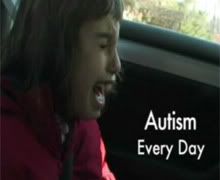
Hi, kids. Today I want to talk about sadness and rage. Or basically any related emotion or combination of the two that causes the people around you to be uncomfortable. An easy way to talk about this is by talking about Autism Every Day, which has been beaten to within an inch of its life, and I certainly don't have anything new to say about it, but look at this:


This is the title card of the movie, which as you know is basically a propaganda piece about how hard it is to live with someone who has autism. If I remember right, the movie features montages of young people with autism crying and screaming.

A friend of mine, who is usually pretty social-justice-y and good on disability stuff, watched this movie for the first time, and after watching about a minute of it, she said, "Wow, I didn't know autism was this bad, maybe I wouldn't be able to handle this either if I was a parent." And I felt sad that she had this response, because to me the portrayal of emotion in this movie is very obviously incredibly slanted.

Because here we have a picture of a girl crying being used to prove that people like this girl should not exist. We basically have someone's emotions being used to devalue her. And to me, it's very obvious how emotions mean completely different things depending on the privilege or the role of the person showing emotion.

If you see the family member of someone who's identified as "the disabled person" expressing emotion--crying, screaming, expressing that they want to kill themselves or kill someone else, seeming very annoyed about something pretty small like not being able to go out to lunch--this is taken of evidence of how wronged the person is by the disability that "the disabled person" has (which, I'm sorry, is not that different from saying they are wronged by "the disabled person," straight up).

For the record, I should say that I don't have any problem with the one mother in Autism Every Day complaining that she can't go out to lunch--I don't think she's being petty or something, I think it's something that represents, to her, how much pressure she's under. What I do have a problem with is that if "the disabled person" complained about something small like not being able to go out to lunch, it would probably be used to show that "the disabled person" is unreasonable. And definitely in the cases of crying, screaming, and verbally or physically showing an interest in violence against oneself or others, "the disabled person" cannot do these things without showing how undesirable their disability is, or how unbearable they are.

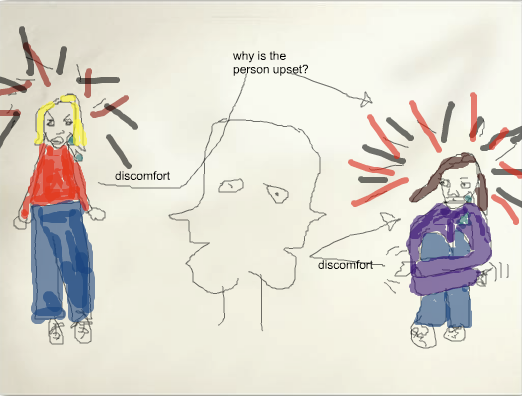
So if you have privilege, when you show emotion that causes discomfort in someone else, it just shows that your life sucks, and turns the viewer's discomfort toward the cause that you want to promote. If you don't have privilege, and you show the same emotion, the viewer's discomfort stays with you and is turned back towards you. I made this swell picture at artpad showing how to respond when a family member of "the disabled person" is upset to a degree that makes you uncomfortable, vs. how you should respond if "the disabled person" herself is upset.

a very messy drawing showing a standing woman crying and obviously upset, and on the other side of the picture a woman sitting with some mannerisms suggesting she has autism. a two-faced figure looks at them both. from the standing, non-disabled woman comes an arrow that says, discomfort, then asks, why is the person upset, and points to the disabled woman. from the disabled woman comes an arrow that says, discomfort, and simply points back at her

This is sure to turn out really well for everyone except the disabled person.

Someone in my family who I'm very close with has a mental health condition and I know they don't want people to know about it. But it is also very hard for me not to write about it, because in retrospect I can really see how it fits into "the disabled person" vs. family member in terms of expression of emotion. (I'm talking about this in the past tense, somewhat disingenuously, but whatever.)

I was seen as "the disabled person," while this other person wasn't. And it only became apparent to me fairly recently that I, and another family member, who regularly experienced this person screaming and crying at us, didn't just deserve this because of the way we were.

I wasn't nice always. Sometimes I felt threatened and would hit or shove the person to get them out of my space. If we were having a conflict, I would sometimes get really upset and say things that I knew were hurtful. Sometimes I was sad about things that were going on, and I cried, which caused the person to be upset.

However, I've eventually come to realize the incredible amount of room this person had compared to the amount of room I had. The person could say all kinds of small hurtful things and it wasn't considered wrong for them to do that. If I said anything back, even if I tried to be really diplomatic, what happened next was my fault. If the person cried, it was because I was hurting them. If I cried, I was hurting them by crying. If someone apologized, it was usually me. If someone tried to calm someone else down, it was usually me.

I know, now, that this person can't help being very emotional and sad sometimes, and that what happens is no one's fault. But the person never really sat me down and said, "I have depression. Sometimes things will be scary. It's not your fault." Instead they allowed everything to go into this frame, where the people they cried and yelled at had brought on this reaction by not having certain abilities. This is the only thing I resent them for, not the actual crying.

Sometimes I think that my whole interest in anti-ableism just comes out of growing up this way.

But the reason I wanted to write this in the first place is because I have this really good friend. Let's call him K. It feels like every few times I hang out with K, I end up not only crying really hard and talking about every sad thing I can think of, but I actually say mean things to K and accuse him of not caring about me. K gets upset by this, of course, and wonders if he's a bad friend. I feel bad because I'm putting the huge emotional burden of these conversations on him--but I can't seem to stop.

Today, I started trying to write K an email apologizing and telling him that he really isn't a bad friend at all. Then I started trying to explain why I treat him this way, if I don't think he's a bad friend. I ended up realizing that the reason I get so angry and difficult is that I know nothing bad will happen; K won't be mad at me long-term, he won't stop being friends with me, he won't hate me. When I'm with him, I have a safe place to get upset.

Obviously this is a problem, since I don't want to punish people for making me feel safe. But it made me think about how anger and sadness can kind of be a privilege. We think of crying really hard as being an undesirable experience. But really, the ability to cry really hard and not have it be used against you means that you have power. You have so much control if even losing control doesn't matter.

20 November, 2010

how an autism spectrum disability affects my life now

[the video hasn't processed yet, if it doesn't make it onto youtube I'm going to plotz though.
FUCK YEAH SEAKING IT'S PROCESSING
score

]

Hey um I tried to do this yesterday but the video was too long and it wouldn't post. Um, I made this video a year and a half ago which is called "How Asperger's Syndrome affects my life now." I, um, constantly want to delete this video because I don't identify as having Asperger's Syndrome anymore, and um the video also starts with me saying something like, "Well I guess I'm very high-functioning so you probably shouldn't judge Asperger's Syndrome from listening to me," and in retrospect I think that's a ridiculous thing to say. But I mean like everyone else I like when people talk to me on the Internet and I get a lot of comments on that video so I don't want to delete it. But I wanted to make a sequel.

Um, first of all, like, the whole Asperger's thing...kind of a stupid word, not going to be in the DSM anymore because it's not a concept that makes sense. Um, I mean it's not the only ASD diagnosis that I ever got, either, and I also um...the thing is that the reason I used that word about myself was not ever because I wanted to. Like, I used to use the word autistic when I was much younger. But um, from non-disabled people I would face you know criticism because I would be told, "You shouldn't be using that word about yourself because you're not severely disabled enough" or something like that. Um, I don't really think that this is a way of talking that makes sense, I mean there are lots of...pretty much every disability that I can think of, there are some people who are very severely affected and some people who are very mildly affected. I also don't think that people can just talk to me and decide that I am mildly affected when they don't live my life. Um, so, I guess, I'm no longer interested in feeling guilty about using the word Autistic about myself--I mean I consider myself part of Autistic culture, I consider people with severe disabilities to be people who I feel as much loyalty to as I do to people who have a disability experience very much like my own, I don't, um...I mean, I've known a lot of people with severe autism, and I mean it's more severe but it's not something else, and I don't...that doesn't really make sense to say it is.

Yeah, sorry, to actually talk about myself, um...I, like, I feel like, I mean before, I didn't know other people with autism so I was very um, my whole view of what stuff was was very much based in what I read in books by people who didn't have autism, so I was, I feel like I was always trying to fit myself into that kind of category and then when I didn't fit it I would just say, "oh well I must be so high-functioning that that's why I don't fit into that description." [note: but then there were other things I couldn't do that even people with "classic Asperger's" [i.e. worse than mine] were supposed to be able to do, so I didn't understand that.] But you know as I've gotten to meet other people with autism and other disabilities I've realized that you know I have stuff going on that's pretty classic sometimes but it hasn't been written about as much but it happens to most of the Autistic people that I know.

Um, okay, so, first of all, the whole social thing has been something that's really massively changed for me in the past year and a half since I made that video and since I became more involved in disability culture. I think the thing is that even though before I used to think of myself as being, like, "better" and "recovered" and "not really autistic anymore," like, because I was always judging by, because I was always judging myself by the standard of whether I looked like a normal person, I...it was very hard for me to relate to other people who didn't have disabilities because I always felt inferior to them.

Like, um, I guess um the way that I walk is kind of different from some people who don't have disabilities, so um, especially with other women--when I was friends with other girls, if we were both walking down the street I would become so conscious of the way that I walked and the way that it wasn't like the way the other person was walking that I would get like pretty upset, and um it really poisoned my relationships especially with other girls because I was very, I was always comparing myself to them and thinking how I couldn't move like them and stuff like that which is kind of stupid.

Um, another thing is that I was really really worried always that other people didn't really want to be around me and I was just like attaching myself to them, so it meant that it was hard for me to reach out to people and then when I did I felt really like upset about it and like they didn't really want me there and I mean...I think this has been a really...it was a really bad thing in a lot of my friendships because I couldn't help...I would always resent people as if they'd actually done something to me, when in fact like the only thing that was going on was that I thought that I was inferior to them so I just resented them. And um I guess all I can say is that since I've become more conscious of identifying as disabled and less upset about being disabled, it's pretty, like...you know if I'm walking along and I know that I'm walking differently from someone else it's like, surprise! I guess I'm disabled so I walk like I'm disabled. Shock! Not really a big deal. Um, I mean I figure that other people probably want to be around me just as much as they want to be around anyone else so I'm not afraid I guess of trying to reach out to people and talking to people and...

It's funny because people, um, professionals always talk about "social skills" and they frame social skills as being able to look like you're normal, but I mean, what I would call my social skills have vastly improved now that I don't care about that anymore because you know when you're not thinking about trying to make yourself look like you're normal, you really are much more interested in other people and you have a lot more energy to spare on just caring about other people and listening to what they have to say.

Um, other stuff, the brain stuff, which is actually, like, the real problem. Um I've been watching The Walking Dead recently which is a TV show about zombies and I figured out that I'm basically a zombie. For example if a zombie was following a person that it wanted to eat, and the person leaves, the zombie will just keep going in the same direction, and um that's pretty much what I'm like. It's hard for zombies to like make new decisions or um figure things out, like they just see objects that they used to use when they were alive and they just get triggered into using them the same way 'cause they don't really, you know, get it. Um, it's very hard for me to think about anything in a new way or to switch myself into any kind of new task, which can be a really huge problem. It's, um, and I mean there's also a lot of stuff which I guess is probably a bit like having dementia which is just you know constantly forgetting what you're doing a lot--and I mean, I know all this stuff is the kind of stuff where people can be like, "oh that happens to everyone," which is totally true, but I mean the way that it happens to me is very pervasive and makes it hard to do things.

I also have pretty severe anxiety problems and um a problem is that I get such severe anxiety about my um (laughs) cognitive problems, which I guess are what you would call poor um central coherence and executive dysfunction, and stuff like that, if you like big words, um I get so upset about those things that I like will intentionally like block off like the part of my brain that tries to remember what I have to do and um will intentionally get myself stuck on like new ideas--or, not new ideas, I will intentionally get myself stuck on old ideas so I can just kind of stim out on them and not have to um do the actual work--which I mean, it's very hard, the only way...I mean, the good way for things to happen is for someone else to just sit down with me and like calmly explain to me what I have to do and help me like stay like emotionally stable during that.

But that doesn't always happen because I don't get disability services at school because I haven't been recently diagnosed enough, etc., and even if I was people would probably be like, "well, autism is just a social disability so why do you think you need help with mental stuff?" Um, yeah, not a lot of fun, that stuff.

Something that's interesting, I don't know how many people it happens to, but I, um, when things are very bad for me I have like dissociative and derealization symptoms which are um...it basically means that everything kind of looks and feels the same. So like talking to my mom and talking to my best friend and talking to a stranger all feel exactly the same. It's like um I mean intellectually I remember who people are but it's kind of as if I had just been fed the information and I didn't actually have like the lived experience of having them in my life. So it's just like when you're with people you don't feel the same click of recognition when you're having that kind of episode (I guess it's, I guess you could call it an episode) and I um I don't know. It can be really scary. Especially because you feel like you don't know them so it's kind of like a sense of stage fright, because you know it's as if you're performing a relationship with someone that you don't really have in your life. So um that can be really hard and I think that's a lot of why I try to avoid all my cognitive stuff and just end up fucking myself over by trying to ignore like the brain stuff, just because um when I look at things head-on I get a lot of anxiety and the results can be so unpleasant that I feel like it's almost worse not to do it.

Okay, I ran out of time, I hope this video is short enough that it'll actually post. But I just wanted to make this because the other video I don't like so much and I really think this is better and more in line with what I actually think about and believe now. Okay.

12 November, 2010

Social Skills Don't Exist

An exploration of the concept of social skills, particularly (but not exclusively) as it relates to people with autism, victim-blaming, and the Power of Love:

1. What are social skills?
2. What this is not

Showing likability and connection, and skill and work, that is unrelated to being normal:

3. About Stephen
4. Social skills and intent
5. Is going to a hospital normal?
6. Mindfulness and modulation (a general look)

7. Break for love

Some more on skill/work/compassion:

8. Mindfulness and modulation (cashiering)
9. Mindfulness and modulation (being practiced, and not practiced, by professionals)

Other things on various subjects:

10. a note on a
10a. input vs. output
11. My year of flops
12. Bird brains

13. Social model of social failure

13. Social model of social failure

I guess this as close as I will get to an ending. I've typed up everything I can find in my notebook related to this, and written the things I had floating around.

Basically I think it's definitely true that a lot of normal people sync up with each other and come off in certain ways to each other, and then when a lot of people with autism don't sync up with normal people, or don't come off properly, the results can be very bad for the person with autism.

I don't think this relates to people with autism not having "social skills."

I don't think social skills exist. Or, if I do, I think they exist like God exists--in everyone. They just may not always be apparent. For example, I may have very good social skills when relating to other people who have disabilities, or people who are interested in the same things I'm interested in. I have much better social skills with men than I do with women. Social skills are not contained in a person--they require the right other person.

With work, I think a lot of people can learn to develop their mindfulness and modulation skills so that they can have good social skills (i.e., capacity to connect) with more people--or, so that more people can have good social skills with them. It's the same thing.

Some people--disabled or not--may not be able to learn how to do that, but they will still sometimes meet a person who is exactly like them, or who is very good at mindfulness and modulation, and they will have good social skills when they are with that person.

Other people will just not let other people in. Sometimes it will be because the other person is obviously different. Such people may have good social skills when interacting with people who aren't different. But with people who are different, they will always have no social skills; and when a person who's different is with someone like that, they will "lack social skills" too. (But if they were told by a professional that they lack social skills, they won't understand the two-way nature of the failed connection.)

A person could be going through life, who can't talk, doesn't like to look at people, and is in a lot of emotional pain which they express with "challenging behaviors." This person may live in an institution where no one engages with them because the person is not judged to be interesting, or interested, or capable. One day a new person comes to the institution who is interested in the first person. They start to walk around together and sit together, even though they don't look at each other. Maybe they play games like the two kids I knew who liked to move each other's arms without looking at each other. Maybe they make noises at each other. Maybe they just physically stay near each other as much as possible. This is what life is about, and for some people, it never happens.

But it just takes people who fit each other, or learn to fit each other.

When someone is isolated or bullied, that is not all about them. Other people are bullying them and deciding not to engage them. Still other people, from a distance, in abstract, are framing the person as Someone Without Social Skills, while leaving the other people involved unmarked.

But everyone involved must have bad social skills, because they are all contributing to what is going on. Maybe we can't in the short term stop people from bullying and isolating other people, but we can in the abstract apply the social model of social failure, and stop saying that social failures deserve to be alone.

12. Bird brains

The classic example of impaired "social skills" in people with "Asperger's" is a person who constantly talks about their favorite subject, and doesn't notice other people's boredom or discomfort. I will explore this by presenting two people who like to talk differently.

Tobias likes to receive a lot of information at once, or give a lot of information at once. When talking to Jake, Tobias will try to talk about his favorite subject, roadkill, and doesn't notice that Jake is indicating he is bored, which he is showing by checking his watch, sighing, and trying to change the subject.

Jake likes to joke around and talk briefly about various subjects. He will ask Tobias how he is doing, then switch the topic to his own family and friends, then just as quickly make a joke that he hopes Tobias will laugh at and build on. Jake doesn't notice that Tobias finds all the agitating and confusing, and is expressing his feelings by humming, rocking around, and constantly changing the subject back to roadkill.

Jake and Tobias have different brains, but they're both acting the same. Neither person is observant about how the other person might be feeling; neither puts forth the effort to have the kind of conversation that the other person might like.

However, if a professional observed Jake and Tobias and wrote a report, the report would be about how Tobias couldn't relate to the "typically developing" or "neurotypical" Jake. Jake kept trying to have a give-and-take conversation with Tobias, but Tobias wasn't having it. The professional might even conclude by saying what a nice person Jake is for being friends with someone like Tobias.

But in fact, even if Jake is being "nice" by wanting to be friends with someone different from him, they're both failing each other in the same way. This is why I don't like the words "neurotypical" or especially "typically developing." People plug those words in to be politically correct, but if they still are framing interactions between "typically developing" and "special needs" people this way, then the words they really mean are normal and defective.

11. My Year of Flops

At the Onion AV Club, Nathan Rabin writes a series (which is now also a book) called My Year of Flops. Rabin watches very unsuccessful movies and rates them as Failure, Fiasco, or Secret Success. I am interested in the idea of people being "flops." A good example is Stephen, described above. Like most people with significant developmental disabilities, Stephen is written off by many normal humans; and a professional could have a great time studying Stephen and writing about all the "social skills" he "lacks." However, Stephen does connect to people, does affect other people positively, and is well-liked. Stephen is a Secret Success.

The opposite of flops, of course, are blockbusters. Some normal people--and I would argue that these are the people who could actually be termed "superneurotypical"--come off to other normal people as really nice, trustworthy, decent, competent, etc. They just hit all the buttons that make normal people feel at home. (And people with autism who are trying to fit in may try to have the same reaction to blockbusters that normal people do.) Blockbusters can be rated as Success, Fiasco, or Secret Failure.

One time when I was thirteen, all the Spanish classes in my grade went on a field trip to a Mexican restaurant. The table where my only friend was sitting was full, so I sat at the nearest table to her. The people who sat down at my table included a boy named Michael who was a Secret Failure. Michael asked why I had to be sitting at their table. I responded "I thought it would be amusing" (this is hard to explain but it's kind of similar to when George Takei said that he wanted to have sex with Tim Hardaway--the idea being that if someone thinks you're disgusting, you try to take ownership of that).

Michael said, "Well, I think it would be amusing if you fell out through that window." (There was a large plate glass window across the restaurant.) I tried to distract myself by writing a poem on the flyleaf of the book I was reading, but Michael carried on in this vein for the entire meal, describing different ways that I could die or become injured. Later my mom made the mistake of repeating this to the mom of another kid from my school. The other mom replied, "I believe that Amanda thinks she's telling the truth, but Michael is a really nice boy."

Michael went on to go to Georgetown and will probably live the rest of his life without anyone finding out he is a failure. I on the other hand actually think of my younger self as a failure for doing things like using the word "amusing" when a more standard word for someone my age would have been "funny." I also used the words "quite" and "suppose." Seriously! What did I think was going to happen?

In addition to using the wrong words, I was also kind of a douche at that age. For example I did (and still do sometimes) make jokes about things that other people were sensitive about. I didn't think about how this would hurt someone's feelings, and I still feel bad when it happens now. But I've never told anyone that I think they should fall out a glass window, so I think I am fairly categorized as a fiasco, not a failure, even though I am a flop.

6. Mindfulness and modulation (a general look)

One time when I was making an earlier stage of this post, Fiona commented and defined social skills in the following way:

I think social skills are a cluster of related skills, not just one skill. Mainly I think it revolves around a) being able to read people via their body language and facial expression and tone of voice, and to be able to adjust you how deal with them appropriately based on that, b) being a good communicator; knowing how to bring up sensitive topics and assert yourself without increasing the level of conflict but being able to achieve a sort of win-win situation where both parties feel like they were treated fairly and got what they emotionally needed, c) being able to approach people and make friends without experiencing a lot of rejection.

Right now I would like to zoom in on b (I think c is what a lot of this series is about--rejection is an action undertaken by other people--and I may briefly address a because I think it's the "skill" that has the strongest case and it would be disingenuous for me to ignore it). If you are going to describe social skills as getting along with other people and being diplomatic, then you have to prove that normal people usually get along with other people and are diplomatic. You can't prove this, because almost everything that happens in the world shows that it isn't true. Besides, if all normal people had this type of "social skills" and all people with autism didn't, then people with autism wouldn't have social problems anyway--as long as they only interacted with normal people, they could rely on the normal people to adapt to them. Since this is not how things are, it can't really be true that b is a part of being normal and not-b is a part of having autism.

I actually do think there is a skill set that involves mindfulness and accommodating other people, but it is not particularly associated with normal people. Lots of normal people have it but lots of people with ASD have it too. In fact, I think that some people who have grown up being "weird" or "socially impaired" or "socially isolated" have an almost mathematical sensitivity to other people's feelings, because to them relationships feel more novel.

One time another person with ASD send me an email saying something like, "I'm really stressed and I have to write an email to my sister, but I thought I should write to you first because I know that you might get worried and think I'm mad at you if I don't email you back." This is a good example (and a lovely person), but a better exploration of the same thing was written by Luai and posted here:

I saw a report once about a study where autistic kids and NT kids were asked a series of questions about how they would act in certain situations; one of them was what they would do if they saw their mother crying. While the NT kids answered that they would go over and talk to her and hold her, the autistic kids almost universally said they would do something they knew she liked, like emptying the dishwasher, or making something for her.
And I love this, because it illustrates something I've always felt was true. If you don't know the social script, the set thing "everyone" does when someone is upset, or the set thing that "everyone" thinks is valuable, you have to think it through for yourself. You have to think, what makes person X happy? And this is why that boy caught bugs for you in seventh grade, and why I made a green alligator-shaped valentine for my crush in first grade, and why a friend of mine made a special "romantic dinner" for her boyfriend that consisted of pokemon mac-and-cheese and dinosaur chicken nuggets.

Sadly the article referred to going over to one's mother and hugging her as being the "right answer" (as in, "all the normal kids picked the right answer, but the autistic kids...."). >.<; I honestly don't know how people can continue to be so stupid.


Postscript: I like Fiona and she can have whatever opinions she wants. I don't want her to feel like a frog that I am taking apart.

5. Is going to a hospital normal?

I really love chaoticidealism's blog, but I take issue with something she said in this NPR article about her. I actually don't really like the article at all because it seems to be focusing on how Lisa Daxer/chaoticidealism's ASD causes her to be able to study normal people and their amazing social behavior. I dislike this frame of autism ("autism teaches us about ourselves [ourselves meaning people who have certain abilities and act a certain way]!") and, although I haven't read all of her posts, the ones I have read have been about ableism and disability/autistic identity, not about studying normal people. I feel it does her a disservice to describe her blog that way.

Anyway, the offending passage is:

Daxer learned a lot about empathy from one of her housemates, a young woman she calls "superneurotypical" because she had such good social skills.

At the time, Daxer was feeling increasingly depressed and isolated. This woman seemed to understand. "I think she knew that I was hurting and she didn't want me to hurt anymore," Daxer says.

But her depression got worse. Eventually, Daxer ended up in the hospital.

"She visited me in the mental ward," Daxer says. "In our society, being crazy is considered very, very frightening. You think of TV slasher killers. And this girl, when I had depression, she visited me in the mental ward. That takes courage; that takes friendship; that takes empathy."


Obviously this girl sounds awesome, but I wouldn't characterize her awesomeness as "superneurotypical." To say that someone is "supersmart" would mean that they have more of whatever the average smart person has; to say that someone is "supergay" would mean they have more of whatever the average gay person has; and so on.

So, is the average "neurotypical" person (not a word I like, but I'll go with it) able to kind of judge what a person with ASD is feeling? I mean, is it the case that "neurotypicals" are better able than ASD people to judge everyone's feelings, not just "neurotypical" feelings? Which would lead to the conclusion that "neurotypical" people outperform ASD people at judging ASD people's feelings?

Well, that would be interesting--but it's obviously not true, because many people with ASD say that they can judge the feelings of other people with ASD. I don't know whether that's the case for me*, but I definitely know that lots of non-ASD people are terrible at judging how people with ASD are feeling. If you just noodle around the Internet for a minute, you will find quite a lot of ASD people describing how someone thought they were nervous or sad when they were calm, bored when they were having a panic attack, uninterested in things they were actually very interested in, and so on. In fact, sometimes police officers will harass or physically hurt people with ASD because they misinterpreted the person's behavior.

Lisa Daxer describes the "superneurotypical" girl as not just being able to identify LD's feelings, but as being brave and kind because she visited Daxer in the mental ward of a hospital, an intimidating and stigmatized place. Is this, too, a super version of normal behavior? Would the average normal person do something a little bit intimidating for the sake of kindness, whereas this extra-normal person did something very intimidating? With the implication being that people with ASD wouldn't inconvenience themselves for the sake of kindness at all?

Again, I think this is not true. I think normal people run around hugging each other all the time because that's easy for them. I think all people, when confronted with a scary action that seems like the right thing to do, make a decision based on various things--ability to handle anxiety and stress, bravery, morality, how much they care about the person they're doing it for.

I don't think chaoticidealism's friend was more normal than other normal people. I think she was a normal person who was extremely sensitive, loving, and brave. I think disabled people can also be sensitive, loving, and brave, and I would prefer that those characteristics not be equated with "ourselves" (non-disabled people) at the expense of the rest of us.

(I should mention that the impression I get of chaoticidealism from her blog is so different from the impression I get of Lisa Daxer from the article that I wonder if her comments were misrepresented by NPR. I have no idea whether this is true, but if it is true, the passage in the article is still a good example of how not having autism is associated in pop culture with kindness and sensitivity, to an illogical degree.)