Hi guys it's FALLACY WEEK! Every day you get some fallacy action from a post I made a super long time ago at LOVE-NOS.
Undisabling Fallacies
Undisabling is when someone is speaking as a person with a disability, and you convince them that they don’t have a right to do that. I’m not going to go over these fallacies with a fine-toothed comb because a)there are tons of them, and b)they often contain elements of the Harder Fallacy, the Shocking Behavior Fallacy, and the Suddenly Specific Definition Fallacy–so they should be pretty easy to figure out.
I should probably mention that a lot of the other fallacies are pretty innocent and are often used by people who don’t have these conversations very much and aren’t really thinking about what they’re saying. Undisabling fallacies tend to be used by people who are very very involved in these issues, and are really vicious.
1. Mary tries to convince John that his disability either isn’t real, or isn’t severe enough for him to have an opinion. She does this by trying to make him feel guilty by telling him something bad that happened to someone else with the same disability. For example, if John has muscular dystrophy, Mary could tell him about someone she knew with muscular dystrophy who died when they were very young. John is set up as seeming to claim a bad experience that he didn’t have. He feels bad. This is the Suddenly Specific Definition Fallacy, and is closely related to the Shocking Behavior Fallacy, although it’s not an exact application.
2. John says something that goes against disability being the Super Sad Worst Thing–probably it was about Thomas the Tank Engine, knowing him. Mary takes this to mean that John is happy and doesn’t see his disability as a problem at all; therefore, she says, his disability must not be very severe; therefore he doesn’t understand. This is both the Harder Fallacy and the Suddenly Specific Definition Fallacy.
3. A really souped-up version of #1 where Mary tries to pick a behavior that she thinks will really gross John out, to the point that he’ll get super confused and never say anything about disability ever. I’ve seen some people in the Autistic community use the phrase “You don’t smear feces!” as an inside joke because it is so consistently used in this type of fallacy.
4. John is being insensitive to Mary’s very negative feelings about disability by stating his own feelings and opinions, which of course she takes as being very positive because they are not like hers. Kind of Harder Fallacy-ish. Also kind of ties into what I’m about to describe. Since I am posting this in pieces, you'll have to wait till tomorrow if you're reading this on ISE!
Showing posts with label physical disability. Show all posts
Showing posts with label physical disability. Show all posts
23 June, 2011

27 February, 2011
Arnie and the New Kid
I have so much affection for Arnie and the New Kid by Nancy Carlson, who wrote a ton of books for kids about anthropomorphic animals. I wrote about this on tumblr but I just want to write about it again because it ties into what I've written about disabled queerness. Also, it's incredibly cute.
Arnie is a non-disabled cat who is quick to make fun of Phillip, a dog who uses a wheelchair. (I loved writing this sentence.) One day, Arnie is shambling around pretending to be Phillip, holding his arms up to his chest or whatever in an attempt to look disabled, and instead of getting an Oscar or an Academy Award like if he was a human, he falls down the stairs and injures his leg, wrist, and tail. Cut to Arnie wearing an adorable brace on his tail, using crutches, and needing much more help with things than Phillip ever did.
Like Harry Potter, Phillip has the social grace of a saint and befriends Arnie even though Arnie was a dick to him. Arnie and Phillip start spending all their time together doing the things Phillip likes to do--like playing video games, trading baseball cards, and birdwatching. (I especially love the page that shows them in a theater, watching a horror movie through their paws.) Of course, Arnie recovers from his injuries and goes to play baseball, which was one of the things he originally bullied Phillip for not being able to do. Phillip is worried that their friendship is over, but then Arnie says that Phillip will come along and be the coach.
I've read a review criticizing this book for exactly the reason I like it: Phillip is a loser who needs Arnie's help to be included socially. Well, Phillip is not a loser in my estimation, but he isn't so incredibly cool that he can overcome the stigma of disability, especially when Arnie is constantly drawing attention to everything Phillip can't do. What accounts for this failure of character? PHILLIP IS AN ELEMENTARY SCHOOL KID. Not every kid can go into a new school and have everyone be staring at them and bullying them, and deal with that competently and make a lot of friends.
Phillip is just an ordinary, nerdy kid--and by Arnie's standards, he really is a loser. He takes longer to eat, can't race, and can't play baseball. Basically, Phillip is slow, which dooms him not to be taken seriously by many of the kids.
But then, when Arnie is injured, we learn that Phillip has all these other interests and abilities that don't relate to whether he can walk or perform complex tasks with his hands. Arnie has a great time when he's temporarily disabled, and this, I think, is what keeps Arnie and the New Kid from being a book about charity or pity. Arnie doesn't think, "Wow, being disabled is awful, I should be nicer to Phillip." He learns that Phillip is actually a fun person and a good friend. He learns that his conception of what makes someone a loser was wrong.
When Arnie asks Phillip to be his coach, yes, he is making an effort to include him and maybe Arnie's actions will be the key to Phillip's social success. But Arnie makes the effort because he's grateful to Phillip and likes spending time with him, not because it's the nice thing to do. Arnie's decision is ultimately not about his own good qualities, but Phillip's.
I actually feel really frustrated by the idea that it's offensive to portray a disabled character needing help or being socially isolated. Phillip is not portrayed as weak or unpleasant at all; he's just up against a lot of ableism which, being a child, he can't handle all by himself. If Phillip was some kind of amazing superdog who could play baseball in his wheelchair and advocate for himself to be included in the games and be such an all-around badass that no one even noticed he was disabled, that would be an incredibly unfair image to show to kids. Most disabled kids cannot be that and shouldn't be made to feel that that is what they have to be in order to succeed. Non-disabled kids shouldn't be told that instead of adjusting their ideas of what you can do with a friend, or what qualities make someone cool, they can just wait for a supercrip who forces his way into their world and adjusts to their standards. Because they will be waiting a long time and, while they wait, some of them will be bullying ordinary disabled kids.
I'm thinking of making a series of posts about disability-related children's books, which would hopefully involve a lot of DISCUSSION! I'm wondering if anyone else read this book and what they thought of it. Obviously I am not a wheelchair user so I may have missed something really egregious. (One problem I have with the book is that Phillip obviously needs an aide and doesn't have one, so the nicer kids are always doing stuff for him. Really, really not a good message to send.)
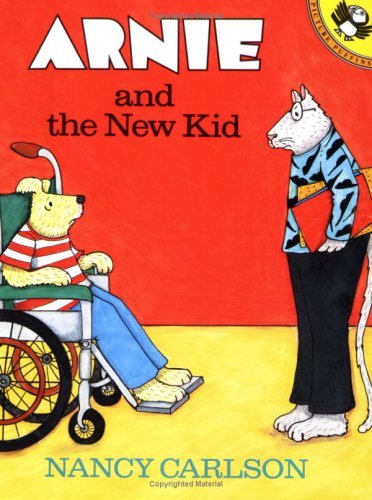
Image description: cover of the book Arnie and the New Kid. On the left side of the picture, Phillip, a yellow dog wearing a t-shirt and jeans, sits in a wheelchair. On the right side, Arnie, a gray cat wearing glasses, black pants, and a shirt with mice on it, is standing and holding some books. Arnie is practically looming over Phillip with a mean look on his face, and Phillip looks scared.
Arnie is a non-disabled cat who is quick to make fun of Phillip, a dog who uses a wheelchair. (I loved writing this sentence.) One day, Arnie is shambling around pretending to be Phillip, holding his arms up to his chest or whatever in an attempt to look disabled, and instead of getting an Oscar or an Academy Award like if he was a human, he falls down the stairs and injures his leg, wrist, and tail. Cut to Arnie wearing an adorable brace on his tail, using crutches, and needing much more help with things than Phillip ever did.
Like Harry Potter, Phillip has the social grace of a saint and befriends Arnie even though Arnie was a dick to him. Arnie and Phillip start spending all their time together doing the things Phillip likes to do--like playing video games, trading baseball cards, and birdwatching. (I especially love the page that shows them in a theater, watching a horror movie through their paws.) Of course, Arnie recovers from his injuries and goes to play baseball, which was one of the things he originally bullied Phillip for not being able to do. Phillip is worried that their friendship is over, but then Arnie says that Phillip will come along and be the coach.
I've read a review criticizing this book for exactly the reason I like it: Phillip is a loser who needs Arnie's help to be included socially. Well, Phillip is not a loser in my estimation, but he isn't so incredibly cool that he can overcome the stigma of disability, especially when Arnie is constantly drawing attention to everything Phillip can't do. What accounts for this failure of character? PHILLIP IS AN ELEMENTARY SCHOOL KID. Not every kid can go into a new school and have everyone be staring at them and bullying them, and deal with that competently and make a lot of friends.
Phillip is just an ordinary, nerdy kid--and by Arnie's standards, he really is a loser. He takes longer to eat, can't race, and can't play baseball. Basically, Phillip is slow, which dooms him not to be taken seriously by many of the kids.
But then, when Arnie is injured, we learn that Phillip has all these other interests and abilities that don't relate to whether he can walk or perform complex tasks with his hands. Arnie has a great time when he's temporarily disabled, and this, I think, is what keeps Arnie and the New Kid from being a book about charity or pity. Arnie doesn't think, "Wow, being disabled is awful, I should be nicer to Phillip." He learns that Phillip is actually a fun person and a good friend. He learns that his conception of what makes someone a loser was wrong.
When Arnie asks Phillip to be his coach, yes, he is making an effort to include him and maybe Arnie's actions will be the key to Phillip's social success. But Arnie makes the effort because he's grateful to Phillip and likes spending time with him, not because it's the nice thing to do. Arnie's decision is ultimately not about his own good qualities, but Phillip's.
I actually feel really frustrated by the idea that it's offensive to portray a disabled character needing help or being socially isolated. Phillip is not portrayed as weak or unpleasant at all; he's just up against a lot of ableism which, being a child, he can't handle all by himself. If Phillip was some kind of amazing superdog who could play baseball in his wheelchair and advocate for himself to be included in the games and be such an all-around badass that no one even noticed he was disabled, that would be an incredibly unfair image to show to kids. Most disabled kids cannot be that and shouldn't be made to feel that that is what they have to be in order to succeed. Non-disabled kids shouldn't be told that instead of adjusting their ideas of what you can do with a friend, or what qualities make someone cool, they can just wait for a supercrip who forces his way into their world and adjusts to their standards. Because they will be waiting a long time and, while they wait, some of them will be bullying ordinary disabled kids.
I'm thinking of making a series of posts about disability-related children's books, which would hopefully involve a lot of DISCUSSION! I'm wondering if anyone else read this book and what they thought of it. Obviously I am not a wheelchair user so I may have missed something really egregious. (One problem I have with the book is that Phillip obviously needs an aide and doesn't have one, so the nicer kids are always doing stuff for him. Really, really not a good message to send.)
Image description: cover of the book Arnie and the New Kid. On the left side of the picture, Phillip, a yellow dog wearing a t-shirt and jeans, sits in a wheelchair. On the right side, Arnie, a gray cat wearing glasses, black pants, and a shirt with mice on it, is standing and holding some books. Arnie is practically looming over Phillip with a mean look on his face, and Phillip looks scared.
21 February, 2011
thinking more about "updating" the wheelchair symbol
re: this
I think that because it’s primarily used to indicate stuff like extra space, shorter distances, and seating, it isn’t as vital that it be inclusive of mind disabilities. To my knowledge the people who are most hurt by the current symbol (in terms of the attitudes it promotes) are people who need those things, but don’t use mobility aids, who can for example be pressured to stand up and give the “disabled seats” to someone else. I remember there being a few posts on FWD/Forward by contributors with fatigue, pain, and mobility disabilities who have experienced this. Obviously this is challenging to fix because it’s hard to make a picture that immediately communicates CFS/ME or something like that. And I also think that because the current symbol is so familiar, changing it to something like the open door would create a lot of problems.
So I think that the best symbol would be something like this (except done by someone who can actually draw):
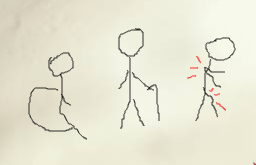
This is much cheesier than the cool-looking person pushing their wheelchair, but I think it could work because it:
1. keeps the original symbol that people are familiar with, so they know immediately that it’s a “disabled access” sign (sorry the wheelchair user looks so weird, I was trying to point their hand so they could be reaching for their joystick but they just ended up looking depressed)
2. shows a person with pain in their back and leg, which brings in the idea of people who don’t use mobility aids and reminds the viewer that such people might also be among those who need the seats, parking spots, etc.
3. shows people with different kinds of impairments to remind the viewer that there is more than one disability that would cause someone to need these things, and hopefully suggest that there are even more disabilities than the ones portrayed here
#3 might be expecting too much of people, but even if people look at someone in the disabled seats and think “oh, I don’t see any mobility aids, they must have a bad knee,” that would still improve how that person is treated.
thoughts?
I think that because it’s primarily used to indicate stuff like extra space, shorter distances, and seating, it isn’t as vital that it be inclusive of mind disabilities. To my knowledge the people who are most hurt by the current symbol (in terms of the attitudes it promotes) are people who need those things, but don’t use mobility aids, who can for example be pressured to stand up and give the “disabled seats” to someone else. I remember there being a few posts on FWD/Forward by contributors with fatigue, pain, and mobility disabilities who have experienced this. Obviously this is challenging to fix because it’s hard to make a picture that immediately communicates CFS/ME or something like that. And I also think that because the current symbol is so familiar, changing it to something like the open door would create a lot of problems.
So I think that the best symbol would be something like this (except done by someone who can actually draw):
This is much cheesier than the cool-looking person pushing their wheelchair, but I think it could work because it:
1. keeps the original symbol that people are familiar with, so they know immediately that it’s a “disabled access” sign (sorry the wheelchair user looks so weird, I was trying to point their hand so they could be reaching for their joystick but they just ended up looking depressed)
2. shows a person with pain in their back and leg, which brings in the idea of people who don’t use mobility aids and reminds the viewer that such people might also be among those who need the seats, parking spots, etc.
3. shows people with different kinds of impairments to remind the viewer that there is more than one disability that would cause someone to need these things, and hopefully suggest that there are even more disabilities than the ones portrayed here
#3 might be expecting too much of people, but even if people look at someone in the disabled seats and think “oh, I don’t see any mobility aids, they must have a bad knee,” that would still improve how that person is treated.
thoughts?
01 December, 2010
Passing as Ethics: a primer
Passing as Ethics
So, passing as ethics is a term I invented and I use it a lot. It’s at the core of a lot of the stuff I write. In retrospect, I wish I had said “passing as functioning” or “passing as cure” because I think that would be more inclusive and cover more ground. Originally I thought that passing as ethics only happened to people with autism, but as I learned more I found out that it was more pervasive than I could ever have imagined.
Here are some passing as ethics values. I’m mostly writing this as if a professional is saying it, but disabled people can totally feel most of this stuff about themselves and I certainly did for a long time. I think it’s a very basic part of life for most people.
1. It is better for a person with a physical disability to walk without any visible mobility aids than it is to use a wheelchair, crutches, or cane--even if the person finds it painful or tiring to walk unaided, and/or is danger of falling.
2. If someone’s disability causes them to have an unusual gait, this is a problem, and it would be an improvement if their gait could be changed to look more normal, even if this didn’t make the person walk any faster or more easily.
3. Habits that mark someone as a person with an intellectual disability or autism, such as flapping hands, are inherently bad, and people who do them should be trained not to do them.
4. If there is a conflict between someone with autism and someone without autism, it’s the person with autism’s fault. If a person with autism gets bullied, this is evidence of why #3 is true; if no one had been able to tell they had autism, this wouldn’t have happened.
5. If someone misunderstands a person with autism, it is because the person with autism didn’t express themselves right.
6. Deaf and hard-of-hearing people should learn to lip-read. Hearing people need not learn sign language.
7. So basically, people with disabilities should always try to communicate in a way that is comfortable for people without disabilities, even if it makes the people with disabilities uncomfortable
8. To sum up, any habit, style of movement, facial expression, interest, feeling, word choice, way of pronouncing words, way of sitting, way of communicating, okay you get the idea, that is commonly associated with disabled people is
a. the opposite of success, and must be destroyed to improve someone’s “functioning”
b. morally wrong in some cases--that is, the person who is doing the behavior that’s associated with disability becomes automatically wrong in any conflict
9. If someone who used to look like they had a disability now doesn’t look like they have a disability (to most people), then they are recovered/cured (no matter how negatively it affects them to hide their disability, and no matter how many less visible aspects of their disability continue to affect them).
10. Don’t kill yourself after reading #1-9 because people will just think you killed yourself because it was so depressing to be disabled.
So, passing as ethics is a term I invented and I use it a lot. It’s at the core of a lot of the stuff I write. In retrospect, I wish I had said “passing as functioning” or “passing as cure” because I think that would be more inclusive and cover more ground. Originally I thought that passing as ethics only happened to people with autism, but as I learned more I found out that it was more pervasive than I could ever have imagined.
Here are some passing as ethics values. I’m mostly writing this as if a professional is saying it, but disabled people can totally feel most of this stuff about themselves and I certainly did for a long time. I think it’s a very basic part of life for most people.
1. It is better for a person with a physical disability to walk without any visible mobility aids than it is to use a wheelchair, crutches, or cane--even if the person finds it painful or tiring to walk unaided, and/or is danger of falling.
2. If someone’s disability causes them to have an unusual gait, this is a problem, and it would be an improvement if their gait could be changed to look more normal, even if this didn’t make the person walk any faster or more easily.
3. Habits that mark someone as a person with an intellectual disability or autism, such as flapping hands, are inherently bad, and people who do them should be trained not to do them.
4. If there is a conflict between someone with autism and someone without autism, it’s the person with autism’s fault. If a person with autism gets bullied, this is evidence of why #3 is true; if no one had been able to tell they had autism, this wouldn’t have happened.
5. If someone misunderstands a person with autism, it is because the person with autism didn’t express themselves right.
6. Deaf and hard-of-hearing people should learn to lip-read. Hearing people need not learn sign language.
7. So basically, people with disabilities should always try to communicate in a way that is comfortable for people without disabilities, even if it makes the people with disabilities uncomfortable
8. To sum up, any habit, style of movement, facial expression, interest, feeling, word choice, way of pronouncing words, way of sitting, way of communicating, okay you get the idea, that is commonly associated with disabled people is
a. the opposite of success, and must be destroyed to improve someone’s “functioning”
b. morally wrong in some cases--that is, the person who is doing the behavior that’s associated with disability becomes automatically wrong in any conflict
9. If someone who used to look like they had a disability now doesn’t look like they have a disability (to most people), then they are recovered/cured (no matter how negatively it affects them to hide their disability, and no matter how many less visible aspects of their disability continue to affect them).
10. Don’t kill yourself after reading #1-9 because people will just think you killed yourself because it was so depressing to be disabled.
Finding it (well, sort of)
So I've read the piece Hell-Bent on Helping: Benevolence, Friendship, and the Politics of Help (which is a really great piece about how inclusion doesn't work if you always put the non-disabled students in the position of giving charity to disabled students, because they can't develop real friendships) and I realized maybe I should actually go to the domain it's at and see what kind of website it is. It's pretty great! It's a guy with CP and his wife, who do training and speaking about including people with disabilities at school work etc. And some other stuff.
So (I'm still on the same topic, you guys) there used to be this post at an "autistic" blog, which doesn't seem to be there anymore, and this post was saying something like, "I don't like when people compare the Deaf and autistic communities, because being Deaf vs. being deaf is about using sign language, so being Deaf instead of deaf is a decision, but there isn't a language that autistic people can decide to use and there aren't two ways of being autistic like being Deaf and deaf are two different ways of being deaf." I'm not naming the blog because I think I may be oversimplifying the post, and I don't want to attribute statements to them that they might not have said, or might no longer agree with since they apparently deleted the post.
But based on my reading of the post? I could not disagree more. My understanding of Deaf culture is very basic, but it seems parallel to Autistic culture for reasons I will discuss below. I don't use a capital A specifically to reference Deaf culture; but I think my reasons for using capital A are because I think there's a big difference between the identity I have now, and the identity (or non-identity) I used to have and the one some people still have.
For people with autism, it's not as simple as sign language vs. lip-reading and speech as a mode of communication. But it is the case, just like for deaf people historically, that lots of people with autism grow up with parents and professionals trying to teach them to communicate in a "normal" way, and just as it is often unpleasant and difficult for a deaf or hard-of-hearing person to have to communicate only through lip-reading and speaking, it is unpleasant and difficult for someone with autism to have to always express themselves exactly as someone without autism would, and understand exactly the things that someone without autism would. (Plus of course there are people in both groups who can't even reach the point that is deemed to be "success," even mediocre success. And those people, from that perspective, are just doomed.)
Here's a simple way of putting, in my mind, what constitutes the difference between being only a person with an autism spectrum disability, and being a person with ASD who is also Autistic.
I used to think of myself as being like a mosaic. I was very smart, I thought, so the mosaic was very complicated--the squares were getting smaller and smaller, and to most people, the mosaic looked like it was an ordinary picture. But it was really just a calculation, and there would always be things that looked a little too sharp or disjointed, parts of the image that required soft curved lines; so occasionally, my mosaic would fail as an image. It would get to be more and more like a real picture, but it would never get all the way there; if you zoomed in close enough there would always be squares.
When I thought of this, less than two years ago, I just thought it was an interesting way of explaining why some things were hard for me. It didn't occur to me how incredibly sad it was that I thought I wasn't a real picture.
Now I know that I'm a real picture, and I live as a real picture. As I've discussed, this is both more and less self-centered than the way I used to live. In one way, the things that I think are appealing and cool and smart, or the things that I'm naturally moved to do, now form the center of my experience in a way they didn't before. I make all my decisions as myself. However, this leads to a calmness and makes me more open to other people (whereas I used to sort of hate most people because I was constantly thinking, "they get to just be themselves and that's allowed").
I could go into a bunch of detail about what "living as a real picture" looks like for me in real life, but that isn't really the point of what I'm saying. What I'm saying is that I imagine a person with autism choosing to live as a real picture (i.e. to be Autistic) is comparable to a deaf or hard-of-hearing person choosing to communicate primarily in a way that is comfortable for them, instead of in a way that is comfortable for other people and difficult for them (i.e. choosing to be Deaf).
To cycle way way way back, I have really enjoyed reading Norman Kunc and Emma van der Klift's website, because they are very smart, but one thing that struck me was Kunc's description of his childhood and adolescence. He went to various types of therapy where he was constantly encouraged to change the way he walked, talked, etc. As a teenager, he tried to keep track of and control situations (like eating and moving in front of people) so that his cerebral palsy would be less obvious. As a young adult, he suddenly realized that, as he puts it, "I had the right to be disabled."
I don't exactly want to say I think it's cool to read about Kunc's awful childhood experiences or deaf students historically being forbidden to use sign language, or the article I linked to a few days ago about someone with CP being forced to get a painful, useless operation because it might make her walk more normally--but there is something extremely powerful in seeing that passing as ethics and passing as cure have been used to hurt so many different people with such different disability experiences. I guess I can say it's sort of a relief. Parents and professionals who support passing as ethics/passing as cure for people with my disability will end up saying, "Oh well autism is different." They basically defend their obsession with passing on the basis that autism is a "social disability," or whatever.
And while I don't think that "autism is different," I think when I started figuring out passing as ethics, I thought I was almost the first person to start figuring out these things, and I thought it mainly related to autism and maybe intellectual disabilities. There's something really deep and lovely--they're not lovely facts, but it's a lovely feeling--about realizing how many different kinds of people have had to put up with this exact same thing, and that people have been fighting it for much longer than the twenty years Autistic culture has been around.
So (I'm still on the same topic, you guys) there used to be this post at an "autistic" blog, which doesn't seem to be there anymore, and this post was saying something like, "I don't like when people compare the Deaf and autistic communities, because being Deaf vs. being deaf is about using sign language, so being Deaf instead of deaf is a decision, but there isn't a language that autistic people can decide to use and there aren't two ways of being autistic like being Deaf and deaf are two different ways of being deaf." I'm not naming the blog because I think I may be oversimplifying the post, and I don't want to attribute statements to them that they might not have said, or might no longer agree with since they apparently deleted the post.
But based on my reading of the post? I could not disagree more. My understanding of Deaf culture is very basic, but it seems parallel to Autistic culture for reasons I will discuss below. I don't use a capital A specifically to reference Deaf culture; but I think my reasons for using capital A are because I think there's a big difference between the identity I have now, and the identity (or non-identity) I used to have and the one some people still have.
For people with autism, it's not as simple as sign language vs. lip-reading and speech as a mode of communication. But it is the case, just like for deaf people historically, that lots of people with autism grow up with parents and professionals trying to teach them to communicate in a "normal" way, and just as it is often unpleasant and difficult for a deaf or hard-of-hearing person to have to communicate only through lip-reading and speaking, it is unpleasant and difficult for someone with autism to have to always express themselves exactly as someone without autism would, and understand exactly the things that someone without autism would. (Plus of course there are people in both groups who can't even reach the point that is deemed to be "success," even mediocre success. And those people, from that perspective, are just doomed.)
Here's a simple way of putting, in my mind, what constitutes the difference between being only a person with an autism spectrum disability, and being a person with ASD who is also Autistic.
I used to think of myself as being like a mosaic. I was very smart, I thought, so the mosaic was very complicated--the squares were getting smaller and smaller, and to most people, the mosaic looked like it was an ordinary picture. But it was really just a calculation, and there would always be things that looked a little too sharp or disjointed, parts of the image that required soft curved lines; so occasionally, my mosaic would fail as an image. It would get to be more and more like a real picture, but it would never get all the way there; if you zoomed in close enough there would always be squares.
When I thought of this, less than two years ago, I just thought it was an interesting way of explaining why some things were hard for me. It didn't occur to me how incredibly sad it was that I thought I wasn't a real picture.
Now I know that I'm a real picture, and I live as a real picture. As I've discussed, this is both more and less self-centered than the way I used to live. In one way, the things that I think are appealing and cool and smart, or the things that I'm naturally moved to do, now form the center of my experience in a way they didn't before. I make all my decisions as myself. However, this leads to a calmness and makes me more open to other people (whereas I used to sort of hate most people because I was constantly thinking, "they get to just be themselves and that's allowed").
I could go into a bunch of detail about what "living as a real picture" looks like for me in real life, but that isn't really the point of what I'm saying. What I'm saying is that I imagine a person with autism choosing to live as a real picture (i.e. to be Autistic) is comparable to a deaf or hard-of-hearing person choosing to communicate primarily in a way that is comfortable for them, instead of in a way that is comfortable for other people and difficult for them (i.e. choosing to be Deaf).
To cycle way way way back, I have really enjoyed reading Norman Kunc and Emma van der Klift's website, because they are very smart, but one thing that struck me was Kunc's description of his childhood and adolescence. He went to various types of therapy where he was constantly encouraged to change the way he walked, talked, etc. As a teenager, he tried to keep track of and control situations (like eating and moving in front of people) so that his cerebral palsy would be less obvious. As a young adult, he suddenly realized that, as he puts it, "I had the right to be disabled."
I don't exactly want to say I think it's cool to read about Kunc's awful childhood experiences or deaf students historically being forbidden to use sign language, or the article I linked to a few days ago about someone with CP being forced to get a painful, useless operation because it might make her walk more normally--but there is something extremely powerful in seeing that passing as ethics and passing as cure have been used to hurt so many different people with such different disability experiences. I guess I can say it's sort of a relief. Parents and professionals who support passing as ethics/passing as cure for people with my disability will end up saying, "Oh well autism is different." They basically defend their obsession with passing on the basis that autism is a "social disability," or whatever.
And while I don't think that "autism is different," I think when I started figuring out passing as ethics, I thought I was almost the first person to start figuring out these things, and I thought it mainly related to autism and maybe intellectual disabilities. There's something really deep and lovely--they're not lovely facts, but it's a lovely feeling--about realizing how many different kinds of people have had to put up with this exact same thing, and that people have been fighting it for much longer than the twenty years Autistic culture has been around.
22 November, 2010
from Ragged Edge Magazine May/June 1999
Playing Cards at Boston Children's Hospital by Lisa Blumberg was linked in a blog I was looking at and it's a really good and important piece. It made me really upset to read it.
It was striking to me how much I related as an Autistic person to the professional attitudes that Blumberg experienced, since she has cerebral palsy and no mind disabilities. I'm kind of leery about doing this because I don't want to give the impression of appropriating someone else's very different experience, but I want to quote some of the lines that really resonated with me:
Once Matty [her physical therapist] watched me walk and said, "You don't concentrate. You just go--like you think you walk normally or something."
I tried to explain it to my mother: "They exalt form over substance." I didn't have the right words...
When Blumberg was in her first year of college, a doctor spent months pressuring her and her mother to agree to a surgery that involved cutting into Blumberg's muscles, even though Blumberg really, really didn't want it. The doctor constantly told them that if she didn't get the surgery, her hips would dislocate by the time she was forty (then he kept lowering the age at which this would supposedly happen). As an adult, she found out that there was no way this would have happened before she was very old.
By Monday, after five days without movement, both my legs were sticks. I screamed when Matty touched them. She sat me up. I fell over. "You make me sick," I said to Pan later. That was obviously an understatement...Matty said I was being terrible to Dr. Pan. She said he knew I didn't like him.
Nine days after surgery, I went home and that was when the fun really began. There was a problem with pain management. The problem was that Pan was not interested. He said his concern was with correcting my leg, not with how I felt while he was doing it. Both my legs now hurt everywhere, but he had only cut one muscle on one leg, so I could not blame all this on him, no indeed. Anyway, I was just faking.
... Throughout July and August, while the pain turned into aches, I had therapy. My hamstrings and some of my hip muscles were doing weird things. I couldn't straighten out my legs the way I used to. My left leg--the leg that was supposed to be untouched--was turning in.
At first Matty pretended things had been this way all along but then finally said, "When you cut a muscle, every other muscle reacts. When you do something to one leg, the other changes."
No one had told me. I had not been playing with a full deck.
"Why did he do it?" I screamed.
"If you don't take risks, you don't do anything," Matty said crossly. "It's not like you had a great walk to begin with."
So it was spoken, so it was said. I had a disability to begin with. It was all right for other people to take risks with me.
...By 1979 I had oozed into the disability rights movement and for the first time met other adults with disabilities. Many of these people had been "treated" at a local pediatric orthopedic hospital I'll call Newcastle, since this article really isn't about Newcastle. The first thing I heard about was the amphitheater where the kids were examined in front of students and whoever. This was a new one on me.
Then I heard about the surgery--lots of it. As someone said, "surgery was all there was." Three, five, seven, eighteen operations on one person. Sometimes one surgery would be successful and then, well, the next one would be sort of a mistake.
I asked Bette what the hell was going on. She said that kids at Newcastle were looked at from an orthopedic perspective but did not necessarily get rehab. For kids who had lasting disabilities rather than, say, a club foot, that was a problem. People did not understand that. Even most primary physicians did not recognize this...It occurred to me that if your focus is on a fix, working with individuals with lifelong disabilities must be aggravating--aggravating enough to make you swear or become a gambling man.
(emphasis mine)
It was striking to me how much I related as an Autistic person to the professional attitudes that Blumberg experienced, since she has cerebral palsy and no mind disabilities. I'm kind of leery about doing this because I don't want to give the impression of appropriating someone else's very different experience, but I want to quote some of the lines that really resonated with me:
Once Matty [her physical therapist] watched me walk and said, "You don't concentrate. You just go--like you think you walk normally or something."
I tried to explain it to my mother: "They exalt form over substance." I didn't have the right words...
When Blumberg was in her first year of college, a doctor spent months pressuring her and her mother to agree to a surgery that involved cutting into Blumberg's muscles, even though Blumberg really, really didn't want it. The doctor constantly told them that if she didn't get the surgery, her hips would dislocate by the time she was forty (then he kept lowering the age at which this would supposedly happen). As an adult, she found out that there was no way this would have happened before she was very old.
By Monday, after five days without movement, both my legs were sticks. I screamed when Matty touched them. She sat me up. I fell over. "You make me sick," I said to Pan later. That was obviously an understatement...Matty said I was being terrible to Dr. Pan. She said he knew I didn't like him.
Nine days after surgery, I went home and that was when the fun really began. There was a problem with pain management. The problem was that Pan was not interested. He said his concern was with correcting my leg, not with how I felt while he was doing it. Both my legs now hurt everywhere, but he had only cut one muscle on one leg, so I could not blame all this on him, no indeed. Anyway, I was just faking.
... Throughout July and August, while the pain turned into aches, I had therapy. My hamstrings and some of my hip muscles were doing weird things. I couldn't straighten out my legs the way I used to. My left leg--the leg that was supposed to be untouched--was turning in.
At first Matty pretended things had been this way all along but then finally said, "When you cut a muscle, every other muscle reacts. When you do something to one leg, the other changes."
No one had told me. I had not been playing with a full deck.
"Why did he do it?" I screamed.
"If you don't take risks, you don't do anything," Matty said crossly. "It's not like you had a great walk to begin with."
So it was spoken, so it was said. I had a disability to begin with. It was all right for other people to take risks with me.
...By 1979 I had oozed into the disability rights movement and for the first time met other adults with disabilities. Many of these people had been "treated" at a local pediatric orthopedic hospital I'll call Newcastle, since this article really isn't about Newcastle. The first thing I heard about was the amphitheater where the kids were examined in front of students and whoever. This was a new one on me.
Then I heard about the surgery--lots of it. As someone said, "surgery was all there was." Three, five, seven, eighteen operations on one person. Sometimes one surgery would be successful and then, well, the next one would be sort of a mistake.
I asked Bette what the hell was going on. She said that kids at Newcastle were looked at from an orthopedic perspective but did not necessarily get rehab. For kids who had lasting disabilities rather than, say, a club foot, that was a problem. People did not understand that. Even most primary physicians did not recognize this...It occurred to me that if your focus is on a fix, working with individuals with lifelong disabilities must be aggravating--aggravating enough to make you swear or become a gambling man.
(emphasis mine)
15 November, 2010
On Shambling
I had the creepiest dream about zombies, you guys. They were pretty out of it, but they could talk so even though you could tell by looking at them that they were dead a lot of people wouldn't read them as zombies. I got on one of those really big elevators with a guy my age and his little son, and then this older guy started to get on who I knew was a zombie. I told the guy my age not to let the guy on the elevator, and he ineffectively tried to stop him but he got on anyway. The whole time we were on this elevator, I was telling the zombie to stay on the other side of the elevator, and picking up this folding chair that was in the elevator and threatening to smash his head. By the time we got to my level (we were in a parking garage) the living guy in the elevator obviously thought there was something wrong with me because I was being so aggressive and rude to this other guy, who seemed really gentle. As I got off the elevator I grabbed the living guy and whispered in his ear, "He's a zombie. He will kill you."
When I got in the car two zombies I knew were just sitting in there like we were friends. Riding shotgun was this really nice female zombie (she reminded me a lot of a particular lady with a disability who I worked with this summer). In the back was the zombie from the elevator who was a little more calculating. I couldn't convince them to get out of the car, so I just started driving. The zombie from the elevator kept saying, "What did you whisper to him in the elevator? He was staying away from me. Why did you do that?"
Finally I was at the end of my rope. "Because if you bite people, they will die," I said. "When you bite people, they die, okay? I didn't want you to bite him."
"Oh, I see why you said that," said the female zombie.
I think this dream was interesting because it was the culmination of a lot of thoughts and feelings I've been having about zombies lately. I've been watching The Walking Dead a lot and obviously--and, yes, this does skeeve me out--pretty much every horror entity can be read as disabled in some way or another. Well, I don't read vampires that way, but lots of supernatural figures and ghosts tend to be creepy because they have nonstandard faces/bodies and/or they move differently. For example, in this completely terrifying short film Mama--which I've never been able to watch all the way through so don't be too hard on yourself. Another example is The Grudge where one of the ghosts often crawls around instead of walking. The Orphanage and Darkness Falls have ghosts that cover their faces because their faces are supposed to be so horrifying.
Recently I saw a YouTube video of people dressing up as and impersonating zombies. One commenter said that "they look like they have cerebral palsy," and was lambasted by other commenters for "making fun of people with special needs." I can't help seeing this as really disingenuous--not that the first commenter was awesome, but are you seriously going to pretend to be some kind of gooey champion of "special needs" when you're into zombies, which resemble disabled people more than any other monster? Like, look at this video of extras in The Walking Dead learning to "walk like zombies":
I mean, without the makeup there is kind of a sketchy feeling in watching this, at least for me. Some of the people still look supernatural, but a lot of them just look like they're doing an awkward impression of a disabled person. (By the way, I'm definitely including people with mind disabilities, including myself, in the "people who zombies movie like" category. For whatever reason, weird gaits tend to be a thing for a lot of people with ASD and ID.)
I think I ended up having a dream where I was kind of friendly with zombies because for the last month I've been developing a sense that I'm basically a zombie. Like, it seems like a pretty simple way to explain stuff. Look at this from the Walking Dead comics Wikipedia page:
Zombies may follow something that has caught their attention for hours, such as a gunshot, after which they may follow in the general direction for days, even if they have forgotten what they originally were pursuing.
From the page describing Romero zombies vs. other kinds of zombies:
The animated dead retain vague impulses derived from former living behavior. For instance, zombies often return to specific locations they frequented when alive...Lacking immediate victims to hunt, zombies will often fumble through crude motions reminiscent of life activities, often when prompted by a familiar artifact such as a telephone or car.
Yeah, pretty much.
I was thinking of writing a story about a person who is bitten by a zombie but thinks she can remain human through willpower. Then I found out from TV Tropes that this is already considered a trope, but I think there would still be mileage in it. Especially because I don't think a zombie apocalypse would happen (can you imagine a bunch of AWVs being powerful enough to destroy society?), I think that the infected person could still be trying to go to school or work or whatever, while losing the cognitive function that enables them to succeed in those environments. And they do a pretty good job, until one day they can't anymore.
(Note: if you found this post when you were googling The Walking Dead or something, please don't start making comments about how I'm too politically correct or whatever. I'm not trying to attack/call out anyone for being into zombies--I mean, I'm into zombies and I obviously am into/am affected by some of the other tropes I'm reading as disability tropes. It's probably kind of fucked up that that's the case, but I'm more interested in reclaiming this stuff and thinking about what it means instead of just saying it needs to go away.)
When I got in the car two zombies I knew were just sitting in there like we were friends. Riding shotgun was this really nice female zombie (she reminded me a lot of a particular lady with a disability who I worked with this summer). In the back was the zombie from the elevator who was a little more calculating. I couldn't convince them to get out of the car, so I just started driving. The zombie from the elevator kept saying, "What did you whisper to him in the elevator? He was staying away from me. Why did you do that?"
Finally I was at the end of my rope. "Because if you bite people, they will die," I said. "When you bite people, they die, okay? I didn't want you to bite him."
"Oh, I see why you said that," said the female zombie.
I think this dream was interesting because it was the culmination of a lot of thoughts and feelings I've been having about zombies lately. I've been watching The Walking Dead a lot and obviously--and, yes, this does skeeve me out--pretty much every horror entity can be read as disabled in some way or another. Well, I don't read vampires that way, but lots of supernatural figures and ghosts tend to be creepy because they have nonstandard faces/bodies and/or they move differently. For example, in this completely terrifying short film Mama--which I've never been able to watch all the way through so don't be too hard on yourself. Another example is The Grudge where one of the ghosts often crawls around instead of walking. The Orphanage and Darkness Falls have ghosts that cover their faces because their faces are supposed to be so horrifying.
Recently I saw a YouTube video of people dressing up as and impersonating zombies. One commenter said that "they look like they have cerebral palsy," and was lambasted by other commenters for "making fun of people with special needs." I can't help seeing this as really disingenuous--not that the first commenter was awesome, but are you seriously going to pretend to be some kind of gooey champion of "special needs" when you're into zombies, which resemble disabled people more than any other monster? Like, look at this video of extras in The Walking Dead learning to "walk like zombies":
I mean, without the makeup there is kind of a sketchy feeling in watching this, at least for me. Some of the people still look supernatural, but a lot of them just look like they're doing an awkward impression of a disabled person. (By the way, I'm definitely including people with mind disabilities, including myself, in the "people who zombies movie like" category. For whatever reason, weird gaits tend to be a thing for a lot of people with ASD and ID.)
I think I ended up having a dream where I was kind of friendly with zombies because for the last month I've been developing a sense that I'm basically a zombie. Like, it seems like a pretty simple way to explain stuff. Look at this from the Walking Dead comics Wikipedia page:
Zombies may follow something that has caught their attention for hours, such as a gunshot, after which they may follow in the general direction for days, even if they have forgotten what they originally were pursuing.
From the page describing Romero zombies vs. other kinds of zombies:
The animated dead retain vague impulses derived from former living behavior. For instance, zombies often return to specific locations they frequented when alive...Lacking immediate victims to hunt, zombies will often fumble through crude motions reminiscent of life activities, often when prompted by a familiar artifact such as a telephone or car.
Yeah, pretty much.
I was thinking of writing a story about a person who is bitten by a zombie but thinks she can remain human through willpower. Then I found out from TV Tropes that this is already considered a trope, but I think there would still be mileage in it. Especially because I don't think a zombie apocalypse would happen (can you imagine a bunch of AWVs being powerful enough to destroy society?), I think that the infected person could still be trying to go to school or work or whatever, while losing the cognitive function that enables them to succeed in those environments. And they do a pretty good job, until one day they can't anymore.
(Note: if you found this post when you were googling The Walking Dead or something, please don't start making comments about how I'm too politically correct or whatever. I'm not trying to attack/call out anyone for being into zombies--I mean, I'm into zombies and I obviously am into/am affected by some of the other tropes I'm reading as disability tropes. It's probably kind of fucked up that that's the case, but I'm more interested in reclaiming this stuff and thinking about what it means instead of just saying it needs to go away.)
12 September, 2010
Our growing and shrinking island
I got weirdly depressed because my friend was talking positively about the head of disability services at our school, who I sort of loathe. (Way out of proportion to what she actually did to me, which was three years ago, but it just was really bad, and I've gotten the impression that she is really great to students with Real Disabilities and not so good to students with Fake Disabilities--to put it bluntly.) The stuff my friend was saying wasn't really different from what I'd expect for her; the two of them had basically been talking about physical accessibility issues and how they suck at school, and how it's even harder now to get the administration to make things accessible because the two students who were full-time wheelchair users graduated and can no longer be invoked as an obvious example of how shitty things are. And she (the head) has now made the administration promise to clean up ice and snow which my friend is really happy about because he had a lot of trouble getting around last winter. (He's ambulatory but has balance problems.)
I think I'm not good at holding two conflicting ideas at the same time, though. So knowing that she works really hard to make school more accessible for kids with mobility disabilities (which it is admittedly not at ALL) makes me feel bad about the fact that I resent her a lot. I also feel bad about the fact that I'm so into "disability stuff" but I didn't even think about the fact that ice would be a problem for my friend. I think that partly because we're going through the MR-->ID shift right now, and also because there are so many annoying euphemisms like "special needs," "developmental delay," "Down syndrome" (used to mean all ID), and "developmental disability" (used to mean only ID), I have a really bad habit of using the word "disabled" when I'm talking about the issues I am especially interested and entrenched in--the issues of people with intellectual disabilities and autism spectrum disorders.
I don't feel good about doing that because I feel like that's exactly what people with physical disabilities sometimes do to us. And it's what some people who identify as allies of disabled people, like the head of disability services, do as well. (In fact I wonder if it's non-disabled allies more than people with Real Disabilities who have such a sense of what a Real Disability is.)
The first time I went on FWD/Forward, I remember being surprised when I read the contributors' descriptions of themselves. Mental illnesses weren't disabilities! Physical disabilities that were invisible weren't disabilities! How could this website be called Feminists with Disabilities, when most of these people weren't Really Disabled? My confusion soon turned into excitement and happiness as I started to feel like maybe, just maybe, I didn't have to apologize four hundred billion times for identifying as disabled. I've really been changed by the disability blogosphere, because I now see issues of ableism, disability, and accessibility as being much bigger and broader and more complex than I thought they were. I know this sounds depressing, but it really isn't, because I can see that many things that I once thought were Problems With No Name are actually related to disability.
However, I guess I also worry that as the definition of "disabled" becomes more broad, there won't be enough attention paid to the needs of people who use wheelchairs. I mean, it makes me really frustrated that I have to depend on my professors' goodwill in order to be successful*, and that I feel like I have nowhere to turn if I have a professor who dislikes me or judges my work harshly because of things related to my disability. At the same time if I do poorly in a class it's not the end of the world. And an infinite number of nice professors can't make campus better for a student who uses a wheelchair. It just completely sucks. I can sort of scrape by in a lot of ways because my impairments clash with people not buildings.
[*I would never, ever go through the disability services office because I know it wouldn't work. On a basic level I need not to be judged for not being able to speak well or understand unspoken rules about what an assignment is supposed to be like--something I can't ask for because a professor is either the kind of person who is going to resent me, or they aren't. Last year when things were really terrible, I asked for some extensions (I've probably asked for fewer extensions than a non-disabled person in the time I've been at school) and I asked to take exams in a separate room on a computer to reduce panic/discomfort. Which is not something that's a stereotype of autism, so I don't think the disability office would support me in asking for that if a professor refused to give it to me.]
I think I just feel guilty sometimes for being so angry about being erased from the mainstream understanding of the word disability. It's funny because to the extent that there is disability stuff at my school, I feel totally erased by that too because it's mainly people with specific learning disabilities. I just go through life feeling there are many things that I'll never be able to do, and I think that something like dyslexia or dyscalculia can shut down certain parts of the world, but sometimes I feel like there's such a small area that I can actually safely move around in and aim for. So I totally find myself mumbling to myself, too, "yeah, come back when you have a Real Disability." Except. You know. Is that ever valid?
I think I'm not good at holding two conflicting ideas at the same time, though. So knowing that she works really hard to make school more accessible for kids with mobility disabilities (which it is admittedly not at ALL) makes me feel bad about the fact that I resent her a lot. I also feel bad about the fact that I'm so into "disability stuff" but I didn't even think about the fact that ice would be a problem for my friend. I think that partly because we're going through the MR-->ID shift right now, and also because there are so many annoying euphemisms like "special needs," "developmental delay," "Down syndrome" (used to mean all ID), and "developmental disability" (used to mean only ID), I have a really bad habit of using the word "disabled" when I'm talking about the issues I am especially interested and entrenched in--the issues of people with intellectual disabilities and autism spectrum disorders.
I don't feel good about doing that because I feel like that's exactly what people with physical disabilities sometimes do to us. And it's what some people who identify as allies of disabled people, like the head of disability services, do as well. (In fact I wonder if it's non-disabled allies more than people with Real Disabilities who have such a sense of what a Real Disability is.)
The first time I went on FWD/Forward, I remember being surprised when I read the contributors' descriptions of themselves. Mental illnesses weren't disabilities! Physical disabilities that were invisible weren't disabilities! How could this website be called Feminists with Disabilities, when most of these people weren't Really Disabled? My confusion soon turned into excitement and happiness as I started to feel like maybe, just maybe, I didn't have to apologize four hundred billion times for identifying as disabled. I've really been changed by the disability blogosphere, because I now see issues of ableism, disability, and accessibility as being much bigger and broader and more complex than I thought they were. I know this sounds depressing, but it really isn't, because I can see that many things that I once thought were Problems With No Name are actually related to disability.
However, I guess I also worry that as the definition of "disabled" becomes more broad, there won't be enough attention paid to the needs of people who use wheelchairs. I mean, it makes me really frustrated that I have to depend on my professors' goodwill in order to be successful*, and that I feel like I have nowhere to turn if I have a professor who dislikes me or judges my work harshly because of things related to my disability. At the same time if I do poorly in a class it's not the end of the world. And an infinite number of nice professors can't make campus better for a student who uses a wheelchair. It just completely sucks. I can sort of scrape by in a lot of ways because my impairments clash with people not buildings.
[*I would never, ever go through the disability services office because I know it wouldn't work. On a basic level I need not to be judged for not being able to speak well or understand unspoken rules about what an assignment is supposed to be like--something I can't ask for because a professor is either the kind of person who is going to resent me, or they aren't. Last year when things were really terrible, I asked for some extensions (I've probably asked for fewer extensions than a non-disabled person in the time I've been at school) and I asked to take exams in a separate room on a computer to reduce panic/discomfort. Which is not something that's a stereotype of autism, so I don't think the disability office would support me in asking for that if a professor refused to give it to me.]
I think I just feel guilty sometimes for being so angry about being erased from the mainstream understanding of the word disability. It's funny because to the extent that there is disability stuff at my school, I feel totally erased by that too because it's mainly people with specific learning disabilities. I just go through life feeling there are many things that I'll never be able to do, and I think that something like dyslexia or dyscalculia can shut down certain parts of the world, but sometimes I feel like there's such a small area that I can actually safely move around in and aim for. So I totally find myself mumbling to myself, too, "yeah, come back when you have a Real Disability." Except. You know. Is that ever valid?
10 August, 2010
who does sadness belong to?
I was just rereading the transcript of the May 30 IACC meeting and I came across a particular saying that Francis Collins used in his not-especially-sensitive comments.
"A parent is never happier than your saddest child."
Now, what does this mean? Is autism the same as sadness?
And if Autistic children are sad, does their sadness belong to their parents instead of to them?
Collins, who amused me by saying, "I know this is a tough time for anybody, any family, any individual who is going through the experience of raising a child with autism spectrum disorder" (bending over backwards to include all family structures, but forgetting that actual disabled people might be having a tough time), probably does think that. What does it mean if you don't even have the rights to your own sadness?
A few months ago I was consumed by the idea that my parents would have aborted me if they had known I would have ASD. Despite knowing it would lead to a lot of drama, I couldn't help but ask my mom if this was the case. She said that she wouldn't choose not to have me now that she knows me, but that if she hadn't known me but had known "how sad you would be," she might have had doubts about bringing me into the world.
The thing is I don't think of myself as a sad person. Obviously there have been occasions when I've been really sad, but I'm a pretty dissociative person (which is scary, but I guess it happens because I need it) and I also tend to produce a lot and be very spiritual when things are going badly. I'm not saying I enjoy being sad but I just don't think of it as being a big part of my life; it doesn't happen that much and when it does I focus more on the byproducts.
The worst thing about times when my life is going badly is that my mom won't stop talking about it and basically criticizing me for wanting to do other things than emote about how bad things are. I feel like she doesn't understand that if I did constantly do that, my life would be terrible. I couldn't think that way, so I don't. The way things are, I'm more guilty about how sad she is about my "sadness" than I am actually sad myself.
It becomes an affront to her that I am not worried and sad in the way she thinks I am or should be. It also becomes insensitive for me to be uncomfortable with the idea that I maybe shouldn't have existed because of my sadness--it's insensitive to her, because my sadness doesn't belong to me, it belongs to her.
It kind of reminds me how fans of Jerry Lewis and his telethon will accuse his opponents of being "bitter" or "hateful" when in fact the opponents are the ones being positive, and the telethon is negative. Even though Jerry Lewis doesn't have muscular dystrophy, he has ownership of it and gets to decide how it feels. If people with MD don't consider their lives to be tragic, then they're taking away something that belongs to Jerry Lewis. Somehow, they're the ones being mean.
"A parent is never happier than your saddest child."
Now, what does this mean? Is autism the same as sadness?
And if Autistic children are sad, does their sadness belong to their parents instead of to them?
Collins, who amused me by saying, "I know this is a tough time for anybody, any family, any individual who is going through the experience of raising a child with autism spectrum disorder" (bending over backwards to include all family structures, but forgetting that actual disabled people might be having a tough time), probably does think that. What does it mean if you don't even have the rights to your own sadness?
A few months ago I was consumed by the idea that my parents would have aborted me if they had known I would have ASD. Despite knowing it would lead to a lot of drama, I couldn't help but ask my mom if this was the case. She said that she wouldn't choose not to have me now that she knows me, but that if she hadn't known me but had known "how sad you would be," she might have had doubts about bringing me into the world.
The thing is I don't think of myself as a sad person. Obviously there have been occasions when I've been really sad, but I'm a pretty dissociative person (which is scary, but I guess it happens because I need it) and I also tend to produce a lot and be very spiritual when things are going badly. I'm not saying I enjoy being sad but I just don't think of it as being a big part of my life; it doesn't happen that much and when it does I focus more on the byproducts.
The worst thing about times when my life is going badly is that my mom won't stop talking about it and basically criticizing me for wanting to do other things than emote about how bad things are. I feel like she doesn't understand that if I did constantly do that, my life would be terrible. I couldn't think that way, so I don't. The way things are, I'm more guilty about how sad she is about my "sadness" than I am actually sad myself.
It becomes an affront to her that I am not worried and sad in the way she thinks I am or should be. It also becomes insensitive for me to be uncomfortable with the idea that I maybe shouldn't have existed because of my sadness--it's insensitive to her, because my sadness doesn't belong to me, it belongs to her.
It kind of reminds me how fans of Jerry Lewis and his telethon will accuse his opponents of being "bitter" or "hateful" when in fact the opponents are the ones being positive, and the telethon is negative. Even though Jerry Lewis doesn't have muscular dystrophy, he has ownership of it and gets to decide how it feels. If people with MD don't consider their lives to be tragic, then they're taking away something that belongs to Jerry Lewis. Somehow, they're the ones being mean.
05 June, 2010
acquired disability is hardly the only kind
I was thinking about Battlestar Galactica and how two of the characters who acquire disabilities are bitter about it and one becomes evil. On FWD/Forward this was said to be a bad thing, and although I do think it's cliched, I guess I don't find the trope as inherently offensive as some people do. I don't think it's unreasonable for a person who acquires a disability to be quite upset about it. It's a very different experience from being born with one.
[Fun fact: The third acquired disability on BSG was actually written in at the last minute as an accommodation for the actor's temporary disability. I really think that inflexible notions of "the way things have to be done" is a huge barrier for PWDs in many different areas--actually, one of the biggest barriers of all--and the fact that the BSG writers don't subscribe to that shit redeems them in my eyes for anything they've done wrong.]
However--why are fictional characters with physical disabilities almost always people with acquired disabilities? Usually paraplegia? Don't quote me on this because I'm too lazy to do an analysis of all the recent TV shows and movies that have included characters with disabilities, but I think I'm right. For example I think Avatar was the most recent big movie that had a character with a disability, and he of course had paraplegia. I think it's usually paraplegia. (Actually, House is an extremely good example--it's probably the most popular TV show with a major disabled character, and he is played not very convincingly by a non-disabled actor, and though he is well-developed he fits the bitter/evil disabled person stereotype in a way that wouldn't be possible if the character had been born disabled).
One obvious reason is casting. As we all know, people with disabilities can't act, so you can only write disabled characters who can be played by nondisabled actors. There are some disabilities where people who have them look physically different. There are also disabilities where people move differently--a person who doesn't have CP probably could play someone with CP, but it would take actual study and work. Which would be terrible.
(I want to start watching Breaking Bad for the sole reason that there is a character with CP. He's played by an actor with CP, which makes it 400 times better, but even if he wasn't, I'd just be so excited to see a character with something besides a spinal cord injury.)
But the other reason, I think, is just that the idea of someone being born with a disability is unrelatable or unattractive to audiences/writers, or threatening, or just inconceivable--which makes me really angry. I'd like to think this isn't true but I think it's not only tremendously rare to have characters who were born with disabilities, it's especially rare to be given anything from those characters' perspectives (this includes telling their friends how they feel, having a relatable emotional outburst, and so on).
I think that:
1. It is hard for normal people to relate to someone with a disability who is not upset about having a disability. It's a lot more logical for someone to be upset about having a disability if they didn't have a disability before. Then the normal people can just be like, "yeah, I can relate, that would suck." Whereas someone who's just never been able to walk very well and is used to it would be impossible to relate to because...HOW CAN YOU BE OKAY WITH NOT BEING GOOD AT WALKING?? THAT'S SOOO TRAGIC!
2. Maybe people who acquire disabilities don't "feel disabled," at least at the beginning of their life with a disability. Maybe normal people can't identify with people who feel disabled, or they don't think of us as real, maybe because we're not good enough at being upset. So if we are portrayed, the focus has to be on our relatives and how upset they are, because watching a non-upset disabled person is just not possible for most people?
What do you think?
[Fun fact: The third acquired disability on BSG was actually written in at the last minute as an accommodation for the actor's temporary disability. I really think that inflexible notions of "the way things have to be done" is a huge barrier for PWDs in many different areas--actually, one of the biggest barriers of all--and the fact that the BSG writers don't subscribe to that shit redeems them in my eyes for anything they've done wrong.]
However--why are fictional characters with physical disabilities almost always people with acquired disabilities? Usually paraplegia? Don't quote me on this because I'm too lazy to do an analysis of all the recent TV shows and movies that have included characters with disabilities, but I think I'm right. For example I think Avatar was the most recent big movie that had a character with a disability, and he of course had paraplegia. I think it's usually paraplegia. (Actually, House is an extremely good example--it's probably the most popular TV show with a major disabled character, and he is played not very convincingly by a non-disabled actor, and though he is well-developed he fits the bitter/evil disabled person stereotype in a way that wouldn't be possible if the character had been born disabled).
One obvious reason is casting. As we all know, people with disabilities can't act, so you can only write disabled characters who can be played by nondisabled actors. There are some disabilities where people who have them look physically different. There are also disabilities where people move differently--a person who doesn't have CP probably could play someone with CP, but it would take actual study and work. Which would be terrible.
(I want to start watching Breaking Bad for the sole reason that there is a character with CP. He's played by an actor with CP, which makes it 400 times better, but even if he wasn't, I'd just be so excited to see a character with something besides a spinal cord injury.)
But the other reason, I think, is just that the idea of someone being born with a disability is unrelatable or unattractive to audiences/writers, or threatening, or just inconceivable--which makes me really angry. I'd like to think this isn't true but I think it's not only tremendously rare to have characters who were born with disabilities, it's especially rare to be given anything from those characters' perspectives (this includes telling their friends how they feel, having a relatable emotional outburst, and so on).
I think that:
1. It is hard for normal people to relate to someone with a disability who is not upset about having a disability. It's a lot more logical for someone to be upset about having a disability if they didn't have a disability before. Then the normal people can just be like, "yeah, I can relate, that would suck." Whereas someone who's just never been able to walk very well and is used to it would be impossible to relate to because...HOW CAN YOU BE OKAY WITH NOT BEING GOOD AT WALKING?? THAT'S SOOO TRAGIC!
2. Maybe people who acquire disabilities don't "feel disabled," at least at the beginning of their life with a disability. Maybe normal people can't identify with people who feel disabled, or they don't think of us as real, maybe because we're not good enough at being upset. So if we are portrayed, the focus has to be on our relatives and how upset they are, because watching a non-upset disabled person is just not possible for most people?
What do you think?
18 May, 2010
Our shrinking island
I
Recently I saw a person on the Internet defending neurodiversity by saying that intellectual disability and brain injuries aren't part of neurodiversity. (This was in response to a person who was arguing against neurodiversity by talking about how bad their kid with a brain injury has it.) Later, the person said that they weren't sure about what they said and maybe they do consider ID to be part of neurodiversity. The thing is, though, that while that had especially bothered me since I feel especially invested in ID issues, the idea of saying which disabilities are and are not covered by neurodiversity is inherently not okay with me. Letting ID, or any other disability, under the neurodiversity umbrella doesn't change the fact that according to this person only particular disabilities are allowed.
Although I don't mean to imply that all or most people who identify as supporting neurodiversity think about it as not being for everyone, the comment I saw just seems like a really extreme embodiment of what it means to use the term neurodiversity at all. I get very hung up on terms and neurodiversity is a term that has for a long time hung me up. Why not just say "disability rights," or if you are being specific, "autism rights," "developmental disability rights," "learning disability rights," and so on?
I do have trouble with this myself because "rights" implies that I am talking about concrete changes and I'm frequently not, and neither, frequently, are other people. I believe the personal is political and I generally write about personal things from a frame of deconstructing ableism. So maybe "disability rights" isn't the best thing to say. But at least it has the word disability in it.
I'm starting to think that every tenth or fifteenth post on this blog is exactly the same post. But bear with me.
II
Defending your disability (or, sorry, "way of being") by saying that it isn't so bad or you are really good at other things that make up for the things you are bad at is a tack doomed to failure. Especially if you have ASD, is what I was going to say, because a lot of people with ASD "have no skills" as Alison Singer once charmingly said about her daughter--this isn't how I think about people, but I'm just saying it's definitely possible for people who do think that way to pull out lots of ASD people to use as examples of how someone with ASD can't necessarily be mathematically calculated to be equal to a normal person.
I was going to say that. That, like, maybe it makes a little more sense with something like ADHD that doesn't ever result in people not being able to talk and usually doesn't result in people not being able to live independently. Because with ASD it's very easy for someone to be like "oh look at this person who can't live independently, their life is bad."
Unfortunately, I realize that's not even an argument that the people I'd be addressing are unaware of. They know, and their tactic is retreat. They defend neurodiversity by saying they are only counting some people with ASD. They are only counting the people who are equal to non-disabled people, good at memorizing pi or killing cows creatively--and again, no, that is not what I think the world equal means. But if you accept the idea that the word equal means that, or that a good life is a life where a person reaches certain "milestones," then you will always be in retreat.
(I also think that, while a person like me will be safe for a long time, they're capable of moving the milestones.)
III
I recently met the most severely disabled person I've ever met, a girl in Joe's class who can't walk, can't talk, can't eat, and doesn't lift her hands from the desk of her wheelchair. H. is fourteen, and she can and does look at things and have emotional reactions to them. I haven't known her long and I would not claim to know her well, but anyone can see her smile when she sees a new person or object, or laugh when the kids in her class are screwing around.
I think this is really important and is maybe the core or the base of what I believe in. I have no idea how H. feels about her life, and wouldn't try to extrapolate from the fact that she frequently laughs. At the same time, she does laugh. I'm dissatisfied with this world's conception of disability because I think it tries to erase the individuality of PWDs. Or to say that individuality (including joy) is incompatible with disability that is severe past a certain point--that a life that is something more complex than endlessly grim is not possible for you, or if it is, you're different from other disabled people who really are tragic.
This is a hard thing to put into words because I often feel that some people who use the wrong words are nonetheless expressing things in tune with my values. It is almost impossible to say that my beliefs are about a principle because they're highly specific. They are about a way of looking at and thinking about people, and not writing people off because of a list you can make in your head about what such a person can't do or can't experience.
I feel that I have to express my values using a term that includes the word disability, because I don't want to use any term that could be used to say, "my disability isn't that bad or it isn't really a disability because I'm good at math." I do not think that having a disability that is "that bad" disqualifies anyone from being looked at honestly and valued as an individual. I'm not prepared to say I'm "anti-cure" in some concrete way, but I tend to feel thankful that God allowed disability into the universe. I'm not good at overarching principles and ideas, but I do experience some kind of spirituality and joy, and that joy often comes from realizing that someone is much more complex than I thought. So that's what I believe in.
Every single person who has ever lived deserves to be talked about and portrayed not as someone who Will Never or Can't Even, but as someone who Is. There is no point at which someone stops deserving to be an Is.
Recently I saw a person on the Internet defending neurodiversity by saying that intellectual disability and brain injuries aren't part of neurodiversity. (This was in response to a person who was arguing against neurodiversity by talking about how bad their kid with a brain injury has it.) Later, the person said that they weren't sure about what they said and maybe they do consider ID to be part of neurodiversity. The thing is, though, that while that had especially bothered me since I feel especially invested in ID issues, the idea of saying which disabilities are and are not covered by neurodiversity is inherently not okay with me. Letting ID, or any other disability, under the neurodiversity umbrella doesn't change the fact that according to this person only particular disabilities are allowed.
Although I don't mean to imply that all or most people who identify as supporting neurodiversity think about it as not being for everyone, the comment I saw just seems like a really extreme embodiment of what it means to use the term neurodiversity at all. I get very hung up on terms and neurodiversity is a term that has for a long time hung me up. Why not just say "disability rights," or if you are being specific, "autism rights," "developmental disability rights," "learning disability rights," and so on?
I do have trouble with this myself because "rights" implies that I am talking about concrete changes and I'm frequently not, and neither, frequently, are other people. I believe the personal is political and I generally write about personal things from a frame of deconstructing ableism. So maybe "disability rights" isn't the best thing to say. But at least it has the word disability in it.
I'm starting to think that every tenth or fifteenth post on this blog is exactly the same post. But bear with me.
II
Defending your disability (or, sorry, "way of being") by saying that it isn't so bad or you are really good at other things that make up for the things you are bad at is a tack doomed to failure. Especially if you have ASD, is what I was going to say, because a lot of people with ASD "have no skills" as Alison Singer once charmingly said about her daughter--this isn't how I think about people, but I'm just saying it's definitely possible for people who do think that way to pull out lots of ASD people to use as examples of how someone with ASD can't necessarily be mathematically calculated to be equal to a normal person.
I was going to say that. That, like, maybe it makes a little more sense with something like ADHD that doesn't ever result in people not being able to talk and usually doesn't result in people not being able to live independently. Because with ASD it's very easy for someone to be like "oh look at this person who can't live independently, their life is bad."
Unfortunately, I realize that's not even an argument that the people I'd be addressing are unaware of. They know, and their tactic is retreat. They defend neurodiversity by saying they are only counting some people with ASD. They are only counting the people who are equal to non-disabled people, good at memorizing pi or killing cows creatively--and again, no, that is not what I think the world equal means. But if you accept the idea that the word equal means that, or that a good life is a life where a person reaches certain "milestones," then you will always be in retreat.
(I also think that, while a person like me will be safe for a long time, they're capable of moving the milestones.)
III
I recently met the most severely disabled person I've ever met, a girl in Joe's class who can't walk, can't talk, can't eat, and doesn't lift her hands from the desk of her wheelchair. H. is fourteen, and she can and does look at things and have emotional reactions to them. I haven't known her long and I would not claim to know her well, but anyone can see her smile when she sees a new person or object, or laugh when the kids in her class are screwing around.
I think this is really important and is maybe the core or the base of what I believe in. I have no idea how H. feels about her life, and wouldn't try to extrapolate from the fact that she frequently laughs. At the same time, she does laugh. I'm dissatisfied with this world's conception of disability because I think it tries to erase the individuality of PWDs. Or to say that individuality (including joy) is incompatible with disability that is severe past a certain point--that a life that is something more complex than endlessly grim is not possible for you, or if it is, you're different from other disabled people who really are tragic.
This is a hard thing to put into words because I often feel that some people who use the wrong words are nonetheless expressing things in tune with my values. It is almost impossible to say that my beliefs are about a principle because they're highly specific. They are about a way of looking at and thinking about people, and not writing people off because of a list you can make in your head about what such a person can't do or can't experience.
I feel that I have to express my values using a term that includes the word disability, because I don't want to use any term that could be used to say, "my disability isn't that bad or it isn't really a disability because I'm good at math." I do not think that having a disability that is "that bad" disqualifies anyone from being looked at honestly and valued as an individual. I'm not prepared to say I'm "anti-cure" in some concrete way, but I tend to feel thankful that God allowed disability into the universe. I'm not good at overarching principles and ideas, but I do experience some kind of spirituality and joy, and that joy often comes from realizing that someone is much more complex than I thought. So that's what I believe in.
Every single person who has ever lived deserves to be talked about and portrayed not as someone who Will Never or Can't Even, but as someone who Is. There is no point at which someone stops deserving to be an Is.
12 May, 2010
Chill out about facilitated communication, okay?
People get so excited about kicking facilitated communication in the face as much as possible. My psych book has a sidebar in the DD section called "The Bogus Form of Treatment Called Facilitated Communication" which gleefully announces the poor results of FC studies and says how awful it is that Autism is a World ("which purports to show that FC works") was nominated for an Academy Award.
I really don't know how to react to this.
I don't agree with a lot of what Sue Rubin says but, you know, she's a person. Autism is a World is a movie about Sue Rubin, a person. Referring to it as a movie about FC completely erases her.
FC is easy to fake and frequently has been faked. It shouldn't ever be assumed to be working without evidence that that particular person is really typing. However, I feel like there is a way of reacting against FC which is not about FC at all. (In fact, it is even leveled against AAC users who are not communicating in a situation where someone could be physically influencing what they say. The immediate assumption is that they are being influenced, whether there is evidence of that or not.)
In the Amazon comments for Autism is a World people are basically saying stuff like: look at Sue Rubin. How could she possibly have those thoughts? This was also said, of course, about one of the first people to benefit from FC, Anne McDonald, who has CP and grew up in an institution thanks to a diagnosis of severe intellectual disability. It is pretty inarguable that Sue Rubin and Anne McDonald are really typing when they type. Which definitely doesn't mean that most people who someone is doing FC with are really typing. But does this mean that it's bad to do FC with someone, especially if you are doing it to attempt to teach them how to type independently later? I don't think it's bad at all as long as you don't assume that the person is expressing all their own thoughts.
But my psych book bemoans the fact that some people who work with nonverbal individuals still use FC as a treatment! Oh no! Because...every treatment is proven to work all the time? Stuff like music and outdoor activities are probably not proven to consistently "work" for severely disabled people, but...you know, I feel like they're a good idea. Because they might be helpful in some way.
Sometimes I just feel like there's this element of, "Aha! I told you that people who look like that don't have anything to say!" And that makes me feel very scared.
I really don't know how to react to this.
I don't agree with a lot of what Sue Rubin says but, you know, she's a person. Autism is a World is a movie about Sue Rubin, a person. Referring to it as a movie about FC completely erases her.
FC is easy to fake and frequently has been faked. It shouldn't ever be assumed to be working without evidence that that particular person is really typing. However, I feel like there is a way of reacting against FC which is not about FC at all. (In fact, it is even leveled against AAC users who are not communicating in a situation where someone could be physically influencing what they say. The immediate assumption is that they are being influenced, whether there is evidence of that or not.)
In the Amazon comments for Autism is a World people are basically saying stuff like: look at Sue Rubin. How could she possibly have those thoughts? This was also said, of course, about one of the first people to benefit from FC, Anne McDonald, who has CP and grew up in an institution thanks to a diagnosis of severe intellectual disability. It is pretty inarguable that Sue Rubin and Anne McDonald are really typing when they type. Which definitely doesn't mean that most people who someone is doing FC with are really typing. But does this mean that it's bad to do FC with someone, especially if you are doing it to attempt to teach them how to type independently later? I don't think it's bad at all as long as you don't assume that the person is expressing all their own thoughts.
But my psych book bemoans the fact that some people who work with nonverbal individuals still use FC as a treatment! Oh no! Because...every treatment is proven to work all the time? Stuff like music and outdoor activities are probably not proven to consistently "work" for severely disabled people, but...you know, I feel like they're a good idea. Because they might be helpful in some way.
Sometimes I just feel like there's this element of, "Aha! I told you that people who look like that don't have anything to say!" And that makes me feel very scared.
09 May, 2010
What is severe? (an experiment)
To be honest, my classmate's use of "severely disabled" to describe her sister kind of pisses me off. It reminds me of my feelings about certain autism rhetoric--about autism being The Worst Disability and nonverbal ASD people being "locked inside." I mean, I've been spending time with kids who have multiple disabilities (well in some cases I wonder if it's "they can't talk because of physical disability and we're not creative enough to figure out AAC, so we're going to diagnose them with intellectual disability"--but whatever). Scenes in the story involve my classmate's sister using language communicatively, kicking my classmate, and wandering off and getting lost. Joe can't do any of those things. He can make noises to get people's attention, and he can move around in his wheelchair or trainer--but he usually doesn't, because people often ignore his wishes no matter how clearly he expresses them. Kids like Joe are not troublesome to take care of like kids with ASD can be, because no matter how frustrated Joe gets, he can't kick anyone.
What a horrible way to use the word "severe."
Maybe I'm being nitpicky, because I can see that a possible response is, "Well, your classmate's sister has severe ASD, while Joe is severely physically disabled--the spectrums are different, so it's still okay to call them both severe--just like a severely dyslexic person is much less impaired than A. or Joe."
Okay but she used the term "severely disabled" not "severely autistic." So...wouldn't that mean she's on the severe end of all disabilities?
I don't know. Still nitpicking, I guess.
I'm not trying to set up some sort of "which disability is worse" contest. I mean, I don't know whether Joe is going around thinking, "man, I have the worst life." Probably not. He's a child. There are things going on he is interested in. Sometimes he gets to go outside, sometimes he gets to listen to music.
But I sometimes have a sense that he has mostly given up trying to express himself, and that horrifies me. When I saw my classmate call her sister "severely disabled," I was so offended it surprised me. I felt insulted on Joe's behalf. Which is maybe really weird.
In terms of me: I'm mildly ASD and mildly disabled--but I do sometimes feel pressured to say that I'm not even either of those things at all. And I think that's because I'm not troublesome. I don't do a bunch of obviously odd things. There are just a bunch of tasks most people are expected to do that are extremely difficult and tiring for me and sometimes I feel like I'm falling apart. Sometimes I feel like if I was more obviously odd, it would be easier for me to ask for help.
Would that make me more severely disabled?
What a horrible way to use the word "severe."
Maybe I'm being nitpicky, because I can see that a possible response is, "Well, your classmate's sister has severe ASD, while Joe is severely physically disabled--the spectrums are different, so it's still okay to call them both severe--just like a severely dyslexic person is much less impaired than A. or Joe."
Okay but she used the term "severely disabled" not "severely autistic." So...wouldn't that mean she's on the severe end of all disabilities?
I don't know. Still nitpicking, I guess.
I'm not trying to set up some sort of "which disability is worse" contest. I mean, I don't know whether Joe is going around thinking, "man, I have the worst life." Probably not. He's a child. There are things going on he is interested in. Sometimes he gets to go outside, sometimes he gets to listen to music.
But I sometimes have a sense that he has mostly given up trying to express himself, and that horrifies me. When I saw my classmate call her sister "severely disabled," I was so offended it surprised me. I felt insulted on Joe's behalf. Which is maybe really weird.
In terms of me: I'm mildly ASD and mildly disabled--but I do sometimes feel pressured to say that I'm not even either of those things at all. And I think that's because I'm not troublesome. I don't do a bunch of obviously odd things. There are just a bunch of tasks most people are expected to do that are extremely difficult and tiring for me and sometimes I feel like I'm falling apart. Sometimes I feel like if I was more obviously odd, it would be easier for me to ask for help.
Would that make me more severely disabled?
07 May, 2010
On not being real
I'm too tired to write, but I feel uncomfortable because a girl in my writing class just turned in a story about her sister who has severe ASD. We previously had an exchange about ASD that was really uncomfortable for me and I'm dreading reading the story. A cursory glance reveals that it contains the line "she may never fall in love," which is all kinds of offensive to me, but I don't really know what to do or say in the workshop next week. I just tend to feel really shitty and fake-disabled in these situations.
A lot of the time I feel like it's not okay for me to be writing this blog or be into these things because I'm not really disabled. Like it's just an accessory for me and for some people this is real.
I try to calm myself by thinking "what if I had CP?" What if I was a walking, talking college student with CP and I had had some stuff to say about it in my writing, and then someone wrote a story about their sister with CP who was nonverbal and quadriplegic? I don't think I would feel like this. I think it's possibly something to do with the social construction of autism, in particular.
Or the idea that the thing that makes my thoughts difficult to organize and express isn't just less of what makes my classmate's sister the way she is. CP is just physical so you couldn't tell a person with mild CP that there is some complex thing about the being of someone with severe CP that they just don't understand. Of course, I don't have CP--maybe people do say things like that and I just don't know it. I assume that severity levels of CP aren't so extremely divided in the cultural messages about CP I've gotten in my life, just because, if they were, that analogy wouldn't actually make me feel like less of a huge faker using a disability as an accessory.
If you are on the mild end of a spectrum disability that isn't autism, I'd be curious to hear if you feel fake-disabled and/or like you don't have the right to talk about things. (Mild is relative obviously: the comments on this post prove that even a severely disabled person can be told they don't know what the Real Disability is like.)
A lot of the time I feel like it's not okay for me to be writing this blog or be into these things because I'm not really disabled. Like it's just an accessory for me and for some people this is real.
I try to calm myself by thinking "what if I had CP?" What if I was a walking, talking college student with CP and I had had some stuff to say about it in my writing, and then someone wrote a story about their sister with CP who was nonverbal and quadriplegic? I don't think I would feel like this. I think it's possibly something to do with the social construction of autism, in particular.
Or the idea that the thing that makes my thoughts difficult to organize and express isn't just less of what makes my classmate's sister the way she is. CP is just physical so you couldn't tell a person with mild CP that there is some complex thing about the being of someone with severe CP that they just don't understand. Of course, I don't have CP--maybe people do say things like that and I just don't know it. I assume that severity levels of CP aren't so extremely divided in the cultural messages about CP I've gotten in my life, just because, if they were, that analogy wouldn't actually make me feel like less of a huge faker using a disability as an accessory.
If you are on the mild end of a spectrum disability that isn't autism, I'd be curious to hear if you feel fake-disabled and/or like you don't have the right to talk about things. (Mild is relative obviously: the comments on this post prove that even a severely disabled person can be told they don't know what the Real Disability is like.)
04 May, 2010
I felt kind of confused by one of the Blog Against Disablism Day posts that was at FWD/Forward. The post, Do You Need Assistance?, was advice, identified as being for non-disabled people, about how to offer help to a person with a disability.
I think the reason I'm confused is that I know that a lot of the FWD/Forward contributors, including I believe the contributor who made this post, are "invisibly disabled." They did a good post a while ago pointing out that "invisible disabilities" are not really objectively invisible, they just can't be seen by people who assume that everyone is non-disabled unless there is a really obvious and stereotypical indication that that's not the case. So maybe I shouldn't be using the term invisible disabilities, but it's hard to come up with a better one. But what I mean is that there are some PWDs who aren't perceived as being disabled and so aren't going to be reacted to by non-disabled people with the attitude of "oh, a person with a disability, I wonder if I should help them."
The poster, s.e. smith, included a description of a time when ou was in the grocery store and asked a wheelchair user if he needed help getting his stuff on the conveyer belt.
I didn’t shout at him or talk very slowly as though I was afraid he wouldn’t understand me. I looked at his face, not his chair, while we were talking...In addition to watching your literal language, it helps to watch your body language and tone; are you using a sing songy voice? Are you talking any differently from the way you would talk to anyone else?
This is definitely a very small part of what is otherwise a great post, but it's something that Zoe (zheyna) reacted to, and she pointed out in comments that as an ASD person she doesn't necessarily look anyone in the face. (I have a very singsongy voice, so that's what stood out to me.) I'm leery of trying to summarize the conversation because I feel like I might mischaracterize what people were trying to say--you should read the comments. But while I really like FWD/Forward, and am not trying to start a fight with them, I felt that the responses of s.e. smith and lauredhel, to Zoe and then me, seemed to be saying something like, "Well, this post was aimed at people without disabilities." (With the implication being, it doesn't matter if these tips can't work for you because of your disability.)
I really don't understand this because I think that Zoe and I are in exactly the same situation as any nondisabled person who sees a wheelchair user in the grocery store and doesn't know if the person would like help. I don't know a lot of wheelchair users in real life and I think I can use this kind of advice just as much as someone who isn't disabled. Also I don't know if the average random wheelchair user on the street would even consider me to be disabled--even if I explained why I consider myself disabled. And if I didn't explain, almost definitely not.
I tried to say this in the comments but then I was told that FWD/Forward does consider people like me to be disabled and that many of the contributors are not, as lauredhel put it, the stereotypical "Wheelchair/Blind/Deaf." I felt that this didn't really answer what I was saying though. I consider myself disabled but in that situation, where I am offering help to someone, I'm not going to be read as "another disabled person" by the wheelchair user. At worst I'm going to be read as an asshole because of my singsongy voice.
It bothered me that s.e. smith said:
I don’t think of ‘interacting with people with disabilities’ as 101 for disabled folks! People with disabilities can and do help each other out (and are not necessarily read as disabled when doing so), but, for the most part, this post was designed as guidance for people who are not familiar interacting with disability. Folks who identify as disabled clearly are familiar with interacting with disability and they already treat people with disabilities like fellow human beings, which was the most critical point made in this post.
I don't think that I treat wheelchair users, etc., as not human, but I also don't think that the fact that I have an extremely different disability gives me any sort of leg up in being better at interacting with wheelchair users in a respectful way.
Sorry if I'm being a jerk by posting this, respect to all involved, etc.--I've been trying to write this post for several days and I'm actually just going to give up and do it now. It is not meant to be personally critical of s.e. smith, lauredhel, or FWD/Forward in general, but I really don't agree with what was being said.
I think the reason I'm confused is that I know that a lot of the FWD/Forward contributors, including I believe the contributor who made this post, are "invisibly disabled." They did a good post a while ago pointing out that "invisible disabilities" are not really objectively invisible, they just can't be seen by people who assume that everyone is non-disabled unless there is a really obvious and stereotypical indication that that's not the case. So maybe I shouldn't be using the term invisible disabilities, but it's hard to come up with a better one. But what I mean is that there are some PWDs who aren't perceived as being disabled and so aren't going to be reacted to by non-disabled people with the attitude of "oh, a person with a disability, I wonder if I should help them."
The poster, s.e. smith, included a description of a time when ou was in the grocery store and asked a wheelchair user if he needed help getting his stuff on the conveyer belt.
I didn’t shout at him or talk very slowly as though I was afraid he wouldn’t understand me. I looked at his face, not his chair, while we were talking...In addition to watching your literal language, it helps to watch your body language and tone; are you using a sing songy voice? Are you talking any differently from the way you would talk to anyone else?
This is definitely a very small part of what is otherwise a great post, but it's something that Zoe (zheyna) reacted to, and she pointed out in comments that as an ASD person she doesn't necessarily look anyone in the face. (I have a very singsongy voice, so that's what stood out to me.) I'm leery of trying to summarize the conversation because I feel like I might mischaracterize what people were trying to say--you should read the comments. But while I really like FWD/Forward, and am not trying to start a fight with them, I felt that the responses of s.e. smith and lauredhel, to Zoe and then me, seemed to be saying something like, "Well, this post was aimed at people without disabilities." (With the implication being, it doesn't matter if these tips can't work for you because of your disability.)
I really don't understand this because I think that Zoe and I are in exactly the same situation as any nondisabled person who sees a wheelchair user in the grocery store and doesn't know if the person would like help. I don't know a lot of wheelchair users in real life and I think I can use this kind of advice just as much as someone who isn't disabled. Also I don't know if the average random wheelchair user on the street would even consider me to be disabled--even if I explained why I consider myself disabled. And if I didn't explain, almost definitely not.
I tried to say this in the comments but then I was told that FWD/Forward does consider people like me to be disabled and that many of the contributors are not, as lauredhel put it, the stereotypical "Wheelchair/Blind/Deaf." I felt that this didn't really answer what I was saying though. I consider myself disabled but in that situation, where I am offering help to someone, I'm not going to be read as "another disabled person" by the wheelchair user. At worst I'm going to be read as an asshole because of my singsongy voice.
It bothered me that s.e. smith said:
I don’t think of ‘interacting with people with disabilities’ as 101 for disabled folks! People with disabilities can and do help each other out (and are not necessarily read as disabled when doing so), but, for the most part, this post was designed as guidance for people who are not familiar interacting with disability. Folks who identify as disabled clearly are familiar with interacting with disability and they already treat people with disabilities like fellow human beings, which was the most critical point made in this post.
I don't think that I treat wheelchair users, etc., as not human, but I also don't think that the fact that I have an extremely different disability gives me any sort of leg up in being better at interacting with wheelchair users in a respectful way.
Sorry if I'm being a jerk by posting this, respect to all involved, etc.--I've been trying to write this post for several days and I'm actually just going to give up and do it now. It is not meant to be personally critical of s.e. smith, lauredhel, or FWD/Forward in general, but I really don't agree with what was being said.
20 April, 2010
Zoe decided to win at life
Why Glee Makes Me Want to Kill Someone
other recommended reading while I'm at it:
Just Stop It (really old Dave Hingsburger post about trying to get ID people to act "age-appropriate")
I am not responsible for your discomfort (another really old post, by the person who wrote the "Growing Up With Sky" post that I linked in a previous recommended reading)
(I know I need to do a "mental age" tag and maybe do some more in-depth posts about mental age etc. I have a lot to say about it.)
oh wait, edited to add: A Five-Year-Old's Explanation of Autism
AWWWWW
(This is the best day of the year because it's the day that everyone else thinks and talks like me.)
other recommended reading while I'm at it:
Just Stop It (really old Dave Hingsburger post about trying to get ID people to act "age-appropriate")
I am not responsible for your discomfort (another really old post, by the person who wrote the "Growing Up With Sky" post that I linked in a previous recommended reading)
(I know I need to do a "mental age" tag and maybe do some more in-depth posts about mental age etc. I have a lot to say about it.)
oh wait, edited to add: A Five-Year-Old's Explanation of Autism
AWWWWW
(This is the best day of the year because it's the day that everyone else thinks and talks like me.)
15 April, 2010
The Joe and Zach Liberation Front
So, I mentioned to LF that this kid in Joe's class, CJ, treats Joe like a toy. LF's reaction was "That's really rude of him," and I rushed to CJ's defense--I mean, I could be really inappropriate when I was a kid, and presumably CJ has some kind of DD to be in the class. (I don't know many kids so I'm bad at reading them as DD, and CJ is the only one who doesn't have a visible disability. He's also one of two kids who can talk, the other of whom is very difficult to understand.) I was sure CJ wasn't trying to be rude or patronizing, but I figured he was just kind of impaired in these areas, and hadn't been educated about what's respectful behavior toward someone who has a lot less freedom of movement than you do.
But at this point I'm just like, what the fuck. The way CJ treats Jonathan (the boy with CP) and especially Zach and Joe is not okay. Whenever people talk about students of different abilities being together, all the focus is always on the poor non-disabled or least-disabled student who is supposedly being dragged down or traumatized by the presence of more severely disabled kids. But I can't imagine what it's like for all the nonverbal kids when the teacher asks a question during circle time and CJ yells out the answer. They never even get a chance to think about it or try to show what they know.
And mostly, CJ is just really super rude.
CJ comes up to Joe, throws his arms around Joe, slaps Joe on the back a few times, and declares, "I love Joe! We're buddies!" Obviously I'm looking on doubtfully, since poor Joe has no choice but to receive this boundless affection--but CJ reassures me, "Joe loves me! We're friends."
Okay. This bugs me. I'm not trying to say that a kid like Joe is incapable of feeling or expressing love--in fact, just today he indicated to me that he loves Easter. I haven't seen that kind of quantitative proof when it comes to CJ, but Joe may well love CJ, who knows. But I just don't think it's appropriate for CJ to constantly announce that Joe loves him, when Joe isn't capable of saying, "No I don't." A kid like CJ and a kid like Joe can be friends, but I think that CJ needs to be encouraged to think about the fact that Joe can't express himself as clearly and unambiguously as CJ can, and needs a friend who is sensitive and doesn't smother him. It's easy to smother someone who can't tell you to stop, but that doesn't make it okay.
Also, CJ will grab the other kids' wheelchairs and trainers and try to push them; pick up Joe's hand and wave it for him; try to shush the other kids when they're being noisy; wait for the other kids when they're late; and other things that are not appropriate to do with people who are your own age (and, in most cases, older).
Then the Zach thing, and admittedly, this is a really biased description of what happened because CJ was getting on my nerves. As previously mentioned, Zach is a very small, very emotional teenage boy who I am inordinately fond of and who uses a trainer during gym. Zach's trainer was being used by another kid, so Zach had to use Joe's trainer from when he was younger--I know nothing about trainers, but given that Joe is not as strong or fast as Zach, I'm wondering if the trainer wasn't suited to Zach and that's why he was zooming around incredibly fast and started smashing into walls. Because eventually that's what was happening.
Zach started running the trainer over to where the ambulatory kids were playing golf (practicing for the Special Olympics, I assume). CJ kept yelling at Zach and grabbing his trainer and moving Zach away. CJ always has a smile on his face, so I don't know if he had bad intentions, but it would have really pissed me off if I was Zach. By the time I really started paying attention, Zach was crying as he again and again turned his trainer and barreled it in CJ's direction. CJ kept confronting Zach very physically and asking what was wrong with him.
I had a feeling, though I could be totally wrong, that Zach was actually trying to run CJ down with his trainer. Maybe I just wanted that to happen. However I managed to restrain myself from cheering Zach on, and pulled/encouraged him over to the steps at the side of the gym, where I could sit down and be at his eye level. He either likes me or is a pretty easy kid as soon as anyone treats him with respect; I put out my hand, we held hands, he stopped crying, I talked to him about how CJ isn't very sensitive and there's nothing we can do about it, he put out his arms and hugged me for a long time, and then we walked around as far away from CJ's corner of the gym as we possibly could--with me pretty much always holding onto Zach's hands, both because he seemed to want me to, and because he was just going so fast in the trainer it was freaking me out.
So, eventually CJ is walking around too, and CJ comes up and says very loudly into Zach's face, "You're okay? You're better?" I was kind of afraid Zach would get upset again, but he had no reaction as CJ hugged him, smacked him on the back a few times, and informed me, "Zach and I are buddies."
Yeah, okay.
But at this point I'm just like, what the fuck. The way CJ treats Jonathan (the boy with CP) and especially Zach and Joe is not okay. Whenever people talk about students of different abilities being together, all the focus is always on the poor non-disabled or least-disabled student who is supposedly being dragged down or traumatized by the presence of more severely disabled kids. But I can't imagine what it's like for all the nonverbal kids when the teacher asks a question during circle time and CJ yells out the answer. They never even get a chance to think about it or try to show what they know.
And mostly, CJ is just really super rude.
CJ comes up to Joe, throws his arms around Joe, slaps Joe on the back a few times, and declares, "I love Joe! We're buddies!" Obviously I'm looking on doubtfully, since poor Joe has no choice but to receive this boundless affection--but CJ reassures me, "Joe loves me! We're friends."
Okay. This bugs me. I'm not trying to say that a kid like Joe is incapable of feeling or expressing love--in fact, just today he indicated to me that he loves Easter. I haven't seen that kind of quantitative proof when it comes to CJ, but Joe may well love CJ, who knows. But I just don't think it's appropriate for CJ to constantly announce that Joe loves him, when Joe isn't capable of saying, "No I don't." A kid like CJ and a kid like Joe can be friends, but I think that CJ needs to be encouraged to think about the fact that Joe can't express himself as clearly and unambiguously as CJ can, and needs a friend who is sensitive and doesn't smother him. It's easy to smother someone who can't tell you to stop, but that doesn't make it okay.
Also, CJ will grab the other kids' wheelchairs and trainers and try to push them; pick up Joe's hand and wave it for him; try to shush the other kids when they're being noisy; wait for the other kids when they're late; and other things that are not appropriate to do with people who are your own age (and, in most cases, older).
Then the Zach thing, and admittedly, this is a really biased description of what happened because CJ was getting on my nerves. As previously mentioned, Zach is a very small, very emotional teenage boy who I am inordinately fond of and who uses a trainer during gym. Zach's trainer was being used by another kid, so Zach had to use Joe's trainer from when he was younger--I know nothing about trainers, but given that Joe is not as strong or fast as Zach, I'm wondering if the trainer wasn't suited to Zach and that's why he was zooming around incredibly fast and started smashing into walls. Because eventually that's what was happening.
Zach started running the trainer over to where the ambulatory kids were playing golf (practicing for the Special Olympics, I assume). CJ kept yelling at Zach and grabbing his trainer and moving Zach away. CJ always has a smile on his face, so I don't know if he had bad intentions, but it would have really pissed me off if I was Zach. By the time I really started paying attention, Zach was crying as he again and again turned his trainer and barreled it in CJ's direction. CJ kept confronting Zach very physically and asking what was wrong with him.
I had a feeling, though I could be totally wrong, that Zach was actually trying to run CJ down with his trainer. Maybe I just wanted that to happen. However I managed to restrain myself from cheering Zach on, and pulled/encouraged him over to the steps at the side of the gym, where I could sit down and be at his eye level. He either likes me or is a pretty easy kid as soon as anyone treats him with respect; I put out my hand, we held hands, he stopped crying, I talked to him about how CJ isn't very sensitive and there's nothing we can do about it, he put out his arms and hugged me for a long time, and then we walked around as far away from CJ's corner of the gym as we possibly could--with me pretty much always holding onto Zach's hands, both because he seemed to want me to, and because he was just going so fast in the trainer it was freaking me out.
So, eventually CJ is walking around too, and CJ comes up and says very loudly into Zach's face, "You're okay? You're better?" I was kind of afraid Zach would get upset again, but he had no reaction as CJ hugged him, smacked him on the back a few times, and informed me, "Zach and I are buddies."
Yeah, okay.
05 April, 2010
Recommended Reading Number One
First, the geek stuff:
Five Geek Social Fallacies. I guess this is a really old and classic thing but I just encountered it for the first time. I actually don't socialize in groups very much but I do think it's interesting to think about how socialization is different among people who didn't socialize when they were younger.
Better Late Than Never? The Office by Zack Handlen at the Onion AV Club. This is interesting because I've had a problem since I was a little kid with fiction where characters are about to get caught doing something wrong--like, I'd have to leave the room during movies and stuff. I find it really hard to watch/read things where characters cheat, lie, or impersonate other people because I get anxious about the idea that they're going to get caught.
Then, this wonderful post at FWD/Forward by Anna: Jenny McCarthy & Autism Part 2: Let's All Be Normal (Acting). The post isn't actually about Jenny McCarthy or even really specifically about autism, but is about the pressure that non-disabled parents of disabled kids put on their kids to act less disabled.
Today the FWD/Forward Recommended Reading included this post, AngryBlackBitch: On Autism Awareness, by a woman who is a guardian of her ASD brother. There are some problematic aspects as Kowalski pointed out in her comment on the FWD/Forward post, but overall I think it's really nice. That post reminded me of a post I found that's a few years old and was written in response to the Ashley Treatment, by someone whose sister is severely intellectually disabled: Fit of Pique: Growing Up with Sky.
Also Dave Hingsburger has continued to post awesome videos with transcripts: Change Begins, about witnessing abuse in an institution and being pressured to keep quiet about it; and Sean--An Evening Out, about treating a teenager with severe CP like a person. His Easter post is also beautiful.
I hope this post isn't annoying or anything. I don't know if I will make another like it--I mean, I probably will, but I don't know when. I just find things I like and I get excited and want to make sure everyone else gets a chance to like them too.
Quote of the day:
"Facebook is a lot of fun. I always pretended not to like Facebook when I thought I was too cool for school, but now I really like it. All these girls comment on things I do, which is not all like real life."--John
Five Geek Social Fallacies. I guess this is a really old and classic thing but I just encountered it for the first time. I actually don't socialize in groups very much but I do think it's interesting to think about how socialization is different among people who didn't socialize when they were younger.
Better Late Than Never? The Office by Zack Handlen at the Onion AV Club. This is interesting because I've had a problem since I was a little kid with fiction where characters are about to get caught doing something wrong--like, I'd have to leave the room during movies and stuff. I find it really hard to watch/read things where characters cheat, lie, or impersonate other people because I get anxious about the idea that they're going to get caught.
Then, this wonderful post at FWD/Forward by Anna: Jenny McCarthy & Autism Part 2: Let's All Be Normal (Acting). The post isn't actually about Jenny McCarthy or even really specifically about autism, but is about the pressure that non-disabled parents of disabled kids put on their kids to act less disabled.
Today the FWD/Forward Recommended Reading included this post, AngryBlackBitch: On Autism Awareness, by a woman who is a guardian of her ASD brother. There are some problematic aspects as Kowalski pointed out in her comment on the FWD/Forward post, but overall I think it's really nice. That post reminded me of a post I found that's a few years old and was written in response to the Ashley Treatment, by someone whose sister is severely intellectually disabled: Fit of Pique: Growing Up with Sky.
Also Dave Hingsburger has continued to post awesome videos with transcripts: Change Begins, about witnessing abuse in an institution and being pressured to keep quiet about it; and Sean--An Evening Out, about treating a teenager with severe CP like a person. His Easter post is also beautiful.
I hope this post isn't annoying or anything. I don't know if I will make another like it--I mean, I probably will, but I don't know when. I just find things I like and I get excited and want to make sure everyone else gets a chance to like them too.
Quote of the day:
"Facebook is a lot of fun. I always pretended not to like Facebook when I thought I was too cool for school, but now I really like it. All these girls comment on things I do, which is not all like real life."--John
25 March, 2010
affectionate disability issues
The Joe and Amanda Adventure wasn't one, because Joe wasn't as smiley as last week, and the teachers said that all the kids were in a bad mood because it was the day after their field trip. Something else interesting happened, though. After circle time, the teacher dimmed the lights (which for some reason resulted in Joe yelling) and put on some quiet music and had the ambulatory kids sit on beanbags, and picked up Joe and put him on a beanbag. She laughed and said, "It's really more for my benefit than theirs."
There is a kid in the class named Zach who frequently cries and seems angry. I don't know what his disability is but it's the kind of thing where if I was more educated I'd probably be able to tell. He's very small, uses a wheelchair, and has a really small, short face and small eyes. I like Zach because he's always trying to take off his shoe so he can stim by waving his sock in front of his face. Today I think he seemed interested in my presence when I showed up in the middle of their gym class, he was kind of looking at me and clapping and stuff.
But yeah, he was making a lot of noise after the teacher had dimmed the lights, and she picked him up out of his wheelchair and put him on the floor. I couldn't tell if she did this as a punishment, or just because she thought it was more appropriate for what was supposed to be a relaxing time. I feel like if she was trying to relax him she would have put him on a beanbag. I just thought it was sort of weird.
Zach crawled over to me where I was sitting in a chair. He took hold of my arms and with my help lifted himself into a standing position. Then he sort of turned so I was holding him in my lap. I sort of hugged him, but I felt weird about it because he's fourteen. When I first met him I thought he was seven or eight at the oldest, and I wouldn't have reacted that way, but I just wasn't sure if it had different connotations given how old he is, so I sort of made him sit back down on the floor.
Then he crawled over to the other side of the room where his teacher had put his wheelchair, and I got up and went with him. Zach was sitting next to the wheelchair and touching it. He reached out to me and looked at the wheelchair. I felt really bad because it seemed like he wasn't comfortable not being in the wheelchair and was hoping that I would help him (I may be totally projecting, but I don't know why else he would crawl away to the corner of the room if not to be near his wheelchair). I quietly talked to him and told him that he couldn't go in his wheelchair yet but would probably get to be in it again after the class finished listening to music. I don't remember what else I said.
Anyway, he started kind of having me pull him into a standing position, and then he basically put his arms around me, and I was sort of holding him (I was kneeling, I think), and he had his face pretty close to mine and I think might have been trying to kiss me--I got a bit of an impression of that, at least, so I kept turning my head away.
Now that I write this out, it sounds a lot weirder than I thought it was at the time. I mean, from a little kid I wouldn't think it was weird. I also know some intellectually disabled people who are very physically affectionate with people they don't know well, and it doesn't bother me at all, I think it's awesome. But because I'm confused about what the nature of Zach's disability is, I didn't know how to react, whether to classify him as the kind of person from whom such a display would be cute.
I'm thinking about this more and thinking about what hugging and kissing means, and what it means to define someone as the kind of person from whom hugging and kissing is cute, and the kind of person from whom it's inappropriate. I'm not sure it even makes sense for me to act as if there are people who are always allowed to do it and people who always aren't. I met an intellectually disabled guy who, when meeting women who were wearing low-cut shirts, would take both their hands and shake them up and down, staring at their breasts--his way of greeting people obviously wasn't "cute," and he was rather creepily taking advantage of the fact that people were going to perceive physical contact from him as "cute" rather than as sexual. Another intellectually disabled person actually had to explain to my friend why she shouldn't let Adam shake her hand. On the other hand, I know a woman named Andrea who likes to hug and kiss people, especially people she's seen before, and it doesn't strike me as creepy. But it's theoretically possible that Andrea is doing this for sexual reasons, whether or not she's aware of it. But I just assume she's not. I'm not saying Andrea doesn't have a sex drive, but just that this particular action of hers isn't necessarily sexual, and it doesn't seem obviously sexual to me.
If a fourteen-year-old boy who didn't have a disability started hugging me and climbing up on me, I would absolutely not be okay with it. But let's say, even, that Zach has absolutely no intellectual disability at all, but just can't communicate--well, that still means he's had a hugely different life from the average boy his age. And the reason I'd be upset by the average boy his age doing that is not because I think every single thing a fourteen-year-old boy does is sexual, but because the average fourteen-year-old boy will be trained to think of that as sexual and inappropriate behavior, so if he's doing that, it's almost an act of violence and it's definitely disrespectful. I don't know if, out of that context, it is inappropriate.
And besides, my example of Adam shows that an intellectually disabled person can be creepy as fuck, so then can't the opposite also be true? Why does Zach have to be intellectually disabled for this to be okay?
I know it seems like I'm weirdly invested in arguing that it's okay for Zach to hug me. I think it's because platonic physical affection is a major part of my life and my identity. I used to call myself "heteroaffectionate," meaning I fall in love with guys (I'm not sexually attracted to guys, for those keeping track). Basically, I've had several male friends with whom I'd hold hands, spoon/sleep in the same bed, and just do sort of semi-ironic things, like kissing each other on the top of the head, being each other's Valentine, etc. And I can be really intense about these guys.
I'm not really heteroaffectionate to be honest; it's not like I actually don't have any romantic feelings for girls. That's kind of a joke. But because I don't really date, I've had to figure out that there are a lot of other ways of being close to people and caring about them, and I really don't like the idea that you can only be close to someone you're in a sexual relationship with (which is an impression I get from some straight girls I know). It's really weird for me in the early stages of friendships, sometimes, because I might not know if the guy knows I'm gay, or even if he does, I'm afraid that when I do things that are seen as too romantic, he might not know what to make of it. So I guess this is why I sort of jumped on my reaction of "oh shit, I don't know if Zach should be hugging me"--because I know from experience that lots and lots of kinds of affection are not about sex.
I mean, yeah, he may be a creeper (or an unconscious creeper, who doesn't get that he's being creepy, but is nonetheless hugging me for a sexual reason). But he also might not even like girls, or like anyone. Or maybe I'm not the kind of girl he's attracted to. There are all kinds of nonsexual reasons for Zach to try to get me to hold him--sensory needs, platonic affection, a desire to feel more high up and secure like he does in his wheelchair.
This may be an unpopular opinion, but I sometimes feel that assuming disabled people are always being sexual doesn't make any more sense than assuming that we never are.
P.S. I got to see Shawna, who is a little girl with autism and mental illness who I met two years ago, who was one of the first DD people I ever met. Well, she's not so little anymore, she's eleven, and she's really tall. She was just standing around near the gates of the gym so I went up and talked to her and put out my hand, and she held my hand and reached out and touched my collar, which I recall she does a lot. She was saying something she maybe used to say, that sounds like "walking, walking, walking" or maybe "wanting, wanting, wanting"--but after a minute one of her teachers told her to come away from the gates.
There is a kid in the class named Zach who frequently cries and seems angry. I don't know what his disability is but it's the kind of thing where if I was more educated I'd probably be able to tell. He's very small, uses a wheelchair, and has a really small, short face and small eyes. I like Zach because he's always trying to take off his shoe so he can stim by waving his sock in front of his face. Today I think he seemed interested in my presence when I showed up in the middle of their gym class, he was kind of looking at me and clapping and stuff.
But yeah, he was making a lot of noise after the teacher had dimmed the lights, and she picked him up out of his wheelchair and put him on the floor. I couldn't tell if she did this as a punishment, or just because she thought it was more appropriate for what was supposed to be a relaxing time. I feel like if she was trying to relax him she would have put him on a beanbag. I just thought it was sort of weird.
Zach crawled over to me where I was sitting in a chair. He took hold of my arms and with my help lifted himself into a standing position. Then he sort of turned so I was holding him in my lap. I sort of hugged him, but I felt weird about it because he's fourteen. When I first met him I thought he was seven or eight at the oldest, and I wouldn't have reacted that way, but I just wasn't sure if it had different connotations given how old he is, so I sort of made him sit back down on the floor.
Then he crawled over to the other side of the room where his teacher had put his wheelchair, and I got up and went with him. Zach was sitting next to the wheelchair and touching it. He reached out to me and looked at the wheelchair. I felt really bad because it seemed like he wasn't comfortable not being in the wheelchair and was hoping that I would help him (I may be totally projecting, but I don't know why else he would crawl away to the corner of the room if not to be near his wheelchair). I quietly talked to him and told him that he couldn't go in his wheelchair yet but would probably get to be in it again after the class finished listening to music. I don't remember what else I said.
Anyway, he started kind of having me pull him into a standing position, and then he basically put his arms around me, and I was sort of holding him (I was kneeling, I think), and he had his face pretty close to mine and I think might have been trying to kiss me--I got a bit of an impression of that, at least, so I kept turning my head away.
Now that I write this out, it sounds a lot weirder than I thought it was at the time. I mean, from a little kid I wouldn't think it was weird. I also know some intellectually disabled people who are very physically affectionate with people they don't know well, and it doesn't bother me at all, I think it's awesome. But because I'm confused about what the nature of Zach's disability is, I didn't know how to react, whether to classify him as the kind of person from whom such a display would be cute.
I'm thinking about this more and thinking about what hugging and kissing means, and what it means to define someone as the kind of person from whom hugging and kissing is cute, and the kind of person from whom it's inappropriate. I'm not sure it even makes sense for me to act as if there are people who are always allowed to do it and people who always aren't. I met an intellectually disabled guy who, when meeting women who were wearing low-cut shirts, would take both their hands and shake them up and down, staring at their breasts--his way of greeting people obviously wasn't "cute," and he was rather creepily taking advantage of the fact that people were going to perceive physical contact from him as "cute" rather than as sexual. Another intellectually disabled person actually had to explain to my friend why she shouldn't let Adam shake her hand. On the other hand, I know a woman named Andrea who likes to hug and kiss people, especially people she's seen before, and it doesn't strike me as creepy. But it's theoretically possible that Andrea is doing this for sexual reasons, whether or not she's aware of it. But I just assume she's not. I'm not saying Andrea doesn't have a sex drive, but just that this particular action of hers isn't necessarily sexual, and it doesn't seem obviously sexual to me.
If a fourteen-year-old boy who didn't have a disability started hugging me and climbing up on me, I would absolutely not be okay with it. But let's say, even, that Zach has absolutely no intellectual disability at all, but just can't communicate--well, that still means he's had a hugely different life from the average boy his age. And the reason I'd be upset by the average boy his age doing that is not because I think every single thing a fourteen-year-old boy does is sexual, but because the average fourteen-year-old boy will be trained to think of that as sexual and inappropriate behavior, so if he's doing that, it's almost an act of violence and it's definitely disrespectful. I don't know if, out of that context, it is inappropriate.
And besides, my example of Adam shows that an intellectually disabled person can be creepy as fuck, so then can't the opposite also be true? Why does Zach have to be intellectually disabled for this to be okay?
I know it seems like I'm weirdly invested in arguing that it's okay for Zach to hug me. I think it's because platonic physical affection is a major part of my life and my identity. I used to call myself "heteroaffectionate," meaning I fall in love with guys (I'm not sexually attracted to guys, for those keeping track). Basically, I've had several male friends with whom I'd hold hands, spoon/sleep in the same bed, and just do sort of semi-ironic things, like kissing each other on the top of the head, being each other's Valentine, etc. And I can be really intense about these guys.
I'm not really heteroaffectionate to be honest; it's not like I actually don't have any romantic feelings for girls. That's kind of a joke. But because I don't really date, I've had to figure out that there are a lot of other ways of being close to people and caring about them, and I really don't like the idea that you can only be close to someone you're in a sexual relationship with (which is an impression I get from some straight girls I know). It's really weird for me in the early stages of friendships, sometimes, because I might not know if the guy knows I'm gay, or even if he does, I'm afraid that when I do things that are seen as too romantic, he might not know what to make of it. So I guess this is why I sort of jumped on my reaction of "oh shit, I don't know if Zach should be hugging me"--because I know from experience that lots and lots of kinds of affection are not about sex.
I mean, yeah, he may be a creeper (or an unconscious creeper, who doesn't get that he's being creepy, but is nonetheless hugging me for a sexual reason). But he also might not even like girls, or like anyone. Or maybe I'm not the kind of girl he's attracted to. There are all kinds of nonsexual reasons for Zach to try to get me to hold him--sensory needs, platonic affection, a desire to feel more high up and secure like he does in his wheelchair.
This may be an unpopular opinion, but I sometimes feel that assuming disabled people are always being sexual doesn't make any more sense than assuming that we never are.
P.S. I got to see Shawna, who is a little girl with autism and mental illness who I met two years ago, who was one of the first DD people I ever met. Well, she's not so little anymore, she's eleven, and she's really tall. She was just standing around near the gates of the gym so I went up and talked to her and put out my hand, and she held my hand and reached out and touched my collar, which I recall she does a lot. She was saying something she maybe used to say, that sounds like "walking, walking, walking" or maybe "wanting, wanting, wanting"--but after a minute one of her teachers told her to come away from the gates.
16 March, 2010
Slightly Happier Math Exercise
As you might but probably don't remember, because you weren't here (except Ari who creepily went back and started arguing with me about my calculations), I one time wrote this really complicated post called the Sad Math Exercise about how I can never get married because I only want to date people with ASD, plus I'm gay, and ASD and gayness are both more common in boys which I am not, THE MISERY!
I guess it sounds like this might be a lead-in to a post about me announcing I'm in a relationship, but don't worry, that will never happen. I was just thinking today when I was at work that maybe the Sad Math Exercise doesn't have to be quite as sad as it is because I think I could date a regular person if they had cerebral palsy.
Like, I think the main issue is really my physicality--okay, part one, I think it's harder to communicate with someone who is not a stimming person, but part two, it's just very uncomfortable to be a woman who moves like I do and I spend a huge amount of time feeling jealous of guys for being allowed to move stiffly or bouncily when I have to constantly feel terrible about myself because of the way I walk and feel like I'm so much worse than practically everyone I know just because I'm stimmy and sometimes trying not to be stimmy and my proprioception is terrible so all my movements are very dramatic. I think that it would be nice to have a relationship with a person with CP because I would be able to go places with them without unfavorably comparing my movements to theirs.
However, while I was thinking this when I was at work, I was sort of backing it up by being like, "the one person in the world I feel terribly, easily close to is a person with CP, so maybe there's actually a specific body language overlap," and then I got all excited and was drawing ASD + CP = true love forever on the imaginary tree in my head
but then I was in class and my friend called me like eleven times, it was really awkward, and when I called him during the class break he started yammering about how he took the Simon Baron-Cohen test and I was like, "buddy, you don't need to have autism, I still like you," but then he started listing the billions of things that he read that prove his ASD, and telling me about his mom's problems when she was a kid, la la la, and I started, somewhat gloomily, to sink into the belief that there was no magical ESP connection between our disabilities and that the reason I like him so much is just that he's really been like me all along.
It's sort of depressing. I'd like to believe in fluidity, or love or something. This doesn't really discount my Math Exercise though, it still makes sense even without this particular experience to back it up.
I guess it sounds like this might be a lead-in to a post about me announcing I'm in a relationship, but don't worry, that will never happen. I was just thinking today when I was at work that maybe the Sad Math Exercise doesn't have to be quite as sad as it is because I think I could date a regular person if they had cerebral palsy.
Like, I think the main issue is really my physicality--okay, part one, I think it's harder to communicate with someone who is not a stimming person, but part two, it's just very uncomfortable to be a woman who moves like I do and I spend a huge amount of time feeling jealous of guys for being allowed to move stiffly or bouncily when I have to constantly feel terrible about myself because of the way I walk and feel like I'm so much worse than practically everyone I know just because I'm stimmy and sometimes trying not to be stimmy and my proprioception is terrible so all my movements are very dramatic. I think that it would be nice to have a relationship with a person with CP because I would be able to go places with them without unfavorably comparing my movements to theirs.
However, while I was thinking this when I was at work, I was sort of backing it up by being like, "the one person in the world I feel terribly, easily close to is a person with CP, so maybe there's actually a specific body language overlap," and then I got all excited and was drawing ASD + CP = true love forever on the imaginary tree in my head
but then I was in class and my friend called me like eleven times, it was really awkward, and when I called him during the class break he started yammering about how he took the Simon Baron-Cohen test and I was like, "buddy, you don't need to have autism, I still like you," but then he started listing the billions of things that he read that prove his ASD, and telling me about his mom's problems when she was a kid, la la la, and I started, somewhat gloomily, to sink into the belief that there was no magical ESP connection between our disabilities and that the reason I like him so much is just that he's really been like me all along.
It's sort of depressing. I'd like to believe in fluidity, or love or something. This doesn't really discount my Math Exercise though, it still makes sense even without this particular experience to back it up.
Subscribe to:
Comments (Atom)