When it comes to ASD, the medical model is woefully inadequate.* According to the medical model, some really specific thing (like extra time on a test, or magnifying or screen-reading software) can make the person learn just as well as other students. Even if the professor doesn't believe the student's disability is real, doesn't like the student in particular, or doesn't believe disabled people should be going to college, they can be forced to allow the accommodation. And all is well! Well, not really, if the professor is an asshole, but that's the theory.
But with ASD there is not something you can ask for like this. The professor has to be okay. If the professor dislikes or disrespects a person because the person moves or talks in a nonstandard way, the person is fucked. In my first term of college I had a professor who really disliked me and formed opinions about what I was like because of my way of speaking and talking. I wasn't blameless--I accidentally came late to the first class, and forgot to turn in an assignment (which I had completed; I just forgot to turn it in)--but my professor took my mistakes and combined them with my ASD presentation to create a narrative where I was lazy and didn't care about the class, even though my other actions showed that I did care. He was openly contemptuous to a degree that made me cry, but because I hadn't been a perfect student, I felt like there was nothing I could do. I felt I had to drop the class; this would mean I'd have less than the required amount of credits, but I was too anxious to do the work.
But fortunately, my professor referred to me as "really weird" when he was talking to another student, and she told me what he said. After talking to the head of disability services (more for emotional support than anything else), I confronted my professor. By stating outright that I knew he didn't like me and had insulted me to another student, I was basically able to force him into being nice to me for the rest of the term. He claimed I was imagining his dislike of me and the other student was lying; but I wasn't looking for an apology, just a less terrifying professor.
Hooray! But most professors are not dumb enough to insult a student to another student, so most ASD people in this situation wouldn't have such measurable proof of malice. Also, it was really lucky that he happened to say this to someone I was friendly with. ASD students are probably less likely to be friendly with their classmates, so they'd be less likely to be told that their teacher insulted them. And they'd be less likely to ask their classmates for their opinions on whether the teacher is acting inappropriately. I am super lucky that I didn't have to drop the class.
An ASD student really, really needs professors who can interact with a person who acts different without having a total overreaction. I would say that my school is really accessible to me because (except for that one glaring exception, who has fortunately now retired) most professors don't overreact to my difference.
(*Of course, the medical model is actually woefully inadequate for other disabled students as well. I previously mentioned how my friend was patronized by a professor because he has cerebral palsy. The disability services office can provide him with a notetaker, but not a professor who understands that slurred speech isn't indicative of low intelligence or immaturity.)
14 January, 2010

I'm officially Pop Culture Normal
okay, so I just finished giving myself the Adult Asperger Assessment and would like to share that as I expected, I am Pop Culture Normal, i.e. I don't have Pop Culture Asperger's Syndrome.
Before you suggest that maybe I just don't have AS at all and this whole blog is a ridiculous lie, I would like to remind you that as a kid I was mistakenly thought to have been molested because I was such a weirdo, and sent to a psychologist who told my mom, "It's almost like autism, but autistic children can't talk," then diagnosed with PDD-NOS at age ten, then diagnosed with Asperger's at age 14, and went to a psychiatrist when I was 16 who casually confirmed that I seemed AS to him (I was there for other reasons--basically a less competent psychiatrist had put me on antipsychotics because I talked too much, then put me on Adderall because like most people who are taking unnecessary antipsychotics, I was really depressed and listless). To be 100% honest, I also got kicked out of a study for AS kids when I was 16 because I was too good at reading facial expressions, but they didn't actually say I wasn't AS, just that I was either not impaired enough or already too good at coping in that particular area to be helped by the product they were testing. So like a lot of women I compensate too well to be considered legit, but there has been lots of professional opinion my whole life that I am ASD.
But let's see what Simon Baron Cohen says! I'm not posting my whole comments about the AAA, but just the ones that I think are striking.
Social Impairments
2--failure to develop peer relationships appropriate to developmental level. This is an example of how dumb Simon Baron-Cohen is! When I was 18 my relationships were way behind but now that I’m 21 they’re not so behind. That’s because once you’re an adult, the kind of relationships you’re expected to have stays the same, so if you have ASD, you get a chance to catch up. If this is supposed to be an assessment for adults, SBC should realize that developmental level is a really weird idea to apply to adults, and he should think about whether ASD people can catch up or not. My opinion is that some ASD people can catch up in many ways, and be completely happy socially with normal people, but they’re not going to socialize in exactly the same way as normal people. I think it would be smarter for SBC to see if someone socializes in an atypical way, instead of only counting someone as AS if they’re actually bad at socializing.
This section has a lot of silly symptoms that are hard to understand, like “does not enjoy social situations.” What does that mean? I don’t like parties. I don’t like being with people I don’t know. Yesterday I watched Battlestar Galactica with my roommate, then went to visit my friend Gabe while talking to FFD on the phone, and stayed at Gabe’s apartment for several hours, talking and reading. I enjoyed all these experiences a lot. Aren’t they social? I guess if you put me with a lot of really normal people, and expected certain kinds of socialization, I would do really badly, like I did in the UK. I go to a school that fits me like a glove, socially, as much as any school can fit a person like me like a glove. I guess I had all these symptoms when I was in the UK, so we can say yes on “failure to develop peer relationships appropriate to developmental level.” At least, I think we can.
4--lack of social or emotional reciprocity. Here SBC says a lot of stuff that is really insulting, like, “is not concerned if late when meeting a friend.” That isn’t social, it’s just a rule. Everyone is taught as a kid that you shouldn’t be late. So if someone doesn’t care about being late, it’s because they’re being a jerk, not because they’re impaired. SBC just thinks that AS is the same as being a jerk. Also, “does not spot when someone in a group is feeling awkward or uncomfortable,” is funny, because if normal people were good at identifying and helping awkward people, then Simon Baron-Cohen would be out of a job. I do think comforting people is scary (but interesting), so I guess I could say I have some of this. And “is not upset by seeing people cry” is technically true; I like seeing people cry because it makes it easier to figure out what they’re feeling. But the person described in this section is just such an asshole that I’ll go ahead and say I don’t have #4.
Stereotypy/Obsessions/Rituals
3--stimming, which for some reason he gives no examples of like he does the other symptoms. People try to leave stimming out of pop culture AS because it doesn’t fit into the brilliant jerk scientist stereotype. Anyway, I stim of course.
4--persistent preoccupation with parts of objects/systems. #4 is weird. When I first read it it didn’t seem like me at all. Then when I actually looked at the examples, some were things like “usually concentrates on the small details rather than the whole picture.” Wouldn’t it make more sense to describe #4 as “having trouble generalizing” or “having trouble seeing the whole picture or the ‘gist’ or the socially important part of a situation?” SBC makes it sound like this is all about some weird interest in license plates or something, instead of a learning impairment. Well, by his standards, I don’t have #4.
Communication
2--marked impairment in the ability to initiate or sustain a conversation with others. I feel the same way about #2 as #1 (turning conversations back to yourself/your interests)--sort of, a little, but not to the extent that he’s implying. I don’t like parties because they feel unpredictable and I feel like no one says or does anything important and I feel lost and anxious and like I should be doing something else. But I like just talking to one or two other people for hours, and don’t consider that a waste of time at all.
4--inability to recognize when the listener is interested or bored. Oh look SBC has actually taken into account that ASD people adjust their behavior: “Even if the person has been told not to talk about their particular obsessive topic for too long, this difficulty may be evident if other topics arise.” GOOD JOB SBC!! Anyway, I guess I have #4, I have no idea whether people are interested in what I’m saying a lot. I check a lot verbally, and basically assume that if someone is my friend, they think I’m interesting, and I try to make the other person talk from time to time, and I don’t really talk about my obsessions at all, and I just assume that all of those coping mechanisms result in me not talking too much to people who are uninterested.
5--frequent tendency to say things without considering the emotional impact on the listener. I guess. Sort of. I’m just having trouble not saying “sort of” to all of these communication ones. But I feel like even normal people would say “sort of” to some of them.
Impairments in imagination
1--lack of spontaneous make-believe play appropriate to developmental level. No. Also! The symptom “finds it difficult now to play games with children that involve pretending” doesn’t make any sense because if the person isn’t at an appropriate developmental level, then wouldn’t this mean that they would actually enjoy being with children? NO IT WOULDN’T BECAUSE PEOPLE WITH ASPERGER’S HATE FEELINGS AND ANYTHING GIRLY.
Prerequisites
2--clinically significant impairment in social, occupational, or other important areas of functioning. Does executive function count? Wait I didn’t realize that SBC never talked about executive function at all! Executive dysfunction is even more uncool from a Pop Culture AS perspective than stimming.
4--no clinically significant delay in cognitive development or self-help skills or adaptive behavior. Dude! He just kicked out executive function problems altogether because he think AS people only have problems with things “linked to social awareness e.g. personal hygiene.” I don’t understand why SBC even claims to be studying AS at all because he’s just studying “people with bad social skills.” That’s all he thinks it is.
Social Impairments--3/5 required, I got 3, but only because I was stretching it; only "difficulties in understanding social situations and other people’s thoughts and feelings" was inarguably true about me.
Stereotypy/Obsessions/Rituals--3/5 required, I got 3 without trying, but had trouble judging the other two.
Communication--3/5 required, I had a lot of trouble judging this. Somewhere between 1 and 5.
Impairments in imagination--1/3 required, I got 0 BECAUSE THIS IS COMPLETELY STUPID AND HAS NOTHING TO DO WITH AS. If AS gets remade as something about being a particular kind of nerd who likes taking apart machines, I just don't see what the point of the AS diagnosis is anyway. SBC isn't trying to identify a collection of impairments that people need help and support with, he's just listing a bunch of stereotypes. How is preferring nonfiction to fiction an impairment? How is not liking to play with children an impairment? Is one ASD person better-functioning than another simply because they like reading fiction? How does this make any sense?
Sarah made a post about how Simon Baron-Cohen is the most boring person who ever lived. Actually that's not how she put it but that's what I got out of it. He made something called the Adult Asperger Assessment which is for diagnosing adults with AS. And by AS I mean, Simon Baron-Cohen's version of AS, which I don't have, because I always fail the AQ test. It's sort of weird that I keep taking it as if I'll get a different result. I guess AS has become such a pop culture phenomenon that it's possible to have actual AS without having the pop culture version of AS, and vice versa.
I am in the process of giving myself the Adult Asperger Assessment, but I'm sort of screwing around and seeing if it's even possible for me to get a Pop Culture AS diagnosis. I don't think it is.
I am in the process of giving myself the Adult Asperger Assessment, but I'm sort of screwing around and seeing if it's even possible for me to get a Pop Culture AS diagnosis. I don't think it is.
13 January, 2010
I tire myself out again
So I went to the Onion AV Club and it said that Jay Reatard died and I was sort of glad. I don't know anything about him except that he called himself that, but hell, I'm just so fucking sick of people thinking that the word retarded is okay and acting like it's ridiculous for anyone to have a problem with it.
It's really rare for me to criticize anyone for saying it, especially in real life. But when I do, don't worry, the other person always acts prissy as hell. The AV Club bit linked to an interview with him they did a few years ago, which is here, where he says, "who cares? Your average 6-year-old uses it as an adjective...It's a name...When I was a child, my grandmother raised retarded people for a living. I spent my youth, when I was 4 or 5 years old, playing with [them]...I don't want people to just laugh at them. It just stems from how I do really dumb shit sometimes."
I'm not quoting the whole answer, because he said something about the people he played with that I find kind of gross. It's just fucking boring. At FWD they say you shouldn't use "stupid" as an insult, and I don't know if I agree, but I do find that there are a lot of words I prefer, like boring and cowardly. That's what my irritation and anger is usually about; I am totally, completely bored of hearing people using the words "retard" and "retarded" in an insulting manner, or making fun of people with intellectual disabilities. And I'm bored of hearing their dumb descriptions of why it's okay. Because everyone uses it! And I forgot that retarded people are actually real! I guess that being insincere and not caring about stuff is maybe supposed to be good if you're punk or whatever genre Jay Reatard was, but okay, I will just state that if your music genre thinks the word retard is okay, then your music genre is boring.
Anyway, I am sorry he's dead; he was only 29 and I'm sure he was a good person, and even if he wasn't, it's sad for anyone to die. But sometimes I am a shit and feel little flashes of triumph when I shouldn't. I just hate that word. And I hate the excuses and I hate how people think insulting disabled people is cool and smart.
When I was in twelfth grade, my calculus teacher would sometimes bring his baby to class. Many of us were infatuated with the baby and would ask to hold her and play with her. She had Down Syndrome. One time he brought her to an extra help session and was making faces at her to make her laugh. One of the girls said, "Make that retarded face at her."
My teacher said (in a completely friendly, non-confrontational way), "Don't say retarded, she's retarded."
The girl said, "What? No, she's not!"
"Yes, she is."
"That's a horrible thing to say!"
"You're the one making fun of retarded people!" My teacher laughed, throwing up his hands in disbelief. He was so simple and cool. I wish I could react to things that way.
12 January, 2010
I'm somewhere else
If you were wondering what the title of this blog means, I've been watching Battlestar Galactica, and Gaius gives good Somewhere Else, but I don't have a screencap of him.
Vincent Kartheiser, the blog's patron saint, goes Somewhere Else in Mad Men 2x02:
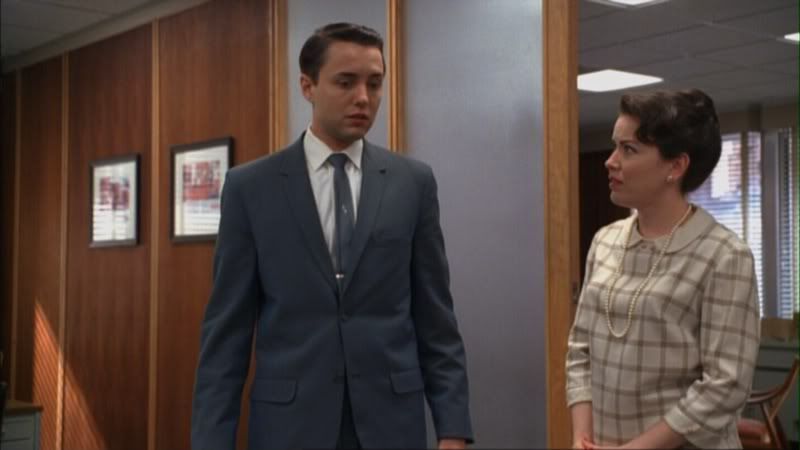
His character has a normal reason, so it maybe it doesn't count, but he could definitely play a Somewhere Else person in a movie if they needed him to.
If I have to, I am massively good at dropping out behind my eyes. Sometimes I don't mean to. I'm prone to losing time. I used to think I was possibly epileptic. I think I'm just your standard-issue dreamy person, though. I don't really like the idea that ASD people aren't Somewhere Else because I know that I am (sometimes). I think the thing is that people make such a huge deal out of it and think it's the most important thing, when it's probably just a reaction to stress and advanced focusing skills. Going Somewhere Else isn't actually autism. At the same time, it's certainly there.
It's hard for me to explain why I worry about my weight, or why I dye my hair. But it's also hard to explain why I script--but things do go worse when I don't. I need to have qualities. Something needs to be ongoing.
Keep me here.
Vincent Kartheiser, the blog's patron saint, goes Somewhere Else in Mad Men 2x02:
His character has a normal reason, so it maybe it doesn't count, but he could definitely play a Somewhere Else person in a movie if they needed him to.
If I have to, I am massively good at dropping out behind my eyes. Sometimes I don't mean to. I'm prone to losing time. I used to think I was possibly epileptic. I think I'm just your standard-issue dreamy person, though. I don't really like the idea that ASD people aren't Somewhere Else because I know that I am (sometimes). I think the thing is that people make such a huge deal out of it and think it's the most important thing, when it's probably just a reaction to stress and advanced focusing skills. Going Somewhere Else isn't actually autism. At the same time, it's certainly there.
It's hard for me to explain why I worry about my weight, or why I dye my hair. But it's also hard to explain why I script--but things do go worse when I don't. I need to have qualities. Something needs to be ongoing.
Keep me here.
The most boring thing ever
A Feministing thread about this video was linked by Ouyang Dan on FWD and it (the thread and the video) is legitimately the most boring thing I've ever seen in my life. Everyone on the Feministing thread is shitting themselves about how great it is for 14-year-old girls to be expressing these sentiments which is like--really?
1. No one who's 14 still plays with Barbies anyway, so I don't see how it's some amazing rebellion for a 14-year-old to make fun of Barbie. It reminds me of how when I was eight my friend and I used to watch Blue's Clues (which is aimed at 3-5-year-olds) and make fun of how Steve didn't know anything.
2. I would have killed to look like these girls when I was 14. Actually I still would. I guess I shouldn't make assumptions about how other people feel about their appearance, but it's just hard for me to imagine that this song comes out of a struggle, that those girls have felt really bad about themselves and now they're writing this song to fight those feelings. These very pretty, thin girls are writing a song about how you don't have to be pretty and thin! Yeah! Awesome!
A good example of something not-boring is Sleater-Kinney; specifically, Corin Tucker. Corin Tucker is different from these girls because she's actually talented, but also, she isn't incredibly skinny or conventionally pretty. I've seen her be called fat. I'm not saying that you should like bands because they're less conventionally pretty, but just that being part of Sleater-Kinney fandom actually made me feel less anxious about the way I look, whereas the Care Bears on Fire video says the right words, but doesn't make you feel anything different.
3. I have to admit to not feeling a ton of pity when women say things like, "I have a super high metabolism, and people always tell me I'm too skinny and should eat something." It sort of reminds me of "It Ain't Easy Being White" by Gob Bluth:
I know that I'm not seen as fat--I'm about a size six or eight--but I know a lot of girls who are a lot thinner than I am, and I've never felt good about my weight. If I somehow get one of those metabolisms and become a size two and everyone keeps telling me to eat something, I'll be incredibly delighted. Maybe I'm displaying insufficient empathy, but seriously, I just can't imagine that these magic metabolism people feel as bad about being skinny as they claim. How can they?
But that said, that doesn't mean that "eat a sandwich" is actually a feminist thing to say. First of all, some women are not thin because of their metabolism, they're thin because of an eating disorder, or another health reason; criticizing them for their thinness is hurtful. Second of all, when women are thin because of their metabolism, it's still kind of a stupid, messed-up thing to say, even though they're the privileged group. And finally, the bogeyman (implied when women bend over backwards to insist that they're thin because of their metabolism)--some women are thin because of a really strict diet. But why insult those women, either? To reference yet another dead TV show, this reminds me of a scene from Buffy the Vampire Slayer, in which Veruca and Oz have the following exchange:
Oz: Big lunch?
Veruca: I like to eat. I hate chicks who are like, "does it have dressing on it?"
To give some background, Veruca is a villain, though she's a small-scale, human-relations villain, not a Big Bad like Angelus or the Mayor. She is basically in the show to try to seduce Oz away from Willow. Veruca has various things in common with Oz that make Willow feel left out, and in the scene I'm quoting, Willow soon approaches Veruca and Oz and is made to feel uncomfortable because they are talking about music (they're both musicians and Willow is not). Veruca seems to relish making Willow feel uncomfortable and left out.
Feeling stupid and uninformed about music (IIRC, Veruca and Oz are talking about some very stereotypically masculine thing, like gear) is an archetypal feeling for a woman surrounded by men. It seems like Veruca is setting herself up as "one of the guys;" a girl who understands stuff that most girls don't understand. Those stupid girls, feeling left out of music! How could they possibly feel that way? Certainly not because guys don't make them feel welcome, or anything like that. And it's the same with the food. It's Veruca vs. those stupid girls who are obsessed with dressing and don't appreciate hamburgers and stuff, like guys do! Of course Oz would never find a woman unattractive because she was heavy! Of course Oz would never insult or judge a woman for being heavy! No man would do anything like that. This is just some stupid thing that women made up, because they're stupid, and they like to freak out about things that aren't real.
I'm not saying that Joss Whedon is good on weight issues, because that would be the most hilarious mischaracterization of the century, but I think that particular scene is really striking and accurate. A woman refusing to see the ways women are oppressed, so that she (while still being quite conventionally attractive, if slightly less thin than Alyson Hannigan) can be The Exception, the woman who doesn't worry about dumb stuff.
I sound like I'm going off on a tangent, but this is how I feel about that video. I was told in elementary school and in Girl Scouts that Barbie would fall over if she was a live woman. Everyone knows that. "Barbie Eat a Sandwich" is the most wholesome, socially acceptable song you could possibly write about body image. What if Care Bears on Fire wrote a song about a girl's mother criticizing her weight all the time? Or her boyfriend making snarky comments because she eats a cheeseburger? Or a girl who was actually "fat," not a size four or whatever they are, going to the doctor and having her actual health issues be ignored because the doctor is guilting her about her weight? That song wouldn't be so wholesome and socially acceptable to everyone because it would actually be calling out people who discriminate against women for their size and eating habits, instead of criticizing a woman for being too thin and not eating enough (who, okay, okay, as everyone on Feministing keeps saying, isn't a real person--but that just makes the song even more cowardly and makes me even more annoyed that people think it's so brave and great or whatever).
So, to finish up, this song is just incredibly boring and doesn't say anything cool at all, and now I will post my favorite Sleater-Kinney song:
Basically I think this song is really good, and not-boring, because it portrays the narrator's issues with food in a complex way and shows how they come from the oppression of women. Instead of a woman blaming another woman for being so stupid as to care about her weight and what she eats, we have a woman angrily and sadly expressing how she feels and raging against the forces that have made her feel that way.
(I hope it doesn't come off like I think all eating disorders are related to sexism; I know that's not the case.)
10 January, 2010
magic
me: Who was your favorite Animorph?
Mark: Rachel!!
me: Oh, of course [Mark is very fashionable]. [FFD] and I like Tobias.
Mark: (bursts out laughing) OH OF COURSE YOU DO.
me: What the hell does that mean?
Mark: Well, I mean Tobias is cool, but, he's kind of the strange one, isn't he?
me: Well, he's a bird, so.
(later a text message arrives)
"can you be the tobias to my rachel and can i like have dinner in your presence"
Subscribe to:
Posts (Atom)