from my disability page here
Hi, I was just wondering why you keep using words like "ASD" and "autism spectrum disorder" and "autism" and "Autistic" about yourself when it's pretty clear that you have Asperger's and not autism at all.
Well, that is a good question. Can it be "pretty clear" that someone has Asperger's and not autism? What is Asperger's anyway? What's the difference?
I don't think there is a difference. This isn't to say that everyone with ASD is the same, or that I'm denying the privilege I get from being a person with a relatively mild disability, when some people with ASD are quite severely disabled. But I do think there aren't two distinct types of people with ASD called "people with autism" and "people with Asperger's."
You might be interested to know that there is even another ASD diagnosis besides those two. It's called PDD-NOS and when doctors give it to people they mean "this person has ASD that's milder than Asperger's" or "this person has ASD that's more severe than Asperger's but milder than autism" or "this person has autism but I don't want their parents to flip out so I'm going to give them a diagnosis they've never heard of" or "this person has the traits of Asperger's but they have an intellectual disability or they had a speech delay which people with Asperger's aren't technically supposed to have" or a billion other things. There is also a diagnosis called Nonverbal Learning Disorder, which is something that doctors diagnose people with even though it's pretty much exactly like mild ASD, and some people think that only happens because there is a lot of stigma attached to ASD so doctors don't want to diagnose it.
This is pretty boring to read, but just imagine how much more boring it is to go around with for example a PDD-NOS or an NVLD diagnosis and have people going, "but do you have autism or Asperger's??" And no the solution is not to get rid of the PDD-NOS and NVLD diagnoses and stick to autism and Asperger's, because those are hard to separate too. For example, some imaginary people I made up for you so you can do a diagnosis braintwister:
A. ASD person who is pretty good socially and has good self-care skills, but is nonverbal
B. ASD person who seems very verbal when they are assessed by a doctor, but can't talk when they are stressed, speaks in a very disorganized fashion, and has trouble pronouncing words in a way that other people can understand
C. Person who is quite impaired by their sensory issues, to the extent that in loud places they are perceived as someone with a severe developmental disability--who is actually extremely verbal and has normal intelligence
D. Person who has mild ASD that only affects them a little, in terms of being disorganized and a bit socially inept, but has an intellectual disability that keeps them from being able to read or write very well
E. Person who as a young child was nonverbal and seemed severely affected in other ways, but became verbal as they got older and has worked really hard to learn to do a lot of things, and now doesn't "look disabled" to the average person
F. I could make up some more examples but I am again becoming bored so I will just tell you about a cool exchange I had with someone once:
Me: My friend has cerebral palsy.
Other person: Oh, how does it affect him?
The reason I thought this was cool is because I think it's often not useful to talk about disabilities in terms of "mild," "moderate," and "severe." I mean, sometimes it's necessary to use those terms as shortcuts I guess, but when you're talking about an individual I think it makes more sense to say whether they can walk, whether they can talk, and if so what is the way they walk and talk like? What is hard for them? What is something that they've learned to do on a regular basis, but it still kind of tires them out? What are they good at? What do they like to do? Do some things make them upset that wouldn't make a non-disabled person upset? Can other people tell they're disabled? How does the disabled person feel if other people can tell? How do they feel if other people can't tell? Do they ever take steps to try to keep people from "reading" them as disabled? What is their social life like? How are they at academic stuff? How are they at handling transitions? Are they clumsy? Do they make noises sometimes? Do they want to be in a relationship and if so how's that going for them? Do they live on their own? Can they eat lots of different foods and can they tell time?
I just think that, although the terms ASD and autism may seem overly broad to you, it is much better to use a broad term and then fill in the specifics than it is to act like autism exists in two distinct types, especially when there are so many stereotypes associated with each type. I'd rather someone just find out what I am like by knowing me instead of demanding that I tell them my diagnosis or my level of "functioning" or whether I am "mild."
15 June, 2011

14 June, 2011
can't imagine, can't judge?
(from LOVE-NOS)
Adelaide, actually I didn’t understand what line you were referring to with the terrible vs. unimaginable thing. I’ve been thinking about it more.
I think the difference between terrible and unimaginable is huge.
on the one hand, you can’t completely imagine anything if it isn’t your experience–and everyone should accept that that’s true.
for example, I grew up in a rich family. so if someone’s from a working-class family I’m obviously going to be like, I can’t speak from their experience and I’m going to give more weight to their opinions than mine re: class issues because I’m surely unaware of a lot of stuff. same for other oppressed groups that I don’t belong to. and I guess this is one kind of way of saying, “I can’t imagine your experience–not necessarily because I think it’s a terrible experience, but just, no matter what it is, because it’s not mine. so I’m not going to behave like an authority." But there are limits to this; if I strongly strongly disagree with someone’s actions/beliefs and they attribute their actions/beliefs to an oppressed identity or a terrible experience that I don’t have, and I really think about it but I just think what they did/think is not ethical at all…well, I’m still going to think it’s not ethical.
that’s not totally related but I feel like the response of “I can’t imagine your experience so I can’t judge you” is in SOME WAYS a good response to have, but I feel like when it comes to parents of disabled children, it gets way overdone. the raising/having of a disabled child is seen as so unimaginably terrible that other people are put in the position of feeling like they’re absolutely not ever, ever allowed to judge parents. of course we see this when parents of disabled children kill or seriously abuse their children or put their children in facilities where they are given shocks or take out their kids’ uteruses. anyone who criticizes these parents is constantly told, “you don’t understand the emotional pain/the financial pressure/the physical strain/the lack of free time these parents have.”
of course I don’t understand personally, because I’m not a parent. I try to be as aware as I can. I try to read blogs/watch movies/etc. about people with severe disabilities and their families so that I don’t just project my own experience of disability onto other people and families. I work with people with severe disabilities (I don’t do this to improve my thinking or anything, but just because it’s the type of work I enjoy the most and am good at-–but it helps my thinking, too). I try to think about how all those things could affect a parent–-and I also know that since I am not a parent, I can’t really imagine how it is.
at the same time, I think I can imagine enough to say: there are certain things that no parent should ever do to their kid. It’s not okay. I don’t believe there is some secret feeling that I can’t conceive of, that I would experience if I had a disabled child, and in this feeling would be the reason it is morally acceptable for me to abuse or kill my kid.
so, yes, I can’t imagine other people’s experiences-–but not to an extent where I am going to say, oh, I think certain experiences are so terrible that I’m not even going to begin to think about them, I’m just going to completely detach and not have any opinions about what it’s ethical for that person to do.
13 June, 2011
hi guys it's SUMMER BACK CATALOGUE time!!
I know no one reads this blog anymore because I never post, etc., but starting tomorrow there will be a post every weekday
but every silver lining has a cloud and the cloud of the moment is this: most of the posts will just be things that I already posted in other blogs before, wah-wah. I haven't felt much motivation to write lately and I'm not sure why that is.
Well actually I raised 2 Gyarados

which resulted in a sense of pride I've never experienced writing this blog or anything else, so I may raise a few more Gyarados before they lose their luster and I come back here. But anyway, drumroll, summer back catalogue.
AND if you would like to write a guest post, just email me at awf.vivian at gmail.com or ask me on tumblr. I will probably publish your guest post if I agree with it and think it is interesting, some stuff I like is:
disability + pop culture, or really any social justice reviews of pop culture
children's television/movies/games
intersectionality, especially including disability as one of the identities
Christian ideas/discussion
fallacy smackdowns (next week will be a whole week of fallacy smackdowns, so you'll have ample opportunity to see what I mean)
I reserve the right to think your post is boring or just off-topic for what I think of this blog as being about, but I definitely don't care about whether it's polished, I just care about ideas. You can even make a guest post by anthologizing your facebook statuses, if they are on topic.
I know no one reads this blog anymore because I never post, etc., but starting tomorrow there will be a post every weekday
but every silver lining has a cloud and the cloud of the moment is this: most of the posts will just be things that I already posted in other blogs before, wah-wah. I haven't felt much motivation to write lately and I'm not sure why that is.
Well actually I raised 2 Gyarados
which resulted in a sense of pride I've never experienced writing this blog or anything else, so I may raise a few more Gyarados before they lose their luster and I come back here. But anyway, drumroll, summer back catalogue.
AND if you would like to write a guest post, just email me at awf.vivian at gmail.com or ask me on tumblr. I will probably publish your guest post if I agree with it and think it is interesting, some stuff I like is:
disability + pop culture, or really any social justice reviews of pop culture
children's television/movies/games
intersectionality, especially including disability as one of the identities
Christian ideas/discussion
fallacy smackdowns (next week will be a whole week of fallacy smackdowns, so you'll have ample opportunity to see what I mean)
I reserve the right to think your post is boring or just off-topic for what I think of this blog as being about, but I definitely don't care about whether it's polished, I just care about ideas. You can even make a guest post by anthologizing your facebook statuses, if they are on topic.
04 June, 2011
hi universe, trying to get this out before I forget.
I haven't been posting here for two reasons, one long in the making and one more recent and specific:
1. I have been using tumblr to have more specific conversations and to make shorter and less formed posts.
2. My school switched over to gmail hardcore. It's weird, because they were basically on gmail before, like my school email worked like gmail and I could gchat on it, so I became dependent on it as my main gchat email. Then it somehow became MORE gmail and now I can't be simultaneously logged into my school account and the gmail account I use for this blog. Anyone who knows me knows that all I do is gchat, so I can never log out there, i.e. I can never log in here.
Since I graduated I'll have to either switch back to my old gmail account or somehow consolidate both accounts into a new one (does anyone know if this is possible?) so I'll probably be here more eventually, but I'm working at camp starting in a week for two months, which completely shuts me off from the Internet.
So
DUN DUN DUN
I'm probably going to set up a queue that will result in quite a lot of posting here while I'm gone! Most of the content will be stuff that I've posted on love-nos or tumblr, and a little bit will be things that I just never ended up posting. Of course if anyone is still reading this blog they're probably pretty rabid fans (as if) and will have doubtless read all of these things before...but you know, rabid fans, and therefore will rejoice in getting to read all of this stuff over again.
Which is to say, this blog might spend the next two months being regularly written by no one and read by no one. It'll be like a zombie apocalypse.
Also, if there was a zombie apocalypse, wouldn't it be exciting if you met the zombies of famous people? They'd be acting just like everyone else.
16 May, 2011
what is an indistinguishable when it’s at home? that is, what do indistinguishables look like when they stand in empty rooms? who could love an indistinguishable? (people do, every day.) what happens to them?
how indistinguishable are indistinguishables? does keeping your hands by your sides really cover for all that could go wrong? what does it take to be an indistinguishable? what kind of thoughts are churning in the indistinguishable mind?
can indistinguishables cry? what does it look like? what kinds of places do indistinguishables go to to cry?
what sorts of feelings do indistinguishables have? what about people who were taught that being an indistinguishable was the first thing they should want—but are incorrigibly distinguishable?
what do indistinguishables eat for dinner? what do they put in their napkin? what happens to indistinguishables who pretend they can cook?
do indistinguishables have rumbly stomachs, or do they try to create a clatter to distract the people around them?
David Foster Wallace used to carry around a tennis racket to explain why he carried around a towel, which he actually used to wipe sweat off himself when he was scared. it’s a good story, but there is no indistinguishable pride parade. all the pride of indistinguishablility is like holding a taste in your mouth in a place where you’re not supposed to be eating.
in Sparta, a boy died holding a fox under his shirt while it chewed up his stomach. this has lasted for millennia as a story of something to be proud of, and why this is the case is something that people in power should be asking themselves, but asking themselves questions is something most people in power are too busy to do.
13 May, 2011
I hate hate hate when professors have office hours in fucking cafes or random places. Or especially when they say they’re having them in a cafe and then they actually have office hours SITTING ON A WALL BEHIND THE BUILDING. This is one of those things where I bet everyone else thinks it’s SO COOL (just like the project we had in my history class last month that involved social networking as a historical character and I had no idea how to get a good grade, when or how much to work on it, etc.--I was blindsided when I got a B because I thought I’d do badly because thinking about the project made me cry and I got the bare minimum done at random intervals).
First off I feel like it implies that everyone knows where a certain place is and has familiarity with it, but I don’t have familiarity with this place and had never been there before, and felt anxious about going. I’m sitting here feeling all anxious about: will they tell me to leave because I haven’t bought anything? If I asked for the wireless password, would they say no because I haven’t bought anything? What if my professor doesn’t realize I’m here, since he’s NOT EVEN INSIDE and only came inside for a minute to collect the person he’s meeting with before me? Should I go outside and creepily sit there so he can see me from the wall where he’s meeting with the other student, which will probably make it look like I’m telling him to hurry up, when I don’t even care because I’m doing work (except that it’s annoying that I don’t have wireless)? I tried to go into the bathroom and it was locked and instead of assuming that someone was in there (which turned out to be the case when I tremulously asked for the key) I just assumed that it’s one of those bathrooms where you have to ask for the key because that’s how things go for me usually, awesome.
I can’t even email my professor to inform him I’m here because of the NOT WIRELESS.
Dear professors of the world: please, please, please, be boring forever. Don’t have class outside. Don’t randomly have class involve a group activity if it’s a lecture class. Also, no group projects ever please. No fun projects unless you provide a boring alternative such as a PAPER. Even if the paper is intellectually/academically more challenging the fun project, I will suck it up, that’s how much I loathe fun. Have office hours IN YOUR OFFICE. IN YOUR OFFICE. IN YOUR OFFICE. Not at a picnic table, not in a COFFEE SHOP, and not ON A WALL BEHIND A COFFEE SHOP. Or if you have to do this because you’re SO QUIRKY (and I admit I’m being a bitch, and my professor probably just has a whole day of meetings and wants to be somewhere he can eat/drink), make it super 100% easy for students to find you and know that you know that they’re here.
Sincerely,
The lone voice of super boring, uncreative, wonderful, less-anxiety-producing liberal arts education,
AWFV
Update: It got worse.
06 May, 2011
“I can do RAD all by myself”: a fancy About Me section
I was born in 1988 to a rich white family on the East Coast of the United States of America. For those keeping track, I was diagnosed with PDD-NOS when I was 9 and Asperger’s when I was 14--but all that really tells you about me is that I was born in 1988 to a rich white family on the East Coast of the United States of America.
By the time I was 18, I had been undiagnosed many times by people both qualified and unqualified to do so; and after a brief flirtation with Autistic culture I soon succumbed to the implications of the types of praise and encouragement young disabled people often receive. When we succeed we’re told that we’re not really disabled or that we’re different from other disabled people. The idea of being a real average disabled person becomes unacceptable. Being approved of or getting the things that we want is associated with not being something that we are; so, growing up, we bury part of ourselves.
I grew up to be a buried young adult. When I associated autism with myself at all, I identified as “very high-functioning” or “someone who used to have Asperger’s.” I even wished there was a word for someone who was more high-functioning than Asperger’s, since I felt I was on the very, very mild end of that spectrum, almost disappearing into thin air.
I experienced a lot of intense emotions, but ultimately calmness and joy, when I was around disabled people; so in college, I decided that I wanted to work with disabled people professionally. As I began to get experience doing this, I became aware of two things. First, I learned that I liked real average disabled people and would like to be one. I also learned that disabled people were often treated or judged in ways that didn’t make sense but were accepted as natural.
So, I became interested in analyzing and taking apart some of the “natural” judgments and decisions that are made about disabled people, and that’s most of what I do here. In the process of writing this blog and learning from other blogs, I’ve made some real average disabled friends and acquaintances who have helped me get better at being RAD.
In a few weeks I’ll graduate from college and go work at a summer camp for teenagers and adults with disabilities. I don’t know what I’m doing after the summer, so I can’t write a better description of my life circumstances. The best way to describe my “disability experience” is to say I’m a cognitive zombie and an emotional werewolf, but I’d rather not try. I’m Christian, queer, and cis; I write genre fiction about dishonest people; and I used to make pop music.
Here is a picture of me with a book I really like, but unfortunately have to write a paper on soon:
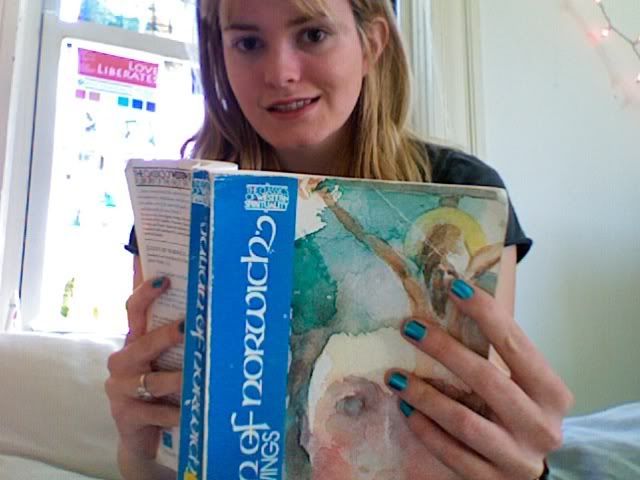
[Image description: a white girl with blond hair wearing a black shirt, blue nail polish, and a ring, sitting in front of a window in a white room and holding up Showings by Julian of Norwich. Unintentionally covering up Christ's face. Overdoes image descriptions and as a result tends to avoid them or put them as alt text so no one finds out how dumb the image description is without using a screen reader, or hovering over the image to see what it says.]
By the time I was 18, I had been undiagnosed many times by people both qualified and unqualified to do so; and after a brief flirtation with Autistic culture I soon succumbed to the implications of the types of praise and encouragement young disabled people often receive. When we succeed we’re told that we’re not really disabled or that we’re different from other disabled people. The idea of being a real average disabled person becomes unacceptable. Being approved of or getting the things that we want is associated with not being something that we are; so, growing up, we bury part of ourselves.
I grew up to be a buried young adult. When I associated autism with myself at all, I identified as “very high-functioning” or “someone who used to have Asperger’s.” I even wished there was a word for someone who was more high-functioning than Asperger’s, since I felt I was on the very, very mild end of that spectrum, almost disappearing into thin air.
I experienced a lot of intense emotions, but ultimately calmness and joy, when I was around disabled people; so in college, I decided that I wanted to work with disabled people professionally. As I began to get experience doing this, I became aware of two things. First, I learned that I liked real average disabled people and would like to be one. I also learned that disabled people were often treated or judged in ways that didn’t make sense but were accepted as natural.
So, I became interested in analyzing and taking apart some of the “natural” judgments and decisions that are made about disabled people, and that’s most of what I do here. In the process of writing this blog and learning from other blogs, I’ve made some real average disabled friends and acquaintances who have helped me get better at being RAD.
In a few weeks I’ll graduate from college and go work at a summer camp for teenagers and adults with disabilities. I don’t know what I’m doing after the summer, so I can’t write a better description of my life circumstances. The best way to describe my “disability experience” is to say I’m a cognitive zombie and an emotional werewolf, but I’d rather not try. I’m Christian, queer, and cis; I write genre fiction about dishonest people; and I used to make pop music.
Here is a picture of me with a book I really like, but unfortunately have to write a paper on soon:
[Image description: a white girl with blond hair wearing a black shirt, blue nail polish, and a ring, sitting in front of a window in a white room and holding up Showings by Julian of Norwich. Unintentionally covering up Christ's face. Overdoes image descriptions and as a result tends to avoid them or put them as alt text so no one finds out how dumb the image description is without using a screen reader, or hovering over the image to see what it says.]
Subscribe to:
Posts (Atom)