1. Danny for not being modified.
2. Henry Darger.
3. Francisco Hernandez Jr. for not being made of stone.
4. Noah, a boy I went to camp with when we were 15 and 17, who would carefully and nervously look at everyone and apologize. Once, I saw him look around and find a box of Kleenex for a girl who was crying. I was proud like he'd scored a home run.
5. Shawna, a kid in Lorain County who I met when I was 19, but with any luck will be seeing again soon. Shawna has an aide who is always saying "I don't know what's wrong with Shawna today." But Shawna continues to come up to people and clamp her hands on their hands, and stare at their collars and shoes. She's a lover not a fighter, I mean love is her war.
11 February, 2010

THE DSM V AGAIN (sorry)
A really long time ago I had talked about how I read an article about how the DSM is trying to change Asperger's, autism, and PDD into Autism Spectrum Disorders, and I had talked before about how I thought this was incredibly good and important. And I guess, now, they've sort of made it more official that they're planning on doing that, and of course some people have said things about how they don't agree, and I don't know, I find that very upsetting.
I'll explain more about what I mean, because I feel like this sounds like a very big statement to make, but I feel like some people with Asperger's, or people with Autism Spectrum Disorders who are verbal and fairly academically gifted, think that the way they're different is okay but they don't feel ready to accept the ways that other people are different.
This makes me very upset. I feel like I've certainly probably been like that at some point, like, when I was younger I didn't know a lot of people with severe disabilities, so I feel like a lot of people I probably thought that I didn't have much in common with them. But as I've gotten older I've found out that this isn't true, and that prejudice against some people with disabilities is insulting to all people with disabilities, and prejudice against some people with Autism Spectrum Disorders is insulting to everybody with an Autism Spectrum Disorder.
And, I'm very uncomfortable with the idea that I'm more like nondisabled people than I am like severely autistic people. Like, maybe if you made a diagram, and you had somebody who can't talk and isn't toilet-trained, etc., I guess you could probably figure it out mathematically so that I'm more like a nondisabled person--but I don't know, I still feel like the ways in which I'm different are important, and I still feel very connected and identified with that severely disabled person. And it's very hard for me to feel that I'm not supposed to care about that person [and feel identified with them as ASD people].
And my mom--I haven't heard it yet, 'cause I guess it was on the radio and it's not online yet. But my mom heard this interview with a woman about my age who has Asperger's, and she [the woman] said that she doesn't agree with Asperger's being considered autism, because she says that she doesn't identify with people who are severely disabled--and, um, apparently, she said people who are mentally disabled
--which, I think, I've probably gone over how this doesn't make sense, and how if someone's severely autistic, you can't actually tell if they're mentally disabled, and some people with severe autism have been shown to have normal intelligence or even be brilliant, and that's just a fallacy, it's not true.
But anyway, I guess this girl had said that she thought it was a problem with services because if everyone was called autistic, then she doesn't know what she'll do because the services that she needs aren't the services that a severely autistic person needs. Well I feel like this is just a strawman and it doesn't make any sense. Because I mean, for example, a person could have a diagnosis of an intellectual disability, and this could mean that when they get a job they need some extra help with their job and they need some extra help with their tax forms and stuff. Or it could mean that they can't talk at all and they live in a group home and they need people to help them with quite a lot of things all the time. And these people have the same diagnosis. [Actually I guess this isn’t accurate--one would have a diagnosis of Profound/Severe and one would have a diagnosis of Mild or Borderline. But this is also going to be the case for ASD, I think, so whatever.]
And another example is cerebral palsy, which is a physical disability involving muscle weakness and poor muscle control. So, for some people this could mean that they use a wheelchair, and they can't really talk, so they have to use a machine or a computer to talk, and some people don't even have enough muscle control to do that. So, those people definitely need a lot of services from the government, because they need an aide to help them get around, and they need communication devices, and they need a wheelchair. But there are also maybe people who have some trouble walking, but they can walk, and they talk in a different way, but they can still talk. And those people obviously don't need as many services, or they need different kinds of services.
So, I don't think the fact that all these people are called people with cerebral palsy, or that all the intellectually disabled people are called intellectually disabled people...I don't think that means that they all have to get the same services. I mean, that's kind of ridiculous. I feel like, to the extent that that's true, that everyone with one disability is expected to be the same, and you're expected to be judged by the word that your disability is--you're not able to be like "I have trouble with self-care skills" or "I need help moving around" or something like that--that isn't an acceptable way for services to work. And I don’t get services so I’m not an expert, but I don’t think that’s the way services do work.
So, I guess I don't understand how me being called "autistic" means that I'm somehow going to end up with all the services that a severely autistic person would have. I've also been accused of, people like me, who are "high-functioning," trying to take away the services from "low-functioning" people which also isn't true--I have no desire to take all the services that a severely disabled person needs, and have them end up with my services, which at this point are not any services. That just doesn't make any sense, and I feel like this person doesn't know what she's talking about, about services.
And I also feel like it's a little, maybe, even, dishonest, for people to pretend that it's about services. Because I really feel, sometimes, that people--like me, when I was younger, and like many other people--don't know a lot of people with severe disabilities, and feel very uncomfortable about it, and think that those people can't be anything like them, but that's just not true.
I read some interview with some guy, who, while he ultimately came out supporting Asperger's being enfolded into the autism diagnosis, he said that it's hard to think of yourself as being like people who have to wear a helmet and use adult diapers. And I don't know, I think that's funny because even some people who don't have autism have to use diapers, because all kinds of people have those problems, especially when they're older and stuff, or if they're in a car accident...I guess I think it's funny that he thinks that only happens to severely autistic people.
But anyway, I just think it's really funny that someone is upset by the idea that they might even be associated with someone who God forbid uses diapers. If you ever actually met anyone who has those kinds of disabilities, it's pretty much like meeting any other person, if you can believe it, it's not like that's the only thing there when you look at them. And I don't know, that just makes me feel upset.
On a different (but not extremely different) subject, I get really upset by the word retarded, when it's used as an insult. And I feel like when I try to say that it upsets me, I get this attitude like I'm being really politically correct, and I think people imagine that I'm trying to defend this imaginary group of like, "retarded people," all these disabled people who are, like, too disabled to understand what's going on, and that I'm trying to be charitable. Well, that's not the case. Retarded people, who have a diagnosis of mental retardation...some of these people that I care about and think are really cool and like to be around as much as I like to be around anyone else, and, I'm definitely not being charitable--I'm defending, basically, my friends, or my fellow disabled people.
I mean, I've been called "retarded” as an insult. I think a lot of people with Autism Spectrum Disorders have been. And, there are certain people who will go around...well, I feel like Asperger's has gotten to this point in our culture where we're kind of being thought of as, like, these exotic zoo animals, because we have, like, splinter skills and special talents, and a big effort is being made to distinguish us from either severely autistic people, or retarded people, or sometimes they're just considered to be one big group of people, which doesn't really make sense.
But this makes me very uncomfortable. I don't think my value is in my supposed splinter skills, if I even have such a thing. And I've been called retarded, and I think I have some of the same problems that some intellectually disabled people have. I definitely have some of the same problems that some severely disabled autistic people, who are mistaken for intellectually disabled, have. So, I mean...yeah, to some extent, when people use the word retarded, I even feel like they're insulting me, so I'm not being charitable. I'm defending myself.
And, um, I don't want to separate myself from other disabled people because it isn't fair. It has to go farther than that. I can't just be thinking about myself. I have to be thinking about all the other people who are in this with me.
10 February, 2010
Autism Spectrum Disorders in the DSM V Part 2 Transcript
Um, a really long time ago I had talked about how I read an article about how the diagnostic...something...the DSM...I actually realized I have no idea what that stands for, which is kind of bad. [For the record, I know what the DSM is and all, I just forget what it stands for.]
Yeah, so they're trying to change Asperger's, and autism, and PDD into Autism Spectrum Disorders, and I had talked before about how I thought this was incredibly good and important. And I guess, now, they've sort of made it more official that they're planning on doing that, and of course some people have said things about how they don't agree, and, um, I don't know, I find that very upsetting.
So, um, I guess--and I mean, I'll explain more about what I mean, because I feel like this sounds like a very big statement to make, but I feel like, um, some people with Asperger's, or people with Autism Spectrum Disorders who are verbal and fairly academically gifted think that the way they're different is okay but they don't feel ready to accept the ways that other people are different.
And, um, this makes me very upset. I feel like I've certainly probably been like that at some point, like, when I was younger I didn't know a lot of people with severe disabilities, so I feel like a lot of people I probably thought that I didn't have much in common with them. But as I've gotten older I've found out that this isn't true, and that prejudice against some people with disabilities is insulting to all people with disabilities, and prejudice against some people with Autism Spectrum Disorders is insulting to everybody with an Autism Spectrum Disorder.
And, I'm very uncomfortable with the idea that I'm more like nondisabled people than I am like severely autistic people. Like, I feel like, maybe if you made, like, a diagram, and you had, like, somebody who can't talk and isn't toilet-trained, etc., I guess you could probably figure it out mathematically so that I'm more like a nondisabled person, but I don't know, I still feel like, the ways in which I'm different--I still feel very connected and identified with that severely disabled person. And, um, it's very hard for me to feel that I'm not supposed to care about that person.
And, um, my mom--I haven't heard it yet, 'cause I guess it was on the radio and it's not online yet. But it was a woman about my age who has Asperger's, and she said that she doesn't agree with Asperger's being considered autism, because she says that she doesn't identify with people who are severely disabled--and, um, apparently, she said people who are mentally disabled
--which, I think, I've probably gone over how this doesn't make sense, and how if someone's severely autistic, you can't actually tell if they're mentally disabled, and some people with severe autism have been shown to have normal intelligence or even be brilliant, and that's just a fallacy, it's not true.
But, um, I guess this girl had said that she thought it was a problem with services because if everyone was called autistic, then, um, she doesn't know what she'll do because the services that she needs aren't the services that a severely autistic person needs. Well, this, I guess, I feel like it's just a strawman and it doesn't make any sense. Because I mean, for example, a person could have a diagnosis of an intellectual disability, and this could mean that when they get a job they need some extra help with their job and they need some extra help with their tax forms and stuff. Or it could mean that they can't talk at all and they live in a group home and they need people to help them with quite a lot of things all the time. And these people have the same diagnosis.
And another example is, like, cerebral palsy, which is when you don't get enough air when you're in the womb, and it leads to having, like, a physical disability with, like, trouble controlling your muscles and muscle weakness and stuff. So, for some people this could mean that they use a wheelchair, and they can't really talk, so they have to use like a machine or a computer to talk, and some people don't even have enough muscle control to do that. So, those people definitely need a lot of services from the government, because they need an aide to help them get around, and they need communication devices, and they need a wheelchair. But there are also maybe people who have some trouble walking, but they can walk, and they talk in a different way, they can still talk. And those people obviously don't need as many services, or they need different kinds of services.
So, um, I don't think the fact that all these people are called people with cerebral palsy, or that all the intellectually disabled people are called intellectually disabled people...I don't think that means that they all have to get the same services. I mean, that's kind of ridiculous. I feel like, to the extent that that's true, that everyone with one disability is expected to be the same, and you're expected to be judged--what you need is supposed to be judged by, like, the word that your disability is--you're not able to be like "I have trouble with self-care skills" or "I need help moving around" or something like that--that isn't really the case, and to the extent that that is the case, it shouldn't be the case.
So, I guess I don't understand how me being called "autistic" means that I'm somehow going to end up with all the services that a severely autistic person would have. Or, um, I've also been accused of, people like me, who are "high-functioning," trying to take away the services from "low-functioning" people which also isn't true--like, I have no desire to take all the services that a severely disabled person needs, and have them end up with my services, which at this point are not any services. Like, that just doesn't make any sense, and I feel like this person doesn't know what she's talking about.
And I also feel like it's a little, maybe, even, dishonest, for people to pretend that it's about services. Because I really feel, sometimes, that, um, people--like me, when I was younger, and like many other people--don't know a lot of people with severe disabilities, and feel very uncomfortable about it, and think that those people can't be anything like them, but that's just not true.
I read some interview with some guy, who, like, while he ultimately came out supporting Asperger's being enfolded into the autism diagnosis, he said, um, that it's hard to think of yourself as being like people who have to wear a helmet and use adult diapers. And, um, I don't know, I think that's funny because, like, even some people who don't have autism have to use diapers, because, like, all kinds of people have those problems, especially when they're older and stuff, or if they're in a car accident, you know, like...I guess I think it's funny that he thinks that only happens to severely autistic people.
But, um, just the same, I just think it's really funny that someone is upset by the idea that they might even be associated with someone who God forbid uses diapers. If you ever actually met anyone who has those kinds of disabilities, it's pretty much like meeting any other person, if you can believe it, it's not like that's the only thing there when you look at them. And, um, I don't know, that just makes me feel upset
I feel like, um...Okay. I get really upset by the word retarded, when it's used as an insult. And I feel like when I try to say that it upsets me, I get this attitude like I'm being really politically correct, and I think people imagine that I'm trying to defend this imaginary group of like, "retarded people," all these disabled people who are, like, too disabled to understand what's going on, and that I'm trying to be charitable. Well, that's not the case. Retarded people, who have a diagnosis of mental retardation...some of these people that I care about and think are really cool and like to be around as much as I like to be around anyone else, and, um, I'm definitely not being charitable--I'm defending, basically, my friends, or my fellow disabled people. And also, I think--
I mean, I've been called "retarded." I think a lot of people with Autism Spectrum Disorders have been called "retarded." And, um, there are certain people who will go around...I feel like Asperger's has gotten to this point in our culture where we're kind of being thought of as, like, these exotic zoo animals, because we have, like, splinter skills and special talents, and a big effort is being made to distinguish us from either severely autistic people, or retarded people, or sometimes they're just considered to be one big group of people, which doesn't really make sense.
But, um, this makes me very uncomfortable. I don't think my value is in my supposed splinter skills, if I even have such a thing. And, um, I've been called retarded, I think I have some of the same problems that some intellectually disabled people have. I definitely have some of the same problems that some severely disabled autistic people, who are also called "retarded," have. So, I mean...yeah, to some extent, when people use the word retarded, I even feel like they're insulting me, so I'm not being charitable. I'm defending myself.
And, um, I don't want to separate myself from other disabled people because it isn't fair. It has to go farther than that. I can't just be thinking about myself. I have to be thinking about all the other people who are in this with me.
(I guess maybe I do these in case a person who can't hear or doesn't like noises would be interested, but I also am just interested in figuring out how I speak, which is a lot of why I started making YouTube videos in the first place. I think it's interesting that as I've recently started trying to advocate for myself a lot more, I've started using the phrases "It upsets me" and "It makes me feel uncomfortable" almost compulsively. It's really cool to be able to say those words, I hope someday all of us learn how to say them.)
AGGHHH
So, I really want this job. It's at a camp in Vermont for people with disabilities (mostly DDs but other stuff too).
I am worried because I feel that things are never easy, but the assistant camp director sounds like Laura Roslin on the phone, so my interview was strangely calming. Also, usually I am afraid of giving the wrong answer, but I basically have a lot of sincere feelings about this stuff, so it wasn't very hard. I said that my hero was Harriet McBryde Johnson and I thought my strength was enthusiasm and my weakness was I don't have much experience dressing people or giving them showers. I said that I feel uncomfortable about giving people showers, but that if someone is used to getting help with that stuff, that would probably help me feel more comfortable, when I saw that the other person wasn't awkward or mad at me. She said that's probably true, and that it's natural to be uncomfortable with that stuff.
Job interviews are scary, because thanks to past experience, I feel concerned that a place I'm applying to work at is less ethical than I am. I'm not too good a person to work at an unethical place because I feel like at least I'll only do the bare minimum of unethical stuff, and once I have job experience I can become a big shot and revolutionize the system. So, I feel like I shouldn't be too noisy about my convictions.
This place seems really good though! She asked what I would do if someone wouldn't get dressed and go to breakfast, and I was really afraid that I was supposed to say that I would grab them and pull them to breakfast, or something. Instead I said that I would try to talk to them about how they might regret not going to breakfast, and how if they don't go to breakfast they might miss out on other activities later in the day. AND THIS WAS TREATED AS A GOOD ANSWER!! I was so relieved.
Also, it was just really emotional to hear about all the stuff they do, how they have all kinds of different activities and special events, because when I was visiting Clayton he told me how he went to disabled camp when he was a kid and it was basically like a warehouse, they sat around and the kids who could walk were sometimes taken for a walk, and that was it. This camp has as many activities as any other camp, if not more.
I was supposed to think it over and call her back. The problem is I had nothing to think over. I was supposed to talk to people so I talked to Noah and my mom, but all I really said was "THIS IS THE BEST CAMP, do you think I should be worried about giving people showers" and they were like "not really." So, after waiting the minimum suggested amount of time (she said two to three days) I called her back and as soon as she answered the phone I said "This is Amanda Forest Vivian [I love how I think putting a random word in the middle of my name will keep people from stalking me on the Internet], I really want to work at Camp ____, it wasn't a difficult decision, so I don't know how well I can explain my thought process, do you want me to try to explain."
Then I heard some coughing. She has a cold, as I learned when I talked to her before. Then she said, "You caught me off guard. Well, you considered it briefly, and I think if people really want to be doing this, they usually are sure about it fairly soon; I try to describe a lot about the camp when I talk to people, and if they seem to be hesitating, then those are usually the people who change their minds. So I'll check your references, and if nothing horrible turns up, you should be getting a contract in a few weeks."
I started to get seized with paranoia that my references secretly hate me and/or don't remember me, because I haven't worked with DD people in a while. It's too bad that the DD people can't give the references, because I think my friend Mike would remember me and give a really good reference, as long as he could communicate by stimming. (His verbal reference would probably be something like "Hi...blue...toast...BABIES!" One time I saw a woman with a baby walking by and basically forced her to come over and show the baby to Mike. All Mike has ever wanted to do is look at babies and talk to them, but unfortunately there are no babies in the South Group Home or the Oberlin Work Activity Center. However, he can carry pictures of them around.)
But anyway, I started emailing my references to remind them of who I am. But it took me like two hours because I kept accidentally flicking my wrists and jumping around the room, like Mike does when he encounters babies, police officers, mailmen, and flyers. I mean, Mike would never flick his wrists at a baby. Around babies, he finally becomes still. I hope nothing horrible turns up because if I get this job, I will have the best summer, and my life will more or less be on track FOREVER.
eta: oh oh oh, also the DSM? Best day ever. Except, I already heard two dumb comments about it today. You guys, if part of your Asperger's identity is thinking that Einstein had Asperger's, YOU'RE DOING IT WRONG. He had a speech delay. This is a good example of how Asperger's ISN'T REAL AND MAKES NO SENSE.
Unnecessary things
Dave Hingsburger made a really good post about how he wanted a book that he couldn't reach from his wheelchair, and the bookstore employee got annoyed because he was picky about which edition of the book he wanted her to reach for him. I feel like it's good not to feel that you only deserve things that are necessary. Especially because it's hard to tell what's necessary.
I have ASD. I also probably have some not-worth-diagnosing condition that makes me feel faint and on a few occasions has led to me losing the ability to see. I guess this is called "chronic low blood pressure" or something. This summer, my vision almost completely took its leave of me while I was in line at a grocery store. I felt confident explaining to the people around me that I had to leave my food on the counter, go outside, and sit down. (It didn't hurt that on my way outside I tried to walk through a glass door.)
Mostly this doesn't affect me, because I leave situations where I am getting faint, or avoid getting into them in the first place. ASD doesn't always affect me badly either. But the other day, at work, I was told to do a different job than the one I had been hired to do, one which was very taxing for me in terms of sensory issues and Feeling Faint. Although I've never thought about Feeling Faint, or thought much about ASD, when applying for part-time jobs in the dining hall, it would never have occurred to me to apply to do this other job. It's not something I have a word for, I just find several aspects of it to be very difficult over long periods of time.
Anyway, I didn't lose any vision while I was working there, and my Feeling Faint is not really a severe or chronic enough problem for me to be able to explain. I doubt the Disability Services office or anyone would advocate for my right to have a job that isn't upsetting to me for sensory reasons. However, I'll be very upset if I'm pressured into doing that job again, and I will make an effort to insist that I be allowed to do the job I was hired to do.
The problem is that it isn't a necessity for me to avoid anything that might be difficult for me on a sensory level, or a Feeling Faint level. So I don't feel that I deserve respect and help, objectively, the way I did when my vision went out. But the truth is that if I'm forced to remain in a difficult situation for hours, it is really bad--so in the long run, I think it becomes a necessity that my impairments be acknowledged and accommodated.
Also, I don't think it's even going far enough to just admit that some apparently unnecessary things can actually be necessary or become necessary. What about things that aren't necessary like Dave Hingsburger's book? Nothing horrible will happen to him if he has to have an ugly cover instead of the cover he likes--but shouldn't disabled people be able to ask for help that will give us the same range of opportunities as a nondisabled person?
To continue pelting you with examples, I'm afraid to meet with professors when I'm having trouble in class, because I'm concerned that my communication and body language might cause them to resent me and give me a worse grade. Not meeting with professors isn't a huge deal; I always get by. But if I could meet with professors, I could do better. If I was as smart as I am, but didn't have ASD, I could do better in school. I'm going to try to meet with professors and advocate for myself if they make up stories about who I am. I deserve to do as well in school as a regular person can.
YES EISLEY LEFT WB!!
I wrote this long essay/review about Eisley a while back, I was editing it lately and thinking of maybe posting it here soon. But I will just say (because I should be asleep) they're this creepy/cute indie Christian sci-fi/fantasy family band that I used to be tremendously into when I was 16. They were the first band I was seriously obsessed with and a fan of without being introduced to them by my dad. When they were getting signed (in 2002, if I remember right) all these Christian labels wanted them, but they don't consider themselves a Christian band, etc. etc.--which is fine, but they signed to Warner Brothers of all places. Why would they do that? WB treats them like an embarrassment and has actually tried to get them to tone down the geeky aspects of their music, and never ever makes music videos of their songs, and basically sucks, and it was really hard to see a band I was once so into just get buried. So I'm just so happy that they're doing this, finally, after eight years.
08 February, 2010
Infiltrate
This scene makes me think of my fifth-grade teacher:
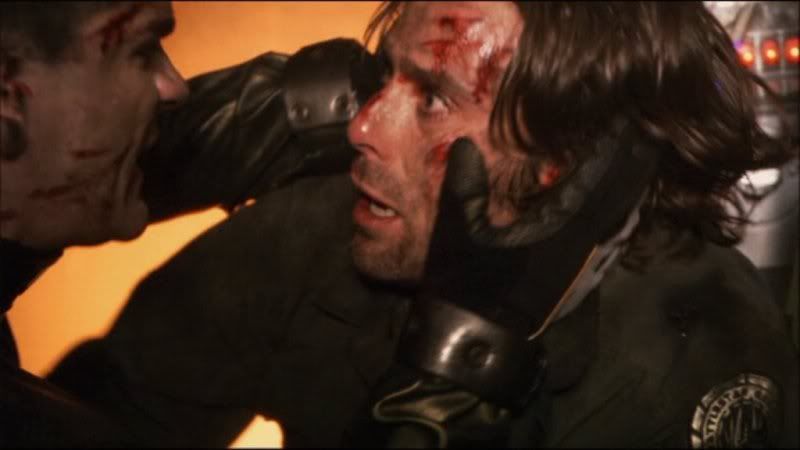
I don't have much to say, just this. I am in a disability studies class; I don't know what I think so far. The professor has never taught a disability studies class before and I think we're supposed to figure out for ourselves what we want to write a paper on.
I want to write a paper on infiltration. I don't like for people to talk to me in a way that makes me feel like that picture. And I can't do it to someone else, which in some people's minds makes me bad at ABA. I am quiet when I talk to people who are upset. I don't grab them by the shoulders and force them to walk in a less stimmy line. I want to infiltrate services for developmentally disabled people so that for the minutes or hours or days a person is with me, no one makes them feel like that. It's not everything but it's something and it could change something in them.
I'm afraid to talk. A lot of the time if you work with ASD kids, being normal is a qualification. It's obvious in the way they talk--you want to bring in normal kids to show the ASD kids what normal is like. You want to model normal ways of sitting and interacting. By definition, I'm not qualified for a lot of the jobs I want to do. Because it's all about us vs. them. I want to write a paper on us vs. them. Because I can't ever be us, the most I can be is a really good them who everyone looks at as a success story because I try really hard. But do I want to try hard? And do I want to "emerge" from them, so I can yell in their faces too? Not hardly.
Subscribe to:
Posts (Atom)