what is an indistinguishable when it’s at home? that is, what do indistinguishables look like when they stand in empty rooms? who could love an indistinguishable? (people do, every day.) what happens to them?
how indistinguishable are indistinguishables? does keeping your hands by your sides really cover for all that could go wrong? what does it take to be an indistinguishable? what kind of thoughts are churning in the indistinguishable mind?
can indistinguishables cry? what does it look like? what kinds of places do indistinguishables go to to cry?
what sorts of feelings do indistinguishables have? what about people who were taught that being an indistinguishable was the first thing they should want—but are incorrigibly distinguishable?
what do indistinguishables eat for dinner? what do they put in their napkin? what happens to indistinguishables who pretend they can cook?
do indistinguishables have rumbly stomachs, or do they try to create a clatter to distract the people around them?
David Foster Wallace used to carry around a tennis racket to explain why he carried around a towel, which he actually used to wipe sweat off himself when he was scared. it’s a good story, but there is no indistinguishable pride parade. all the pride of indistinguishablility is like holding a taste in your mouth in a place where you’re not supposed to be eating.
in Sparta, a boy died holding a fox under his shirt while it chewed up his stomach. this has lasted for millennia as a story of something to be proud of, and why this is the case is something that people in power should be asking themselves, but asking themselves questions is something most people in power are too busy to do.
16 May, 2011

13 May, 2011
I hate hate hate when professors have office hours in fucking cafes or random places. Or especially when they say they’re having them in a cafe and then they actually have office hours SITTING ON A WALL BEHIND THE BUILDING. This is one of those things where I bet everyone else thinks it’s SO COOL (just like the project we had in my history class last month that involved social networking as a historical character and I had no idea how to get a good grade, when or how much to work on it, etc.--I was blindsided when I got a B because I thought I’d do badly because thinking about the project made me cry and I got the bare minimum done at random intervals).
First off I feel like it implies that everyone knows where a certain place is and has familiarity with it, but I don’t have familiarity with this place and had never been there before, and felt anxious about going. I’m sitting here feeling all anxious about: will they tell me to leave because I haven’t bought anything? If I asked for the wireless password, would they say no because I haven’t bought anything? What if my professor doesn’t realize I’m here, since he’s NOT EVEN INSIDE and only came inside for a minute to collect the person he’s meeting with before me? Should I go outside and creepily sit there so he can see me from the wall where he’s meeting with the other student, which will probably make it look like I’m telling him to hurry up, when I don’t even care because I’m doing work (except that it’s annoying that I don’t have wireless)? I tried to go into the bathroom and it was locked and instead of assuming that someone was in there (which turned out to be the case when I tremulously asked for the key) I just assumed that it’s one of those bathrooms where you have to ask for the key because that’s how things go for me usually, awesome.
I can’t even email my professor to inform him I’m here because of the NOT WIRELESS.
Dear professors of the world: please, please, please, be boring forever. Don’t have class outside. Don’t randomly have class involve a group activity if it’s a lecture class. Also, no group projects ever please. No fun projects unless you provide a boring alternative such as a PAPER. Even if the paper is intellectually/academically more challenging the fun project, I will suck it up, that’s how much I loathe fun. Have office hours IN YOUR OFFICE. IN YOUR OFFICE. IN YOUR OFFICE. Not at a picnic table, not in a COFFEE SHOP, and not ON A WALL BEHIND A COFFEE SHOP. Or if you have to do this because you’re SO QUIRKY (and I admit I’m being a bitch, and my professor probably just has a whole day of meetings and wants to be somewhere he can eat/drink), make it super 100% easy for students to find you and know that you know that they’re here.
Sincerely,
The lone voice of super boring, uncreative, wonderful, less-anxiety-producing liberal arts education,
AWFV
Update: It got worse.
First off I feel like it implies that everyone knows where a certain place is and has familiarity with it, but I don’t have familiarity with this place and had never been there before, and felt anxious about going. I’m sitting here feeling all anxious about: will they tell me to leave because I haven’t bought anything? If I asked for the wireless password, would they say no because I haven’t bought anything? What if my professor doesn’t realize I’m here, since he’s NOT EVEN INSIDE and only came inside for a minute to collect the person he’s meeting with before me? Should I go outside and creepily sit there so he can see me from the wall where he’s meeting with the other student, which will probably make it look like I’m telling him to hurry up, when I don’t even care because I’m doing work (except that it’s annoying that I don’t have wireless)? I tried to go into the bathroom and it was locked and instead of assuming that someone was in there (which turned out to be the case when I tremulously asked for the key) I just assumed that it’s one of those bathrooms where you have to ask for the key because that’s how things go for me usually, awesome.
I can’t even email my professor to inform him I’m here because of the NOT WIRELESS.
Dear professors of the world: please, please, please, be boring forever. Don’t have class outside. Don’t randomly have class involve a group activity if it’s a lecture class. Also, no group projects ever please. No fun projects unless you provide a boring alternative such as a PAPER. Even if the paper is intellectually/academically more challenging the fun project, I will suck it up, that’s how much I loathe fun. Have office hours IN YOUR OFFICE. IN YOUR OFFICE. IN YOUR OFFICE. Not at a picnic table, not in a COFFEE SHOP, and not ON A WALL BEHIND A COFFEE SHOP. Or if you have to do this because you’re SO QUIRKY (and I admit I’m being a bitch, and my professor probably just has a whole day of meetings and wants to be somewhere he can eat/drink), make it super 100% easy for students to find you and know that you know that they’re here.
Sincerely,
The lone voice of super boring, uncreative, wonderful, less-anxiety-producing liberal arts education,
AWFV
Update: It got worse.
06 May, 2011
“I can do RAD all by myself”: a fancy About Me section
I was born in 1988 to a rich white family on the East Coast of the United States of America. For those keeping track, I was diagnosed with PDD-NOS when I was 9 and Asperger’s when I was 14--but all that really tells you about me is that I was born in 1988 to a rich white family on the East Coast of the United States of America.
By the time I was 18, I had been undiagnosed many times by people both qualified and unqualified to do so; and after a brief flirtation with Autistic culture I soon succumbed to the implications of the types of praise and encouragement young disabled people often receive. When we succeed we’re told that we’re not really disabled or that we’re different from other disabled people. The idea of being a real average disabled person becomes unacceptable. Being approved of or getting the things that we want is associated with not being something that we are; so, growing up, we bury part of ourselves.
I grew up to be a buried young adult. When I associated autism with myself at all, I identified as “very high-functioning” or “someone who used to have Asperger’s.” I even wished there was a word for someone who was more high-functioning than Asperger’s, since I felt I was on the very, very mild end of that spectrum, almost disappearing into thin air.
I experienced a lot of intense emotions, but ultimately calmness and joy, when I was around disabled people; so in college, I decided that I wanted to work with disabled people professionally. As I began to get experience doing this, I became aware of two things. First, I learned that I liked real average disabled people and would like to be one. I also learned that disabled people were often treated or judged in ways that didn’t make sense but were accepted as natural.
So, I became interested in analyzing and taking apart some of the “natural” judgments and decisions that are made about disabled people, and that’s most of what I do here. In the process of writing this blog and learning from other blogs, I’ve made some real average disabled friends and acquaintances who have helped me get better at being RAD.
In a few weeks I’ll graduate from college and go work at a summer camp for teenagers and adults with disabilities. I don’t know what I’m doing after the summer, so I can’t write a better description of my life circumstances. The best way to describe my “disability experience” is to say I’m a cognitive zombie and an emotional werewolf, but I’d rather not try. I’m Christian, queer, and cis; I write genre fiction about dishonest people; and I used to make pop music.
Here is a picture of me with a book I really like, but unfortunately have to write a paper on soon:
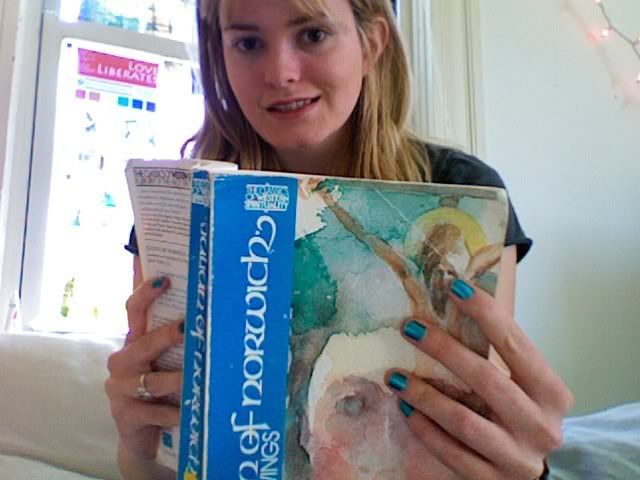
[Image description: a white girl with blond hair wearing a black shirt, blue nail polish, and a ring, sitting in front of a window in a white room and holding up Showings by Julian of Norwich. Unintentionally covering up Christ's face. Overdoes image descriptions and as a result tends to avoid them or put them as alt text so no one finds out how dumb the image description is without using a screen reader, or hovering over the image to see what it says.]
By the time I was 18, I had been undiagnosed many times by people both qualified and unqualified to do so; and after a brief flirtation with Autistic culture I soon succumbed to the implications of the types of praise and encouragement young disabled people often receive. When we succeed we’re told that we’re not really disabled or that we’re different from other disabled people. The idea of being a real average disabled person becomes unacceptable. Being approved of or getting the things that we want is associated with not being something that we are; so, growing up, we bury part of ourselves.
I grew up to be a buried young adult. When I associated autism with myself at all, I identified as “very high-functioning” or “someone who used to have Asperger’s.” I even wished there was a word for someone who was more high-functioning than Asperger’s, since I felt I was on the very, very mild end of that spectrum, almost disappearing into thin air.
I experienced a lot of intense emotions, but ultimately calmness and joy, when I was around disabled people; so in college, I decided that I wanted to work with disabled people professionally. As I began to get experience doing this, I became aware of two things. First, I learned that I liked real average disabled people and would like to be one. I also learned that disabled people were often treated or judged in ways that didn’t make sense but were accepted as natural.
So, I became interested in analyzing and taking apart some of the “natural” judgments and decisions that are made about disabled people, and that’s most of what I do here. In the process of writing this blog and learning from other blogs, I’ve made some real average disabled friends and acquaintances who have helped me get better at being RAD.
In a few weeks I’ll graduate from college and go work at a summer camp for teenagers and adults with disabilities. I don’t know what I’m doing after the summer, so I can’t write a better description of my life circumstances. The best way to describe my “disability experience” is to say I’m a cognitive zombie and an emotional werewolf, but I’d rather not try. I’m Christian, queer, and cis; I write genre fiction about dishonest people; and I used to make pop music.
Here is a picture of me with a book I really like, but unfortunately have to write a paper on soon:
[Image description: a white girl with blond hair wearing a black shirt, blue nail polish, and a ring, sitting in front of a window in a white room and holding up Showings by Julian of Norwich. Unintentionally covering up Christ's face. Overdoes image descriptions and as a result tends to avoid them or put them as alt text so no one finds out how dumb the image description is without using a screen reader, or hovering over the image to see what it says.]
30 April, 2011
about individuals
I started to write something about this two years ago but I didn't really know where I was going with it, and still don't, but (like lots of people) I find it really gross when professionals and other "allies" think that using person-first language is more important than actually not being ableist. Especially when they boss people who are actually less ableist than they are, or are actually disabled, because the person didn't use PFL.
However, something that I think is even weirder than the prescriptivism on PFL is the word "individuals." You basically only see the word individuals used about people who have committed a crime or are disabled, and a lot of the kind of people who overprioritize person-first language are the kind of people who use the word individuals. It's primarily used by professionals when they are talking about disabled people, either in specific or in general. Someone will talk about the "individual with autism" they are working with, or also you see this in a more broad way used to describe a big group of people--like a service provider might have on their website, "we serve individuals with profound disabilities."
I can't exactly put my finger on what bothers me about the word individual, but I think it's really just the fact that it only seems to be used about disabled people. I assume the decision to use a different word instead of "people" is a reaction to something, but what is it a reaction to? It sounds so alienating and medicalized--what's wrong with saying "we serve people with profound disabilities" or "I've been working with this man with autism?"
Can someone explain this to me?
However, something that I think is even weirder than the prescriptivism on PFL is the word "individuals." You basically only see the word individuals used about people who have committed a crime or are disabled, and a lot of the kind of people who overprioritize person-first language are the kind of people who use the word individuals. It's primarily used by professionals when they are talking about disabled people, either in specific or in general. Someone will talk about the "individual with autism" they are working with, or also you see this in a more broad way used to describe a big group of people--like a service provider might have on their website, "we serve individuals with profound disabilities."
I can't exactly put my finger on what bothers me about the word individual, but I think it's really just the fact that it only seems to be used about disabled people. I assume the decision to use a different word instead of "people" is a reaction to something, but what is it a reaction to? It sounds so alienating and medicalized--what's wrong with saying "we serve people with profound disabilities" or "I've been working with this man with autism?"
Can someone explain this to me?
29 April, 2011
hurt power and disability 2; or, I HAVE A LOT OF FEELINGS
I always feel like I'm really hard on my parents here when they're pretty great people and also overpathologizing your kids is such a stereotypical rich person thing, I can't even. But I've written a lot about how I think it's super important for disabled people to be able to make bad decisions without that being seen (especially in the case of people who are receiving services or "dependent" on someone) as a reason that they shouldn't be allowed to make decisions or a reason that their self-expression and decisions should be seen as "part of their disability" in a way that means those things should be suppressed or ignored.
And I feel that is kind of how I was raised; things that in retrospect seem pretty innocent, or at the most things that I would try to stop my kid from doing but would see as funny and not that big a deal, began to feel like ammunition against me and evidence that I a)was someone to be worried about and b)shouldn't be allowed to make my own decisions. Which does a lot to explain the Supercrip Mongoose you see before you, because I feel that if I need support, I won't be able to have anything.
Two entire humans told me they liked and related to the part of my s/m post that talked about submission as a way to experience parts of yourself that you dislike and/or avoid. I was pleased because that was the part that I totally cribbed from other people and mumbled through to avoid saying anything dramatic and getting it wrong. It seems like dominance would be the opposite, i.e. experiencing power that you don't have in real life and sweeping weakness under the rug, but in fact I feel like it's exactly the same failure embrace just in a different way. After all I do stuff with people who know me so it's not like anyone's under the impression I have super good brains and am really tough.
What happens is not exactly a good thing because it means I really overattach to people I do stuff with (and also develop the biggest savior complex in the known universe, which is gross), but for someone to relate to me in that way and vice versa feels like a really radical acceptance of me as a whole person, which is a huge departure from the tendency to either look at what someone does and deny their disability, or look at what someone doesn't do (or does wrong) and say that that's all of them and means something about how they should be treated. For someone to think that it's okay for me to occupy a certain role and make certain decisions, when they know I have all these cracks, is an acknowledgment of The Elevators in me.
And I feel that is kind of how I was raised; things that in retrospect seem pretty innocent, or at the most things that I would try to stop my kid from doing but would see as funny and not that big a deal, began to feel like ammunition against me and evidence that I a)was someone to be worried about and b)shouldn't be allowed to make my own decisions. Which does a lot to explain the Supercrip Mongoose you see before you, because I feel that if I need support, I won't be able to have anything.
Two entire humans told me they liked and related to the part of my s/m post that talked about submission as a way to experience parts of yourself that you dislike and/or avoid. I was pleased because that was the part that I totally cribbed from other people and mumbled through to avoid saying anything dramatic and getting it wrong. It seems like dominance would be the opposite, i.e. experiencing power that you don't have in real life and sweeping weakness under the rug, but in fact I feel like it's exactly the same failure embrace just in a different way. After all I do stuff with people who know me so it's not like anyone's under the impression I have super good brains and am really tough.
What happens is not exactly a good thing because it means I really overattach to people I do stuff with (and also develop the biggest savior complex in the known universe, which is gross), but for someone to relate to me in that way and vice versa feels like a really radical acceptance of me as a whole person, which is a huge departure from the tendency to either look at what someone does and deny their disability, or look at what someone doesn't do (or does wrong) and say that that's all of them and means something about how they should be treated. For someone to think that it's okay for me to occupy a certain role and make certain decisions, when they know I have all these cracks, is an acknowledgment of The Elevators in me.
27 April, 2011
Hi everyone. My name is autism and some mood/anxiety stuff but a lot of people just call me autism. I’m 22 and about to graduate from college. There’s not really much to say about me--I like Skins, I move very quickly, I’m not a great disability to go to church with. But overall I’m just like any other disability and I want the same things.
Well, except that I happen to have a person. My person is called an Amanda Forest Vivian Spectrum Disorder, or AFVSD for short. I was diagnosed with AFVSD when I was nine and she has caused me to have problems with social communication and being gayyy. But seriously guys, that’s between her and me. My AFVSD is none of your business--I’m first and foremost autism, and I want to be treated that way.
The most difficult disabilities for me to be friends with are the ones who don’t respect me as a disability and just treat me like a PERSON. They don’t even see me, just a stereotype of what a person is. They’re so busy looking at my Amanda Forest Vivian Spectrum Disorder that they don’t realize when something is too loud for me, or when I’m really not feeling good and might end up werewolf-attacking AFVSD. Then they act all surprised, but if they just treated me like autism instead of "Amanda," I would be able to achieve more of the things that I want.
No matter how different I may seem with this giant lesbian tragedy attached to my face, please remember that I’m a disability first and a person second--so please use disability-first language to show that you respect me as a whole disability and aren’t obsessed with my person. It’s the LAW.
Yours in disabilitycapades,
autism and some mood/anxiety stuff, ES-FUCKING-SQUIRE
P.S. My AFVSD continues to prefer person-first language and isn't saying otherwise, but neither of us can handle nothings-with-persons thinking they have a right to actually criticize and correct disabilities for not using PFL, especially when they complete ignore actually important things that disabilities are saying about anti-ableism in favor of bitching about a LANGUAGE USAGE THAT SOME OTHER NWAP TOLD THEM TO USE. FOR FUCK'S SAKE.
Well, except that I happen to have a person. My person is called an Amanda Forest Vivian Spectrum Disorder, or AFVSD for short. I was diagnosed with AFVSD when I was nine and she has caused me to have problems with social communication and being gayyy. But seriously guys, that’s between her and me. My AFVSD is none of your business--I’m first and foremost autism, and I want to be treated that way.
The most difficult disabilities for me to be friends with are the ones who don’t respect me as a disability and just treat me like a PERSON. They don’t even see me, just a stereotype of what a person is. They’re so busy looking at my Amanda Forest Vivian Spectrum Disorder that they don’t realize when something is too loud for me, or when I’m really not feeling good and might end up werewolf-attacking AFVSD. Then they act all surprised, but if they just treated me like autism instead of "Amanda," I would be able to achieve more of the things that I want.
No matter how different I may seem with this giant lesbian tragedy attached to my face, please remember that I’m a disability first and a person second--so please use disability-first language to show that you respect me as a whole disability and aren’t obsessed with my person. It’s the LAW.
Yours in disabilitycapades,
autism and some mood/anxiety stuff, ES-FUCKING-SQUIRE
P.S. My AFVSD continues to prefer person-first language and isn't saying otherwise, but neither of us can handle nothings-with-persons thinking they have a right to actually criticize and correct disabilities for not using PFL, especially when they complete ignore actually important things that disabilities are saying about anti-ableism in favor of bitching about a LANGUAGE USAGE THAT SOME OTHER NWAP TOLD THEM TO USE. FOR FUCK'S SAKE.
24 April, 2011
There used to be a guy who went to my school, named James, who was blind. One reason I thought James was cool was because of his competence and confidence in asking people for help. He would walk into a room and ask what he needed to know about what was in the room. (I don't mean to act like this is some kind of unusual quality in a blind person, but I hadn't met anyone who was blind before so it seemed really cool to me.)
Once I was talking to Noah about James and Noah told me something he had heard from James's former roommate. James's roommate had asked, "What do you imagine it would be like to be able to see?" and James said, "It would be like having a hand that could feel everything in a room all at once." This has always stuck with me and I don't think I realized why until I watched this video that's been going around tumblr.
The video is an ad for a marketing firm, called "The Power of Words." It depicts a blind guy begging on the street and not getting very much money. A woman comes up, grabs his sign, turns it over, and writes a new message on it. For the rest of the day, the blind guy makes tons of money, and when the woman comes back later he asks, "What did you do to my sign?" She says, "I wrote the same thing with different words."
This would obviously be patronizing no matter what the sign said, but I found the words on the sign to be the most interesting part of the video. The guy's sign originally says, "I'M BLIND, PLEASE HELP." The woman changes it to, "IT'S A BEAUTIFUL DAY AND I CAN'T SEE IT."
This illustrates exactly what non-disabled people want from disabled people.
A lot of blind people are unemployed either because they weren't taught the skills they need to be independent, or aren't given the proper accommodations for getting and keeping a job. I think it's reasonable in our society for a disabled person to express frustration that their disability keeps them from getting the things they want, and to ask for help from other people because of their situation. So although I find a blind beggar to be a questionable subject for an inspirational video, the existence of such a person is realistic and I don't feel that I can condemn the video just because it's about a disadvantaged disabled person asking for money.
However, we're told in the video that the fact that this guy can't work and needs money isn't enough for people to want to help him. People only want to help him when he comes out and says not only, "There are things I can't do because of my disability and that sucks," but, "My experience of the world sucks on an existential level, not just a practical one, because I can't experience the world the way non-disabled people can."
I think one of my Autistics Speaking Day posts was about my desire to always add the phrase, "It's no big deal," after telling people about my disability, even though it actually is a big deal. This is because I don't trust people to understand the difference between the fact that there are some bad things about being disabled, and the idea that my disabledness is tragic in some overarching, objective way. Or rather an overarching, objective, spiritual way, if you know what I mean--the idea that disabled people are less human or less alive due to being disabled.
I think the most negative view you could reasonably have about being disabled is that it makes your life really hard, and it makes you upset a lot, and that sucks. This isn't necessarily my view but I would never criticize another disabled person for having it. But that isn't enough for non-disabled people. They have to feel that disabled people are missing not just the ability to have a job or feel secure, but that we're actually missing a vital part of being alive on the pure basis of our impairment.
I realize now that what James said stuck out to me because I heard it in the context of a society where stories about blind people are often about how they don't get to look at sunsets, or colors, and how tragic that is. I think I remember reading a children's book about a kid who "helps" his blind friend by describing different colors to him in terms of emotion. But if you're blind, the really cool, lovely details of life don't have to do with visual information because that just isn't a part of your life. Not getting to look at a sunset really isn't a big problem. What I liked about James's quote was that he thought of problems due to blindness in very practical terms--because he was blind, he didn't immediately know what was in a room the way sighted people did.
But for sighted people, this isn't enough.
Blind people have to say that their day is worse on an experiential level because they are blind.
And I think this duality--objective impairment, and the nebulous, often unlikely connotations of misery that are attached to it--explains a lot of the things non-disabled people do to disabled people, and why they seem so ridiculous when you look at them straight on.
Once I was talking to Noah about James and Noah told me something he had heard from James's former roommate. James's roommate had asked, "What do you imagine it would be like to be able to see?" and James said, "It would be like having a hand that could feel everything in a room all at once." This has always stuck with me and I don't think I realized why until I watched this video that's been going around tumblr.
The video is an ad for a marketing firm, called "The Power of Words." It depicts a blind guy begging on the street and not getting very much money. A woman comes up, grabs his sign, turns it over, and writes a new message on it. For the rest of the day, the blind guy makes tons of money, and when the woman comes back later he asks, "What did you do to my sign?" She says, "I wrote the same thing with different words."
This would obviously be patronizing no matter what the sign said, but I found the words on the sign to be the most interesting part of the video. The guy's sign originally says, "I'M BLIND, PLEASE HELP." The woman changes it to, "IT'S A BEAUTIFUL DAY AND I CAN'T SEE IT."
This illustrates exactly what non-disabled people want from disabled people.
A lot of blind people are unemployed either because they weren't taught the skills they need to be independent, or aren't given the proper accommodations for getting and keeping a job. I think it's reasonable in our society for a disabled person to express frustration that their disability keeps them from getting the things they want, and to ask for help from other people because of their situation. So although I find a blind beggar to be a questionable subject for an inspirational video, the existence of such a person is realistic and I don't feel that I can condemn the video just because it's about a disadvantaged disabled person asking for money.
However, we're told in the video that the fact that this guy can't work and needs money isn't enough for people to want to help him. People only want to help him when he comes out and says not only, "There are things I can't do because of my disability and that sucks," but, "My experience of the world sucks on an existential level, not just a practical one, because I can't experience the world the way non-disabled people can."
I think one of my Autistics Speaking Day posts was about my desire to always add the phrase, "It's no big deal," after telling people about my disability, even though it actually is a big deal. This is because I don't trust people to understand the difference between the fact that there are some bad things about being disabled, and the idea that my disabledness is tragic in some overarching, objective way. Or rather an overarching, objective, spiritual way, if you know what I mean--the idea that disabled people are less human or less alive due to being disabled.
I think the most negative view you could reasonably have about being disabled is that it makes your life really hard, and it makes you upset a lot, and that sucks. This isn't necessarily my view but I would never criticize another disabled person for having it. But that isn't enough for non-disabled people. They have to feel that disabled people are missing not just the ability to have a job or feel secure, but that we're actually missing a vital part of being alive on the pure basis of our impairment.
I realize now that what James said stuck out to me because I heard it in the context of a society where stories about blind people are often about how they don't get to look at sunsets, or colors, and how tragic that is. I think I remember reading a children's book about a kid who "helps" his blind friend by describing different colors to him in terms of emotion. But if you're blind, the really cool, lovely details of life don't have to do with visual information because that just isn't a part of your life. Not getting to look at a sunset really isn't a big problem. What I liked about James's quote was that he thought of problems due to blindness in very practical terms--because he was blind, he didn't immediately know what was in a room the way sighted people did.
But for sighted people, this isn't enough.
Blind people have to say that their day is worse on an experiential level because they are blind.
And I think this duality--objective impairment, and the nebulous, often unlikely connotations of misery that are attached to it--explains a lot of the things non-disabled people do to disabled people, and why they seem so ridiculous when you look at them straight on.
Subscribe to:
Posts (Atom)