I've written about this before a bit. but does it make anyone else really sad when you're reading a book or watching a movie, and a character who originally seems really stereotypically disabled (this especially happens with mentally ill characters) starts to get more complex and less stereotypical and turn into a cool character, and then it's like, surprise...they actually weren't really disabled. or they weren't, like, organically disabled, if it's a mental thing. they acted like that because of something wrong that someone else did to them and/or because society is messed up.
I'm leery of saying this because it kind of sounds like I'm saying PTSD and other stuff that comes from trauma isn't a real disability. I don't think that but I do think there's this weird division in fiction between people who are "really" mentally disabled (usually: depression, psychosis, autism, social anxiety, sometimes intellectual disability) and people who appear that way, but actually it's someone else's fault, making them actually at their core non-disabled.
obvious example: lisbeth salander!!
I'm not saying some of these characters are proven beyond a shadow a doubt to have entered the world non-disabled. but there is a revelation that at least some of their disability is related to trauma, and they are "sensible" at their core even if they are eccentric. and it's like, other people think that they don't know what they're talking about, and think that they don't know what really happened to them and/or what's really wrong with the state of the world, because they're disabled--but surprise, because they aren't innately disabled, they actually DO know what's going on and what they're saying is actually true.
I read a book recently that didn't exactly make clear whether it was doing this or not. it was a great book but I felt disappointed, I guess, by the one element.
early on a (now absent) character is referred to and described for the first time. she's kind of a typical mentally ill/depressed character, there's a big focus on the strange things she did and how difficult it was to live with her and take care of her. as the book goes on she is described/flashbacked to again and again, and seems more complex, human, nice, and interesting each time. in the second half of the book we learn that she was abused, and that the way her family treated her when she was depressed actually kept her from recovering at least as much as her actual depression did. when she finally appears at the end of the book, she is a heroic character.
I thought this was really cool, but I guess I felt a little sad too, because I knew that most people would perceive the book in the ordinary model of mental illness--i.e. this apparently mentally ill character turned out to be a smart and heroic person who was wronged by other people, therefore she wasn't REALLY mentally ill, it was just because of her family, and by defeating them, she can stop being ill. the book doesn't really assert this but it also doesn't assert the opposite--that she would have had mental health problems anyway and they were exacerbated and used as an excuse by her family. it just doesn't really say.
so I've read lots of reviews of the book that are like, "IT TURNS OUT THAT HER 'MENTAL ILLNESS' WAS ACTUALLY BECAUSE OF HER FAMILY!" wah wah. this may seem nitpicky of me, especially because the author may not even have meant for people to have that reaction--but I just find it disappointing because it would be cool to see an inarguably mentally ill character who's also smart and a hero. also a portrayal of interaction between mental illness and life experience, instead of the idea that you can only have one or the other.
Showing posts with label book. Show all posts
Showing posts with label book. Show all posts
07 October, 2011

27 February, 2011
Arnie and the New Kid
I have so much affection for Arnie and the New Kid by Nancy Carlson, who wrote a ton of books for kids about anthropomorphic animals. I wrote about this on tumblr but I just want to write about it again because it ties into what I've written about disabled queerness. Also, it's incredibly cute.
Arnie is a non-disabled cat who is quick to make fun of Phillip, a dog who uses a wheelchair. (I loved writing this sentence.) One day, Arnie is shambling around pretending to be Phillip, holding his arms up to his chest or whatever in an attempt to look disabled, and instead of getting an Oscar or an Academy Award like if he was a human, he falls down the stairs and injures his leg, wrist, and tail. Cut to Arnie wearing an adorable brace on his tail, using crutches, and needing much more help with things than Phillip ever did.
Like Harry Potter, Phillip has the social grace of a saint and befriends Arnie even though Arnie was a dick to him. Arnie and Phillip start spending all their time together doing the things Phillip likes to do--like playing video games, trading baseball cards, and birdwatching. (I especially love the page that shows them in a theater, watching a horror movie through their paws.) Of course, Arnie recovers from his injuries and goes to play baseball, which was one of the things he originally bullied Phillip for not being able to do. Phillip is worried that their friendship is over, but then Arnie says that Phillip will come along and be the coach.
I've read a review criticizing this book for exactly the reason I like it: Phillip is a loser who needs Arnie's help to be included socially. Well, Phillip is not a loser in my estimation, but he isn't so incredibly cool that he can overcome the stigma of disability, especially when Arnie is constantly drawing attention to everything Phillip can't do. What accounts for this failure of character? PHILLIP IS AN ELEMENTARY SCHOOL KID. Not every kid can go into a new school and have everyone be staring at them and bullying them, and deal with that competently and make a lot of friends.
Phillip is just an ordinary, nerdy kid--and by Arnie's standards, he really is a loser. He takes longer to eat, can't race, and can't play baseball. Basically, Phillip is slow, which dooms him not to be taken seriously by many of the kids.
But then, when Arnie is injured, we learn that Phillip has all these other interests and abilities that don't relate to whether he can walk or perform complex tasks with his hands. Arnie has a great time when he's temporarily disabled, and this, I think, is what keeps Arnie and the New Kid from being a book about charity or pity. Arnie doesn't think, "Wow, being disabled is awful, I should be nicer to Phillip." He learns that Phillip is actually a fun person and a good friend. He learns that his conception of what makes someone a loser was wrong.
When Arnie asks Phillip to be his coach, yes, he is making an effort to include him and maybe Arnie's actions will be the key to Phillip's social success. But Arnie makes the effort because he's grateful to Phillip and likes spending time with him, not because it's the nice thing to do. Arnie's decision is ultimately not about his own good qualities, but Phillip's.
I actually feel really frustrated by the idea that it's offensive to portray a disabled character needing help or being socially isolated. Phillip is not portrayed as weak or unpleasant at all; he's just up against a lot of ableism which, being a child, he can't handle all by himself. If Phillip was some kind of amazing superdog who could play baseball in his wheelchair and advocate for himself to be included in the games and be such an all-around badass that no one even noticed he was disabled, that would be an incredibly unfair image to show to kids. Most disabled kids cannot be that and shouldn't be made to feel that that is what they have to be in order to succeed. Non-disabled kids shouldn't be told that instead of adjusting their ideas of what you can do with a friend, or what qualities make someone cool, they can just wait for a supercrip who forces his way into their world and adjusts to their standards. Because they will be waiting a long time and, while they wait, some of them will be bullying ordinary disabled kids.
I'm thinking of making a series of posts about disability-related children's books, which would hopefully involve a lot of DISCUSSION! I'm wondering if anyone else read this book and what they thought of it. Obviously I am not a wheelchair user so I may have missed something really egregious. (One problem I have with the book is that Phillip obviously needs an aide and doesn't have one, so the nicer kids are always doing stuff for him. Really, really not a good message to send.)
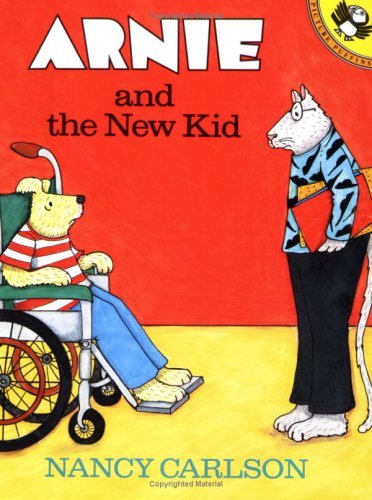
Image description: cover of the book Arnie and the New Kid. On the left side of the picture, Phillip, a yellow dog wearing a t-shirt and jeans, sits in a wheelchair. On the right side, Arnie, a gray cat wearing glasses, black pants, and a shirt with mice on it, is standing and holding some books. Arnie is practically looming over Phillip with a mean look on his face, and Phillip looks scared.
Arnie is a non-disabled cat who is quick to make fun of Phillip, a dog who uses a wheelchair. (I loved writing this sentence.) One day, Arnie is shambling around pretending to be Phillip, holding his arms up to his chest or whatever in an attempt to look disabled, and instead of getting an Oscar or an Academy Award like if he was a human, he falls down the stairs and injures his leg, wrist, and tail. Cut to Arnie wearing an adorable brace on his tail, using crutches, and needing much more help with things than Phillip ever did.
Like Harry Potter, Phillip has the social grace of a saint and befriends Arnie even though Arnie was a dick to him. Arnie and Phillip start spending all their time together doing the things Phillip likes to do--like playing video games, trading baseball cards, and birdwatching. (I especially love the page that shows them in a theater, watching a horror movie through their paws.) Of course, Arnie recovers from his injuries and goes to play baseball, which was one of the things he originally bullied Phillip for not being able to do. Phillip is worried that their friendship is over, but then Arnie says that Phillip will come along and be the coach.
I've read a review criticizing this book for exactly the reason I like it: Phillip is a loser who needs Arnie's help to be included socially. Well, Phillip is not a loser in my estimation, but he isn't so incredibly cool that he can overcome the stigma of disability, especially when Arnie is constantly drawing attention to everything Phillip can't do. What accounts for this failure of character? PHILLIP IS AN ELEMENTARY SCHOOL KID. Not every kid can go into a new school and have everyone be staring at them and bullying them, and deal with that competently and make a lot of friends.
Phillip is just an ordinary, nerdy kid--and by Arnie's standards, he really is a loser. He takes longer to eat, can't race, and can't play baseball. Basically, Phillip is slow, which dooms him not to be taken seriously by many of the kids.
But then, when Arnie is injured, we learn that Phillip has all these other interests and abilities that don't relate to whether he can walk or perform complex tasks with his hands. Arnie has a great time when he's temporarily disabled, and this, I think, is what keeps Arnie and the New Kid from being a book about charity or pity. Arnie doesn't think, "Wow, being disabled is awful, I should be nicer to Phillip." He learns that Phillip is actually a fun person and a good friend. He learns that his conception of what makes someone a loser was wrong.
When Arnie asks Phillip to be his coach, yes, he is making an effort to include him and maybe Arnie's actions will be the key to Phillip's social success. But Arnie makes the effort because he's grateful to Phillip and likes spending time with him, not because it's the nice thing to do. Arnie's decision is ultimately not about his own good qualities, but Phillip's.
I actually feel really frustrated by the idea that it's offensive to portray a disabled character needing help or being socially isolated. Phillip is not portrayed as weak or unpleasant at all; he's just up against a lot of ableism which, being a child, he can't handle all by himself. If Phillip was some kind of amazing superdog who could play baseball in his wheelchair and advocate for himself to be included in the games and be such an all-around badass that no one even noticed he was disabled, that would be an incredibly unfair image to show to kids. Most disabled kids cannot be that and shouldn't be made to feel that that is what they have to be in order to succeed. Non-disabled kids shouldn't be told that instead of adjusting their ideas of what you can do with a friend, or what qualities make someone cool, they can just wait for a supercrip who forces his way into their world and adjusts to their standards. Because they will be waiting a long time and, while they wait, some of them will be bullying ordinary disabled kids.
I'm thinking of making a series of posts about disability-related children's books, which would hopefully involve a lot of DISCUSSION! I'm wondering if anyone else read this book and what they thought of it. Obviously I am not a wheelchair user so I may have missed something really egregious. (One problem I have with the book is that Phillip obviously needs an aide and doesn't have one, so the nicer kids are always doing stuff for him. Really, really not a good message to send.)
Image description: cover of the book Arnie and the New Kid. On the left side of the picture, Phillip, a yellow dog wearing a t-shirt and jeans, sits in a wheelchair. On the right side, Arnie, a gray cat wearing glasses, black pants, and a shirt with mice on it, is standing and holding some books. Arnie is practically looming over Phillip with a mean look on his face, and Phillip looks scared.
20 October, 2010
disabling queerness: Fingersmith
Before I start, there are two kinds of ASD (or generally mind-disabled) characters, besides those who are actually canonically identified as having ASD. There are people like Pete Campbell where I sincerely think that if they were a real person born in 2000, they would be diagnosed with ASD. Then there are people like River Tam from Firefly, who obviously doesn't literally have ASD or schizophrenia, because we know that her ASD/schizophrenic traits come from emotional trauma and brain injury. If I write something "reading" River as a person like me, I'm not trying to deny the canon of the show, but just saying that functionally, she is kind of like people with certain disabilities, and can be identified with/claimed by us.
The character Maud Lilly, from the book and movie Fingersmith, is the second kind of character; she comes off as being like a person with ASD because of her life experience. Although this isn't the reason I love the book and movie--they're just incredibly fantastic and creative--it is probably the reason I find the love story so affecting, because Maud's experience of infatuation is so much like mine.
If you are interested in watching the movie or reading the book Fingersmith, you should probably know that there's a big twist and it has to do with exactly what this post is about. I knew the twist beforehand and I still love the book and movie, but if you want to be surprised, you should stop reading here.
Okay. (I'm talking about the book, but the movie doesn't change any of the facts--it just doesn't focus in on Maud's adolescence and sexuality as much as the book.)
So Fingersmith is a gothic novel about a 19th-century teenage pickpocket, Sue, who is hired to scam a sheltered girl named Maud. Maud lives with her uncle in the country and would inherit a lot of money from him if she ever got married--but it seems like she never will get married because she's so isolated. Gentleman, a con artist, is planning on marrying her and then getting her labeled as "mad" and put in an institution so he can have her money.
Sue's job is to be Maud's maid, become friends with her, and do anything possible to get her to fall in love with Gentleman and elope with him. Sue narrates in the movie, "When I saw her I thought: 'This is going to be easy.'" Maud is very stiff and soft-spoken and has nightmares every night (during which she begs Sue not to leave her alone). Sue has grown up taking care of babies and young children, so despite her plans to hurt Maud she has an instinctive protective reaction to Maud's anxious, childlike nature.
Maud is "developmentally delayed"--I don't use this as a euphemism for intellectual disability, but as a term for something that most disabled young adults have, both because of disability and as a result of being sheltered and not learning to be independent. Maud is young for her age. She does not understand how to do a lot of things that most people her age know how to do.
Sue becomes very attached to Maud, and ends up kissing and having sex with her because Maud claims not to know how to have sex. But she doesn't know how to stop what she's doing, and the con continues as planned. In the days after Maud and Gentleman have gotten married, but before Maud is institutionalized, Sue becomes more and more distraught and depressed about betraying someone she loves, someone who is so innocent. Then Maud steals Sue's identity, and Sue is institutionalized as Maud Lilly. Sue realizes that Maud was actually working with Gentleman to scam Sue.
The twist of the story is that Maud isn't a "pigeon," the term Gentleman uses for an easily manipulated person. This is already a "fuck yeah" moment for disabled readers. But what's even cooler is that Maud wasn't faking very much. She really is developmentally delayed and she really does have nightmares, and she really is very stiff and impaired when it comes to other people. Nonetheless, she is calculating and capable of doing evil.
The unevenness of Maud's abilities, the fallacy inherent in categorizing her as "childlike" or "adultlike," is encapsulated by her knowledge of sex. In the second part of the book, which is narrated by Maud, we learn that her uncle collects pornographic writing and images, and she has been his secretary since she was a child. The servants in the house don't know what her uncle's library consists of, and became unsettled by Maud because she would use sexual terms at a young age; this led to her losing their motherly support, after which she began to bully and harass them. Her uncle's friends are attracted to Maud when they visit the house and she reads porn to them--they think of her as sexy, impure, and probably available, though of course she's never even kissed anyone. After Maud has scammed Sue and is living in London, she tries to get help from one of her uncle's friends, but he refuses to associate with her because of her reputation.
Maud can't be categorized as a virgin or a whore; she is physically and emotionally untouched, but seen as damaged goods because of her intellectual knowledge. To me, the most beautiful passages in the book are those describing Maud's attraction to Sue--her surprise at realizing that something she's very intellectually familiar with could actually happen to her; that sexuality isn't the boring, mildly disgusting thing she always thought it was.
After putting Sue in the institution, Maud realizes that she is in love with Sue and wants to save her. But it's very difficult for her to do anything because she has no common sense or understanding of how to move around in a city. I won't summarize the rest of the book, but don't worry, everything turns out awesome and there are some more twists. I basically just want to talk about what a great mind-disabled character Maud is. She comes off at first as being completely guileless and unable to do anything. Then we find out that isn't true at all and she's a force to be reckoned with, but her disability doesn't just disappear; there really are things she can't do. And she's neither good or evil, she's both, just like all the other characters.
The character Maud Lilly, from the book and movie Fingersmith, is the second kind of character; she comes off as being like a person with ASD because of her life experience. Although this isn't the reason I love the book and movie--they're just incredibly fantastic and creative--it is probably the reason I find the love story so affecting, because Maud's experience of infatuation is so much like mine.
If you are interested in watching the movie or reading the book Fingersmith, you should probably know that there's a big twist and it has to do with exactly what this post is about. I knew the twist beforehand and I still love the book and movie, but if you want to be surprised, you should stop reading here.
Okay. (I'm talking about the book, but the movie doesn't change any of the facts--it just doesn't focus in on Maud's adolescence and sexuality as much as the book.)
So Fingersmith is a gothic novel about a 19th-century teenage pickpocket, Sue, who is hired to scam a sheltered girl named Maud. Maud lives with her uncle in the country and would inherit a lot of money from him if she ever got married--but it seems like she never will get married because she's so isolated. Gentleman, a con artist, is planning on marrying her and then getting her labeled as "mad" and put in an institution so he can have her money.
Sue's job is to be Maud's maid, become friends with her, and do anything possible to get her to fall in love with Gentleman and elope with him. Sue narrates in the movie, "When I saw her I thought: 'This is going to be easy.'" Maud is very stiff and soft-spoken and has nightmares every night (during which she begs Sue not to leave her alone). Sue has grown up taking care of babies and young children, so despite her plans to hurt Maud she has an instinctive protective reaction to Maud's anxious, childlike nature.
Maud is "developmentally delayed"--I don't use this as a euphemism for intellectual disability, but as a term for something that most disabled young adults have, both because of disability and as a result of being sheltered and not learning to be independent. Maud is young for her age. She does not understand how to do a lot of things that most people her age know how to do.
Sue becomes very attached to Maud, and ends up kissing and having sex with her because Maud claims not to know how to have sex. But she doesn't know how to stop what she's doing, and the con continues as planned. In the days after Maud and Gentleman have gotten married, but before Maud is institutionalized, Sue becomes more and more distraught and depressed about betraying someone she loves, someone who is so innocent. Then Maud steals Sue's identity, and Sue is institutionalized as Maud Lilly. Sue realizes that Maud was actually working with Gentleman to scam Sue.
The twist of the story is that Maud isn't a "pigeon," the term Gentleman uses for an easily manipulated person. This is already a "fuck yeah" moment for disabled readers. But what's even cooler is that Maud wasn't faking very much. She really is developmentally delayed and she really does have nightmares, and she really is very stiff and impaired when it comes to other people. Nonetheless, she is calculating and capable of doing evil.
The unevenness of Maud's abilities, the fallacy inherent in categorizing her as "childlike" or "adultlike," is encapsulated by her knowledge of sex. In the second part of the book, which is narrated by Maud, we learn that her uncle collects pornographic writing and images, and she has been his secretary since she was a child. The servants in the house don't know what her uncle's library consists of, and became unsettled by Maud because she would use sexual terms at a young age; this led to her losing their motherly support, after which she began to bully and harass them. Her uncle's friends are attracted to Maud when they visit the house and she reads porn to them--they think of her as sexy, impure, and probably available, though of course she's never even kissed anyone. After Maud has scammed Sue and is living in London, she tries to get help from one of her uncle's friends, but he refuses to associate with her because of her reputation.
Maud can't be categorized as a virgin or a whore; she is physically and emotionally untouched, but seen as damaged goods because of her intellectual knowledge. To me, the most beautiful passages in the book are those describing Maud's attraction to Sue--her surprise at realizing that something she's very intellectually familiar with could actually happen to her; that sexuality isn't the boring, mildly disgusting thing she always thought it was.
After putting Sue in the institution, Maud realizes that she is in love with Sue and wants to save her. But it's very difficult for her to do anything because she has no common sense or understanding of how to move around in a city. I won't summarize the rest of the book, but don't worry, everything turns out awesome and there are some more twists. I basically just want to talk about what a great mind-disabled character Maud is. She comes off at first as being completely guileless and unable to do anything. Then we find out that isn't true at all and she's a force to be reckoned with, but her disability doesn't just disappear; there really are things she can't do. And she's neither good or evil, she's both, just like all the other characters.
09 October, 2010
Translucent characters
Recently I was reading a story I'd been assigned for class. The story was about a man who had recently experienced trauma and had begun thinking and behaving differently as a result. In one scene, the man badly cuts himself while making dinner for himself and his wife, and starts kind of stimming out on the visual experience of it (I'm trying to describe this in a way that's not triggering). The wife comes home and the man tells her not to worry because dinner isn't ruined; it will just be late. The fact that he got cut won't mess up their evening. His wife is very upset, apparently by his overly calm and spaced-out reaction to his injury. The story is in close third person, so the narration is echoing the man's thoughts and feelings about his injury.
I liked this story; I liked the man, and I enjoyed the tension between his cheerful feelings and what I understood (that his wife was upset by his behavior). However, I realized that this kind of dramatic irony could almost be seen as belonging to a particular way of writing about characters with disabilities and illnesses that affect their reactions and perception.
I admit that my super intense dislike of The Curious Incident of the Dog in the Night-time is a little bit unfair. My biggest problem with it is the way people react to it and think that they've become educated about autism by reading it, and I know that Mark Haddon didn't intend for that to happen and even resents it when the book is framed that way. However, it occurred to me that I have another complaint: part of what makes the book respected is this use of disability for dramatic irony. The blurb of the book says, "[H]erein lies the key to the brilliance of Mark Haddon’s choice of narrator: The most wrenching of emotional moments are chronicled by a boy who cannot fathom emotion."
I don't really think that ASD people can't fathom emotion, and despite my problems with the book I think that Christopher actually does have emotions and has some awareness of other people's emotions. So first off the person who wrote the blurb is just describing what they think autism is, not what the character of Christopher is actually like. But never mind.
The point is that this is the whole dramatic irony thing where the author and the reader are sort of treating Christopher like a wall that they can pass secret messages through. Christopher doesn't understand why his dad is so emotionally unstable, but we (the reader) are supposed to. There's also the scene where Christopher throws up because he's upset but he doesn't actually say he's upset (if I remember correctly). And so on. Lots of emotions happen, and Christopher either doesn't get what is going on, or chooses not to state what is being felt. From what I recall of his character, I think it's arguable that Christopher is aware of at least his own emotions, but chooses not to describe them because he doesn't want to. However, this isn't how the person who wrote the blurb takes it, and the same is true for many many people who write reviews of the book.
The idea is that it's clever/poignant to see emotions through the eyes of a character who doesn't seem to notice them. This is one type of Translucent Disabled Character Irony. Another type is humor; as one review says, "Though Christopher insists, 'This will not be a funny book. I cannot tell jokes because I do not understand them,' the novel brims with touching, ironic humor." There are passages in the book that Haddon sets up to contain information that is supposed to be unintentionally funny. For example, Christopher might write that he said something baldly offensive, and then write that his school aide or his father told him to be careful who he says that to.
The third type of Translucent Disabled Character Irony is about disability itself. An example is the story I read about the traumatized man. The man thought that he was behaving normally, but the reader could tell that he wasn't. Through the act of reading the story, the reader learns about the point-of-view character's disability, even though the character either thinks they are not disabled, or does not realize they are giving away their disability through their narration or their thoughts. This is the kind of TDCI that bothers me the most, although it's also the kind that readers seem to think is the most clever.
I guess that the first two kinds of TDCI--emotion and humor--are also about disability at the same time, since the fact that the TDC doesn't understand the emotion or humor also allows the reader to pick up on the TDC's disability.
Now, I'm obviously not trying to say that I think Translucent Disabled Character Irony is inherently wrong. Translucent Character Irony is a very striking and effective device (Translucent Child Character Irony is very common, and although it can be really troped and annoying, it can also be fun). There are probably at least a few touches of Translucent Character Irony in any work of fiction worth reading that is in first person or close third person--if there aren't, then the main character should probably be diagnosed as a Mary Sue for being so ridiculously clever and aware of everything. Everyone has a different point of view; everyone is so locked into their own experience that they sometimes don't notice how other people are feeling, how they differ from other people, the fact that a situation they're experiencing as serious is actually kind of funny. Having a reader pick up on things the point-of-view character doesn't is probably a sign of good writing.
But I do think there's a point where it is happening too much. Rather than being something that happens occasionally, Translucent Character Irony can become almost the defining feature of the work (as in The Curious Incident)--and this isn't a bad writing decision per se, but I think it's a very common way of writing about people with developmental disabilities and certain mental illnesses. If you keep writing about a minority group in the same way, it becomes offensive. Especially because it's kind of patronizing and othering.
It promotes a tendency to think "oh, how interesting" when encountering a disabled person; to observe someone instead of listening to their words; or even to see the content of what they are saying as being important only because of the insight it provides into their disability. I think there's lots of interesting fiction to be written about people with DDs and mental illnesses, and ASD in particular, but I think that it doesn't have to be fiction where the reader is so detached from the disabled/ill character and is observing their strangeness. A story about such a character can be interesting, and even be disability-centric if you want, without being ironic at the character's expense.
(This is one reason I love The Girl with the Dragon Tattoo--there are very few times when Stieg Larsson is conversing with the reader over Lisbeth's head. Sometimes Lisbeth has thoughts and reactions that most readers probably wouldn't share, but it doesn't come off as TDCI for some reason, maybe because Lisbeth picks up on so many things.)
I liked this story; I liked the man, and I enjoyed the tension between his cheerful feelings and what I understood (that his wife was upset by his behavior). However, I realized that this kind of dramatic irony could almost be seen as belonging to a particular way of writing about characters with disabilities and illnesses that affect their reactions and perception.
I admit that my super intense dislike of The Curious Incident of the Dog in the Night-time is a little bit unfair. My biggest problem with it is the way people react to it and think that they've become educated about autism by reading it, and I know that Mark Haddon didn't intend for that to happen and even resents it when the book is framed that way. However, it occurred to me that I have another complaint: part of what makes the book respected is this use of disability for dramatic irony. The blurb of the book says, "[H]erein lies the key to the brilliance of Mark Haddon’s choice of narrator: The most wrenching of emotional moments are chronicled by a boy who cannot fathom emotion."
I don't really think that ASD people can't fathom emotion, and despite my problems with the book I think that Christopher actually does have emotions and has some awareness of other people's emotions. So first off the person who wrote the blurb is just describing what they think autism is, not what the character of Christopher is actually like. But never mind.
The point is that this is the whole dramatic irony thing where the author and the reader are sort of treating Christopher like a wall that they can pass secret messages through. Christopher doesn't understand why his dad is so emotionally unstable, but we (the reader) are supposed to. There's also the scene where Christopher throws up because he's upset but he doesn't actually say he's upset (if I remember correctly). And so on. Lots of emotions happen, and Christopher either doesn't get what is going on, or chooses not to state what is being felt. From what I recall of his character, I think it's arguable that Christopher is aware of at least his own emotions, but chooses not to describe them because he doesn't want to. However, this isn't how the person who wrote the blurb takes it, and the same is true for many many people who write reviews of the book.
The idea is that it's clever/poignant to see emotions through the eyes of a character who doesn't seem to notice them. This is one type of Translucent Disabled Character Irony. Another type is humor; as one review says, "Though Christopher insists, 'This will not be a funny book. I cannot tell jokes because I do not understand them,' the novel brims with touching, ironic humor." There are passages in the book that Haddon sets up to contain information that is supposed to be unintentionally funny. For example, Christopher might write that he said something baldly offensive, and then write that his school aide or his father told him to be careful who he says that to.
The third type of Translucent Disabled Character Irony is about disability itself. An example is the story I read about the traumatized man. The man thought that he was behaving normally, but the reader could tell that he wasn't. Through the act of reading the story, the reader learns about the point-of-view character's disability, even though the character either thinks they are not disabled, or does not realize they are giving away their disability through their narration or their thoughts. This is the kind of TDCI that bothers me the most, although it's also the kind that readers seem to think is the most clever.
I guess that the first two kinds of TDCI--emotion and humor--are also about disability at the same time, since the fact that the TDC doesn't understand the emotion or humor also allows the reader to pick up on the TDC's disability.
Now, I'm obviously not trying to say that I think Translucent Disabled Character Irony is inherently wrong. Translucent Character Irony is a very striking and effective device (Translucent Child Character Irony is very common, and although it can be really troped and annoying, it can also be fun). There are probably at least a few touches of Translucent Character Irony in any work of fiction worth reading that is in first person or close third person--if there aren't, then the main character should probably be diagnosed as a Mary Sue for being so ridiculously clever and aware of everything. Everyone has a different point of view; everyone is so locked into their own experience that they sometimes don't notice how other people are feeling, how they differ from other people, the fact that a situation they're experiencing as serious is actually kind of funny. Having a reader pick up on things the point-of-view character doesn't is probably a sign of good writing.
But I do think there's a point where it is happening too much. Rather than being something that happens occasionally, Translucent Character Irony can become almost the defining feature of the work (as in The Curious Incident)--and this isn't a bad writing decision per se, but I think it's a very common way of writing about people with developmental disabilities and certain mental illnesses. If you keep writing about a minority group in the same way, it becomes offensive. Especially because it's kind of patronizing and othering.
It promotes a tendency to think "oh, how interesting" when encountering a disabled person; to observe someone instead of listening to their words; or even to see the content of what they are saying as being important only because of the insight it provides into their disability. I think there's lots of interesting fiction to be written about people with DDs and mental illnesses, and ASD in particular, but I think that it doesn't have to be fiction where the reader is so detached from the disabled/ill character and is observing their strangeness. A story about such a character can be interesting, and even be disability-centric if you want, without being ironic at the character's expense.
(This is one reason I love The Girl with the Dragon Tattoo--there are very few times when Stieg Larsson is conversing with the reader over Lisbeth's head. Sometimes Lisbeth has thoughts and reactions that most readers probably wouldn't share, but it doesn't come off as TDCI for some reason, maybe because Lisbeth picks up on so many things.)
02 September, 2010
addendum to explain why I'm being an asshole
I was badly affected by autism pop culture for several years. When I was 14 I received what I thought was my first ASD diagnosis. In some ways the diagnosis pissed me off because I felt like it meant people had a right to treat me badly because I thought the definition of Asperger's was being a person other people didn't like. But then I got interested in belonging or identifying with the diagnosis, which in its own way was just as bad.
Now I dislike armchair diagnostics but I do sometimes note to myself that a particular person seems kind of "DD," by which I mean there is something in their movement or emotions that I respond to. When I was 14 I was totally gay for armchair diagnostics but it didn't have anything to do with my own feelings, it just had to do with whether someone's behavior fit into an autism pop culture/autism pop science stereotype. I annoyed people by telling them they seemed "autistic" at the very slightest hint of social problems or rigidity. I also read books like The Curious Incident of the Dog in the Night-time and was convinced that I was just like the characters with autism, even though I wasn't like them at all. It was very important to me to identify things I did as being symptoms of autism, even when it didn't particularly help to do so and even when it meant denying my own experiences.
As I got older, I realized that I wasn't much like an autism stereotype and it was dumb to want to be one. I started working harder on talking to people, keeping myself out of messed-up situations, and doing things that I had anxiety about. The way I learned to do things was often different from the standard, and I certainly knew that I was working around or against something that made it hard for me to do them the conventional way. But I didn't think of that thing as autism or Asperger's. In fact, I felt guilty that I had even said I had either of those things. People with Asperger's were socially impaired in a different way from me, and people with autism couldn't talk or look after themselves.
Sometimes I found it necessary to explain to people why I was having trouble doing stuff or why I was different. I would say, "I used to have Asperger's" or "I was diagnosed with autism when I was a kid." It didn't occur to me that my impairments could be referred to as autism or Asperger's because I thought that there was only one highly specific way that verbal Autistic people could be, and I wasn't like that.
This wasn't useful. Eventually I found out it wasn't even true. I found that out by being with people with ASD, and reading books and articles that actually centered the experiences of people with ASD. All of which were pretty unpopular compared to The Curious Incident of the Dog in the Night-time.
Now I dislike armchair diagnostics but I do sometimes note to myself that a particular person seems kind of "DD," by which I mean there is something in their movement or emotions that I respond to. When I was 14 I was totally gay for armchair diagnostics but it didn't have anything to do with my own feelings, it just had to do with whether someone's behavior fit into an autism pop culture/autism pop science stereotype. I annoyed people by telling them they seemed "autistic" at the very slightest hint of social problems or rigidity. I also read books like The Curious Incident of the Dog in the Night-time and was convinced that I was just like the characters with autism, even though I wasn't like them at all. It was very important to me to identify things I did as being symptoms of autism, even when it didn't particularly help to do so and even when it meant denying my own experiences.
As I got older, I realized that I wasn't much like an autism stereotype and it was dumb to want to be one. I started working harder on talking to people, keeping myself out of messed-up situations, and doing things that I had anxiety about. The way I learned to do things was often different from the standard, and I certainly knew that I was working around or against something that made it hard for me to do them the conventional way. But I didn't think of that thing as autism or Asperger's. In fact, I felt guilty that I had even said I had either of those things. People with Asperger's were socially impaired in a different way from me, and people with autism couldn't talk or look after themselves.
Sometimes I found it necessary to explain to people why I was having trouble doing stuff or why I was different. I would say, "I used to have Asperger's" or "I was diagnosed with autism when I was a kid." It didn't occur to me that my impairments could be referred to as autism or Asperger's because I thought that there was only one highly specific way that verbal Autistic people could be, and I wasn't like that.
This wasn't useful. Eventually I found out it wasn't even true. I found that out by being with people with ASD, and reading books and articles that actually centered the experiences of people with ASD. All of which were pretty unpopular compared to The Curious Incident of the Dog in the Night-time.
31 July, 2010
Tangerine
When I was a kid I remember encountering fantasy books that took place in societies where people with blond hair and pale skin were considered to be unattractive. Early on, before the character development, the blond main character would be beating him- or herself up for being so "ugly" and "freakish." I enjoyed those books at the time, but in retrospect it strikes me as cheating because the reader gets to enjoy the angst of having the main character think that they're ugly, but doesn't actually have to identify with a character who has dark skin or dark hair, the traits that are considered undesirable in real life.
I just finished reading Tangerine by Edward Bloor, a young adult book that does the same thing with disability. The main character, Paul, is said to be "legally blind" but the implication is that this either hasn't been true since he was a kid, or that it doesn't really affect him that much. People react negatively to Paul's label of disability, and his glasses (which are apparently unusual-looking), but there are no instances in the whole book of Paul not being able to do something, or needing help, because of his vision. He describes things he sees which are quite far away (for example, birds flying and fields that he sees out the car window). His disability seems to exist in name only.
I've had this book since I was 14, because I bought it and never read it. I finally decided to take it to camp so it would stop crowding up my bookcase, and when I opened it to a random page I was surprised to see the word "IEP." It turns out that Paul's IEP is an important plot point--which is interesting, right? When I had an IEP I didn't know I had one, so I don't know whether IEPs are portrayed accurately in the book. They are portrayed as something that sucks.
The implication is that Paul has never had an IEP when he moves to Florida at the beginning of the book. (He's about thirteen or fourteen years old and has been visually impaired since he was five.) His mom mentions to his new principal that Paul is legally blind, and is told to fill out an IEP. Then Paul is given a guide at school, who he blows off saying "I can see fine," and is prevented from playing soccer because it would be bad for the insurance to have a legally blind kid on the team. Paul loves soccer and is really good at it, so he flips out and takes extreme action so that he can transfer to a different school and intentionally keep them from realizing he's disabled. The rest of the plot comes out of Paul's experiences playing soccer at at his new school where most of the students are poor and nonwhite (Paul is rich and white).
Throughout the book, the implication that Paul is impaired in any way is portrayed as laughable. In the narration, Paul keeps commenting that he hopes no authority figures from his old school see him and exclaim, "That kid's handicapped! He needs an IEP!" (Handicapped is the word the soccer coach used when explaining Paul couldn't be on the team; Paul never calls himself handicapped, disabled, blind, etc., but instead refers to "my glasses" as the thing that sets him apart.)
Paul's label of disability is used against him by his family as well as the school. It is obvious from the beginning of the book that Paul's brother has problems with violence and crime, but that their parents play favorites and ignore those problems. When Paul points out things that would reveal what's going on with his brother, his parents remind him that he can't see very well and probably misunderstood. I feel like this would be cool if Paul actually was impaired in any real way--I just read The Girl With the Dragon Tattoo, and I think Larssen does a fantastic job portraying Lisbeth as someone who is unfairly labeled and discriminated against due to her disability, without implying that her disability isn't real. But in Tangerine, disability is just an idea that you use to hurt someone, there's no real disability.
(I also feel like when you spend a lot of time saying "but I'm not really disabled! That's hilarious that you would say I'm disabled!" you start feeding the specter of those Really Disabled People who exist somewhere, who it would be so terrible/outlandish to be associated with.)
There are a few instances in the book that seem to imply a more positive identification with disability--or some kind of identification, anyway. Paul thinks of himself as a circus freak because his brother tells people that Paul became blind from looking at an eclipse straight on. (No prizes for guessing how Paul actually became blind.) Paul says that he doesn't mind being a racial minority at his new school because "my glasses" make him feel like a minority anyway--which is obviously problematic but does imply that disabled people are a minority group.
The most striking instance is when one of Paul's new friends is talking about his (the friend's) brother, Luis. Paul's friend talks about the knee injury Luis got as a kid, his ambitions, and the fact that he played soccer in middle and high school. When Paul asks what position Luis played, the friend replies, "He played goalie [Paul's favorite position], because he was handicapped."
Paul has a strong reaction and imagines that his friend might be making fun of him by using the word "handicapped," but realizes that he isn't and marvels that his friend neutrally used the word. Luis is a heroic character whom Paul admires and learns from, and I don't know exactly why Bloor decided to make him disabled and a goalie. The commonality between Luis and Paul is never discussed again.
I like reading books written for kids (although it was embarrassing when my 14-year-old camper said, "Oh yeah Tangerine, I just read that book for school") and I like the style of this book and think it has an interesting plot. But I'm sort of frustrated that Bloor brought in things like Paul's IEP and his parents undermining him because of his disability label, without making Paul actually be impaired. I feel like it could be a book that would humanize a disabled character and show how he is discriminated against, without being an "issue book" about ableism. But Bloor just makes it a book about a non-disabled kid who's inexplicably treated like he's disabled.
I just finished reading Tangerine by Edward Bloor, a young adult book that does the same thing with disability. The main character, Paul, is said to be "legally blind" but the implication is that this either hasn't been true since he was a kid, or that it doesn't really affect him that much. People react negatively to Paul's label of disability, and his glasses (which are apparently unusual-looking), but there are no instances in the whole book of Paul not being able to do something, or needing help, because of his vision. He describes things he sees which are quite far away (for example, birds flying and fields that he sees out the car window). His disability seems to exist in name only.
I've had this book since I was 14, because I bought it and never read it. I finally decided to take it to camp so it would stop crowding up my bookcase, and when I opened it to a random page I was surprised to see the word "IEP." It turns out that Paul's IEP is an important plot point--which is interesting, right? When I had an IEP I didn't know I had one, so I don't know whether IEPs are portrayed accurately in the book. They are portrayed as something that sucks.
The implication is that Paul has never had an IEP when he moves to Florida at the beginning of the book. (He's about thirteen or fourteen years old and has been visually impaired since he was five.) His mom mentions to his new principal that Paul is legally blind, and is told to fill out an IEP. Then Paul is given a guide at school, who he blows off saying "I can see fine," and is prevented from playing soccer because it would be bad for the insurance to have a legally blind kid on the team. Paul loves soccer and is really good at it, so he flips out and takes extreme action so that he can transfer to a different school and intentionally keep them from realizing he's disabled. The rest of the plot comes out of Paul's experiences playing soccer at at his new school where most of the students are poor and nonwhite (Paul is rich and white).
Throughout the book, the implication that Paul is impaired in any way is portrayed as laughable. In the narration, Paul keeps commenting that he hopes no authority figures from his old school see him and exclaim, "That kid's handicapped! He needs an IEP!" (Handicapped is the word the soccer coach used when explaining Paul couldn't be on the team; Paul never calls himself handicapped, disabled, blind, etc., but instead refers to "my glasses" as the thing that sets him apart.)
Paul's label of disability is used against him by his family as well as the school. It is obvious from the beginning of the book that Paul's brother has problems with violence and crime, but that their parents play favorites and ignore those problems. When Paul points out things that would reveal what's going on with his brother, his parents remind him that he can't see very well and probably misunderstood. I feel like this would be cool if Paul actually was impaired in any real way--I just read The Girl With the Dragon Tattoo, and I think Larssen does a fantastic job portraying Lisbeth as someone who is unfairly labeled and discriminated against due to her disability, without implying that her disability isn't real. But in Tangerine, disability is just an idea that you use to hurt someone, there's no real disability.
(I also feel like when you spend a lot of time saying "but I'm not really disabled! That's hilarious that you would say I'm disabled!" you start feeding the specter of those Really Disabled People who exist somewhere, who it would be so terrible/outlandish to be associated with.)
There are a few instances in the book that seem to imply a more positive identification with disability--or some kind of identification, anyway. Paul thinks of himself as a circus freak because his brother tells people that Paul became blind from looking at an eclipse straight on. (No prizes for guessing how Paul actually became blind.) Paul says that he doesn't mind being a racial minority at his new school because "my glasses" make him feel like a minority anyway--which is obviously problematic but does imply that disabled people are a minority group.
The most striking instance is when one of Paul's new friends is talking about his (the friend's) brother, Luis. Paul's friend talks about the knee injury Luis got as a kid, his ambitions, and the fact that he played soccer in middle and high school. When Paul asks what position Luis played, the friend replies, "He played goalie [Paul's favorite position], because he was handicapped."
Paul has a strong reaction and imagines that his friend might be making fun of him by using the word "handicapped," but realizes that he isn't and marvels that his friend neutrally used the word. Luis is a heroic character whom Paul admires and learns from, and I don't know exactly why Bloor decided to make him disabled and a goalie. The commonality between Luis and Paul is never discussed again.
I like reading books written for kids (although it was embarrassing when my 14-year-old camper said, "Oh yeah Tangerine, I just read that book for school") and I like the style of this book and think it has an interesting plot. But I'm sort of frustrated that Bloor brought in things like Paul's IEP and his parents undermining him because of his disability label, without making Paul actually be impaired. I feel like it could be a book that would humanize a disabled character and show how he is discriminated against, without being an "issue book" about ableism. But Bloor just makes it a book about a non-disabled kid who's inexplicably treated like he's disabled.
02 January, 2010
Whyyyyy
"The Animorphs freak out after their identities are discovered by the evil Yeerks — and they decide to recruit some more kids to join their team, in case the original members all get captured. So they decided to recruit disabled kids to be the new group of Auxillary Animorphs, because they figured the Yeerks wouldn't have bothered to infest a disabled kid. (So the Animorphs could skip the three-day screening period for new recruits.) And they figure the morphing powers would cure any disabilities. The leader of the Auxillary Animorphs, James, is paralyzed, until he becomes an Animorph and regains full mobility."--20 Science Fiction Characters Who Got Their Legs Back (linked at FWD)
MY HEART IS BROKEN
Animorphs was my fucking life when I was a kid. If you have ASD you maybe know what I mean, like I carried the books everywhere and constantly wrote fanfiction about them and always bought them on the first day they came out and talked to the characters and sat on the playground looking at birds and pretending they were Tobias. This went on for about two years, from the summer of 1998 when I was nine to maybe fall 1999/spring 2000 when I was eleven. By the end, I would still get excited when the books came out, but I didn't think about them constantly. Eventually I stopped reading them because they got really formulaic, but I held on longer than was really necessary because I didn't want to lose the joy of that devotion. I'm not sure I've ever loved anything that much.
But for Christmas this year my dad gave me a box with a card that said "From Ax" and it was the final book! I haven't read it yet but it's a pretty good example of how my dad is wonderful. Anyway, look at this unfortunate shit that I just found. Apparently the Yeerks don't infest physically disabled people! K.A. Applegate? HOW COULD YOU DO THIS TO ME?
DISABLED PEOPLE AREN'T WORTHWHILE CONTROLLERS?
YOU NEED WORKING LEGS TO CONVINCE PEOPLE TO JOIN THE SHARING?
I'm just going to try to believe it was the ghostwriters, because this makes me sick.
P.S. This actually doesn't even make sense because they're assuming that all physically disabled people are disabled in accidents. What about genetic disabilities? What about "accidents" that happened before you were born, like CP? Also, the idea that there's some "true self" that you return to after you've morphed--instead of returning to your physical state before you morphed--well, that doesn't make any sense, because explain how the Animorphs didn't end up with different haircuts or something that were more fitting for their "true selves." And they could morph clothes (well, leotards). LEOTARDS ARE NOT GENETIC.
ETA ETA: This means that if any of the Animorphs had braces, their teeth moved back. AAARGH.
MY HEART IS BROKEN
Animorphs was my fucking life when I was a kid. If you have ASD you maybe know what I mean, like I carried the books everywhere and constantly wrote fanfiction about them and always bought them on the first day they came out and talked to the characters and sat on the playground looking at birds and pretending they were Tobias. This went on for about two years, from the summer of 1998 when I was nine to maybe fall 1999/spring 2000 when I was eleven. By the end, I would still get excited when the books came out, but I didn't think about them constantly. Eventually I stopped reading them because they got really formulaic, but I held on longer than was really necessary because I didn't want to lose the joy of that devotion. I'm not sure I've ever loved anything that much.
But for Christmas this year my dad gave me a box with a card that said "From Ax" and it was the final book! I haven't read it yet but it's a pretty good example of how my dad is wonderful. Anyway, look at this unfortunate shit that I just found. Apparently the Yeerks don't infest physically disabled people! K.A. Applegate? HOW COULD YOU DO THIS TO ME?
DISABLED PEOPLE AREN'T WORTHWHILE CONTROLLERS?
YOU NEED WORKING LEGS TO CONVINCE PEOPLE TO JOIN THE SHARING?
I'm just going to try to believe it was the ghostwriters, because this makes me sick.
P.S. This actually doesn't even make sense because they're assuming that all physically disabled people are disabled in accidents. What about genetic disabilities? What about "accidents" that happened before you were born, like CP? Also, the idea that there's some "true self" that you return to after you've morphed--instead of returning to your physical state before you morphed--well, that doesn't make any sense, because explain how the Animorphs didn't end up with different haircuts or something that were more fitting for their "true selves." And they could morph clothes (well, leotards). LEOTARDS ARE NOT GENETIC.
ETA ETA: This means that if any of the Animorphs had braces, their teeth moved back. AAARGH.
01 January, 2010
Precious
I feel like art is bad art if it portrays horrific events in a way that dulls the audience's reactions. I felt this way about the book Love Does Not Make Me Gentle or Kind by Chavisa Woods, which contains several stories in which underdeveloped female characters are violently abused and murdered. According to comments I've read of hers, almost every event described in the book happened to two women who Chavisa Woods knows. However, because of the way some of the stories are written, the abuse stops seeming real because the characters don't feel real; they seem to exist only as the objects of abuse. I'm not trying to write a review of Love Does Not Make Me Gentle or Kind--for the record, it has some stories I really like--but I'm just saying that I don't think it matters if the events of a piece of art are literally true, I think it's still legit to say that they come off as over-the-top or dulling.
Anyway, I sort of expected to have this reaction to Precious--i.e. I thought it would be so horrifying that I wouldn't be able to actually engage with it. I do feel like Precious's mom is so one-dimensionally evil that it's hard to relate to what's going on, but it turned out that the movie wasn't just a one-way trip to The Worst Life Ever, so that ended up being a smaller aspect of the story than I thought it would be. I don't feel qualified to comment on whether the movie is racist and/or damaging, except to say that Precious was a likable and interesting character and not just a one-dimensional victim, which is cool.
I might as well talk about what I actually feel qualified to talk about: the portrayal of Precious's young daughter with Down Syndrome. I was sort of biased because I had read Dave Hingsburger's post where he criticized the movie because the child was called "Mongo" and never given another name. It's not like I think the creators of the movie are saying that's a good thing to do, so I feel a bit like I can't criticize the movie for that.
However, when I really thought about it, I realized that it's incredibly unrealistic for a teenage girl to have a baby with Down Syndrome because most people who have babies with Down Syndrome are middle-aged. I said this to my friend, and she said that it's not unrealistic at all because the baby was a product of incest. But then when we actually looked this up, we found this article saying that there is no correlation between incest and Down Syndrome. So now I feel like they only made the baby have Down Syndrome because it's supposed to be just another shocking horrible thing about Precious's life. And that's really fucked up.
When Precious has her second baby, her love and devotion for him changes her life. She is capable of this love and devotion partly because her life circumstances have already begun to change, because her teacher and classmates care about her. It makes logical sense that when she had her first baby, she didn't react in the same way. But it still bothers me that they created a narrative where her disabled child is just another problem, while her nondisabled child improves her life.
My friend said that it is bad to have a kid with Down Syndrome because it makes your life harder. I don't think that disabilities being hard is a reason to use a person with a disability as a plot device to show how awful their parent's life is.
It's not a huge aspect of the movie. It's not even a small aspect, I guess. I think they just didn't think about it but that almost upsets me more, that it just made perfect sense to them to use Down Syndrome as a shorthand for awfulness.
Anyway, I sort of expected to have this reaction to Precious--i.e. I thought it would be so horrifying that I wouldn't be able to actually engage with it. I do feel like Precious's mom is so one-dimensionally evil that it's hard to relate to what's going on, but it turned out that the movie wasn't just a one-way trip to The Worst Life Ever, so that ended up being a smaller aspect of the story than I thought it would be. I don't feel qualified to comment on whether the movie is racist and/or damaging, except to say that Precious was a likable and interesting character and not just a one-dimensional victim, which is cool.
I might as well talk about what I actually feel qualified to talk about: the portrayal of Precious's young daughter with Down Syndrome. I was sort of biased because I had read Dave Hingsburger's post where he criticized the movie because the child was called "Mongo" and never given another name. It's not like I think the creators of the movie are saying that's a good thing to do, so I feel a bit like I can't criticize the movie for that.
However, when I really thought about it, I realized that it's incredibly unrealistic for a teenage girl to have a baby with Down Syndrome because most people who have babies with Down Syndrome are middle-aged. I said this to my friend, and she said that it's not unrealistic at all because the baby was a product of incest. But then when we actually looked this up, we found this article saying that there is no correlation between incest and Down Syndrome. So now I feel like they only made the baby have Down Syndrome because it's supposed to be just another shocking horrible thing about Precious's life. And that's really fucked up.
When Precious has her second baby, her love and devotion for him changes her life. She is capable of this love and devotion partly because her life circumstances have already begun to change, because her teacher and classmates care about her. It makes logical sense that when she had her first baby, she didn't react in the same way. But it still bothers me that they created a narrative where her disabled child is just another problem, while her nondisabled child improves her life.
My friend said that it is bad to have a kid with Down Syndrome because it makes your life harder. I don't think that disabilities being hard is a reason to use a person with a disability as a plot device to show how awful their parent's life is.
It's not a huge aspect of the movie. It's not even a small aspect, I guess. I think they just didn't think about it but that almost upsets me more, that it just made perfect sense to them to use Down Syndrome as a shorthand for awfulness.
30 December, 2009
Things Not Seen by Andrew Clements
This was the book I read and it only took me four days and I wasn't even spending that much time reading, so it was a pretty good experience. My excuse for why it was okay for me to read a YA book is that it is disability-related. Things Not Seen is about a 15-year-old boy named Bobby who wakes up one morning and realizes that he's invisible. His dad is a scientist who gets excited about investigating Bobby's condition. Bobby's parents want him to stay inside so the media doesn't find out about what happened, but Bobby gets bored, so he starts figuring out ways to go outside without people noticing that he's invisible.
The book doesn't do inconsistent things like the Animorphs and Twilight books, which have people morphing into animals while wearing cutoffs or leotards or underwear. If your body developed a weird property like morphing or invisibility, clothes would not be included. So Bobby has to either cover his whole body with scarves, sunglasses, and gloves, or he has to walk around naked. Large sections of the book describe how Bobby learns to manage his condition, and how he feels about it. He likes being able to spy on people, but hates the fact that he can't talk to anyone or pick anything up.
One day Bobby is wandering around naked and he feels lonely, so he decides to talk to a girl who is blind. The girl, Alicia, soon figures out that he's naked, so he has to tell her the truth. Alicia's dad is a scientist like Bobby's dad, so the two dads pair up and do research on Bobby. Bobby and Alicia get bored of this and do some sleuthing around. This is basically the plot (surprise surprise, Bobby becomes visible again at the end) but it feels like background. There's more focus on Bobby's coming of age as he fights to be in charge of his life despite his difficult condition. But it's mostly a love story. We get the impression Alicia is Bobby's first close friend, and besides, he has a crush on her before he even talks to her. The friendship develops, but the crush just slow-burns until the loose ends of the plot have been tied up. The book ends before they officially become a couple, but we know that Alicia and Bobby really like each other and are going to get together.
I don't know anyone who's blind, so I am not likely to be sensitive as to whether this book is a cliched or offensive portrayal of blindness. Alicia's major personality traits are a)bitterness/sarcasm, b)easy-to-read facial expressions, and c)sensitivity (both good and bad). I guess these are probably stereotypical traits. Bobby talks about how he loves watching Alicia ride in a cab because he can see her react to all the sounds she's hearing. If I was blind I would probably think this is like intellectually disabled people meeting every new day with wonder, or ASD people being really good with computers. From the perspective of someone with very little experience, I thought it was a nice detail and Alicia was a good character, but I can see how someone might view it as trope-y.
We learn a bit about the assistive technology Alicia uses, which is cool.
Something that was sort of good and sort of bad is the whole theme of the book, articulated in the title. Much is made of how Alicia "can't see herself" doing the things she aspired to before she became blind. She is scared of "disappearing." Obviously Bobby's invisibility is sort of a metaphor for how Alicia feels about being blind. And also, while he is invisible he feels some of the same things. In the last chapter of the book, Alicia sends Bobby an email expressing her love for him and her insecurity that maybe he won't like her anymore because he is no longer disabled. She says, "I liked being able to help you because usually everyone helps me." Alicia calls Bobby her "invisible mirror" because, through helping him and falling in love with him, she has begun to "see herself" again.
I guess it's probably bad that not being able to see yourself because you're blind is equated with feeling like you have no future. But I'm glad that they portrayed Alicia (and Bobby while he's invisible) as having that kind of anxiety and inertia. I've struggled with similar issues, mostly related to being gay. It's overwhelming to know that your life is going to be different from other people's lives, especially if you don't know adults who are like you. In one scene, Alicia kills time while Bobby is stealing information from Sears (it's a long story) by inquiring about employment opportunities for blind people. She ends up talking to a Sears employee who is blind, and some other people who are very comfortable with blindness. This is obviously a big deal for her, and she seems both happy and upset about the experience. Even though it was couched in weird disability-as-metaphor language, I really liked the "seeing yourself doing things" aspect of the book, and was moved by the way Alicia came to feel, once again, like a real person with abilities and a future.
The book doesn't do inconsistent things like the Animorphs and Twilight books, which have people morphing into animals while wearing cutoffs or leotards or underwear. If your body developed a weird property like morphing or invisibility, clothes would not be included. So Bobby has to either cover his whole body with scarves, sunglasses, and gloves, or he has to walk around naked. Large sections of the book describe how Bobby learns to manage his condition, and how he feels about it. He likes being able to spy on people, but hates the fact that he can't talk to anyone or pick anything up.
One day Bobby is wandering around naked and he feels lonely, so he decides to talk to a girl who is blind. The girl, Alicia, soon figures out that he's naked, so he has to tell her the truth. Alicia's dad is a scientist like Bobby's dad, so the two dads pair up and do research on Bobby. Bobby and Alicia get bored of this and do some sleuthing around. This is basically the plot (surprise surprise, Bobby becomes visible again at the end) but it feels like background. There's more focus on Bobby's coming of age as he fights to be in charge of his life despite his difficult condition. But it's mostly a love story. We get the impression Alicia is Bobby's first close friend, and besides, he has a crush on her before he even talks to her. The friendship develops, but the crush just slow-burns until the loose ends of the plot have been tied up. The book ends before they officially become a couple, but we know that Alicia and Bobby really like each other and are going to get together.
I don't know anyone who's blind, so I am not likely to be sensitive as to whether this book is a cliched or offensive portrayal of blindness. Alicia's major personality traits are a)bitterness/sarcasm, b)easy-to-read facial expressions, and c)sensitivity (both good and bad). I guess these are probably stereotypical traits. Bobby talks about how he loves watching Alicia ride in a cab because he can see her react to all the sounds she's hearing. If I was blind I would probably think this is like intellectually disabled people meeting every new day with wonder, or ASD people being really good with computers. From the perspective of someone with very little experience, I thought it was a nice detail and Alicia was a good character, but I can see how someone might view it as trope-y.
We learn a bit about the assistive technology Alicia uses, which is cool.
Something that was sort of good and sort of bad is the whole theme of the book, articulated in the title. Much is made of how Alicia "can't see herself" doing the things she aspired to before she became blind. She is scared of "disappearing." Obviously Bobby's invisibility is sort of a metaphor for how Alicia feels about being blind. And also, while he is invisible he feels some of the same things. In the last chapter of the book, Alicia sends Bobby an email expressing her love for him and her insecurity that maybe he won't like her anymore because he is no longer disabled. She says, "I liked being able to help you because usually everyone helps me." Alicia calls Bobby her "invisible mirror" because, through helping him and falling in love with him, she has begun to "see herself" again.
I guess it's probably bad that not being able to see yourself because you're blind is equated with feeling like you have no future. But I'm glad that they portrayed Alicia (and Bobby while he's invisible) as having that kind of anxiety and inertia. I've struggled with similar issues, mostly related to being gay. It's overwhelming to know that your life is going to be different from other people's lives, especially if you don't know adults who are like you. In one scene, Alicia kills time while Bobby is stealing information from Sears (it's a long story) by inquiring about employment opportunities for blind people. She ends up talking to a Sears employee who is blind, and some other people who are very comfortable with blindness. This is obviously a big deal for her, and she seems both happy and upset about the experience. Even though it was couched in weird disability-as-metaphor language, I really liked the "seeing yourself doing things" aspect of the book, and was moved by the way Alicia came to feel, once again, like a real person with abilities and a future.
10 December, 2009
Why I don't like ASD memoirs, and other stuff
Someone sent me Tim Page's piece about having Asperger's in the New Yorker. I read all of it and it kept my interest on one level but at the same time it was really, really boring. It's funny that I should say this when my blog is so incredibly self-centered, but it was too self-centered for me. I should mention, I'm sure Tim Page is a really nice person and all, I just don't like this genre of ASD memoirs or maybe I just don't like ASD memoirs.
I don't see the point of writing a piece (and now I guess a book) that just seems to be a list of all the weird things you did when you were a kid. Is that weird of me? It's funny because I write so much about having ASD, and when I write fiction it's always about people who are off in some way or another, so it's not like I'm avoiding the subjects of ASD or weirdness. But when I write stories I guess I'm trying to wrangle some kind of beauty out of weirdness or find new things to say about it. And when I write stuff about ASD I am interested in either expressing my opinions about disability or talking about ways to deal with specific impairments. I guess the Tim Page stuff bores me because I feel like there's no movement in it.
As I say about a thousand times a day, my favorite book about ASD and possibly my favorite book ever is Send in the Idiots by Kamran Nazeer. I guess it's technically an ASD memoir, but what's the difference between it and this? I think I like Send in the Idiots because it is about functioning. Some of the subjects of the book are "lower-functioning" than Tim Page, but while Page focuses on all the stuff he did wrong while he was growing up, Nazeer talks about how he, his friends, and their families find ways of getting around what's hard for them. One of his subjects committed suicide, but Nazeer tells us how she taught herself to ride a bike when her parents were at work, to surprise them, and how she learned to read a bus map through trial and error.
Also, when Nazeer talks about how people made fun of Elizabeth at the mall or Randall's boyfriend didn't respect him, I don't get the impression he thinks That's Just How It Is For People Like Us. He says he wanted to kick Randall's boyfriend in the shins. Nazeer launches into long, beautifully pedantic explorations of what a conversation is (with the implication that ASD people are missing out), but he also beautifully, pedantically explores what a dick Randall's boyfriend is for treating Randall like an okapi instead of a person.

completely unnecessary visual aid because okapis are rad-looking
Nazeer's book doesn't focus on his experience like Page's New Yorker piece does, but I don't think that's really the big difference. I think it's just old social model vs. medical model, after all. And that is an inaccurate way of talking about it because medical model means freaking out about how bad a disability is. But I think freaking out about how interesting a disability is, if less dangerous, can be just as annoying to read. I don't feel like looking at one person by themself. I would like to hear some opinions, about goodness or life or love or something. Page's piece is informative if you don't know anything about AS but Send in the Idiots altered my brain. I reread it at least once a year, I love moving my mind through those beautiful squares, if a book can be a home it is my home. It changed what I wanted to do with my life. And also, what I thought my life was.
I never had a blog with tags before and sometimes I get carried away. I like "kartheiser is magic" and I got excited when I realized I kept posting about The Sound and the Fury so I could make a "faulkner" tag. But my favorite tag is "how to be human" and I don't know exactly what it means but all of my posts that I think are worth reading are tagged "how to be human." Sometimes they're about how I try to work around certain aspects of ASD, sometimes they're about things that I think are ableist, and sometimes they are just about my attempt to figure out and implement a moral course of action in some situation. I guess I think those are the interesting things about ASD and ASD in the middle of nowhere is kind of boring. If a disabled person lives in the middle of a forest they're not even disabled, unless the trees think they're a disabled version of a tree.
In conclusion I will just tell you something that's only mildly related and maybe it isn't clear why I think it is. Today when I was walking back from my horrible exam, I thought about how I would visit my friend in his room last year and the year before that. Often he was asleep or not there and I would feel like a creepy stalker; many people have that effect on me, but him more than anyone else, because I just long for him like I long for Send in the Idiots and the particular kind of sneakers I have gone through ten pairs of. Anyway, when he was there, sometimes he was doing physical therapy exercises with his jars of putty. He had all these jars of putty that were different colors and the different colors indicated that the putty had a different consistency and was appropriate for a different time, or different exercises, or something. All I know is that I would sometimes start playing with the putty without thinking about it, and my friend would get mad.
When I came by and my friend was doing his exercises, he would often be watching anime on his computer and he'd always be embarrassed about it. It was always really bad anime about ghost hunters or something, and my friend is kind of a snob, but sometimes he wouldn't be too embarrassed to let me lie down or sit down and watch anime with him. He'd try to explain the plots to me, sometimes.
Then sometimes my friend would go to the vending machine. When he walked around school, he would always sing. His voice has a crystalline quality and he always sang folk songs and show tunes with the result that the words, slightly smudged, ended up sounding ghostly and sweet as he moved through the halls. On his computer, checking Facebook, I'd know my friend was coming back when I heard the heavy uneven sound of his steps trudging under the clean white verse.
I don't see the point of writing a piece (and now I guess a book) that just seems to be a list of all the weird things you did when you were a kid. Is that weird of me? It's funny because I write so much about having ASD, and when I write fiction it's always about people who are off in some way or another, so it's not like I'm avoiding the subjects of ASD or weirdness. But when I write stories I guess I'm trying to wrangle some kind of beauty out of weirdness or find new things to say about it. And when I write stuff about ASD I am interested in either expressing my opinions about disability or talking about ways to deal with specific impairments. I guess the Tim Page stuff bores me because I feel like there's no movement in it.
As I say about a thousand times a day, my favorite book about ASD and possibly my favorite book ever is Send in the Idiots by Kamran Nazeer. I guess it's technically an ASD memoir, but what's the difference between it and this? I think I like Send in the Idiots because it is about functioning. Some of the subjects of the book are "lower-functioning" than Tim Page, but while Page focuses on all the stuff he did wrong while he was growing up, Nazeer talks about how he, his friends, and their families find ways of getting around what's hard for them. One of his subjects committed suicide, but Nazeer tells us how she taught herself to ride a bike when her parents were at work, to surprise them, and how she learned to read a bus map through trial and error.
Also, when Nazeer talks about how people made fun of Elizabeth at the mall or Randall's boyfriend didn't respect him, I don't get the impression he thinks That's Just How It Is For People Like Us. He says he wanted to kick Randall's boyfriend in the shins. Nazeer launches into long, beautifully pedantic explorations of what a conversation is (with the implication that ASD people are missing out), but he also beautifully, pedantically explores what a dick Randall's boyfriend is for treating Randall like an okapi instead of a person.
completely unnecessary visual aid because okapis are rad-looking
Nazeer's book doesn't focus on his experience like Page's New Yorker piece does, but I don't think that's really the big difference. I think it's just old social model vs. medical model, after all. And that is an inaccurate way of talking about it because medical model means freaking out about how bad a disability is. But I think freaking out about how interesting a disability is, if less dangerous, can be just as annoying to read. I don't feel like looking at one person by themself. I would like to hear some opinions, about goodness or life or love or something. Page's piece is informative if you don't know anything about AS but Send in the Idiots altered my brain. I reread it at least once a year, I love moving my mind through those beautiful squares, if a book can be a home it is my home. It changed what I wanted to do with my life. And also, what I thought my life was.
I never had a blog with tags before and sometimes I get carried away. I like "kartheiser is magic" and I got excited when I realized I kept posting about The Sound and the Fury so I could make a "faulkner" tag. But my favorite tag is "how to be human" and I don't know exactly what it means but all of my posts that I think are worth reading are tagged "how to be human." Sometimes they're about how I try to work around certain aspects of ASD, sometimes they're about things that I think are ableist, and sometimes they are just about my attempt to figure out and implement a moral course of action in some situation. I guess I think those are the interesting things about ASD and ASD in the middle of nowhere is kind of boring. If a disabled person lives in the middle of a forest they're not even disabled, unless the trees think they're a disabled version of a tree.
In conclusion I will just tell you something that's only mildly related and maybe it isn't clear why I think it is. Today when I was walking back from my horrible exam, I thought about how I would visit my friend in his room last year and the year before that. Often he was asleep or not there and I would feel like a creepy stalker; many people have that effect on me, but him more than anyone else, because I just long for him like I long for Send in the Idiots and the particular kind of sneakers I have gone through ten pairs of. Anyway, when he was there, sometimes he was doing physical therapy exercises with his jars of putty. He had all these jars of putty that were different colors and the different colors indicated that the putty had a different consistency and was appropriate for a different time, or different exercises, or something. All I know is that I would sometimes start playing with the putty without thinking about it, and my friend would get mad.
When I came by and my friend was doing his exercises, he would often be watching anime on his computer and he'd always be embarrassed about it. It was always really bad anime about ghost hunters or something, and my friend is kind of a snob, but sometimes he wouldn't be too embarrassed to let me lie down or sit down and watch anime with him. He'd try to explain the plots to me, sometimes.
Then sometimes my friend would go to the vending machine. When he walked around school, he would always sing. His voice has a crystalline quality and he always sang folk songs and show tunes with the result that the words, slightly smudged, ended up sounding ghostly and sweet as he moved through the halls. On his computer, checking Facebook, I'd know my friend was coming back when I heard the heavy uneven sound of his steps trudging under the clean white verse.
06 October, 2009
The Sound and the Fury
"It is a tale/Told by an idiot, full of sound and fury/Signifying nothing."
Even if you haven't read The Sound and the Fury, you probably know it is named after a line from a Shakespeare play. But if you haven't read the book, you might not know that one of the protagonists is a literal "idiot"--that is, a severely developmentally disabled person who expresses himself with loud, wordless moans.
I'm not sure Faulker thought about the title of his book, beyond thinking it was a clever literary reference. Because it doesn't really fit where you would expect it to. It's clear upon close reading that Benjy's wails and rages don't actually "signify nothing"--they make at least as much sense as any other Compson's behavior, if not more. Benjy lost his beloved sister, one of the only people who was kind to him. Her name is a very common word, and whenever he hears that word, he gets upset. It is popular to explain this by saying "Benjy has no sense of time, and doesn't understand she is gone"--but in fact, if he didn't understand she was gone, he wouldn't moan when he heard her name. It is very easy to understand why Benjy acts the way he does, and anyone who would describe his behavior as senseless is simply too lazy to engage with him. Instead of claiming that he doesn't understand time, it would be more accurate to say that Benjy feels the events of the past very keenly and hasn't gotten over them. This is true of most of the characters, disabled and non-disabled.
When ableist people try to argue that ASD rights advocates are worlds away from "real autistic people," they invariably invoke people like Benjy--archetypes of violent, nonsensical children and adults. This is supposed to make high-functioning ASD people see low-functioning people as the Other. We're supposed to feel guilty and disgusted, and rush to separate ourselves from them.
But the truth is, violence is a perfectly understandable reaction when you are in pain and don't know what to do. I was a violent kid, in large part because I hadn't learned to cope with my ASD. If I had been more severely affected, I imagine my pain would have been worse, and I would have had more trouble figuring out how to cope. So I imagine I would have been more violent, and violent for longer. I would have needed more help. Hopefully the people around me would have understood what kind of help.
Because I understand where developmentally disabled violence comes from, the fact that someone is violent doesn't make me think they're an "idiot," baffling, irrevocably different from me. Benjy's sound and fury signified that he was in pain.
Even if you haven't read The Sound and the Fury, you probably know it is named after a line from a Shakespeare play. But if you haven't read the book, you might not know that one of the protagonists is a literal "idiot"--that is, a severely developmentally disabled person who expresses himself with loud, wordless moans.
I'm not sure Faulker thought about the title of his book, beyond thinking it was a clever literary reference. Because it doesn't really fit where you would expect it to. It's clear upon close reading that Benjy's wails and rages don't actually "signify nothing"--they make at least as much sense as any other Compson's behavior, if not more. Benjy lost his beloved sister, one of the only people who was kind to him. Her name is a very common word, and whenever he hears that word, he gets upset. It is popular to explain this by saying "Benjy has no sense of time, and doesn't understand she is gone"--but in fact, if he didn't understand she was gone, he wouldn't moan when he heard her name. It is very easy to understand why Benjy acts the way he does, and anyone who would describe his behavior as senseless is simply too lazy to engage with him. Instead of claiming that he doesn't understand time, it would be more accurate to say that Benjy feels the events of the past very keenly and hasn't gotten over them. This is true of most of the characters, disabled and non-disabled.
When ableist people try to argue that ASD rights advocates are worlds away from "real autistic people," they invariably invoke people like Benjy--archetypes of violent, nonsensical children and adults. This is supposed to make high-functioning ASD people see low-functioning people as the Other. We're supposed to feel guilty and disgusted, and rush to separate ourselves from them.
But the truth is, violence is a perfectly understandable reaction when you are in pain and don't know what to do. I was a violent kid, in large part because I hadn't learned to cope with my ASD. If I had been more severely affected, I imagine my pain would have been worse, and I would have had more trouble figuring out how to cope. So I imagine I would have been more violent, and violent for longer. I would have needed more help. Hopefully the people around me would have understood what kind of help.
Because I understand where developmentally disabled violence comes from, the fact that someone is violent doesn't make me think they're an "idiot," baffling, irrevocably different from me. Benjy's sound and fury signified that he was in pain.
27 September, 2009
Like a person
My post yesterday was supposed to be about something else, but I got distracted by the fact that in high school my homosexuality created "special needs" that I had to advocate for. I think it's a funny story and also shows that, while disability is real, many of the worst aspects of having a disability aren't innate to being disabled.
My friend Niyatee said that she interacts with me as though I don't have AS, and she wondered if that was ableist. I don't think it is. At the same time, I like that she thought of it and doesn't buy the idea that people with disabilities, or any difference, should be treated "like everyone else." The "like everyone else" model actually puts a lot of pressure on people who are different to reduce their difference to one very measurable, nonthreatening thing, and be "like everyone else" otherwise. For example, for my teenage self homosexuality couldn't just be as simple as having a girlfriend or wife in the future while a boyfriend or husband was in everyone else's. Because I was attracted to girls, it affected many aspects of how I related to my peers. I ended up feeling like a failure because I couldn't keep my homosexuality "to myself," as I saw it. It was messy. It spilled out into other people's lives.
There probably are lesbian teenagers who have completely asexual friendships with straight girls. Similarly, there are disabled people whose only difference from nondisabled people is that they are in a wheelchair; and while it's hard to find an ASD example of a "like everyone else" disabled person, there is probably someone out there who has developed good social skills and doesn't have trouble with routines and obsessions, but has to use typing to communicate. If you can accept that this person types, you're good; otherwise you can treat them like...well, you know.
One of my favorite books contains the gloriously inarticulate sentence, "Mike needed to treat Randall like an autistic person. But he also needed not to treat him that way." The book is Send in the Idiots by Kamran Nazeer, and Mike and Randall are based on a real couple. Mike was great at advocating for Randall when people tried to bully and manipulate him, but he also patronized Randall, overestimating his guilelessness and dismissing his poetic talent as a savant skill. While Mike was admirably attuned to Randall's impairments, he didn't recognize the parts of Randall that didn't fit a stereotype. To supplement Nazeer's incoherence with my own, the best way to treat other people is always "like a person." Not like everyone else. Not like a gay person or a disabled person or a person of color.
My school treated me like everyone else in a way that was damaging. But on the other hand, what would it have meant for my school to treat me "like a gay person?" I guess, based on my dancing and changing problems, you might institute a system where gay students are classified as the "third sex" we were considered to be in the early twentieth century. It would not be standard practice for gay students to change with the same gender; you would set aside another room. If the atmosphere was especially puritanical (the type of school that doesn't allow boys in girls' residential halls, for example), you would have to set aside more rooms depending on how many gay students there were, with one gay boy and one lesbian changing in each changing room so there was no possibility of misconduct.
I have a feeling that if a school did this, it would be seen as a bad thing by almost everyone. Conservatives would complain that the school was recognizing an "alternative lifestyle," while liberals might protest that it treated gay people like another species. I would have liked it--after all, it's a policy tailored to fit my teenage self--but other gay kids would have been embarrassed that it was made into such a big deal. And of course the policy doesn't mention bisexual or questioning students, who would presumably make up a "fourth sex" not allowed to change with anyone. My school ignored the ways same-sex-attracted students were different, but the third and fourth sex system overestimates it, and assumes that all SSA students are different in the same way.
Actually, putting aside the fact that my school treated me like everyone else in a way that caused special needs, once I actually had those special needs certain teachers did a great job treating me like a person. As I mentioned in the previous post, Mrs. M. either understood, or didn't understand but respected, why I had so much anxiety about dancing with girls. She was also supportive when I dealt with my self-consciousness in idiosyncratic ways, like refusing to workshop my plays until my classmates had signed a contract saying they understood that it was natural for a gay person to write plays about gay people, and that they wouldn't be surprised or judgmental when that plot element appeared. As has probably been obvious, my gay person special needs were completely interconnected with my Asperger's special needs, which my teachers were equally sensitive to even though not all of them knew about my diagnosis. I didn't have to invoke a label for Mrs. G. to believe me and help me when I explained that I couldn't learn a dance by watching other people do it. I almost think it was better without a label, because it meant that Mrs. G. didn't think of a book or movie about autism, but just helped me with the specific problem that I had.
My friend John doesn't believe I have Asperger's. He says that I seem normal and people are overdiagnosed with trendy disorders. But he doesn't make a big show of being amused or baffled by the way I talk, which is something annoying that most people do when they don't know I have AS. This summer, John and I planned to meet in New York City, and based on what he already knew about me, he assumed I would have trouble taking the subway. He offered to take an unnecessary ride so he could find me at the train station and I wouldn't have to take the subway alone. This is a really good example of knowing and thinking about someone's challenges, without making a big deal out of how they are different. And I couldn't care less if John thinks I have Asperger's, because he treats me like a person.
One of the first times I talked to Niyatee, she kept saying how she liked the way I talked because "you just say things straight out." I said that I wished everyone liked it; I actually didn't, because it made it hard to write emails to professors or prospective employers. Then Niyatee said she felt embarrassed because she'd forgotten that I had Asperger's and had assumed I talked the way I did on purpose. This is the only time that she ever needed to consciously think about my AS, and because that was more than a year ago, she thinks it means she might be treating me "like everyone else." But actually, all it means is that when she finds out things about me she just finds them out, and doesn't feel the need to divide them into piles called Amanda and Asperger's, which is good, because those are really difficult piles to make and it also doesn't matter.
My friend Niyatee said that she interacts with me as though I don't have AS, and she wondered if that was ableist. I don't think it is. At the same time, I like that she thought of it and doesn't buy the idea that people with disabilities, or any difference, should be treated "like everyone else." The "like everyone else" model actually puts a lot of pressure on people who are different to reduce their difference to one very measurable, nonthreatening thing, and be "like everyone else" otherwise. For example, for my teenage self homosexuality couldn't just be as simple as having a girlfriend or wife in the future while a boyfriend or husband was in everyone else's. Because I was attracted to girls, it affected many aspects of how I related to my peers. I ended up feeling like a failure because I couldn't keep my homosexuality "to myself," as I saw it. It was messy. It spilled out into other people's lives.
There probably are lesbian teenagers who have completely asexual friendships with straight girls. Similarly, there are disabled people whose only difference from nondisabled people is that they are in a wheelchair; and while it's hard to find an ASD example of a "like everyone else" disabled person, there is probably someone out there who has developed good social skills and doesn't have trouble with routines and obsessions, but has to use typing to communicate. If you can accept that this person types, you're good; otherwise you can treat them like...well, you know.
One of my favorite books contains the gloriously inarticulate sentence, "Mike needed to treat Randall like an autistic person. But he also needed not to treat him that way." The book is Send in the Idiots by Kamran Nazeer, and Mike and Randall are based on a real couple. Mike was great at advocating for Randall when people tried to bully and manipulate him, but he also patronized Randall, overestimating his guilelessness and dismissing his poetic talent as a savant skill. While Mike was admirably attuned to Randall's impairments, he didn't recognize the parts of Randall that didn't fit a stereotype. To supplement Nazeer's incoherence with my own, the best way to treat other people is always "like a person." Not like everyone else. Not like a gay person or a disabled person or a person of color.
My school treated me like everyone else in a way that was damaging. But on the other hand, what would it have meant for my school to treat me "like a gay person?" I guess, based on my dancing and changing problems, you might institute a system where gay students are classified as the "third sex" we were considered to be in the early twentieth century. It would not be standard practice for gay students to change with the same gender; you would set aside another room. If the atmosphere was especially puritanical (the type of school that doesn't allow boys in girls' residential halls, for example), you would have to set aside more rooms depending on how many gay students there were, with one gay boy and one lesbian changing in each changing room so there was no possibility of misconduct.
I have a feeling that if a school did this, it would be seen as a bad thing by almost everyone. Conservatives would complain that the school was recognizing an "alternative lifestyle," while liberals might protest that it treated gay people like another species. I would have liked it--after all, it's a policy tailored to fit my teenage self--but other gay kids would have been embarrassed that it was made into such a big deal. And of course the policy doesn't mention bisexual or questioning students, who would presumably make up a "fourth sex" not allowed to change with anyone. My school ignored the ways same-sex-attracted students were different, but the third and fourth sex system overestimates it, and assumes that all SSA students are different in the same way.
Actually, putting aside the fact that my school treated me like everyone else in a way that caused special needs, once I actually had those special needs certain teachers did a great job treating me like a person. As I mentioned in the previous post, Mrs. M. either understood, or didn't understand but respected, why I had so much anxiety about dancing with girls. She was also supportive when I dealt with my self-consciousness in idiosyncratic ways, like refusing to workshop my plays until my classmates had signed a contract saying they understood that it was natural for a gay person to write plays about gay people, and that they wouldn't be surprised or judgmental when that plot element appeared. As has probably been obvious, my gay person special needs were completely interconnected with my Asperger's special needs, which my teachers were equally sensitive to even though not all of them knew about my diagnosis. I didn't have to invoke a label for Mrs. G. to believe me and help me when I explained that I couldn't learn a dance by watching other people do it. I almost think it was better without a label, because it meant that Mrs. G. didn't think of a book or movie about autism, but just helped me with the specific problem that I had.
My friend John doesn't believe I have Asperger's. He says that I seem normal and people are overdiagnosed with trendy disorders. But he doesn't make a big show of being amused or baffled by the way I talk, which is something annoying that most people do when they don't know I have AS. This summer, John and I planned to meet in New York City, and based on what he already knew about me, he assumed I would have trouble taking the subway. He offered to take an unnecessary ride so he could find me at the train station and I wouldn't have to take the subway alone. This is a really good example of knowing and thinking about someone's challenges, without making a big deal out of how they are different. And I couldn't care less if John thinks I have Asperger's, because he treats me like a person.
One of the first times I talked to Niyatee, she kept saying how she liked the way I talked because "you just say things straight out." I said that I wished everyone liked it; I actually didn't, because it made it hard to write emails to professors or prospective employers. Then Niyatee said she felt embarrassed because she'd forgotten that I had Asperger's and had assumed I talked the way I did on purpose. This is the only time that she ever needed to consciously think about my AS, and because that was more than a year ago, she thinks it means she might be treating me "like everyone else." But actually, all it means is that when she finds out things about me she just finds them out, and doesn't feel the need to divide them into piles called Amanda and Asperger's, which is good, because those are really difficult piles to make and it also doesn't matter.
18 September, 2009
Geek Love by Katherine Dunn
I need to read more, and now that this ordeal of a novel is over, I'm sure I will. I've been reading it since mid-July and it's been hard to get anywhere with it.
John told me he read the first two-thirds and cut his losses. He said, "It's a bad book." I disagree. It's well-composed. It's just that the author's whole intention in writing the book seems to be create something massively disgusting and depressing, and as a result I never wanted to pick it up.
It's probably my fault; I can't remember the last time I read a book without checking ahead to see how it ended. And Geek Love ends horribly. Actually, horrible things are happening from pretty much the first page; if I remember correctly, the book starts with the main character's parents explaining how they intentionally caused their kids to be born with birth defects so they could be sideshows in the family carnival. And this is the most pleasant scene in the novel, since the parents and all their deformed kids are still getting along.
I like carnivals. I like Carnivale. I like Freaks. But the people in Carnivale are regular people, and the people in Freaks are better than regular people. The people in Geek Love all have screwed-up morals, and some of them are downright evil. The most evil character is Arty, who is brilliant and charismatic and has no limbs. He starts a cult based on the idea that having your limbs removed will make you happier. The main character, Oly, is in love with Arty (even though he's evil and her brother). The story is mostly about how Arty destroyed the family, but this is a flashback from the present when Oly is observing the daughter she was forced to give up. Oly's daughter has a tail and Oly will do anything to keep her daughter from getting the tail removed and becoming a "norm," including befriending and murdering the person who's offered to arrange the operation. But it's hard to go undercover when you're an albino hunchback dwarf!
If that sounds like a good book, well, good for you, I guess. Maybe it sounded like a good book to me, at some point--I mean, I like stories about outsiders, the nature of abnormality, and weird love. But I guess I want those stories to have a moral core like Carnivale and Freaks do. Most of the people in Geek Love are the farthest thing from moral, and their motivations are so hard to relate to that it kept me from caring most of the time.
Also, I can't help but be bothered by the way Dunn equates physical disability and difference with evil and repulsiveness. It's all the same to her--luxuriously gross passages about characters' hanging breasts and mildew-infested balls; murder and necrophilia; people who don't have any pigment in their skin or can't walk. Using albinos and people with phocomelia as a metaphor for the darker side of human nature is problematic because disabled people aren't unicorns. It's wrong to write disabled characters for shock value, because real people have to deal with the attitudes you're contributing to.
John told me he read the first two-thirds and cut his losses. He said, "It's a bad book." I disagree. It's well-composed. It's just that the author's whole intention in writing the book seems to be create something massively disgusting and depressing, and as a result I never wanted to pick it up.
It's probably my fault; I can't remember the last time I read a book without checking ahead to see how it ended. And Geek Love ends horribly. Actually, horrible things are happening from pretty much the first page; if I remember correctly, the book starts with the main character's parents explaining how they intentionally caused their kids to be born with birth defects so they could be sideshows in the family carnival. And this is the most pleasant scene in the novel, since the parents and all their deformed kids are still getting along.
I like carnivals. I like Carnivale. I like Freaks. But the people in Carnivale are regular people, and the people in Freaks are better than regular people. The people in Geek Love all have screwed-up morals, and some of them are downright evil. The most evil character is Arty, who is brilliant and charismatic and has no limbs. He starts a cult based on the idea that having your limbs removed will make you happier. The main character, Oly, is in love with Arty (even though he's evil and her brother). The story is mostly about how Arty destroyed the family, but this is a flashback from the present when Oly is observing the daughter she was forced to give up. Oly's daughter has a tail and Oly will do anything to keep her daughter from getting the tail removed and becoming a "norm," including befriending and murdering the person who's offered to arrange the operation. But it's hard to go undercover when you're an albino hunchback dwarf!
If that sounds like a good book, well, good for you, I guess. Maybe it sounded like a good book to me, at some point--I mean, I like stories about outsiders, the nature of abnormality, and weird love. But I guess I want those stories to have a moral core like Carnivale and Freaks do. Most of the people in Geek Love are the farthest thing from moral, and their motivations are so hard to relate to that it kept me from caring most of the time.
Also, I can't help but be bothered by the way Dunn equates physical disability and difference with evil and repulsiveness. It's all the same to her--luxuriously gross passages about characters' hanging breasts and mildew-infested balls; murder and necrophilia; people who don't have any pigment in their skin or can't walk. Using albinos and people with phocomelia as a metaphor for the darker side of human nature is problematic because disabled people aren't unicorns. It's wrong to write disabled characters for shock value, because real people have to deal with the attitudes you're contributing to.
Subscribe to:
Posts (Atom)