Showing posts with label noah rounds. Show all posts

21 April, 2010

Leaning

Even though I'm a cashier I don't handle money. I work at the dining hall so I just do things with people's meal cards. I used to cashier at a place where I handled money, though. And what was the most annoying thing in the world was when people would pretend they were doing you a favor by giving you exact change and standing there counting a million pennies. It's not the pennies. It's the way they say, "Let me see if I can get some pennies for you."

One time a woman stood there looking embarrassed and saying, "I'm so sorry, this must be so annoying," as she was counting out her pennies and I was just sitting there beaming at her. I loved her so much.

The worst thing about ASD is not ASD or even anything I'm expected to do, but just people's tremendous laziness in not realizing that they're asking me to do stuff that is hard. That this isn't me. I mean--I'm being insincere maybe because obviously I am sometimes asked to do things that are pretty impossible and I have to do them anyway or feel bad about myself when I can't--but I sometimes feel like it would be so much easier if someone would just say, "Hey Amanda, I know this is incredibly unfair, I really appreciate it, you're a trooper."

You know?

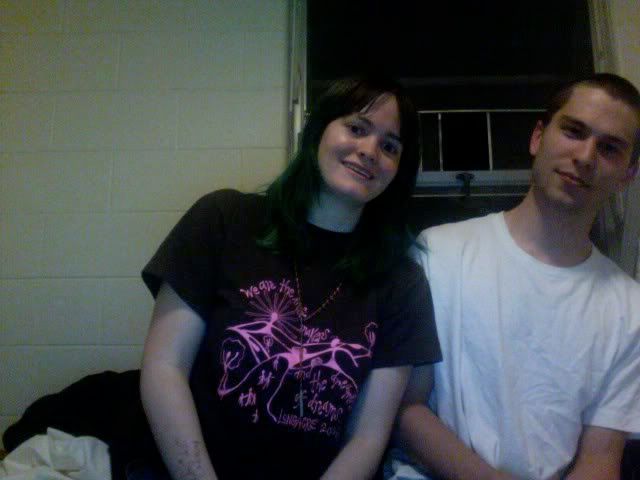
With regular people I feel like this:

picture of a guy, Noah, leaning to the right, as I lean in his direction with a bored look on my face.

And you would imagine that this makes me feel like they're better than me and sometimes it does, but sometimes it just makes me hate them and makes me not want to be around people because I'm tired of leaning in their stupid direction all the time.

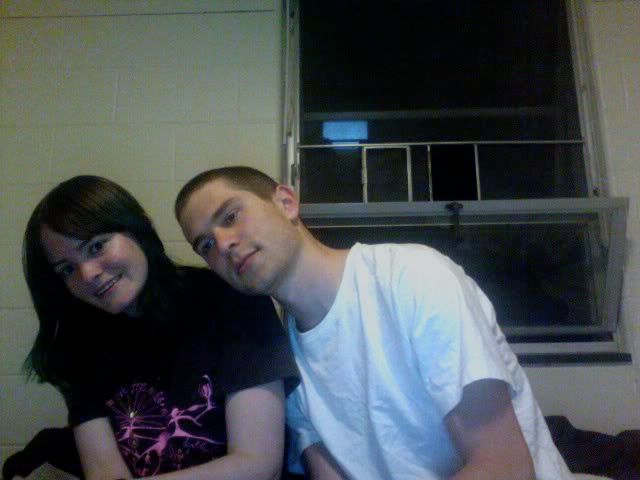
With people who have more visible or severe DDs, I feel like this:

picture of Noah leaning to the left, as I lean in his direction smiling.

I really like being with people with DDs because I get to lean in the other direction and use parts of myself that are usually a hindrance when I'm trying to lean in the direction of normal people. I also like doing it because there's so much social support for the idea that people with DDs are really difficult to interact with--this probably isn't something I should admit, but it's really nice to suddenly be socially coded as a good person or a person with a special talent, instead of the way I am with regular people, which is average when I'm wearing myself down to the bone leaning over at THEIR EXACT ANGLE. With DD people, if I can lean well enough to have good communication with them, that's a positive thing, whereas with regular people it's a problem if it isn't perfect.

There's a third kind of person which includes some normal people but especially seems to include a bunch of people like me--i.e. passing people. Specifically, passing ASD people.

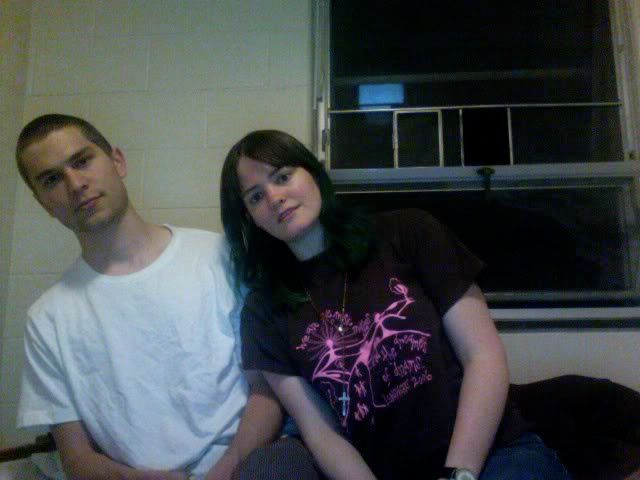
These people can be your friends. And you can talk to them and sometimes it's not any work. But sometimes it's work because everyone is sometimes work. So sometimes I will lean in their direction (whichever direction it happens to be). But also! Look what happens sometimes:

picture of me tilting my head to the side, with Noah tilting his head and leaning it on my shoulder affectionately--the idea being, this is the only picture where Noah is adjusting himself to me instead of the other way around.

When this happens, it makes me so happy I want to cry and it makes the entire being-alive thing worth it.

(Noah is of course a type three and a trooper for sitting and leaning over with me for such a long time.)

05 April, 2010

Some more reading

I was going to tell this to Lion Face but it's not really an LF-specific story so I will just tell you. Last week I was at the doctor's office when a DD person came in. The reason I'm using the umbrella term, even though I know he was intellectually disabled and not ASD, is that the reason I read him was his body language. There are some DD people who have a really distinctive, dramatic way of walking, and I think anyone could read them, but I like to think that my reading of this guy wasn't something that just anyone could do. Without being at all critical of the intellectually disabled people I know in Ohio, who tend to dress in a distinctive way, I'll say that he didn't dress like them. He was wearing an orange striped polo shirt and khaki pants. He looked nice.

The way he moved was nice too. How do I say this? The shape of his smile, but mostly just the fact that he wanted to do things he wasn't doing. He waited for his aide to go in and talk to the nurse, and he started to twist his legs around, started to bend one of his legs up, but kind of stopped himself and put his leg back down.

His aide came out and sat down next to him. And the nicest thing happened--they looked at each other and grinned sneakily. I'd almost forgotten why I used to want to work with adults, but the potential for sneaky grinning is definitely the number one reason. (I'm probably going to work with adults because I think there's a greater need for sincere and ethical support staff when it comes to adults. But in light of recent events, i.e. Joe Cuteness, I've started feeling more reluctant about the idea of not working with kids.)

I wanted to talk to the guy, but I felt weird. His aide went over to the receptionist and he looked at a magazine. I felt like he was aware of my presence because he kept doing almost-stimmy movements with his hands, but when I looked up (I was sitting across from him) he would stop. So I said, "What are you reading?" and he said excitedly, "Good!" and I said "What's it about?" and he indicated that he hadn't really started looking through the magazine yet, and I said, "Well, what are you going to read?" and he looked through the magazine for a minute and then his aide came and got him to go up to the reception desk.

Cut to me feeling weird. Is it okay for me to bug other DD people and try to talk to them? And I mean, let's be honest--it may feel the same to me, I may feel plugged into them in a sense I don't feel with non-disabled people, but we're basically looking at an apparently normal person striking up a conversation with a person who (while almost passing when he doesn't talk) is moderately to severely intellectually disabled. Doesn't that seem patronizing, or something?

I wasn't being charitable. His way of holding himself warmed something in me. It's really, really nice to see other people who move differently--it's funny, because who knows if the way I move even looks that strange--I'm not masochistic enough to ever videotape myself walking. But it's such a deep part of me, it feels like a huge barrier between me and everyone else.

For the past year I've been mildly crushing on a straight girl I don't really know, who has a jerky way of moving. I mentioned it to Noah--I mean, he knew that I liked her, but I was saying that it was a little bit about her being awkward, both as a person and the way she walks--and he said, "Oh--I didn't know if you could tell if other people are weird or not," and I said I could, and he said, "Do you know the way you walk is a little funny--" and I said yeah.

(I guess that exchange makes Noah sound like a jerk. I don't know. I find him an easy person to be with in a lot of ways. Sometimes when I see people I really like, I stretch my hand out towards them, and when I do it to Noah he imitates me and pretends to be a deejay.)

03 March, 2010

I wanted to tell you this

I am going to counseling on Friday but I've basically thought that there's something wrong with me because I'm experiencing constant derealization and frequently I have to concentrate to keep from screaming/crying about something that ordinarily wouldn't be a big deal (waiting for a sandwich, waiting in line, waiting for a class to end). This started a week ago. Well, maybe it happened before, but I noticed the day I shaved my eyebrows. For periods I have thought "oh, it's getting better" but they're only periods. It's not permanent. I can hardly understand what people are saying sometimes, it just looks like a bunch of colors.

I got scared that I was going to be a person who loses skills.

Fortunately I saw Noah who is going to be a psychologist and is basically a joy, and I told him and showed him how much I have to press on my hands with my fingers all the time in an attempt to keep myself inside, and how I feel like I'm constantly in a state of yammering "I can't believe I'm alive, I can't believe I'm alive right here, right now" (this sounds nice but it's not, not all the time--derealization starts out seeming really fucking spiritual or something, but then you're like, shit--I can't do anything when my brain won't stop telling me I'm alive, I can't even feel God because I'm stuck in a creepy spaced-out box of my distinct moment and place).

Anyway, I was talking about how scary and weird it is to find out that something's been wrong with me ever since I came back from the UK--I mean, that must be it, because I'm taking like no classes, two of the four only meet once a week, and Noah was like, "what about your workload?" and I told Noah my workload and Noah was like, "That's a ton of work."

And I was kind of shocked. But like, I think it might just be a ton of work. Maybe I can't get anything done because there's so much to do.

In other news: I think everyone thinks that they like sex too much. Well, I mean, obviously some people are asexual. But I think you can even be asexual and think that you like sex too much. Or think that you want a girlfriend or boyfriend too much. Or that no one eats as much junk food as you do or does as little homework as you do or is as ugly as you or smells as bad as you're afraid you smell. And I think this is especially true for ASD people because we are trained to think of ourselves as deviant and overly intense--but it probably is the case for a lot of other people, too. I just wanted to tell you this because I thought of it later.

19 February, 2010

Passing As Ethics is a World

Or, the Only Useful Thing Glee Ever Did

Disability Blog Carnival #63--Relationships
(due tomorrow, you should write something!)

Autism is not all about being bad with people, even though that's what most people think (once you can talk). A lot of people are bad with people in different ways, but they only want to talk about us. How they can make us better. What they don't know is that being a person who was once bad with people is its own punishment. That is, it's a whole new way of being bad.

I suffer from a syndrome. It's called Passing As Ethics. I made it up, though, so I can call it whatever I want. Sometimes I call it Us vs. Them or Them vs. Me. None of these names do a good job explaining the whole thing, just parts of it. It consists of a collection of false beliefs. Or, exaggerations. Conclusions badly reached.

Fact: Autism Spectrum Disorder people look sort of weird to normal people, and some things are harder for them. To a Passing As Ethics sufferer, this means: the way ASD people do things is worse than the way other people do them--->ASD people should feel guilty if other people can tell there's something weird about them--->ASD people should feel guilty for stimming--->if a normal person isn't interested in something an ASD person says it's because the ASD person is monologuing--->if an ASD person isn't interested in something a normal person says it's because they have no empathy--->a friendship where one person talks most of the time is not a real friendship--->if a normal person doesn't like something an ASD person does, the ASD person should stop--->the opposite is definitely not true--->well, I think you get the idea.

All kinds of people can suffer from Passing As Ethics. A mother who brings her extremely sound-sensitive kid into a grocery store, then gets angry at him for crying, is a PAE sufferer. A teacher who tries to behavior-modify kids out of stimming or using big words, because it's "weird," is a PAE sufferer. And an ASD person who is unable to speak up when her classmates are saying things about ASD people that aren't true, because she doesn't think she can explain in less than four sentences, and she's interested in ASD rights, so if she talks a lot about something she's interested in, that would be monologuing, and that would be wrong--well, I prefer to say I have PAE, it doesn't have me. Who the fuck am I kidding, yeah it does. It has me really bad.

This post isn't about PAE in general, though. It is about how my disability affects my relationships. I think that talking about PAE in vague terms would be confusing, so I will just use specific examples instead.

Like most people who are writers, I like to talk about things I'm writing and things that have happened to me, especially if something is a good story. In a writing workshop, I met a boy named Noah who thought I was a very good writer, and I felt the same way about him. Noah and I haltingly came together out of mutual admiration, and began spending a lot of time together. We told each other about things we had written and interesting things that had happened to us. Although, I guess I talked more.

The semester came to an end and Noah didn't apply for another workshop. He said that he didn't feel ready to be in a workshop again. Early in the next semester, Noah decided that even though he wanted to be a writer, workshops made him feel self-conscious, and he was going to major in Psychology instead of Creative Writing. I bugged Noah about this, both because I wanted to be in more classes with him, and because I felt like it was what I was supposed to do. I always worry that I'm not as interested in other people as I should be, so I felt good about myself for being such a fan of Noah's writing. I made an effort to express this as much as possible; for example, I would introduce Noah to people by telling them that he was a good writer.

I started sleeping in Noah's room because my roommate and I were proving not to be compatible. Noah went to bed early and got up very early. When he got up, he would write for a while on his computer. When I asked to look at what he wrote, he said no. One night when Noah was asleep, I opened his computer and read his stories. A few days later I said, "Hey, Noah, would you be mad at me if I went on your computer and read your stories? Because I did and they were really good."

Noah felt very uncomfortable about what had happened. He told me that I couldn't stay in his room anymore, and for a while we didn't see each other very much. I was very upset of course, but I was also stunned. I hadn't imagined that Noah would be so upset that I had read his stories--and if you insist on reading this as a typical ASD lack of empathy, then I can't stop you. But the reason I was stunned was that I had a conviction that showing interest in another person was morally right. I had been worried about my friendship with Noah because I thought that I talked too much about my writing, my life, and my interests, and Noah mostly listened. I thought that I needed to make the friendship more balanced by learning more about Noah.

Well, I guess this does show a lack of empathy, but it's the PAE kind. The same lack of empathy that a mom shows when she takes her sound-sensitive child to the grocery store is what I showed to Noah. I expected Noah to react like my idea of a normal person, to react positively because I'd done something normal. This expectation was horrible because it showed no understanding of the person Noah actually was--a person who was self-conscious about his writing, and furthermore had actually said he didn't want me to read it.

This is one of the shittiest things I've ever done to another person, and is probably my best PAE story. However, lots of little PAE events occur when I interact with my roommate, Laura. I say things to her, and she doesn't answer me. When this happens, I think that Laura hasn't answered me because I was monologuing or saying something weird, and she thought it was boring or annoying. This makes me feel guilty and embarrassed. Then I feel annoyed at Laura for making me feel that way. I think that she's lording it over me because she's a normal person and I'm a freakish ASD person who doesn't know how to say the normal thing. Sometimes I just feel bad inside my head, but other times, if Laura expresses surprise about something I already told her about, I snap, "I already told you; if you didn't want to listen, that's your problem."

In my nonfiction workshop, they say you can't worry about making yourself look bad. Here goes: Laura is actually deaf in her left ear. I've lived with her for ten cumulative months in freshman and junior year, and I've known about her deafness since probably the first week. Yeah, that's right--I get mad at someone for not listening to me, even though if I actually thought about it, I would know it's because she can't hear me. I feel like there's some Normal Person vs. Freakish Disabled Person conflict going on, even though the lack of communication is actually caused by the normal person having a disability, and not even knowing that communication is being attempted.

I never thought of Laura as having a disability until I saw a person like her being insulted in an episode of Glee, a show that basically exists to insult disabled people. It turned my head around. The sheer irony and ridiculousness of me being embarrassed and angry about being disabled when Laura doesn't answer me because she's disabled is starting to make me realize how bad my PAE is, and how much I want it to stop. Well, I've been working hard at not noticing whether I'm normal or not, and Noah is helping out, too. "If I have something to tell you, I'll tell you" and "If I want you to leave, I'll tell you" are now staples he uses when talking to me. The other day I told him about ASD stuff, for hours. Apparently this is interesting. The whole time I was waiting for the other shoe to drop, but it never did.

Passing As Ethics doesn't just affect the sufferer. If you have PAE, all your friends have PAE too. But there is hope--with the right support, individuals with Passing As Ethics can improve and actually treat people like humans instead of Normal People to fear and resent.

I am trapped in my world of Passing As Ethics. But my friends are trying their hardest to pull me out.

19 January, 2010

recent flowery language on my part

(besides fwd being like that episode of Mr. Show)

Noah: I'm going to enter the New Yorker caption contest.
Me: You should enter the anti-caption contest, it's better.
Noah: No, because I want you to see me in the New Yorker. My caption is going to have your name in it.
Me: What?
Noah: Like, "So Amanda, when can you start work?"
Me: But how will I know it's my name and not another person named Amanda?
Noah: Because it'll say "submitted by Noah Schwarz."
Me: Noah, I really miss you, I sort of forgot. I still feel like you're a lot of cookies that I found under the bed, you know? I think I'll always feel that way.

Me: Oh, you're not boring! You're the bane of the world. You're, like, the Hound of the Baskervilles!

When you're ASD being normal is like a mosaic, and what I mean by this is that it's all a bunch of systems and rules that get smaller and smaller until you can barely see them and I just look like any other picture, but I'm really made up of squares and that will always be visible at close range. I'm clunkier and not as fluid.