So you guys, I kind of think FDR is awesome.
I was reading this person's blog saying that he's not a good role model for disabled kids, which intellectually I get is totally true, but does anyone else find passing kind of swoonworthy? I remember when I was in high school being super enchanted by the movie Gattaca and not really understanding why at the time. But passing is so cool! It makes you feel so smart.
And passing is like smoking--looks awesome, not good for you. Except that doesn't work because passing hurts everyone, so passing is more like not recycling. But sometimes when you are tired don't you just throw your bottle of soda into a trash can because you don't know where to find a recycling bin?
I try to recycle. And in the past maybe six months passing has kind of stopped being a part of my identity--although I do get passed off of course, but that's not who I am. I know that it is better for me in a lot of ways, but I kind of miss passing, i.e. the act of actually calculating how best to frame myself or just flat-out lie. I just felt really clever and calculated and yeah kind of evil but in a cool way.
It's sort of a thrill. I don't know. Life Is Better. But if passing wasn't kind of fun, and if passing--my own and other people's--didn't make me sort of delighted in a mean, fucked-up way...well, maybe I'd feel more okay rejecting FDR.
Showing posts with label history. Show all posts
Showing posts with label history. Show all posts
27 October, 2010

19 October, 2010
I found this picture while I was reading about the Holocaust on Wikipedia (how jolly for me):
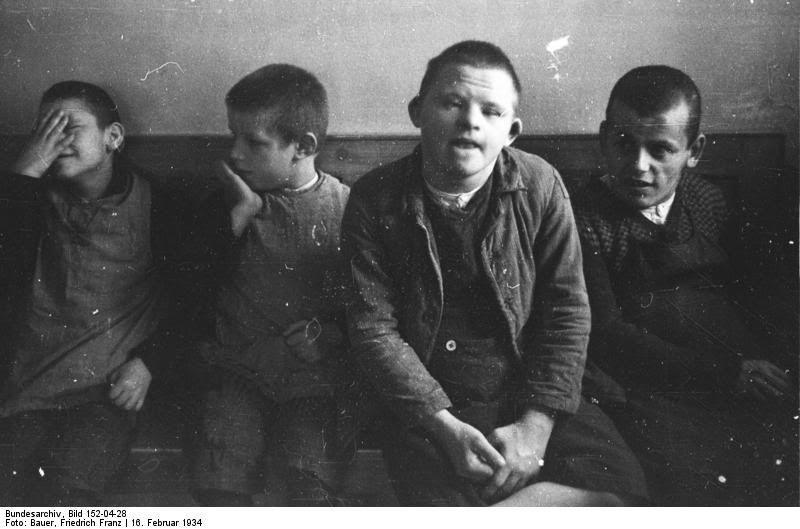
I guess the thing is, I love this picture, and I even considered posting it without saying what it was from, but that seemed creepy I guess. It is just rare to see such an old picture of disabled people, and they're such beautiful kids--I wish I could just keep this and look at it all the time without thinking about where they are and what happened to them later.
I guess the thing is, I love this picture, and I even considered posting it without saying what it was from, but that seemed creepy I guess. It is just rare to see such an old picture of disabled people, and they're such beautiful kids--I wish I could just keep this and look at it all the time without thinking about where they are and what happened to them later.
24 March, 2010
Two YouTube things
I love the Internet:
I have a mildly autistic daughter. She's 11, and she shares a great many of your reported behaviors and, I think, feelings. We also have a hard time telling what's autism and what's just the unique brand of weirdness that every individual person has. I wouldn't worry about it too much. (I know, easy for me to say!) By the way, I hope my daughter turns out as self-possessed and self-aware as you seem to be. Thanks for posting. Stay shiny, Browncoat!
However, what I came here to say was that if you aren't watching Dave Hingsburger's videos about working in institutions at the beginning of his career, you should be. They're...well, I don't think "great" is the word exactly, but I think they're important. I should warn you that this particular video made me cry a lot, and that they're all pretty disturbing so far.
Here is a very good transcription.
I have a mildly autistic daughter. She's 11, and she shares a great many of your reported behaviors and, I think, feelings. We also have a hard time telling what's autism and what's just the unique brand of weirdness that every individual person has. I wouldn't worry about it too much. (I know, easy for me to say!) By the way, I hope my daughter turns out as self-possessed and self-aware as you seem to be. Thanks for posting. Stay shiny, Browncoat!
However, what I came here to say was that if you aren't watching Dave Hingsburger's videos about working in institutions at the beginning of his career, you should be. They're...well, I don't think "great" is the word exactly, but I think they're important. I should warn you that this particular video made me cry a lot, and that they're all pretty disturbing so far.
Here is a very good transcription.
16 February, 2010
catching signals that sound in the dark
Like most people, I love the Hensel twins, and have since I was little. I remember my dad bringing home the Life magazine cover for me. I just spent a lot of time looking at videos and pictures of them online. It's awesome to watch the way they move around. But it's also awesome to watch them asking questions in class and joking around with their friends, because this isn't a life that would have been available for them a hundred years ago.
One of the most obtuse passages I've ever read comes from the Wikipedia page for Schlitzie, my favorite circus freak:
Under the care of Surtees, Schlitzie continued performing the sideshow circuit until Surtees' death in the early 1960s, after which Surtees' daughter, who was not in show business, committed Schlitzie to a Los Angeles county hospital.
Schlitzie remained hospitalized for some time until he was recognized by sword swallower Bill Unks, who happened to be working at the hospital during the off-season. According to Unks, Schlitzie seemed to miss the carnival dearly, and being away from the public eye had made him very sad and depressed. Hospital authorities determined that the best care for Schlitzie would be to make him a ward of Unks' employer, showman Sam Kortes, and return him to the sideshow.
Okay, dude--I really like Schlitzie and would like to think that he lived a happy life. And from the way he comes across in Freaks, he seems like a sweet person who liked attention, so I'll totally buy that he was into being a sideshow performer, and that he felt sad when he stopped doing it.
BUT DON'T YOU THINK HE WAS ALSO SAD BECAUSE HE WAS LIVING IN A HOSPITAL? I mean, if I was living in a hospital for no reason, and someone encountered me there, I'd think it was really fucking weird if they were like, "Amanda seems really sad, she must want to be a sideshow performer." Maybe he just didn't like living in an institutional setting. You know, like almost every person who ever lived.
I am really into the show Carnivale, and one of my favorite things is a very minor aspect of the show. Ben's crush, Ruthie, is a middle-aged woman with an adult son, Gabriel, who is a pretty minor character. But we know that Gabe is intellectually disabled and performs in the carnival as a strongman, as well as helping set up rides and tents with the other young guys in the carnival. Ruthie used to be a snake charmer when she was younger, but now she's mostly the "barker" for Gabe's act. Since I am interested in the history of disabled people (especially intellectually disabled people) who worked as a sideshow performers, Ruthie and Gabe's story seems especially moving to me. I imagine Ruthie realizing that her child was intellectually disabled, and that he didn't have a disability that affected his appearance and could therefore be the basis of his act. I imagine her thinking about Gabe's options outside of the hospital--probably being locked away somewhere. But in the carnival, he could travel and be part of a community. As he got older, he turned out to be really big, and that turned into an act, which was great. And Ruthie doesn't have to worry about what will happen to Gabe when she dies, because he has things he's good at, and he's surrounded by people who have known him his whole life.
But obviously not every carnival was as friendly as the one portrayed in Carnivale. The only good thing that happened in the class I dropped was that we read a piece by Eli Clare, who is a queer trans guy with cerebral palsy. Part of the piece was about his interest in particular historical figures--disabled sideshow performers, and XX people who lived as men. But he admits that he doesn't know exactly why certain XX people lived as men, and that it isn't necessarily accurate for him to claim them as trans. And he admits that some of the sideshow performers may have been manipulated and abused, and felt that they had no choice but to be "freaks." I am interested in the same two groups of people, although I'm a lesbian instead of a trans guy, which proves how hard it is to identify who inverts "belong" to. The Well of Loneliness seems to me to be a story about deviant sexuality, but in the 1940s Michael Dillon, a trans man, identified Stephen Gordon as someone like him.
But I'm getting off topic. I was thinking about Amanda Palmer, who has been criticized at FWD/Forward for starting a band with her friend where they pretend to be a pair of conjoined twins. I don't think Amanda Palmer is coming from a typical ableist perspective, even though she is being ableist. I think she thinks of the idea of conjoined twins as just another part of the whole circus/carnival genre that she's always drawn from. I'm not super offended by Evelyn Evelyn, I don't think, but it does make me kind of uncomfortable. It just seems stupid (although I generally love AFP, don't freak out). However, I feel like if I think that this is really bad, then I have to think Neutral Milk Hotel is really bad, too. Although Jeff Mangum didn't pretend to be conjoined twins, he just wrote a song about them.
I mean, is it ever okay to view people with certain physical conditions as part of a genre? I don't think it's okay to go as far as Palmer has gone but is it okay to be into conjoined twins and make art about them when you aren't actually conjoined and don't know any people who are?
eta: I just deleted a little bit about whether ASD people are circus freaks in modern society, and whether Jeff Mangum can be considered a circus freak because of his mental illness and nonstandard body language--I need more time to write that than I have, because I was too brief and it came off like I was saying "Jeff Mangum and I can have circus freaks but Amanda Palmer can't" or something equally oversimplified and self-serving.
One of the most obtuse passages I've ever read comes from the Wikipedia page for Schlitzie, my favorite circus freak:
Under the care of Surtees, Schlitzie continued performing the sideshow circuit until Surtees' death in the early 1960s, after which Surtees' daughter, who was not in show business, committed Schlitzie to a Los Angeles county hospital.
Schlitzie remained hospitalized for some time until he was recognized by sword swallower Bill Unks, who happened to be working at the hospital during the off-season. According to Unks, Schlitzie seemed to miss the carnival dearly, and being away from the public eye had made him very sad and depressed. Hospital authorities determined that the best care for Schlitzie would be to make him a ward of Unks' employer, showman Sam Kortes, and return him to the sideshow.
Okay, dude--I really like Schlitzie and would like to think that he lived a happy life. And from the way he comes across in Freaks, he seems like a sweet person who liked attention, so I'll totally buy that he was into being a sideshow performer, and that he felt sad when he stopped doing it.
BUT DON'T YOU THINK HE WAS ALSO SAD BECAUSE HE WAS LIVING IN A HOSPITAL? I mean, if I was living in a hospital for no reason, and someone encountered me there, I'd think it was really fucking weird if they were like, "Amanda seems really sad, she must want to be a sideshow performer." Maybe he just didn't like living in an institutional setting. You know, like almost every person who ever lived.
I am really into the show Carnivale, and one of my favorite things is a very minor aspect of the show. Ben's crush, Ruthie, is a middle-aged woman with an adult son, Gabriel, who is a pretty minor character. But we know that Gabe is intellectually disabled and performs in the carnival as a strongman, as well as helping set up rides and tents with the other young guys in the carnival. Ruthie used to be a snake charmer when she was younger, but now she's mostly the "barker" for Gabe's act. Since I am interested in the history of disabled people (especially intellectually disabled people) who worked as a sideshow performers, Ruthie and Gabe's story seems especially moving to me. I imagine Ruthie realizing that her child was intellectually disabled, and that he didn't have a disability that affected his appearance and could therefore be the basis of his act. I imagine her thinking about Gabe's options outside of the hospital--probably being locked away somewhere. But in the carnival, he could travel and be part of a community. As he got older, he turned out to be really big, and that turned into an act, which was great. And Ruthie doesn't have to worry about what will happen to Gabe when she dies, because he has things he's good at, and he's surrounded by people who have known him his whole life.
But obviously not every carnival was as friendly as the one portrayed in Carnivale. The only good thing that happened in the class I dropped was that we read a piece by Eli Clare, who is a queer trans guy with cerebral palsy. Part of the piece was about his interest in particular historical figures--disabled sideshow performers, and XX people who lived as men. But he admits that he doesn't know exactly why certain XX people lived as men, and that it isn't necessarily accurate for him to claim them as trans. And he admits that some of the sideshow performers may have been manipulated and abused, and felt that they had no choice but to be "freaks." I am interested in the same two groups of people, although I'm a lesbian instead of a trans guy, which proves how hard it is to identify who inverts "belong" to. The Well of Loneliness seems to me to be a story about deviant sexuality, but in the 1940s Michael Dillon, a trans man, identified Stephen Gordon as someone like him.
But I'm getting off topic. I was thinking about Amanda Palmer, who has been criticized at FWD/Forward for starting a band with her friend where they pretend to be a pair of conjoined twins. I don't think Amanda Palmer is coming from a typical ableist perspective, even though she is being ableist. I think she thinks of the idea of conjoined twins as just another part of the whole circus/carnival genre that she's always drawn from. I'm not super offended by Evelyn Evelyn, I don't think, but it does make me kind of uncomfortable. It just seems stupid (although I generally love AFP, don't freak out). However, I feel like if I think that this is really bad, then I have to think Neutral Milk Hotel is really bad, too. Although Jeff Mangum didn't pretend to be conjoined twins, he just wrote a song about them.
I mean, is it ever okay to view people with certain physical conditions as part of a genre? I don't think it's okay to go as far as Palmer has gone but is it okay to be into conjoined twins and make art about them when you aren't actually conjoined and don't know any people who are?
eta: I just deleted a little bit about whether ASD people are circus freaks in modern society, and whether Jeff Mangum can be considered a circus freak because of his mental illness and nonstandard body language--I need more time to write that than I have, because I was too brief and it came off like I was saying "Jeff Mangum and I can have circus freaks but Amanda Palmer can't" or something equally oversimplified and self-serving.
11 February, 2010
Henry Darger was a person
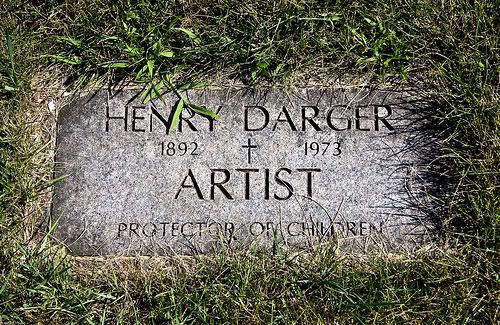
Henry Darger was an ASD person who lived in the Midwest, like me. Like me he enjoyed praying and arts and crafts.
He was treated badly when he was a kid and he wanted very much to help kids. He tried to adopt kids sometimes, but no one would give a child to someone like him. He had one friend. He was a janitor and he spent a lot of time writing and going to mass. He collected pictures of kids who had been murdered, but his favorite disappeared. He said it was a huge calamity and disaster. He wrote 15,145 pages of a book about kids rescuing other kids from monsters and adults.
Everyone says that Henry Darger probably wanted to hurt kids and it’s lucky he never got to be around them very much.
Also everyone looks at his pictures and doesn’t read his books.
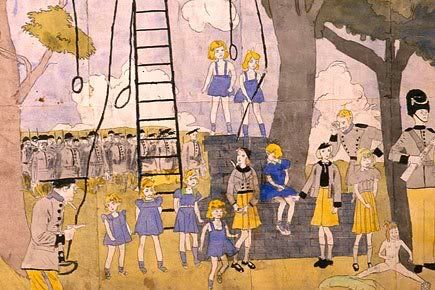
Henry Darger had one friend and his dad died when he was thirteen. He was put in an institution for being creepy, jerking off, or I suspect stimming. Henry Darger’s friend was worried about kids, too.
People are into naming their bands after him, but it’s already my name without even trying. I’m not sure why ASD people don’t feel more excited about Henry Darger. I like him a lot. My dad and I like going into Henry Darger exhibits and buying postcards with credit cards that have our name on them. My dad always tells people about Henry Darger using a worked-out series of phrases.
I think it’s important to remember that he wasn’t happy. We can’t think that arts and crafts is more important than happiness. Henry Darger is in a better place and probably doesn’t care, but he never got any of the money that people spend to get his arts and crafts in their exhibits.
22 January, 2010
livejournal comment/history
It's true that the concept didn't exist, but we can theorize about whether people had some of the same feelings and relationships that we (queer people) have. I think that's what people are saying when they say that someone was "gay" (or "trans" for that matter--it gets a bit messy because some of the same people are claimed as gay and trans, but this is to some extent just a result of not being able to tell 100+ years on why someone acted the way they did).
You can believe in an innate sexual orientation and I guess I do. I think people can act based on their innate sexual orientation without identifying it that way. So I can try to figure out if historical figures might have the feelings and experiences that would add up to that.
It's kind of like people with autism theorizing about whether famous historical figures like Einstein were autistic, or about whether the idea of changelings came from autistic children. Obviously changelings weren't perceived as kids with disabilities, they were perceived as monsters. But autism is real, and if they were autistic, that's what they really were; they shared an innate quality with modern people who are autistic. They weren't really changelings just because they were thought of that way.
I mean, we're stuck in our time too and maybe our concepts are going to be proven wrong, or at least become obsolete, but I think we can try to find history that involves the kind of people who we describe using those concepts. I don't think it's inaccurate to say someone was gay because being gay doesn't necessarily require calling yourself gay. And the thing is queer and trans and autistic people are always being accused of being some new invention, and told that we have no history; that's why we're kind of starving for it and that's why we claim people. So making a big deal out of the fact that "they didn't identify that way" actually seems kind of cruel. This is important.
You can believe in an innate sexual orientation and I guess I do. I think people can act based on their innate sexual orientation without identifying it that way. So I can try to figure out if historical figures might have the feelings and experiences that would add up to that.
It's kind of like people with autism theorizing about whether famous historical figures like Einstein were autistic, or about whether the idea of changelings came from autistic children. Obviously changelings weren't perceived as kids with disabilities, they were perceived as monsters. But autism is real, and if they were autistic, that's what they really were; they shared an innate quality with modern people who are autistic. They weren't really changelings just because they were thought of that way.
I mean, we're stuck in our time too and maybe our concepts are going to be proven wrong, or at least become obsolete, but I think we can try to find history that involves the kind of people who we describe using those concepts. I don't think it's inaccurate to say someone was gay because being gay doesn't necessarily require calling yourself gay. And the thing is queer and trans and autistic people are always being accused of being some new invention, and told that we have no history; that's why we're kind of starving for it and that's why we claim people. So making a big deal out of the fact that "they didn't identify that way" actually seems kind of cruel. This is important.
30 October, 2009
The Elevators
When I was fourteen, on a cold day when I felt full of noise and power and love, I went with my parents to a concert in New York City. It was vocal music, performed in a church, but that's all I remember. After the concert we briefly stopped at the Strand, and I bought the book Foundlings: Lesbian and Gay Historical Emotion Before Stonewall. I was a gay kid--normal people don't have to be gay when they're kids, I think, because the interbrain makes them so aware of the fact that it's stupid and dangerous to think about being gay. But I was gay, and liking girls was just like liking the Animorphs books, and werewolves, and Les Miserables. It didn't occur to me not to tell my parents, or to feel guilty that it bothered my mom, or to not buy books about it. And Foundlings looked like an interesting book.
So now it has been with me a third of my life, but I didn't understand it until I developed common sense at the age of sixteen. Or what I specifically didn't understand was this incredibly convoluted and prissy sentence, which is from a description of a scene in a lesbian pulp novel where the feminine Laura attacks her butch elevator operator girlfriend, Beebo, by telling her she'll never be a man:
By insisting on this terribly narrow story of gender inversion, by taking the elevators out of Beebo's sexuality, Laura returns them both to a brutal ground floor in which desire is always the desire for something real, instead of something living, and every demand is a demand for total validation, or for total destruction--in which there is no distinction between hatred and self-hatred.
"Whaaaaaaat?" I rightly replied as a middle-schooler. Elevators? Ground floors? Something real instead of something living? Frequently during my seven years with Foundlings, I have gone through phases where I've written this paragraph on the inside covers of notebooks so I can laugh whenever I look at it. Or not exactly laugh--marvel. I love rhetoric, even when it seems like it's just for the sake of itself, which is how this paragraph struck me for a long time.
But when I was in my late teens, I started loving inverts. Not because I am an invert, because there's no such thing as inverts anymore, at least in America.* Inversion was a way of making sense of same-sex attraction when being gay did not exist. If women always love men, and you're a woman and you don't, then that means that you have a man's soul. This means you're sort of freakish and tragic, but there's also calmness in it; you just have the wrong kind of soul, but your soul is acting right. If being same-sex-attracted is just a kind of disability, then it's possible to be noble about it. You can feel sad, blunder through all these crushes on straight girls, sometimes collapse under the weight of wanting so much not to be yourself--but you can be a good person, you can be brave.
I miss the medical model of homosexuality. Now that I have more common sense than I did when I was a kid, I'm painfully conscious of all the ways that being gay makes my life more difficult. But the model of homosexuality now is just--well, there isn't even one. You're not supposed to be upset about being gay unless your parents are beating you for it. You're supposed to act like it's this fantastic, jolly thing that makes you more unique, and if other people don't get that, fuck them.
Well, I don't feel that way. I feel impaired by my homosexuality. It's not the most important feeling in my life anymore, thank God, but neither is pride. I used to think that I was some kind of freak and that I just didn't like being gay because I was a maladjusted person, but I've started to think this isn't true. I think it's kind of like how I was the only gay kid at my summer camp. I tend to say things whether or not they're convenient, whether or not they make me feel better. I have watched a lot of gay people act like they don't like being gay; they just don't call it that. It's not part of their narrative like it is part of mine.
I like saying things are hard when they're hard.
I think taking the elevators out of me would be telling me that I must hate myself because I sometimes hate being gay. Or because I talk openly about that fact. Or because I'm interested in the writing of celibate gay Christians, and even identify with it more than the writing of mainstream gay people because they at least seem like they're striving for something instead of pretending that everything is good the way it is. Another way people take the elevators out of me is by telling me that I'm being negative when I try to manage my ASD impairments--for example, telling people before I speak that I'm not a good speaker. Or my parents telling me it's sad that I aspire to a direct support job with intellectually disabled people, which I want to do because it wouldn't make me nervous or tired. But I don't like being tired! How is it being all you can be if you're tired? I aspire to come home from work feeling happy and energetic, how is that not being all I can be?
I like inverts because they admit that things aren't going so well. And that doesn't mean they're always miserable, just because they admit that. I'm not always miserable--quite the contrary. I'm just straightforward.
*Some people would say that inverts exist--they are transgendered people. I don't think they're the same thing. I can see a trans person liking inverts for some of the same reasons I do, but I have never met a trans person who closely resembled an invert.
So now it has been with me a third of my life, but I didn't understand it until I developed common sense at the age of sixteen. Or what I specifically didn't understand was this incredibly convoluted and prissy sentence, which is from a description of a scene in a lesbian pulp novel where the feminine Laura attacks her butch elevator operator girlfriend, Beebo, by telling her she'll never be a man:
By insisting on this terribly narrow story of gender inversion, by taking the elevators out of Beebo's sexuality, Laura returns them both to a brutal ground floor in which desire is always the desire for something real, instead of something living, and every demand is a demand for total validation, or for total destruction--in which there is no distinction between hatred and self-hatred.
"Whaaaaaaat?" I rightly replied as a middle-schooler. Elevators? Ground floors? Something real instead of something living? Frequently during my seven years with Foundlings, I have gone through phases where I've written this paragraph on the inside covers of notebooks so I can laugh whenever I look at it. Or not exactly laugh--marvel. I love rhetoric, even when it seems like it's just for the sake of itself, which is how this paragraph struck me for a long time.
But when I was in my late teens, I started loving inverts. Not because I am an invert, because there's no such thing as inverts anymore, at least in America.* Inversion was a way of making sense of same-sex attraction when being gay did not exist. If women always love men, and you're a woman and you don't, then that means that you have a man's soul. This means you're sort of freakish and tragic, but there's also calmness in it; you just have the wrong kind of soul, but your soul is acting right. If being same-sex-attracted is just a kind of disability, then it's possible to be noble about it. You can feel sad, blunder through all these crushes on straight girls, sometimes collapse under the weight of wanting so much not to be yourself--but you can be a good person, you can be brave.
I miss the medical model of homosexuality. Now that I have more common sense than I did when I was a kid, I'm painfully conscious of all the ways that being gay makes my life more difficult. But the model of homosexuality now is just--well, there isn't even one. You're not supposed to be upset about being gay unless your parents are beating you for it. You're supposed to act like it's this fantastic, jolly thing that makes you more unique, and if other people don't get that, fuck them.
Well, I don't feel that way. I feel impaired by my homosexuality. It's not the most important feeling in my life anymore, thank God, but neither is pride. I used to think that I was some kind of freak and that I just didn't like being gay because I was a maladjusted person, but I've started to think this isn't true. I think it's kind of like how I was the only gay kid at my summer camp. I tend to say things whether or not they're convenient, whether or not they make me feel better. I have watched a lot of gay people act like they don't like being gay; they just don't call it that. It's not part of their narrative like it is part of mine.
I like saying things are hard when they're hard.
I think taking the elevators out of me would be telling me that I must hate myself because I sometimes hate being gay. Or because I talk openly about that fact. Or because I'm interested in the writing of celibate gay Christians, and even identify with it more than the writing of mainstream gay people because they at least seem like they're striving for something instead of pretending that everything is good the way it is. Another way people take the elevators out of me is by telling me that I'm being negative when I try to manage my ASD impairments--for example, telling people before I speak that I'm not a good speaker. Or my parents telling me it's sad that I aspire to a direct support job with intellectually disabled people, which I want to do because it wouldn't make me nervous or tired. But I don't like being tired! How is it being all you can be if you're tired? I aspire to come home from work feeling happy and energetic, how is that not being all I can be?
I like inverts because they admit that things aren't going so well. And that doesn't mean they're always miserable, just because they admit that. I'm not always miserable--quite the contrary. I'm just straightforward.
*Some people would say that inverts exist--they are transgendered people. I don't think they're the same thing. I can see a trans person liking inverts for some of the same reasons I do, but I have never met a trans person who closely resembled an invert.
Subscribe to:
Posts (Atom)