(The story in this post might be upsetting to some people because it involves trying to pressure someone into taking medication and judging them for not taking it.)
I feel like I shouldn't be posting right now because I should be sleeping and I'll be tired on the way to work, but I feel like I use the excuse of sleeping to avoid almost everything, like church, and I barely sleep anyway so here I go.
"They say an unhappy man wants distractions--something to take him out of himself. Only as a dog-tired man wants an extra blanket on a cold night; he'd rather lie there shivering than get up and find one."--CS Lewis, A Grief Observed
When we were freshmen Clayton and I had a friend, let's call her Annie. I don't know how much of this is 100% accurate but I don't think Annie reads this blog, so it's probably all right to just tell you how I remember it. Annie identified herself in conversations as someone who had a mental illness and sometimes hurt herself, and one day she casually told me that she probably should be on medication because she was at an age when the way her brain was was being solidified and if she didn't go on medication right now, she would always have problems. She told me this like it was funny and she didn't particularly care to do anything about it.
Clayton and I both have savior complexes and we made it a project to try and get Annie to go to student counseling. Never mind that he would later realize how fucked up he had gotten from the medication student counseling put him on, or that I've been virulently anti-medication of any kind since I was 16, to the extent that I would rather throw up from pain than take an Advil. For whatever reason we decided that we were right and Annie was wrong and we had to get her to go to counseling.
It was almost summer; Annie wanted to be outside when it was sunny so she could skateboard and hang out with her friends. Every day the two of us would descend on her and try to get her to go to counseling and she would say that she didn't want to go until it was dark. Student counseling closed at five in the evening so this was the same as saying she could never go. I remember how ridiculous and reckless Clayton and I thought she was, and how much we annoyed her.
Annie and I grew apart over the next three years but she is someone I admire a lot because she's so smart and interested in so many things. Sometimes it seems like she just has to think of something she'd like, and all the resources appear to make it happen. I found her hard to be friends with because she moved so fast--she would suggest doing something, I'd resist it because it went against my schedule, and by the time I started realizing I would like to do it she would already have left to begin it.
The point is though that a year or two ago I started really understanding how I could see Annie's decision as smart, not stupid. It got me through the last year and a half of college, trying to think that way--blinding myself to the big picture, trying to unfocus my eyes and look at seconds and colors. I couldn't do things right and I couldn't feel good a lot of the time so I stopped trying. I didn't fail. When I saw something in front of me that might make me feel good, I took it.
So for a long time I've been on that kind of track and I've realized how hard it is for someone outside to see why you don't listen to "reason." Why you'd rather ride in a car than worry about your problems taking care of yourself. Why you'd rather have fun smoking than figure out if you will let yourself live long enough to die of lung cancer. Why instead of constantly apologizing to yourself and everyone for not being more organized, you're making Kraft Macaroni and Cheese in a huge pot and watching YouTube videos with your roommate.
The thing I feel most clearly now is that it was none of my business what Annie did with her time. I'm not as clear on the rest of it--how being like Annie applies to me and how I should feel about it.
I found myself talking about Annie today. I was trying to argue why it's okay for me to be involved with men even though I am gay. I'm probably going to get upset writing about this because the conversation turned to an end that felt more permanent than usual. I know I was convincing him at the beginning. At some point it wasn't working anymore for me to say "we should live in the moment" and "I don't expect to ever have a family or a relationship with a woman, so we might as well try and feel as good as we can."
And I remembered, a few years ago I would have thought being with a guy was like throwing something in God's face, being too lazy and desperate for comfort to feel anything but the shadows of what I could feel. I would have thought it was the real thing or nothing, and even now it's hurting me to type that it's not the real thing, because I want it to be as good as the real thing when it's with a guy, but it's not and that's not my fault. And the boy wasn't hurt, he's the strangest, nicest boy--he was relieved.
The truth is it's very hard for me to work especially not being a driver, and it's really hard for me to live on my own, and the only people I talk to outside of work are men who try and bother me. Giving up smoking is a serious sacrifice not because of nicotine as much as the fact that I lose a reason people will talk to me. I'm really sad right now. Sorry if this is too much information, but I've been going back and forth on the Annie thing for such a long time, and I wanted to write about it. Not Annie herself because obviously she shouldn't have been on meds when she didn't want to be, but thinking about endgames vs. staying in the sunlight whenever I can.
The thing is I don't know if I ever felt so much this way since I was on meds myself in tenth grade. Every day I'd take stimulants and spend a few hours thinking everything was really special and important, not realizing how much I didn't notice or how fucked up everything had gotten. As the day went on I got sadder and sadder and the only thing that mattered to me was--guess what--the person I was dating, who I wasn't actually attracted to.
Towards the end of the drugs, in some sobbing state, I told my mom I wasn't happy. My mom saw me all amped and buzzed up on the way to school every morning after I downed my Wellbutrin and Adderall. She said, "But I see you happy every day."
I said, "but I'm not a happy person."
I built myself back up through the two depressing but somehow joyful last years of high school. I was a very sad but happy person by the time I turned eighteen. I'm not sure how lazy and distracted I must have gotten, to get so far off track--because yeah I have to look at the small things, but this has gotten small enough to seep into all of them.
I'm not a happy person.
And this is me telling God and myself that I'm going to get better.
Showing posts with label sex. Show all posts
Showing posts with label sex. Show all posts
05 March, 2012

07 September, 2011
I imagine this could be triggering
Also, one of the reasons that I find it so upsetting to be told that social skills do exist is that I think social skills are about as legit and dangerous as sexual skills--and by sexual skills, I mean the idea that being good/successful/able at sex is a flat line going from No to Yes.
Like lots of kids with autism I was put on antipsychotics and it screwed up my life. One of the things the psychiatrist used to explain why I should be on antipsychotics was the fact that when he asked me how high my sex drive was, I said it was "low," which indicated that I was depressed. I was 15 years old and felt terrible about myself and my body. I'm also queer and an s/m person among other things, so I haven't always felt like engaging with my sexuality because it's kind of alienating. Also, those things aside, some people just have low sex drives.
So we know that--just like not looking people in the eye is a way to have bad social skills--not wanting to have sex as much as other people do is a way to have bad sexual skills, to be bad (worthy of medicalization) in the area of sex.
I wonder what the other bad sexual skills would be. I imagine they'd be a lot like bad social skills.
Not liking the same things other people like.
Not reacting the way you should.
Crying when someone does something you're supposed to like.
Saying no to something that everyone's supposed to do.
Bringing up something weird just because it makes you happy.
Throwing a fit just because someone tried to make you do something you don't like.
Just not being interested at all.
Like lots of kids with autism I was put on antipsychotics and it screwed up my life. One of the things the psychiatrist used to explain why I should be on antipsychotics was the fact that when he asked me how high my sex drive was, I said it was "low," which indicated that I was depressed. I was 15 years old and felt terrible about myself and my body. I'm also queer and an s/m person among other things, so I haven't always felt like engaging with my sexuality because it's kind of alienating. Also, those things aside, some people just have low sex drives.
So we know that--just like not looking people in the eye is a way to have bad social skills--not wanting to have sex as much as other people do is a way to have bad sexual skills, to be bad (worthy of medicalization) in the area of sex.
I wonder what the other bad sexual skills would be. I imagine they'd be a lot like bad social skills.
Not liking the same things other people like.
Not reacting the way you should.
Crying when someone does something you're supposed to like.
Saying no to something that everyone's supposed to do.
Bringing up something weird just because it makes you happy.
Throwing a fit just because someone tried to make you do something you don't like.
Just not being interested at all.
04 July, 2011
bad brains making bad decisions
(from bad brains making bad decisions)
First off, it's really hard not to write about sex because:
1. The other day I read all the comments in an article about a British guy with an intellectual disability who had been ruled by a judge not to be qualified to have sex. Some of the comments were by people who had worked with people with ID, and were saying things like, "When people with ID have sex, they can't handle it emotionally and they go from partner to partner and get very upset."
2. When I was 15 or 16, I read this livejournal flamewar that I'll always remember. Basically, a woman who was into BDSM, who had kids with autism, suggested that people with autism shouldn't be doms because they wouldn't be able to tell if their partners didn't like what they were doing. Other people said that if this was an issue, the couple should use safewords; the woman replied that she didn't believe in safewords because you should be able to tell how the other person feels.
What do these two incidents tell us (besides that parents and staff are assholes and should never talk)? Well, one thing that stands out to me is that both people talking are implying that there's a standard everyone should meet in order to be able to do a certain thing. If you want to have sex, you have to not become distraught by it, or be reckless in entering into affairs and relationships. If you want to be a dom, you have to be able to tell if your partner doesn't like what you're doing, without them saying so.
But...for some reason, this standard is only being applied to people with disabilities.* No one is calling for immature and overemotional non-disabled people to be banned from having sex, and presumably the woman who was so concerned about autism and BDSM doesn't go around telling non-disabled couples that they shouldn't be doing BDSM if they happen to not be able to read each other's body language.
(*It should go without saying that I don't think either of these judgments about developmentally disabled people is true. But even if they were it still wouldn't be fair.)
By the way I was semi-joking because now I'm going to talk mostly as a staff person, oh noes. During training for my job at summer camp working with adults, we were being given a talk about making sure guys shave, or making sure you shave them if they can't do it. Our boss said, "Nothing makes me angrier than seeing a person with a disability walking down the street with a stain on their shirt and stubble."
But nothing makes me angrier than the idea that if a disabled person doesn't look conventionally put-together, that is a PROBLEM and they're not receiving adequate support.
Let's say a disabled guy gets out of bed in the morning and decides not to shave because he's lazy, or because he thinks stubble looks cool, or because he only shaves when he's going to be kissing his girlfriend that day (haha, double panic, disabled people who are lazy AND kiss). He puts on a stained shirt because even though it's stained, it has his favorite movie character on it, or it belonged to his brother who he really likes, or it's comfortable for someone with his particular sensory issues.
All good decisions. Well, not necessarily good decisions. I personally think stained clothes are 100% gross and would never wear them. But these are decisions that a non-disabled guy might make, and no one would seriously respond with, "Someone ought to be taking better care of him." Yes, this ties into the privilege checklist.
Dave Hingsburger made a post last week called Offering, respecting...a huge difference, in which he talked about the difference between "offering choices"--i.e., choosing the set of choices a person can choose between--and respecting any choices a person makes. "Relationships, yes ... kissing, no; movies, yes ... boozing, no; celery, yes ... smoking, no." To me, saying a person can either be cleanshaven or have a beard is offering choices; saying a person can have whatever kind of facial hair they want is respecting choices.
As I was thinking about this I started thinking...well, for me as a staff person there's probably a limit. I mean, if someone never wanted to brush their teeth I would make that very difficult for them. Which I was thinking made sense, because brushing your teeth is just...well, it's not just about how you look, you have to do it.
But then I remembered when my friend found out that her non-disabled boyfriend hadn't brushed his teeth in weeks. Her reaction (and mine) was, "That's gross," but neither of us thought that someone else should start making him brush his teeth. I think there's a very small number of things that non-disabled people could do to get the reaction, "Someone else should be taking care of you because your actions are so incorrect." Most of the examples I can think of have to do with not eating, self-injury and suicide attempts, and addictions.
One of the commenters on Dave Hingsburger's post did bring up the issue of people having preferences in the short term that don't fit into their long-term plans, which I think is important. I just feel weird about brushing teeth now.
First off, it's really hard not to write about sex because:
1. The other day I read all the comments in an article about a British guy with an intellectual disability who had been ruled by a judge not to be qualified to have sex. Some of the comments were by people who had worked with people with ID, and were saying things like, "When people with ID have sex, they can't handle it emotionally and they go from partner to partner and get very upset."
2. When I was 15 or 16, I read this livejournal flamewar that I'll always remember. Basically, a woman who was into BDSM, who had kids with autism, suggested that people with autism shouldn't be doms because they wouldn't be able to tell if their partners didn't like what they were doing. Other people said that if this was an issue, the couple should use safewords; the woman replied that she didn't believe in safewords because you should be able to tell how the other person feels.
What do these two incidents tell us (besides that parents and staff are assholes and should never talk)? Well, one thing that stands out to me is that both people talking are implying that there's a standard everyone should meet in order to be able to do a certain thing. If you want to have sex, you have to not become distraught by it, or be reckless in entering into affairs and relationships. If you want to be a dom, you have to be able to tell if your partner doesn't like what you're doing, without them saying so.
But...for some reason, this standard is only being applied to people with disabilities.* No one is calling for immature and overemotional non-disabled people to be banned from having sex, and presumably the woman who was so concerned about autism and BDSM doesn't go around telling non-disabled couples that they shouldn't be doing BDSM if they happen to not be able to read each other's body language.
(*It should go without saying that I don't think either of these judgments about developmentally disabled people is true. But even if they were it still wouldn't be fair.)
By the way I was semi-joking because now I'm going to talk mostly as a staff person, oh noes. During training for my job at summer camp working with adults, we were being given a talk about making sure guys shave, or making sure you shave them if they can't do it. Our boss said, "Nothing makes me angrier than seeing a person with a disability walking down the street with a stain on their shirt and stubble."
But nothing makes me angrier than the idea that if a disabled person doesn't look conventionally put-together, that is a PROBLEM and they're not receiving adequate support.
Let's say a disabled guy gets out of bed in the morning and decides not to shave because he's lazy, or because he thinks stubble looks cool, or because he only shaves when he's going to be kissing his girlfriend that day (haha, double panic, disabled people who are lazy AND kiss). He puts on a stained shirt because even though it's stained, it has his favorite movie character on it, or it belonged to his brother who he really likes, or it's comfortable for someone with his particular sensory issues.
All good decisions. Well, not necessarily good decisions. I personally think stained clothes are 100% gross and would never wear them. But these are decisions that a non-disabled guy might make, and no one would seriously respond with, "Someone ought to be taking better care of him." Yes, this ties into the privilege checklist.
Dave Hingsburger made a post last week called Offering, respecting...a huge difference, in which he talked about the difference between "offering choices"--i.e., choosing the set of choices a person can choose between--and respecting any choices a person makes. "Relationships, yes ... kissing, no; movies, yes ... boozing, no; celery, yes ... smoking, no." To me, saying a person can either be cleanshaven or have a beard is offering choices; saying a person can have whatever kind of facial hair they want is respecting choices.
As I was thinking about this I started thinking...well, for me as a staff person there's probably a limit. I mean, if someone never wanted to brush their teeth I would make that very difficult for them. Which I was thinking made sense, because brushing your teeth is just...well, it's not just about how you look, you have to do it.
But then I remembered when my friend found out that her non-disabled boyfriend hadn't brushed his teeth in weeks. Her reaction (and mine) was, "That's gross," but neither of us thought that someone else should start making him brush his teeth. I think there's a very small number of things that non-disabled people could do to get the reaction, "Someone else should be taking care of you because your actions are so incorrect." Most of the examples I can think of have to do with not eating, self-injury and suicide attempts, and addictions.
One of the commenters on Dave Hingsburger's post did bring up the issue of people having preferences in the short term that don't fit into their long-term plans, which I think is important. I just feel weird about brushing teeth now.
24 April, 2011
hurt, power, and disability
Fasten your seatbelts because this is LONG.
In high school I enjoyed reading flamewars between anti-s/m people and their targets, just because it never failed to make me irritated in a comfortably predictable way. It's only natural that I grew up to be fascinated by "but my child smears feces" and other ableist shock arguments, given that I spent my adolescence reading the arguments of anti-s/m people which often seem to consist of listing sex acts that, while enjoyable to the participants, sound gross or upsetting to the average person.
I think what makes me able to derive masochistic enjoyment (ha ha) from anti-s/m arguments, while ableist arguments just destroy me and break my heart, is that there’s less of a sense of immediate danger. A lot of the time, people who are making ableist arguments are in a direct position of power over disabled people, as parents, professionals, heads of an organization, etc., and are actively working to put their beliefs into practice. People who are making anti-s/m arguments often seem to be talking in this weird philosophical way about what sex acts other people should engage in or fantasize about.
I don’t mean to sound like I think s/m people don't get discriminated against, but when it comes to flamewars on the Internet my response to anti-s/m people is one of being annoyed and baffled rather than afraid. Because most people grow up liking whatever they like, sexually, so anti-s/m people seem to be implying that certain people just shouldn’t have sex, which seems like such an obviously douchey and ridiculous demand to make of another person that I can’t believe they spend so much time saying it and feeling as righteous about it as they do.
That said, if I was going to engage with the argument that people shouldn’t do s/m and/or d/s because it’s bad for your politics and your health, I would say that, in an alternate universe where people could choose what sexual acts they were into, there would be very good reasons for a disabled person to think about choosing to be into s/m and power exchange. As an inhabitant of the real world, I just think the intersection of s/m and disability is a happy accident for the people who experience it, rather than something anyone can or should “try” because it can destabilize and alleviate some of the bad parts of being disabled. But I want to write about what those destabilizations and alleviations can be, in the context of stuff like Failure Theory and The Classic Disability Catch-22. A few of the things I’m saying are specific to autism but many of them are not which is why I’m using the term “disabled,” throughout.
One by one I’m going to discuss hurting someone, receiving hurt, dominance, and submission, and what engaging in each of those four things might do, mean, or bring up for someone who is disabled. Most of what I write will be in the form of questions because I’m talking generally, and even if I wasn’t there probably would still be no cut-and-dry meaning or effect or answer.
Hurting Someone
(I’m talking about “hurt” instead of “pain” because I don’t want to imply that I’m only talking about physical pain. I do think hurt is a problematic word for me to have chosen because it seems to imply actual harm, which I obviously don’t think should be present.)
People with psychiatric and developmental disabilities are constantly living against the expectation that we’re going to be physically violent or, in the more “harmless” version of developmental disability stereotypes in particular, that we’re going to offend people and otherwise misunderstand what they want and need from us. Some of us experience police brutality due to being read as "dangerous" just because of the effects of our disability. The idealized behavior for a disabled person is that of working incredibly hard to fit ourselves around and into other people’s desires. If we don’t do this we risk various stigmas, some merely insulting and some negative enough to cause us to lose our job, be arrested, etc., when we haven’t actually hurt anyone.
So, if you live your life having been taught that you could hurt someone at any minute--or maybe you know that’s not true, but you still know that other people think that and you have to manage their reactions to you--what does it mean to decide to hurt someone, and do so carefully and in a way that’s enjoyable to them? What does it mean to realize that, actually, you are not on the verge of exploding and killing someone like in Of Mice and Men--that you can actually be in control of how you hurt someone, and do it “correctly” (for them)?
What does it mean to throw out your usual mindset--be nice, apologize a lot, don’t talk too loud, don’t move too fast? What does it mean for your concept of being a socially skilled person, being polite, or being a good person, if you interact with someone by a completely different (or even opposite) set of rules from your usual set, and this pleases them? Actually I do think there’s an answer to this one, but I’ll spare you the boredom of hearing it from me again.
This is something that I’ll come back to in every section, I guess, and it’s one of the things that is fairly autism-specific. What does it mean to work hard to affect someone in a certain way, and have them appreciate that and see it as something that takes energy and skill, instead of just expecting it?
Also--and this is a topping/hurting-specific thing I guess--in some people’s dynamic, you could even hurt someone in a way they don’t like, and that would be fine; within limits, their feelings are irrelevant to what happens. What if the way you and your partner/s do sex is that you do whatever you want and they’re expected to adjust to you?
Receiving Hurt
One of the most important qualities for a successful disabled person is the ability to bear pain quietly; and not only should you bear pain quietly, but you should bear pain quietly, quietly. The most perfect disabled person receives emotional and physical discomfort and pain with a complete poker face, and this is in the service of a goal: appearing to experience the same amount of pain as non-disabled people, and for the same reasons. Which is to say that the most perfect disabled person appears non-disabled and is not admired by anyone for her stoicism because, if she’s doing it right, no one knows she has anything to be stoic about. If you’re disabled, you deserve to have pain as an invisible constant force in your life, and you deserve it so much it’s not even worth mentioning.
While I’m at it I should mention that some disabled people don’t know what we want, or what hurts us, or what harms us. This can be because of cognitive and language aspects of our disabilities (not being able to sense we’re in pain, or articulate it), or because we have chronic pain and become inured to the sensation, or because people are always telling us what a normal person would be feeling or wanting in our situation, or a combination of those things.
What does it mean to say that you want pain, when you’ve spent your whole life pretending pain doesn’t exist because the expression of pain is so horrifying to people? What does it mean to be able to tell someone that you are or were in pain without this being something that makes them either pity you, or resent you because they see you as lying or exaggerating your pain to get pity?
What does it mean if someone actually enjoys your reaction to being in pain, and wants you to say and show them that you’re in pain? Conversely, what does it mean if you can be very stoic about pain, and someone actually appreciates that about you and sees it as a special skill, instead of a prerequisite for being respected as a decent and competent person?
Also, what does it mean to have it actually be important and expected that you try to figure out what level of hurt is harm, and what your limits are? What does it mean to have a word that means “this isn’t okay it has to stop,” and the other person’s actually supposed to listen?
(I just realized that I was using the word pain instead of hurt for this whole section. I still meant it in the broadest possible way.)
Dominance
In The Classic Disability Catch-22, I wrote that in order to be seen as the kind of disabled person who deserves to be successful, you must make it appear as though there’s nothing you can’t do. This means that you have to perform beyond your means, damaging yourself in the process, and/or lie and trick people into thinking you’re doing things you’re not actually doing. Because of the dishonesty and recklessness involved in fulfilling this requirement, no one who is perceived as belonging to this elite class of disabled people actually feels secure as a member of that class. This is Failure Theory. Of course, people who aren’t perceived as belonging to that class of disabled people have it a lot worse; they have shown the wrong kinds of weakness and impairment, and barring some extraordinary feat of illusion or strength, they will not be seen as deserving the support or acceptance they need to achieve their goals.
There’s also the issue of “body language” and what that means about your sense of power, authority, and control in the real world. If you look disabled, you look like prey. You may look, to some people, like you shouldn’t be out on your own. Your eye gaze or the way you speak may cause people to read you as shifty, incompetent, frightened, or shy--and given the way people read you, you probably do feel shifty, frightened, and shy, and may be beginning to wonder if you are incompetent.
You may be told that in order to deserve respect, or to be seen as a competent or smart or secure person, you have to have the ability to speak in a certain way and look at people in a certain way; or, as discussed in the “receiving hurt” section, you may have to be able to be stoic about things that you simply can’t be stoic about.
When someone decides to submit to a person who is stuck on one side or the other of the Classic Disability Catch-22, is regularly mistaken for a child, starts crying on the subway, needs help getting dressed, can’t speak loudly enough to be heard by most people, etc. etc. etc., this is a dissolution of standards about what kind of person is supposed to be allowed to have authority and control, whether by the standards of society or by the person’s own standards (in the case of people who are read as non-disabled or successful disabled people, but suffer from Failure Theory).
Submission
Obviously submission doesn’t have to do with whether someone is “weak” in a pervasive sense, but for a lot of people being submissive involves doing and saying things that are associated culturally with weakness and vulnerability. It also sometimes involves letting go of control and doing what someone else says.
So if you’re in a position, in real life, where you have a chance to be successful only as long as you never show weakness, then what does it mean to be able to express weakness with someone and not be destroyed by it? To have someone actually like and enjoy that part of you, and want to see it, and still respect you when they see it? On the other hand, if your real life position is one of being fucked over because you’re read as weak or because there are things you can’t do--again, what does it mean to express weakness or inabilities to someone and have them think it’s cool, and have them respect you regardless?
Performing weakness, or allowing yourself to sincerely experience weakness, is an act that is comparable to the act of deciding to hurt someone. It involves a similar controlled reversal of the values and goals you usually hold yourself to, and an embrace of the person you’re afraid of being.
I find it astoundingly privileged when anti-s/m people talk about how, for example, doing power exchange is “bringing in” all these terrible things from the outside world into your relationship. When you’re disabled, lack of power is such a huge part of who you are that it’s hard to imagine that not being a part of any relationship you have. So, like, that would be really cool to be worrying about “bringing in a hierarchy” or “bringing in brokenness” into a relationship. It sounds like a charmed life.
I haven’t come across much discussion of the s/m and disability intersection; staticnonsense’s Kinky Disability posts, which I love, are really one of the only attempts to address the issue that I have seen on any disability blog. Before the Disability Internet, of course, there was Bob Flanagan, but I haven’t done enough research to know if he was part of any kind of movement. I feel nervous about posting this because it is so long and I haven’t really written about any kind of sexuality before, but I just think this intersection is a really fascinating one and worth talking about.
In high school I enjoyed reading flamewars between anti-s/m people and their targets, just because it never failed to make me irritated in a comfortably predictable way. It's only natural that I grew up to be fascinated by "but my child smears feces" and other ableist shock arguments, given that I spent my adolescence reading the arguments of anti-s/m people which often seem to consist of listing sex acts that, while enjoyable to the participants, sound gross or upsetting to the average person.
I think what makes me able to derive masochistic enjoyment (ha ha) from anti-s/m arguments, while ableist arguments just destroy me and break my heart, is that there’s less of a sense of immediate danger. A lot of the time, people who are making ableist arguments are in a direct position of power over disabled people, as parents, professionals, heads of an organization, etc., and are actively working to put their beliefs into practice. People who are making anti-s/m arguments often seem to be talking in this weird philosophical way about what sex acts other people should engage in or fantasize about.
I don’t mean to sound like I think s/m people don't get discriminated against, but when it comes to flamewars on the Internet my response to anti-s/m people is one of being annoyed and baffled rather than afraid. Because most people grow up liking whatever they like, sexually, so anti-s/m people seem to be implying that certain people just shouldn’t have sex, which seems like such an obviously douchey and ridiculous demand to make of another person that I can’t believe they spend so much time saying it and feeling as righteous about it as they do.
That said, if I was going to engage with the argument that people shouldn’t do s/m and/or d/s because it’s bad for your politics and your health, I would say that, in an alternate universe where people could choose what sexual acts they were into, there would be very good reasons for a disabled person to think about choosing to be into s/m and power exchange. As an inhabitant of the real world, I just think the intersection of s/m and disability is a happy accident for the people who experience it, rather than something anyone can or should “try” because it can destabilize and alleviate some of the bad parts of being disabled. But I want to write about what those destabilizations and alleviations can be, in the context of stuff like Failure Theory and The Classic Disability Catch-22. A few of the things I’m saying are specific to autism but many of them are not which is why I’m using the term “disabled,” throughout.
One by one I’m going to discuss hurting someone, receiving hurt, dominance, and submission, and what engaging in each of those four things might do, mean, or bring up for someone who is disabled. Most of what I write will be in the form of questions because I’m talking generally, and even if I wasn’t there probably would still be no cut-and-dry meaning or effect or answer.
Hurting Someone
(I’m talking about “hurt” instead of “pain” because I don’t want to imply that I’m only talking about physical pain. I do think hurt is a problematic word for me to have chosen because it seems to imply actual harm, which I obviously don’t think should be present.)
People with psychiatric and developmental disabilities are constantly living against the expectation that we’re going to be physically violent or, in the more “harmless” version of developmental disability stereotypes in particular, that we’re going to offend people and otherwise misunderstand what they want and need from us. Some of us experience police brutality due to being read as "dangerous" just because of the effects of our disability. The idealized behavior for a disabled person is that of working incredibly hard to fit ourselves around and into other people’s desires. If we don’t do this we risk various stigmas, some merely insulting and some negative enough to cause us to lose our job, be arrested, etc., when we haven’t actually hurt anyone.
So, if you live your life having been taught that you could hurt someone at any minute--or maybe you know that’s not true, but you still know that other people think that and you have to manage their reactions to you--what does it mean to decide to hurt someone, and do so carefully and in a way that’s enjoyable to them? What does it mean to realize that, actually, you are not on the verge of exploding and killing someone like in Of Mice and Men--that you can actually be in control of how you hurt someone, and do it “correctly” (for them)?
What does it mean to throw out your usual mindset--be nice, apologize a lot, don’t talk too loud, don’t move too fast? What does it mean for your concept of being a socially skilled person, being polite, or being a good person, if you interact with someone by a completely different (or even opposite) set of rules from your usual set, and this pleases them? Actually I do think there’s an answer to this one, but I’ll spare you the boredom of hearing it from me again.
This is something that I’ll come back to in every section, I guess, and it’s one of the things that is fairly autism-specific. What does it mean to work hard to affect someone in a certain way, and have them appreciate that and see it as something that takes energy and skill, instead of just expecting it?
Also--and this is a topping/hurting-specific thing I guess--in some people’s dynamic, you could even hurt someone in a way they don’t like, and that would be fine; within limits, their feelings are irrelevant to what happens. What if the way you and your partner/s do sex is that you do whatever you want and they’re expected to adjust to you?
Receiving Hurt
One of the most important qualities for a successful disabled person is the ability to bear pain quietly; and not only should you bear pain quietly, but you should bear pain quietly, quietly. The most perfect disabled person receives emotional and physical discomfort and pain with a complete poker face, and this is in the service of a goal: appearing to experience the same amount of pain as non-disabled people, and for the same reasons. Which is to say that the most perfect disabled person appears non-disabled and is not admired by anyone for her stoicism because, if she’s doing it right, no one knows she has anything to be stoic about. If you’re disabled, you deserve to have pain as an invisible constant force in your life, and you deserve it so much it’s not even worth mentioning.
While I’m at it I should mention that some disabled people don’t know what we want, or what hurts us, or what harms us. This can be because of cognitive and language aspects of our disabilities (not being able to sense we’re in pain, or articulate it), or because we have chronic pain and become inured to the sensation, or because people are always telling us what a normal person would be feeling or wanting in our situation, or a combination of those things.
What does it mean to say that you want pain, when you’ve spent your whole life pretending pain doesn’t exist because the expression of pain is so horrifying to people? What does it mean to be able to tell someone that you are or were in pain without this being something that makes them either pity you, or resent you because they see you as lying or exaggerating your pain to get pity?
What does it mean if someone actually enjoys your reaction to being in pain, and wants you to say and show them that you’re in pain? Conversely, what does it mean if you can be very stoic about pain, and someone actually appreciates that about you and sees it as a special skill, instead of a prerequisite for being respected as a decent and competent person?
Also, what does it mean to have it actually be important and expected that you try to figure out what level of hurt is harm, and what your limits are? What does it mean to have a word that means “this isn’t okay it has to stop,” and the other person’s actually supposed to listen?
(I just realized that I was using the word pain instead of hurt for this whole section. I still meant it in the broadest possible way.)
Dominance
In The Classic Disability Catch-22, I wrote that in order to be seen as the kind of disabled person who deserves to be successful, you must make it appear as though there’s nothing you can’t do. This means that you have to perform beyond your means, damaging yourself in the process, and/or lie and trick people into thinking you’re doing things you’re not actually doing. Because of the dishonesty and recklessness involved in fulfilling this requirement, no one who is perceived as belonging to this elite class of disabled people actually feels secure as a member of that class. This is Failure Theory. Of course, people who aren’t perceived as belonging to that class of disabled people have it a lot worse; they have shown the wrong kinds of weakness and impairment, and barring some extraordinary feat of illusion or strength, they will not be seen as deserving the support or acceptance they need to achieve their goals.
There’s also the issue of “body language” and what that means about your sense of power, authority, and control in the real world. If you look disabled, you look like prey. You may look, to some people, like you shouldn’t be out on your own. Your eye gaze or the way you speak may cause people to read you as shifty, incompetent, frightened, or shy--and given the way people read you, you probably do feel shifty, frightened, and shy, and may be beginning to wonder if you are incompetent.
You may be told that in order to deserve respect, or to be seen as a competent or smart or secure person, you have to have the ability to speak in a certain way and look at people in a certain way; or, as discussed in the “receiving hurt” section, you may have to be able to be stoic about things that you simply can’t be stoic about.
When someone decides to submit to a person who is stuck on one side or the other of the Classic Disability Catch-22, is regularly mistaken for a child, starts crying on the subway, needs help getting dressed, can’t speak loudly enough to be heard by most people, etc. etc. etc., this is a dissolution of standards about what kind of person is supposed to be allowed to have authority and control, whether by the standards of society or by the person’s own standards (in the case of people who are read as non-disabled or successful disabled people, but suffer from Failure Theory).
Submission
Obviously submission doesn’t have to do with whether someone is “weak” in a pervasive sense, but for a lot of people being submissive involves doing and saying things that are associated culturally with weakness and vulnerability. It also sometimes involves letting go of control and doing what someone else says.
So if you’re in a position, in real life, where you have a chance to be successful only as long as you never show weakness, then what does it mean to be able to express weakness with someone and not be destroyed by it? To have someone actually like and enjoy that part of you, and want to see it, and still respect you when they see it? On the other hand, if your real life position is one of being fucked over because you’re read as weak or because there are things you can’t do--again, what does it mean to express weakness or inabilities to someone and have them think it’s cool, and have them respect you regardless?
Performing weakness, or allowing yourself to sincerely experience weakness, is an act that is comparable to the act of deciding to hurt someone. It involves a similar controlled reversal of the values and goals you usually hold yourself to, and an embrace of the person you’re afraid of being.
I find it astoundingly privileged when anti-s/m people talk about how, for example, doing power exchange is “bringing in” all these terrible things from the outside world into your relationship. When you’re disabled, lack of power is such a huge part of who you are that it’s hard to imagine that not being a part of any relationship you have. So, like, that would be really cool to be worrying about “bringing in a hierarchy” or “bringing in brokenness” into a relationship. It sounds like a charmed life.
I haven’t come across much discussion of the s/m and disability intersection; staticnonsense’s Kinky Disability posts, which I love, are really one of the only attempts to address the issue that I have seen on any disability blog. Before the Disability Internet, of course, there was Bob Flanagan, but I haven’t done enough research to know if he was part of any kind of movement. I feel nervous about posting this because it is so long and I haven’t really written about any kind of sexuality before, but I just think this intersection is a really fascinating one and worth talking about.
10 December, 2010
I watched this Skins episode and had some gay thoughts and some Autistic thoughts
So for a really long time I've been wanting to watch Skins because I knew the following information: there was this lesbian couple that everyone liked. And then one of them had sex with a guy with ASD because she felt sorry for him, and all the lesbians on the Internet were mad because it was like she was really straight! Argh! And hearing this, I was kind of like, gosh that's fucked up for the guy with ASD though. What about him? Queer Autistic TV investigation time!
So, I watched the episode where the lesbian sleeps with the guy with autism. And it was like...I actually can't believe it exists. The character with autism is the best fictional character with ASD I've ever read about or seen. It's so easy to explain why something is wrong, and so hard to explain why something is right, so I almost don't even know how to talk about why I love him so much. (Spoilers, obviously.)
The walls of his bedroom are covered with a chart he made about his relationships with other people. And that sounds so stupid and offensive, but somehow it's not. And he walks like he has ASD and he talks like he has ASD; like, the real kind, not the TV kind. And and and...I just can't even talk about it. I'll probably end up watching the entire show and then maybe I can try to write about him again.
It was such a good episode though. Like the wall chart, the "once-only charity event" sex wasn't as offensive as it sounds. Towards the beginning of the episode, JJ says something like, "If I could be normal for one day I'd lose my virginity, and then I'd tell my friends not to fight with each other and they'd listen to me instead of ruffling my hair." Emily (the lesbian character) replies that maybe he could have the things he wants if he actually pursued them. So he sets out to tell his friends what he thinks of them, with terrible results, but in the process he and Emily become closer and she announces that they should sleep together. It's not like, "I'm going to have sex with you because no one else would ever have sex with you," it's like, "I'm going to have sex with you because you think that you'll never have sex, and this will change the way you think of yourself." Which is kind of a messed up reason to have sex with someone, but it's not insulting. (And apparently he later has a real relationship.)
The episode ends with JJ's mom watching the two friends talking and laughing together, and realizing that she doesn't need to worry about him--which was one of the things he most wanted. And then I almost cried. It was so good. I just like, couldn't even handle it, from a gay or an Autistic perspective. Emily and JJ were, like, humans!
Like, if I can put on my other hat--as a person who's gay in a weird way--I really appreciated this. I feel like if people think a lesbian sleeping with men is just inherently offensive no matter what, then they don't understand what's so offensive about most "lesbians sleeping with men" plotlines. I feel like the problem is the implication that men trump women--so women can be involved with women, have sex or even a relationship, and they can even identify as gay or bi--but a guy can change everything, or a guy is the root of everything. For example, my understanding is that on House a female character was having sex with random women because she was depressed, and afraid of a relationship with a guy she liked. This obviously devalues sex/relationships between women because it's just presented as something you do, not something important like heterosexual relationships.
But what happens on Skins is basically the opposite of this. Emily is in love with a girl, she has sex with JJ as a gesture of friendship, and at the end of the episode she's still in love with her girlfriend. It shows that lesbian feelings can be secure and stable and aren't completely dislodged the minute you get the chance to sleep with a guy.
Like, I guess I'm gold star because I've never had sex with a guy, but I feel very un-gold star sometimes because I've had so many really close, affectionate friendships with guys, which have sometimes had a sexual dimension. These guys have always thought of me as gay and I've always known when involved in these friendships that if I get married I want it to be to a woman, and that when I'm sexually moved by something involving a guy, it's in spite of the fact that he's a guy which tends to mean my reactions are weaker.
To try to explain the sex thing without being too explicit, guys are like a bunch of grapes or some Easy Mac or something. I mean I love Easy Mac, but it's not a whole meal. And I don't think the fact that guys are sexual Easy Mac to me (instead of some disgusting food that I would never eat in any circumstances) makes me any less of a lesbian. I'm sorry but it's completely heterosexist to say that my feelings towards guys are on the same level as my feelings towards girls. If you say that, it's like you're saying men are just so super important that the weight of anything involving men gets multiplied by a billion so that it automatically outweighs anything involving just women.
Yeah so anyway I really liked this episode of Skins and I think it's awesome that they showed a lesbian doing stuff with a guy and still very much being a lesbian. And it was the Best Autism Ever. And I'm excited to watch more.
So, I watched the episode where the lesbian sleeps with the guy with autism. And it was like...I actually can't believe it exists. The character with autism is the best fictional character with ASD I've ever read about or seen. It's so easy to explain why something is wrong, and so hard to explain why something is right, so I almost don't even know how to talk about why I love him so much. (Spoilers, obviously.)
The walls of his bedroom are covered with a chart he made about his relationships with other people. And that sounds so stupid and offensive, but somehow it's not. And he walks like he has ASD and he talks like he has ASD; like, the real kind, not the TV kind. And and and...I just can't even talk about it. I'll probably end up watching the entire show and then maybe I can try to write about him again.
It was such a good episode though. Like the wall chart, the "once-only charity event" sex wasn't as offensive as it sounds. Towards the beginning of the episode, JJ says something like, "If I could be normal for one day I'd lose my virginity, and then I'd tell my friends not to fight with each other and they'd listen to me instead of ruffling my hair." Emily (the lesbian character) replies that maybe he could have the things he wants if he actually pursued them. So he sets out to tell his friends what he thinks of them, with terrible results, but in the process he and Emily become closer and she announces that they should sleep together. It's not like, "I'm going to have sex with you because no one else would ever have sex with you," it's like, "I'm going to have sex with you because you think that you'll never have sex, and this will change the way you think of yourself." Which is kind of a messed up reason to have sex with someone, but it's not insulting. (And apparently he later has a real relationship.)
The episode ends with JJ's mom watching the two friends talking and laughing together, and realizing that she doesn't need to worry about him--which was one of the things he most wanted. And then I almost cried. It was so good. I just like, couldn't even handle it, from a gay or an Autistic perspective. Emily and JJ were, like, humans!
Like, if I can put on my other hat--as a person who's gay in a weird way--I really appreciated this. I feel like if people think a lesbian sleeping with men is just inherently offensive no matter what, then they don't understand what's so offensive about most "lesbians sleeping with men" plotlines. I feel like the problem is the implication that men trump women--so women can be involved with women, have sex or even a relationship, and they can even identify as gay or bi--but a guy can change everything, or a guy is the root of everything. For example, my understanding is that on House a female character was having sex with random women because she was depressed, and afraid of a relationship with a guy she liked. This obviously devalues sex/relationships between women because it's just presented as something you do, not something important like heterosexual relationships.
But what happens on Skins is basically the opposite of this. Emily is in love with a girl, she has sex with JJ as a gesture of friendship, and at the end of the episode she's still in love with her girlfriend. It shows that lesbian feelings can be secure and stable and aren't completely dislodged the minute you get the chance to sleep with a guy.
Like, I guess I'm gold star because I've never had sex with a guy, but I feel very un-gold star sometimes because I've had so many really close, affectionate friendships with guys, which have sometimes had a sexual dimension. These guys have always thought of me as gay and I've always known when involved in these friendships that if I get married I want it to be to a woman, and that when I'm sexually moved by something involving a guy, it's in spite of the fact that he's a guy which tends to mean my reactions are weaker.
To try to explain the sex thing without being too explicit, guys are like a bunch of grapes or some Easy Mac or something. I mean I love Easy Mac, but it's not a whole meal. And I don't think the fact that guys are sexual Easy Mac to me (instead of some disgusting food that I would never eat in any circumstances) makes me any less of a lesbian. I'm sorry but it's completely heterosexist to say that my feelings towards guys are on the same level as my feelings towards girls. If you say that, it's like you're saying men are just so super important that the weight of anything involving men gets multiplied by a billion so that it automatically outweighs anything involving just women.
Yeah so anyway I really liked this episode of Skins and I think it's awesome that they showed a lesbian doing stuff with a guy and still very much being a lesbian. And it was the Best Autism Ever. And I'm excited to watch more.
20 October, 2010
disabling queerness: Fingersmith
Before I start, there are two kinds of ASD (or generally mind-disabled) characters, besides those who are actually canonically identified as having ASD. There are people like Pete Campbell where I sincerely think that if they were a real person born in 2000, they would be diagnosed with ASD. Then there are people like River Tam from Firefly, who obviously doesn't literally have ASD or schizophrenia, because we know that her ASD/schizophrenic traits come from emotional trauma and brain injury. If I write something "reading" River as a person like me, I'm not trying to deny the canon of the show, but just saying that functionally, she is kind of like people with certain disabilities, and can be identified with/claimed by us.
The character Maud Lilly, from the book and movie Fingersmith, is the second kind of character; she comes off as being like a person with ASD because of her life experience. Although this isn't the reason I love the book and movie--they're just incredibly fantastic and creative--it is probably the reason I find the love story so affecting, because Maud's experience of infatuation is so much like mine.
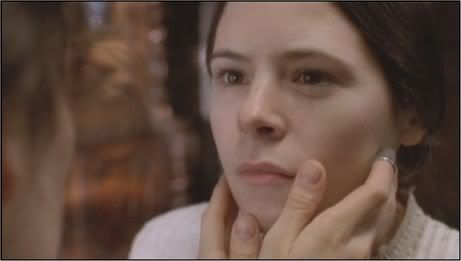
If you are interested in watching the movie or reading the book Fingersmith, you should probably know that there's a big twist and it has to do with exactly what this post is about. I knew the twist beforehand and I still love the book and movie, but if you want to be surprised, you should stop reading here.
Okay. (I'm talking about the book, but the movie doesn't change any of the facts--it just doesn't focus in on Maud's adolescence and sexuality as much as the book.)
So Fingersmith is a gothic novel about a 19th-century teenage pickpocket, Sue, who is hired to scam a sheltered girl named Maud. Maud lives with her uncle in the country and would inherit a lot of money from him if she ever got married--but it seems like she never will get married because she's so isolated. Gentleman, a con artist, is planning on marrying her and then getting her labeled as "mad" and put in an institution so he can have her money.
Sue's job is to be Maud's maid, become friends with her, and do anything possible to get her to fall in love with Gentleman and elope with him. Sue narrates in the movie, "When I saw her I thought: 'This is going to be easy.'" Maud is very stiff and soft-spoken and has nightmares every night (during which she begs Sue not to leave her alone). Sue has grown up taking care of babies and young children, so despite her plans to hurt Maud she has an instinctive protective reaction to Maud's anxious, childlike nature.
Maud is "developmentally delayed"--I don't use this as a euphemism for intellectual disability, but as a term for something that most disabled young adults have, both because of disability and as a result of being sheltered and not learning to be independent. Maud is young for her age. She does not understand how to do a lot of things that most people her age know how to do.
Sue becomes very attached to Maud, and ends up kissing and having sex with her because Maud claims not to know how to have sex. But she doesn't know how to stop what she's doing, and the con continues as planned. In the days after Maud and Gentleman have gotten married, but before Maud is institutionalized, Sue becomes more and more distraught and depressed about betraying someone she loves, someone who is so innocent. Then Maud steals Sue's identity, and Sue is institutionalized as Maud Lilly. Sue realizes that Maud was actually working with Gentleman to scam Sue.
The twist of the story is that Maud isn't a "pigeon," the term Gentleman uses for an easily manipulated person. This is already a "fuck yeah" moment for disabled readers. But what's even cooler is that Maud wasn't faking very much. She really is developmentally delayed and she really does have nightmares, and she really is very stiff and impaired when it comes to other people. Nonetheless, she is calculating and capable of doing evil.
The unevenness of Maud's abilities, the fallacy inherent in categorizing her as "childlike" or "adultlike," is encapsulated by her knowledge of sex. In the second part of the book, which is narrated by Maud, we learn that her uncle collects pornographic writing and images, and she has been his secretary since she was a child. The servants in the house don't know what her uncle's library consists of, and became unsettled by Maud because she would use sexual terms at a young age; this led to her losing their motherly support, after which she began to bully and harass them. Her uncle's friends are attracted to Maud when they visit the house and she reads porn to them--they think of her as sexy, impure, and probably available, though of course she's never even kissed anyone. After Maud has scammed Sue and is living in London, she tries to get help from one of her uncle's friends, but he refuses to associate with her because of her reputation.
Maud can't be categorized as a virgin or a whore; she is physically and emotionally untouched, but seen as damaged goods because of her intellectual knowledge. To me, the most beautiful passages in the book are those describing Maud's attraction to Sue--her surprise at realizing that something she's very intellectually familiar with could actually happen to her; that sexuality isn't the boring, mildly disgusting thing she always thought it was.
After putting Sue in the institution, Maud realizes that she is in love with Sue and wants to save her. But it's very difficult for her to do anything because she has no common sense or understanding of how to move around in a city. I won't summarize the rest of the book, but don't worry, everything turns out awesome and there are some more twists. I basically just want to talk about what a great mind-disabled character Maud is. She comes off at first as being completely guileless and unable to do anything. Then we find out that isn't true at all and she's a force to be reckoned with, but her disability doesn't just disappear; there really are things she can't do. And she's neither good or evil, she's both, just like all the other characters.
The character Maud Lilly, from the book and movie Fingersmith, is the second kind of character; she comes off as being like a person with ASD because of her life experience. Although this isn't the reason I love the book and movie--they're just incredibly fantastic and creative--it is probably the reason I find the love story so affecting, because Maud's experience of infatuation is so much like mine.
If you are interested in watching the movie or reading the book Fingersmith, you should probably know that there's a big twist and it has to do with exactly what this post is about. I knew the twist beforehand and I still love the book and movie, but if you want to be surprised, you should stop reading here.
Okay. (I'm talking about the book, but the movie doesn't change any of the facts--it just doesn't focus in on Maud's adolescence and sexuality as much as the book.)
So Fingersmith is a gothic novel about a 19th-century teenage pickpocket, Sue, who is hired to scam a sheltered girl named Maud. Maud lives with her uncle in the country and would inherit a lot of money from him if she ever got married--but it seems like she never will get married because she's so isolated. Gentleman, a con artist, is planning on marrying her and then getting her labeled as "mad" and put in an institution so he can have her money.
Sue's job is to be Maud's maid, become friends with her, and do anything possible to get her to fall in love with Gentleman and elope with him. Sue narrates in the movie, "When I saw her I thought: 'This is going to be easy.'" Maud is very stiff and soft-spoken and has nightmares every night (during which she begs Sue not to leave her alone). Sue has grown up taking care of babies and young children, so despite her plans to hurt Maud she has an instinctive protective reaction to Maud's anxious, childlike nature.
Maud is "developmentally delayed"--I don't use this as a euphemism for intellectual disability, but as a term for something that most disabled young adults have, both because of disability and as a result of being sheltered and not learning to be independent. Maud is young for her age. She does not understand how to do a lot of things that most people her age know how to do.
Sue becomes very attached to Maud, and ends up kissing and having sex with her because Maud claims not to know how to have sex. But she doesn't know how to stop what she's doing, and the con continues as planned. In the days after Maud and Gentleman have gotten married, but before Maud is institutionalized, Sue becomes more and more distraught and depressed about betraying someone she loves, someone who is so innocent. Then Maud steals Sue's identity, and Sue is institutionalized as Maud Lilly. Sue realizes that Maud was actually working with Gentleman to scam Sue.
The twist of the story is that Maud isn't a "pigeon," the term Gentleman uses for an easily manipulated person. This is already a "fuck yeah" moment for disabled readers. But what's even cooler is that Maud wasn't faking very much. She really is developmentally delayed and she really does have nightmares, and she really is very stiff and impaired when it comes to other people. Nonetheless, she is calculating and capable of doing evil.
The unevenness of Maud's abilities, the fallacy inherent in categorizing her as "childlike" or "adultlike," is encapsulated by her knowledge of sex. In the second part of the book, which is narrated by Maud, we learn that her uncle collects pornographic writing and images, and she has been his secretary since she was a child. The servants in the house don't know what her uncle's library consists of, and became unsettled by Maud because she would use sexual terms at a young age; this led to her losing their motherly support, after which she began to bully and harass them. Her uncle's friends are attracted to Maud when they visit the house and she reads porn to them--they think of her as sexy, impure, and probably available, though of course she's never even kissed anyone. After Maud has scammed Sue and is living in London, she tries to get help from one of her uncle's friends, but he refuses to associate with her because of her reputation.
Maud can't be categorized as a virgin or a whore; she is physically and emotionally untouched, but seen as damaged goods because of her intellectual knowledge. To me, the most beautiful passages in the book are those describing Maud's attraction to Sue--her surprise at realizing that something she's very intellectually familiar with could actually happen to her; that sexuality isn't the boring, mildly disgusting thing she always thought it was.
After putting Sue in the institution, Maud realizes that she is in love with Sue and wants to save her. But it's very difficult for her to do anything because she has no common sense or understanding of how to move around in a city. I won't summarize the rest of the book, but don't worry, everything turns out awesome and there are some more twists. I basically just want to talk about what a great mind-disabled character Maud is. She comes off at first as being completely guileless and unable to do anything. Then we find out that isn't true at all and she's a force to be reckoned with, but her disability doesn't just disappear; there really are things she can't do. And she's neither good or evil, she's both, just like all the other characters.
12 September, 2010
I want to develop this more but whatever
So one session at camp, two of my campers were named Mark* and David. They were both men in their forties who had Down Syndrome and had lived with their parents all their lives (well, David had just moved to what his parents called "a residence," a few days before camp started).
Mark's mom gave me a long talk about how slow Mark was, and so on. She stage-whispered that she had really spoiled him. But finally, she reassured me that Mark was "a fine young man."
WTF?
David's mom said similar things, I guess, about him being slow, but she didn't make me uncomfortable the way Mark's mom did. And she didn't refer to her middle-aged son as a young man.
This was the session that my brain completely shat out because I was working with people too much like me. I guess that technically David and Mark had similar problems. But when David was getting dressed and he spaced out, it was because he started playing with his shoe or very slowly organizing all his '80s TV show theme song tapes. Mark was just sitting there, staring at nothing and waiting.
David didn't like swimming, and when I asked him if he wanted to go swimming, he would say no. Mark would sort of shrug and smile shyly to himself and eventually say something that sounded like an agreement. Then he wouldn't change into his bathing suit and would eventually tell me that he was going to go swimming tomorrow, not today.
I was really stressed because they were both people who required a lot of focus on my part, but emotionally, David was much easier to take. I mean we had problems about a lot of things, but they were the kind of problems you want to have, if you know what I mean. He wanted to stay up and listen to music instead of going to bed. He wanted to make a speech to the whole camp about the circumstances of Michael Jackson's death. He got pissed because he had a really specific idea of what he wanted his Halloween Dance costume to look like, and we couldn't find clothes that fit his requirements.
Like most people who have been alive for four decades, David had preferences and habits. He was a fan of many TV shows, including M.A.S.H. and Dark Shadows, and he would tell me all about them (at my request). He hated to put his head under the water when he was taking a shower. He needed to sleep with a light on. Some of David's personality traits clashed with mine (I find it really hard to sleep with a light on) but, you know, that's what people are like.
Mark just agreed to everything with a sweet smile. He would very occasionally have bursts of energy where he would make really elaborate jokes I didn't understand. I acted really excited about these things because I wanted to encourage him to express himself more, and in fact I did find this stuff enjoyable, but it didn't happen that much.
I also felt uncomfortable because Mark seemed really detached from reality. For example he seemed to think that if he wrote down a schedule of what activities he thought should happen every day, that's what would actually happen. Because of the fact that he was hard to understand, I feel like I could totally be wrong in how I'm interpreting this--maybe it was just another joke--but I know that I was once a person who was very confused about what was coming in from the outside world, and equally confused about how I could affect it. In retrospect that was a scary time and I'm really glad I understand things better now and feel more in control. So it is upsetting to me to think that maybe Mark was stuck in that kind of experience of not really knowing how to affect his life.
I really, really hated living with Mark. On a day-to-day level, I just was frustrated because it was so hard to do daily living stuff with him like getting dressed and brushing teeth, but much deeper than that was the fact that he seemed so distant and, sometimes, submissive to the point of blankness. He made me incredibly uncomfortable, and I felt guilty for being frustrated with him, and guilty that I couldn't help him.
I complained to other counselors about the fact that Mark's mom called him a fine young man. If he'd lived with someone who thought he was a child, that could be why he hadn't developed the strong personality that David had. "No," another counselor replied, "it makes sense for her to say that. They are children. Especially people with Down Syndrome--their faces look so young. How old do you think my camper Josh is?" I guessed that Josh was twenty and the other counselor replied, "He's thirty," as if that proved something. I think he also told me not to be so judgmental of Mark's parents.
However, if Mark was a child, I wasn't clear on why he was writing letters to women asking them to "sleep in my bed please," sneaking into my bed when I was out, showing me this picture in the middle of the night [NOT SAFE FOR WORK NOT SAFE FOR WORK and imagine what it's like to be shown that by someone you've just met when you are half asleep], telling me I had nice legs, trying to kiss female counselors and campers, and other stuff that I don't want to talk about here. All this really freaked me out. Mark was not the only camper who ever acted like that, but there's a difference between someone who's very outgoing, and sometimes crosses the line into sexually inappropriate behavior, and someone who rarely initiates any contact with other people except when they are sexually harassing them. It made me scared of being around Mark--not necessarily scared about what he might say or do, but just scared about the way he was, and feeling like I was failing him because I couldn't understand him or connect with him.
Mark's mom was the only parent or guardian who ever tried to give me a tip when she picked him up from camp. We weren't supposed to take tips, and maybe there were one or two campers I would have taken a tip for, but I gave the money back without hesitating. I didn't feel like I had done a good job with Mark. I felt like I'd done a really shitty job. Mark's mom got mad at me and told me that "the girl last year took it--why won't you?" I tried to say that I already got a paycheck, and I was just doing my job. Finally Mark's mom gave up, got in the car with him and his dad, and said, "Well, I'll just give it to charity then."
"You should give it to something Mark likes," I mumbled as she drove away.
Mark's mom gave me a long talk about how slow Mark was, and so on. She stage-whispered that she had really spoiled him. But finally, she reassured me that Mark was "a fine young man."
WTF?
David's mom said similar things, I guess, about him being slow, but she didn't make me uncomfortable the way Mark's mom did. And she didn't refer to her middle-aged son as a young man.
This was the session that my brain completely shat out because I was working with people too much like me. I guess that technically David and Mark had similar problems. But when David was getting dressed and he spaced out, it was because he started playing with his shoe or very slowly organizing all his '80s TV show theme song tapes. Mark was just sitting there, staring at nothing and waiting.
David didn't like swimming, and when I asked him if he wanted to go swimming, he would say no. Mark would sort of shrug and smile shyly to himself and eventually say something that sounded like an agreement. Then he wouldn't change into his bathing suit and would eventually tell me that he was going to go swimming tomorrow, not today.
I was really stressed because they were both people who required a lot of focus on my part, but emotionally, David was much easier to take. I mean we had problems about a lot of things, but they were the kind of problems you want to have, if you know what I mean. He wanted to stay up and listen to music instead of going to bed. He wanted to make a speech to the whole camp about the circumstances of Michael Jackson's death. He got pissed because he had a really specific idea of what he wanted his Halloween Dance costume to look like, and we couldn't find clothes that fit his requirements.
Like most people who have been alive for four decades, David had preferences and habits. He was a fan of many TV shows, including M.A.S.H. and Dark Shadows, and he would tell me all about them (at my request). He hated to put his head under the water when he was taking a shower. He needed to sleep with a light on. Some of David's personality traits clashed with mine (I find it really hard to sleep with a light on) but, you know, that's what people are like.
Mark just agreed to everything with a sweet smile. He would very occasionally have bursts of energy where he would make really elaborate jokes I didn't understand. I acted really excited about these things because I wanted to encourage him to express himself more, and in fact I did find this stuff enjoyable, but it didn't happen that much.
I also felt uncomfortable because Mark seemed really detached from reality. For example he seemed to think that if he wrote down a schedule of what activities he thought should happen every day, that's what would actually happen. Because of the fact that he was hard to understand, I feel like I could totally be wrong in how I'm interpreting this--maybe it was just another joke--but I know that I was once a person who was very confused about what was coming in from the outside world, and equally confused about how I could affect it. In retrospect that was a scary time and I'm really glad I understand things better now and feel more in control. So it is upsetting to me to think that maybe Mark was stuck in that kind of experience of not really knowing how to affect his life.
I really, really hated living with Mark. On a day-to-day level, I just was frustrated because it was so hard to do daily living stuff with him like getting dressed and brushing teeth, but much deeper than that was the fact that he seemed so distant and, sometimes, submissive to the point of blankness. He made me incredibly uncomfortable, and I felt guilty for being frustrated with him, and guilty that I couldn't help him.
I complained to other counselors about the fact that Mark's mom called him a fine young man. If he'd lived with someone who thought he was a child, that could be why he hadn't developed the strong personality that David had. "No," another counselor replied, "it makes sense for her to say that. They are children. Especially people with Down Syndrome--their faces look so young. How old do you think my camper Josh is?" I guessed that Josh was twenty and the other counselor replied, "He's thirty," as if that proved something. I think he also told me not to be so judgmental of Mark's parents.
However, if Mark was a child, I wasn't clear on why he was writing letters to women asking them to "sleep in my bed please," sneaking into my bed when I was out, showing me this picture in the middle of the night [NOT SAFE FOR WORK NOT SAFE FOR WORK and imagine what it's like to be shown that by someone you've just met when you are half asleep], telling me I had nice legs, trying to kiss female counselors and campers, and other stuff that I don't want to talk about here. All this really freaked me out. Mark was not the only camper who ever acted like that, but there's a difference between someone who's very outgoing, and sometimes crosses the line into sexually inappropriate behavior, and someone who rarely initiates any contact with other people except when they are sexually harassing them. It made me scared of being around Mark--not necessarily scared about what he might say or do, but just scared about the way he was, and feeling like I was failing him because I couldn't understand him or connect with him.
Mark's mom was the only parent or guardian who ever tried to give me a tip when she picked him up from camp. We weren't supposed to take tips, and maybe there were one or two campers I would have taken a tip for, but I gave the money back without hesitating. I didn't feel like I had done a good job with Mark. I felt like I'd done a really shitty job. Mark's mom got mad at me and told me that "the girl last year took it--why won't you?" I tried to say that I already got a paycheck, and I was just doing my job. Finally Mark's mom gave up, got in the car with him and his dad, and said, "Well, I'll just give it to charity then."
"You should give it to something Mark likes," I mumbled as she drove away.
25 March, 2010
affectionate disability issues
The Joe and Amanda Adventure wasn't one, because Joe wasn't as smiley as last week, and the teachers said that all the kids were in a bad mood because it was the day after their field trip. Something else interesting happened, though. After circle time, the teacher dimmed the lights (which for some reason resulted in Joe yelling) and put on some quiet music and had the ambulatory kids sit on beanbags, and picked up Joe and put him on a beanbag. She laughed and said, "It's really more for my benefit than theirs."
There is a kid in the class named Zach who frequently cries and seems angry. I don't know what his disability is but it's the kind of thing where if I was more educated I'd probably be able to tell. He's very small, uses a wheelchair, and has a really small, short face and small eyes. I like Zach because he's always trying to take off his shoe so he can stim by waving his sock in front of his face. Today I think he seemed interested in my presence when I showed up in the middle of their gym class, he was kind of looking at me and clapping and stuff.
But yeah, he was making a lot of noise after the teacher had dimmed the lights, and she picked him up out of his wheelchair and put him on the floor. I couldn't tell if she did this as a punishment, or just because she thought it was more appropriate for what was supposed to be a relaxing time. I feel like if she was trying to relax him she would have put him on a beanbag. I just thought it was sort of weird.
Zach crawled over to me where I was sitting in a chair. He took hold of my arms and with my help lifted himself into a standing position. Then he sort of turned so I was holding him in my lap. I sort of hugged him, but I felt weird about it because he's fourteen. When I first met him I thought he was seven or eight at the oldest, and I wouldn't have reacted that way, but I just wasn't sure if it had different connotations given how old he is, so I sort of made him sit back down on the floor.
Then he crawled over to the other side of the room where his teacher had put his wheelchair, and I got up and went with him. Zach was sitting next to the wheelchair and touching it. He reached out to me and looked at the wheelchair. I felt really bad because it seemed like he wasn't comfortable not being in the wheelchair and was hoping that I would help him (I may be totally projecting, but I don't know why else he would crawl away to the corner of the room if not to be near his wheelchair). I quietly talked to him and told him that he couldn't go in his wheelchair yet but would probably get to be in it again after the class finished listening to music. I don't remember what else I said.
Anyway, he started kind of having me pull him into a standing position, and then he basically put his arms around me, and I was sort of holding him (I was kneeling, I think), and he had his face pretty close to mine and I think might have been trying to kiss me--I got a bit of an impression of that, at least, so I kept turning my head away.
Now that I write this out, it sounds a lot weirder than I thought it was at the time. I mean, from a little kid I wouldn't think it was weird. I also know some intellectually disabled people who are very physically affectionate with people they don't know well, and it doesn't bother me at all, I think it's awesome. But because I'm confused about what the nature of Zach's disability is, I didn't know how to react, whether to classify him as the kind of person from whom such a display would be cute.
I'm thinking about this more and thinking about what hugging and kissing means, and what it means to define someone as the kind of person from whom hugging and kissing is cute, and the kind of person from whom it's inappropriate. I'm not sure it even makes sense for me to act as if there are people who are always allowed to do it and people who always aren't. I met an intellectually disabled guy who, when meeting women who were wearing low-cut shirts, would take both their hands and shake them up and down, staring at their breasts--his way of greeting people obviously wasn't "cute," and he was rather creepily taking advantage of the fact that people were going to perceive physical contact from him as "cute" rather than as sexual. Another intellectually disabled person actually had to explain to my friend why she shouldn't let Adam shake her hand. On the other hand, I know a woman named Andrea who likes to hug and kiss people, especially people she's seen before, and it doesn't strike me as creepy. But it's theoretically possible that Andrea is doing this for sexual reasons, whether or not she's aware of it. But I just assume she's not. I'm not saying Andrea doesn't have a sex drive, but just that this particular action of hers isn't necessarily sexual, and it doesn't seem obviously sexual to me.
If a fourteen-year-old boy who didn't have a disability started hugging me and climbing up on me, I would absolutely not be okay with it. But let's say, even, that Zach has absolutely no intellectual disability at all, but just can't communicate--well, that still means he's had a hugely different life from the average boy his age. And the reason I'd be upset by the average boy his age doing that is not because I think every single thing a fourteen-year-old boy does is sexual, but because the average fourteen-year-old boy will be trained to think of that as sexual and inappropriate behavior, so if he's doing that, it's almost an act of violence and it's definitely disrespectful. I don't know if, out of that context, it is inappropriate.
And besides, my example of Adam shows that an intellectually disabled person can be creepy as fuck, so then can't the opposite also be true? Why does Zach have to be intellectually disabled for this to be okay?
I know it seems like I'm weirdly invested in arguing that it's okay for Zach to hug me. I think it's because platonic physical affection is a major part of my life and my identity. I used to call myself "heteroaffectionate," meaning I fall in love with guys (I'm not sexually attracted to guys, for those keeping track). Basically, I've had several male friends with whom I'd hold hands, spoon/sleep in the same bed, and just do sort of semi-ironic things, like kissing each other on the top of the head, being each other's Valentine, etc. And I can be really intense about these guys.
I'm not really heteroaffectionate to be honest; it's not like I actually don't have any romantic feelings for girls. That's kind of a joke. But because I don't really date, I've had to figure out that there are a lot of other ways of being close to people and caring about them, and I really don't like the idea that you can only be close to someone you're in a sexual relationship with (which is an impression I get from some straight girls I know). It's really weird for me in the early stages of friendships, sometimes, because I might not know if the guy knows I'm gay, or even if he does, I'm afraid that when I do things that are seen as too romantic, he might not know what to make of it. So I guess this is why I sort of jumped on my reaction of "oh shit, I don't know if Zach should be hugging me"--because I know from experience that lots and lots of kinds of affection are not about sex.
I mean, yeah, he may be a creeper (or an unconscious creeper, who doesn't get that he's being creepy, but is nonetheless hugging me for a sexual reason). But he also might not even like girls, or like anyone. Or maybe I'm not the kind of girl he's attracted to. There are all kinds of nonsexual reasons for Zach to try to get me to hold him--sensory needs, platonic affection, a desire to feel more high up and secure like he does in his wheelchair.
This may be an unpopular opinion, but I sometimes feel that assuming disabled people are always being sexual doesn't make any more sense than assuming that we never are.
P.S. I got to see Shawna, who is a little girl with autism and mental illness who I met two years ago, who was one of the first DD people I ever met. Well, she's not so little anymore, she's eleven, and she's really tall. She was just standing around near the gates of the gym so I went up and talked to her and put out my hand, and she held my hand and reached out and touched my collar, which I recall she does a lot. She was saying something she maybe used to say, that sounds like "walking, walking, walking" or maybe "wanting, wanting, wanting"--but after a minute one of her teachers told her to come away from the gates.
There is a kid in the class named Zach who frequently cries and seems angry. I don't know what his disability is but it's the kind of thing where if I was more educated I'd probably be able to tell. He's very small, uses a wheelchair, and has a really small, short face and small eyes. I like Zach because he's always trying to take off his shoe so he can stim by waving his sock in front of his face. Today I think he seemed interested in my presence when I showed up in the middle of their gym class, he was kind of looking at me and clapping and stuff.
But yeah, he was making a lot of noise after the teacher had dimmed the lights, and she picked him up out of his wheelchair and put him on the floor. I couldn't tell if she did this as a punishment, or just because she thought it was more appropriate for what was supposed to be a relaxing time. I feel like if she was trying to relax him she would have put him on a beanbag. I just thought it was sort of weird.
Zach crawled over to me where I was sitting in a chair. He took hold of my arms and with my help lifted himself into a standing position. Then he sort of turned so I was holding him in my lap. I sort of hugged him, but I felt weird about it because he's fourteen. When I first met him I thought he was seven or eight at the oldest, and I wouldn't have reacted that way, but I just wasn't sure if it had different connotations given how old he is, so I sort of made him sit back down on the floor.
Then he crawled over to the other side of the room where his teacher had put his wheelchair, and I got up and went with him. Zach was sitting next to the wheelchair and touching it. He reached out to me and looked at the wheelchair. I felt really bad because it seemed like he wasn't comfortable not being in the wheelchair and was hoping that I would help him (I may be totally projecting, but I don't know why else he would crawl away to the corner of the room if not to be near his wheelchair). I quietly talked to him and told him that he couldn't go in his wheelchair yet but would probably get to be in it again after the class finished listening to music. I don't remember what else I said.
Anyway, he started kind of having me pull him into a standing position, and then he basically put his arms around me, and I was sort of holding him (I was kneeling, I think), and he had his face pretty close to mine and I think might have been trying to kiss me--I got a bit of an impression of that, at least, so I kept turning my head away.
Now that I write this out, it sounds a lot weirder than I thought it was at the time. I mean, from a little kid I wouldn't think it was weird. I also know some intellectually disabled people who are very physically affectionate with people they don't know well, and it doesn't bother me at all, I think it's awesome. But because I'm confused about what the nature of Zach's disability is, I didn't know how to react, whether to classify him as the kind of person from whom such a display would be cute.
I'm thinking about this more and thinking about what hugging and kissing means, and what it means to define someone as the kind of person from whom hugging and kissing is cute, and the kind of person from whom it's inappropriate. I'm not sure it even makes sense for me to act as if there are people who are always allowed to do it and people who always aren't. I met an intellectually disabled guy who, when meeting women who were wearing low-cut shirts, would take both their hands and shake them up and down, staring at their breasts--his way of greeting people obviously wasn't "cute," and he was rather creepily taking advantage of the fact that people were going to perceive physical contact from him as "cute" rather than as sexual. Another intellectually disabled person actually had to explain to my friend why she shouldn't let Adam shake her hand. On the other hand, I know a woman named Andrea who likes to hug and kiss people, especially people she's seen before, and it doesn't strike me as creepy. But it's theoretically possible that Andrea is doing this for sexual reasons, whether or not she's aware of it. But I just assume she's not. I'm not saying Andrea doesn't have a sex drive, but just that this particular action of hers isn't necessarily sexual, and it doesn't seem obviously sexual to me.
If a fourteen-year-old boy who didn't have a disability started hugging me and climbing up on me, I would absolutely not be okay with it. But let's say, even, that Zach has absolutely no intellectual disability at all, but just can't communicate--well, that still means he's had a hugely different life from the average boy his age. And the reason I'd be upset by the average boy his age doing that is not because I think every single thing a fourteen-year-old boy does is sexual, but because the average fourteen-year-old boy will be trained to think of that as sexual and inappropriate behavior, so if he's doing that, it's almost an act of violence and it's definitely disrespectful. I don't know if, out of that context, it is inappropriate.
And besides, my example of Adam shows that an intellectually disabled person can be creepy as fuck, so then can't the opposite also be true? Why does Zach have to be intellectually disabled for this to be okay?
I know it seems like I'm weirdly invested in arguing that it's okay for Zach to hug me. I think it's because platonic physical affection is a major part of my life and my identity. I used to call myself "heteroaffectionate," meaning I fall in love with guys (I'm not sexually attracted to guys, for those keeping track). Basically, I've had several male friends with whom I'd hold hands, spoon/sleep in the same bed, and just do sort of semi-ironic things, like kissing each other on the top of the head, being each other's Valentine, etc. And I can be really intense about these guys.
I'm not really heteroaffectionate to be honest; it's not like I actually don't have any romantic feelings for girls. That's kind of a joke. But because I don't really date, I've had to figure out that there are a lot of other ways of being close to people and caring about them, and I really don't like the idea that you can only be close to someone you're in a sexual relationship with (which is an impression I get from some straight girls I know). It's really weird for me in the early stages of friendships, sometimes, because I might not know if the guy knows I'm gay, or even if he does, I'm afraid that when I do things that are seen as too romantic, he might not know what to make of it. So I guess this is why I sort of jumped on my reaction of "oh shit, I don't know if Zach should be hugging me"--because I know from experience that lots and lots of kinds of affection are not about sex.
I mean, yeah, he may be a creeper (or an unconscious creeper, who doesn't get that he's being creepy, but is nonetheless hugging me for a sexual reason). But he also might not even like girls, or like anyone. Or maybe I'm not the kind of girl he's attracted to. There are all kinds of nonsexual reasons for Zach to try to get me to hold him--sensory needs, platonic affection, a desire to feel more high up and secure like he does in his wheelchair.
This may be an unpopular opinion, but I sometimes feel that assuming disabled people are always being sexual doesn't make any more sense than assuming that we never are.
P.S. I got to see Shawna, who is a little girl with autism and mental illness who I met two years ago, who was one of the first DD people I ever met. Well, she's not so little anymore, she's eleven, and she's really tall. She was just standing around near the gates of the gym so I went up and talked to her and put out my hand, and she held my hand and reached out and touched my collar, which I recall she does a lot. She was saying something she maybe used to say, that sounds like "walking, walking, walking" or maybe "wanting, wanting, wanting"--but after a minute one of her teachers told her to come away from the gates.
Subscribe to:
Posts (Atom)