The reason I've been thinking about intersectionality even more than usual is that I keep seeing these little queer/trans (usually just queer, but trans, in this case) vs. disabled setups.
Sometimes the person doing it doesn't see it.
A queer person attempts to talk about intersectionality and they list race and class. Talking about situations where disability would OBVIOUSLY be an issue, they list race and class.
A guy wrote a column in the school newspaper saying that the "It Gets Better" project is comparable to telling someone to stay in an abusive relationship and it should be called the "You Can Make It Better" project. (Maybe I need to explain my reaction to this further, but--how does he know?)
Then these actual open conflicts happen. How dare anorexic cis people say they have body dysphoria! Or, my favorite--how dare Autistic people (assumed to be straight, usually wrongly, as the Autistic community is heavily queer) try to explain our situation by saying, "What if all the dialogue about gay people was controlled by straight people and was about curing homosexuality?" We obviously don't understand Their Struggles. After all, a gay person pointed out in this conversation, no one gets killed for being Autistic.
Brilliant, guys.
In terms of the Autistic community, at least, it just especially bugs me because...it's so queer, and not just because many of us are. A straight person in the Autistic community is so much smarter and more familiar, when it comes to queer stuff, than nearly any non-disabled straight person, because you just can't get away from queerness. So like, when a bunch of queer non-disabled people who know nothing about disability, the Autistic experience in particular, or our community, start fucking trying to educate us because they think we're cluelessly comparing ourselves to them, I just explode. My head explodes. There are little pieces of my skull and hair lying on the floor around me.
QUIT IT.
I'm taking a student-taught class where we watch Disney movies and analyze the portrayal of (mostly) gender and sexuality, but other stuff when it comes up. Most of the people in the class are queer. Someone asked me what my paper was on, and I said it was on non-humans trying to be human and how that relates to disability. "Oh, wow, disability?" the person said like I was so creative for thinking of such a thing.
Showing posts with label disabled queerness. Show all posts
Showing posts with label disabled queerness. Show all posts
23 March, 2011

27 February, 2011
Arnie and the New Kid
I have so much affection for Arnie and the New Kid by Nancy Carlson, who wrote a ton of books for kids about anthropomorphic animals. I wrote about this on tumblr but I just want to write about it again because it ties into what I've written about disabled queerness. Also, it's incredibly cute.
Arnie is a non-disabled cat who is quick to make fun of Phillip, a dog who uses a wheelchair. (I loved writing this sentence.) One day, Arnie is shambling around pretending to be Phillip, holding his arms up to his chest or whatever in an attempt to look disabled, and instead of getting an Oscar or an Academy Award like if he was a human, he falls down the stairs and injures his leg, wrist, and tail. Cut to Arnie wearing an adorable brace on his tail, using crutches, and needing much more help with things than Phillip ever did.
Like Harry Potter, Phillip has the social grace of a saint and befriends Arnie even though Arnie was a dick to him. Arnie and Phillip start spending all their time together doing the things Phillip likes to do--like playing video games, trading baseball cards, and birdwatching. (I especially love the page that shows them in a theater, watching a horror movie through their paws.) Of course, Arnie recovers from his injuries and goes to play baseball, which was one of the things he originally bullied Phillip for not being able to do. Phillip is worried that their friendship is over, but then Arnie says that Phillip will come along and be the coach.
I've read a review criticizing this book for exactly the reason I like it: Phillip is a loser who needs Arnie's help to be included socially. Well, Phillip is not a loser in my estimation, but he isn't so incredibly cool that he can overcome the stigma of disability, especially when Arnie is constantly drawing attention to everything Phillip can't do. What accounts for this failure of character? PHILLIP IS AN ELEMENTARY SCHOOL KID. Not every kid can go into a new school and have everyone be staring at them and bullying them, and deal with that competently and make a lot of friends.
Phillip is just an ordinary, nerdy kid--and by Arnie's standards, he really is a loser. He takes longer to eat, can't race, and can't play baseball. Basically, Phillip is slow, which dooms him not to be taken seriously by many of the kids.
But then, when Arnie is injured, we learn that Phillip has all these other interests and abilities that don't relate to whether he can walk or perform complex tasks with his hands. Arnie has a great time when he's temporarily disabled, and this, I think, is what keeps Arnie and the New Kid from being a book about charity or pity. Arnie doesn't think, "Wow, being disabled is awful, I should be nicer to Phillip." He learns that Phillip is actually a fun person and a good friend. He learns that his conception of what makes someone a loser was wrong.
When Arnie asks Phillip to be his coach, yes, he is making an effort to include him and maybe Arnie's actions will be the key to Phillip's social success. But Arnie makes the effort because he's grateful to Phillip and likes spending time with him, not because it's the nice thing to do. Arnie's decision is ultimately not about his own good qualities, but Phillip's.
I actually feel really frustrated by the idea that it's offensive to portray a disabled character needing help or being socially isolated. Phillip is not portrayed as weak or unpleasant at all; he's just up against a lot of ableism which, being a child, he can't handle all by himself. If Phillip was some kind of amazing superdog who could play baseball in his wheelchair and advocate for himself to be included in the games and be such an all-around badass that no one even noticed he was disabled, that would be an incredibly unfair image to show to kids. Most disabled kids cannot be that and shouldn't be made to feel that that is what they have to be in order to succeed. Non-disabled kids shouldn't be told that instead of adjusting their ideas of what you can do with a friend, or what qualities make someone cool, they can just wait for a supercrip who forces his way into their world and adjusts to their standards. Because they will be waiting a long time and, while they wait, some of them will be bullying ordinary disabled kids.
I'm thinking of making a series of posts about disability-related children's books, which would hopefully involve a lot of DISCUSSION! I'm wondering if anyone else read this book and what they thought of it. Obviously I am not a wheelchair user so I may have missed something really egregious. (One problem I have with the book is that Phillip obviously needs an aide and doesn't have one, so the nicer kids are always doing stuff for him. Really, really not a good message to send.)
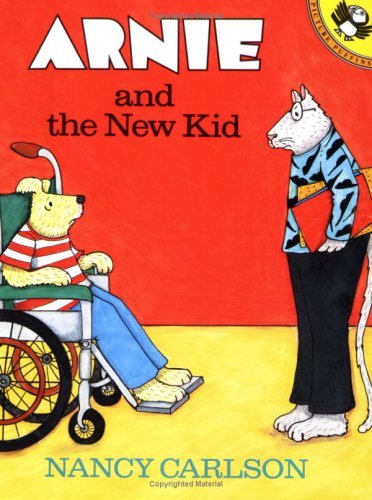
Image description: cover of the book Arnie and the New Kid. On the left side of the picture, Phillip, a yellow dog wearing a t-shirt and jeans, sits in a wheelchair. On the right side, Arnie, a gray cat wearing glasses, black pants, and a shirt with mice on it, is standing and holding some books. Arnie is practically looming over Phillip with a mean look on his face, and Phillip looks scared.
Arnie is a non-disabled cat who is quick to make fun of Phillip, a dog who uses a wheelchair. (I loved writing this sentence.) One day, Arnie is shambling around pretending to be Phillip, holding his arms up to his chest or whatever in an attempt to look disabled, and instead of getting an Oscar or an Academy Award like if he was a human, he falls down the stairs and injures his leg, wrist, and tail. Cut to Arnie wearing an adorable brace on his tail, using crutches, and needing much more help with things than Phillip ever did.
Like Harry Potter, Phillip has the social grace of a saint and befriends Arnie even though Arnie was a dick to him. Arnie and Phillip start spending all their time together doing the things Phillip likes to do--like playing video games, trading baseball cards, and birdwatching. (I especially love the page that shows them in a theater, watching a horror movie through their paws.) Of course, Arnie recovers from his injuries and goes to play baseball, which was one of the things he originally bullied Phillip for not being able to do. Phillip is worried that their friendship is over, but then Arnie says that Phillip will come along and be the coach.
I've read a review criticizing this book for exactly the reason I like it: Phillip is a loser who needs Arnie's help to be included socially. Well, Phillip is not a loser in my estimation, but he isn't so incredibly cool that he can overcome the stigma of disability, especially when Arnie is constantly drawing attention to everything Phillip can't do. What accounts for this failure of character? PHILLIP IS AN ELEMENTARY SCHOOL KID. Not every kid can go into a new school and have everyone be staring at them and bullying them, and deal with that competently and make a lot of friends.
Phillip is just an ordinary, nerdy kid--and by Arnie's standards, he really is a loser. He takes longer to eat, can't race, and can't play baseball. Basically, Phillip is slow, which dooms him not to be taken seriously by many of the kids.
But then, when Arnie is injured, we learn that Phillip has all these other interests and abilities that don't relate to whether he can walk or perform complex tasks with his hands. Arnie has a great time when he's temporarily disabled, and this, I think, is what keeps Arnie and the New Kid from being a book about charity or pity. Arnie doesn't think, "Wow, being disabled is awful, I should be nicer to Phillip." He learns that Phillip is actually a fun person and a good friend. He learns that his conception of what makes someone a loser was wrong.
When Arnie asks Phillip to be his coach, yes, he is making an effort to include him and maybe Arnie's actions will be the key to Phillip's social success. But Arnie makes the effort because he's grateful to Phillip and likes spending time with him, not because it's the nice thing to do. Arnie's decision is ultimately not about his own good qualities, but Phillip's.
I actually feel really frustrated by the idea that it's offensive to portray a disabled character needing help or being socially isolated. Phillip is not portrayed as weak or unpleasant at all; he's just up against a lot of ableism which, being a child, he can't handle all by himself. If Phillip was some kind of amazing superdog who could play baseball in his wheelchair and advocate for himself to be included in the games and be such an all-around badass that no one even noticed he was disabled, that would be an incredibly unfair image to show to kids. Most disabled kids cannot be that and shouldn't be made to feel that that is what they have to be in order to succeed. Non-disabled kids shouldn't be told that instead of adjusting their ideas of what you can do with a friend, or what qualities make someone cool, they can just wait for a supercrip who forces his way into their world and adjusts to their standards. Because they will be waiting a long time and, while they wait, some of them will be bullying ordinary disabled kids.
I'm thinking of making a series of posts about disability-related children's books, which would hopefully involve a lot of DISCUSSION! I'm wondering if anyone else read this book and what they thought of it. Obviously I am not a wheelchair user so I may have missed something really egregious. (One problem I have with the book is that Phillip obviously needs an aide and doesn't have one, so the nicer kids are always doing stuff for him. Really, really not a good message to send.)
Image description: cover of the book Arnie and the New Kid. On the left side of the picture, Phillip, a yellow dog wearing a t-shirt and jeans, sits in a wheelchair. On the right side, Arnie, a gray cat wearing glasses, black pants, and a shirt with mice on it, is standing and holding some books. Arnie is practically looming over Phillip with a mean look on his face, and Phillip looks scared.
22 February, 2011
religion, queerness, disability, background, and consent
I was at my college's queer/faith group today and felt kind of bad because I said something like, "I'm not from a religious background and I came to God through being queer so it's really weird for me when people see gay + Christian and imagine that I have some sort of conflict or that this has caused trauma for me." (Or even imagine that I realized those things in the opposite order from when I actually did.)
This seems really privileged as if I think that the reason people see gay + Christian and associate that with a really terrible set of experiences is just some anti-religion bias. I mean, the people who've said this to me are atheists so I do feel a little bit like they're stereotyping Christianity and religion in general and failing to understand that at its core there's nothing that would inherently be my enemy as a queer person. And I kind of like expressing how much that isn't my experience because my type of experience is so rarely expressed.
At the same time, it's a very rare experience. I grew up with liberal atheist parents and I go to a college that is primarily liberal atheist--that is a tremendous privilege for a gay person. So for me to be like, "Yeah, God and I are buddies, why wouldn't we be?" is kind of a dick move. It's actually kind of like the way I feel about queer people who have overcome certain things, that I can't overcome as easily due to being disabled, and act like all queer people can overcome those things.
I know a lot of people's experience is one of religion being forced on them. But mine is one of being expected not to be religious and even feeling uncomfortable as a religious person in the spaces I tend to be in, and once having someone compare the fact that I believe in God to unusual stuff I do that's related to my disability. Which is really not cool.
This also applies to disability. My disability has been (cognitively and emotionally) a huge barrier to my ability to participate in things like church--largely because church is unfamiliar. So I'm very jealous of my liberal atheist and otherwise non-Christian* friends who had a sort of upbringing where they were brought to church, confirmed, etc., and the fact that they went away from that wasn't such a big deal to their families but it was just kind of how they did things as they were growing up. Because that structure would have been really important and my life would be totally different if I'd had it. I'm really lucky that my dad is as supportive as he is or I would never have (finally) been baptized and would have even less experience going to church than I do.
*(not that atheist=non-Christian but I'm thinking of people who are agnostic or "spiritual but not religious"--not people who have converted to another religion or heavily identify as anything.)
When I was a kid I had a babysitter who was Catholic and would pray with me when she put me to bed, against my parents' wishes. I'm extremely grateful for this because it gave me familiarity with prayer and the knowledge that it was an option. I still pray the way she taught me, every night. But I know what most atheists, and even many Christians, would think of her decision. And I don't know how to reconcile that with my gratitude.
I'm looking for a job next year and I'm interested in a particular facility for kids and teenagers with disabilities, which is Christian. It would be really wonderful for me to work in an environment that's Christian and I do relate being staff to being Christian (I don't mean this the way it probably sounds, but it's a huge other thing to talk about--it has nothing to do with me being better than the people I serve). But I feel creeped out also because, while they write on their website that the people they serve have a choice about being Christian or going to church, religious education, etc., they use the word "encourage."
In my experience, some people with disabilities have been taught to be compliant to the extent that if you "encourage" them to do something, or even ask them if they want to do something, they perceive it as an order.
I mean, I also have known people--and actually, this doesn't just mean more severely disabled people who I've been staff for, this also includes me, and maybe this includes me more than anything in terms of religion--who have a very hard time saying they want to do something, asking to do something, even saying "yes." My camper Stephen from this summer would say no to everything, including things he had previously shown he liked; after bringing up the subject again and again, you might be able to find out whether he really didn't want to. Sometimes this didn't work and you had to put him in a position where he had to make an effort to opt out, instead of to opt in--this was generally how you found out for sure what he really wanted.
I'm not saying this in terms of the facility, because that word encourage really does bother me and I'm not applying there until I can figure out what it means. But when it comes to religion, I am a great deal like Stephen. Which is very confusing for me and which, I'm afraid, often results in me saying things that ignore the very nonconsensual and/or negative history that a lot of people from my communities have with religion.
This seems really privileged as if I think that the reason people see gay + Christian and associate that with a really terrible set of experiences is just some anti-religion bias. I mean, the people who've said this to me are atheists so I do feel a little bit like they're stereotyping Christianity and religion in general and failing to understand that at its core there's nothing that would inherently be my enemy as a queer person. And I kind of like expressing how much that isn't my experience because my type of experience is so rarely expressed.
At the same time, it's a very rare experience. I grew up with liberal atheist parents and I go to a college that is primarily liberal atheist--that is a tremendous privilege for a gay person. So for me to be like, "Yeah, God and I are buddies, why wouldn't we be?" is kind of a dick move. It's actually kind of like the way I feel about queer people who have overcome certain things, that I can't overcome as easily due to being disabled, and act like all queer people can overcome those things.
I know a lot of people's experience is one of religion being forced on them. But mine is one of being expected not to be religious and even feeling uncomfortable as a religious person in the spaces I tend to be in, and once having someone compare the fact that I believe in God to unusual stuff I do that's related to my disability. Which is really not cool.
This also applies to disability. My disability has been (cognitively and emotionally) a huge barrier to my ability to participate in things like church--largely because church is unfamiliar. So I'm very jealous of my liberal atheist and otherwise non-Christian* friends who had a sort of upbringing where they were brought to church, confirmed, etc., and the fact that they went away from that wasn't such a big deal to their families but it was just kind of how they did things as they were growing up. Because that structure would have been really important and my life would be totally different if I'd had it. I'm really lucky that my dad is as supportive as he is or I would never have (finally) been baptized and would have even less experience going to church than I do.
*(not that atheist=non-Christian but I'm thinking of people who are agnostic or "spiritual but not religious"--not people who have converted to another religion or heavily identify as anything.)
When I was a kid I had a babysitter who was Catholic and would pray with me when she put me to bed, against my parents' wishes. I'm extremely grateful for this because it gave me familiarity with prayer and the knowledge that it was an option. I still pray the way she taught me, every night. But I know what most atheists, and even many Christians, would think of her decision. And I don't know how to reconcile that with my gratitude.
I'm looking for a job next year and I'm interested in a particular facility for kids and teenagers with disabilities, which is Christian. It would be really wonderful for me to work in an environment that's Christian and I do relate being staff to being Christian (I don't mean this the way it probably sounds, but it's a huge other thing to talk about--it has nothing to do with me being better than the people I serve). But I feel creeped out also because, while they write on their website that the people they serve have a choice about being Christian or going to church, religious education, etc., they use the word "encourage."
In my experience, some people with disabilities have been taught to be compliant to the extent that if you "encourage" them to do something, or even ask them if they want to do something, they perceive it as an order.
I mean, I also have known people--and actually, this doesn't just mean more severely disabled people who I've been staff for, this also includes me, and maybe this includes me more than anything in terms of religion--who have a very hard time saying they want to do something, asking to do something, even saying "yes." My camper Stephen from this summer would say no to everything, including things he had previously shown he liked; after bringing up the subject again and again, you might be able to find out whether he really didn't want to. Sometimes this didn't work and you had to put him in a position where he had to make an effort to opt out, instead of to opt in--this was generally how you found out for sure what he really wanted.
I'm not saying this in terms of the facility, because that word encourage really does bother me and I'm not applying there until I can figure out what it means. But when it comes to religion, I am a great deal like Stephen. Which is very confusing for me and which, I'm afraid, often results in me saying things that ignore the very nonconsensual and/or negative history that a lot of people from my communities have with religion.
15 February, 2011
notes on my awesome book
Maybe you recall I am writing a book where I attempt to parody and reclaim a certain horror/pulp/gothic fiction trope where some or all of the following qualities:
breaking gender norms
same-sex-attraction
oddness, illness, and/or disability
childhood trauma
evil
depression
obsessive, unhealthy love
are treated as being related to each other and causing each other.
EG's mom killed EG's dad when EG was very little and was never caught. EG grew up with her mom in a very cold and isolated unit. Everything was super gothic, down to their house and their town, so EG's experience of life is very gothic as well. (I'm using initials because I don't like EG's current name.)
EG sits in her dad's study all the time and reads all her dad's favorite books and does all the things he liked to do and wear his clothes. When she is about 11, she begins to be sexually attracted to girls, which she sees as a manifestation of her father's spirit inside her. EG feels the way about her dad's ghost that some people feel about the Holy Spirit--it is working in her and changing her to make her more like him so she can stay close to him her whole life. So being attracted to girls is kind of like being able to speak in tongues.
Of course it's also a difficult and frustrating gift because EG still looks like EG and is treated as a girl when she goes out into the world, but she is her dad.
One reason I like this idea is because the narrative of lesbians and masculine women is always a narrative about hate--lesbians hate men, hate society, hate femininity. It's always an escape and rejection. Whereas EG resembles the most cliched lesbian characters but her narrative is one of love and seeking home. The difference between wearing men's clothes and wearing a particular man's clothes.
breaking gender norms
same-sex-attraction
oddness, illness, and/or disability
childhood trauma
evil
depression
obsessive, unhealthy love
are treated as being related to each other and causing each other.
EG's mom killed EG's dad when EG was very little and was never caught. EG grew up with her mom in a very cold and isolated unit. Everything was super gothic, down to their house and their town, so EG's experience of life is very gothic as well. (I'm using initials because I don't like EG's current name.)
EG sits in her dad's study all the time and reads all her dad's favorite books and does all the things he liked to do and wear his clothes. When she is about 11, she begins to be sexually attracted to girls, which she sees as a manifestation of her father's spirit inside her. EG feels the way about her dad's ghost that some people feel about the Holy Spirit--it is working in her and changing her to make her more like him so she can stay close to him her whole life. So being attracted to girls is kind of like being able to speak in tongues.
Of course it's also a difficult and frustrating gift because EG still looks like EG and is treated as a girl when she goes out into the world, but she is her dad.
One reason I like this idea is because the narrative of lesbians and masculine women is always a narrative about hate--lesbians hate men, hate society, hate femininity. It's always an escape and rejection. Whereas EG resembles the most cliched lesbian characters but her narrative is one of love and seeking home. The difference between wearing men's clothes and wearing a particular man's clothes.
20 October, 2010
disabling queerness: Fingersmith
Before I start, there are two kinds of ASD (or generally mind-disabled) characters, besides those who are actually canonically identified as having ASD. There are people like Pete Campbell where I sincerely think that if they were a real person born in 2000, they would be diagnosed with ASD. Then there are people like River Tam from Firefly, who obviously doesn't literally have ASD or schizophrenia, because we know that her ASD/schizophrenic traits come from emotional trauma and brain injury. If I write something "reading" River as a person like me, I'm not trying to deny the canon of the show, but just saying that functionally, she is kind of like people with certain disabilities, and can be identified with/claimed by us.
The character Maud Lilly, from the book and movie Fingersmith, is the second kind of character; she comes off as being like a person with ASD because of her life experience. Although this isn't the reason I love the book and movie--they're just incredibly fantastic and creative--it is probably the reason I find the love story so affecting, because Maud's experience of infatuation is so much like mine.
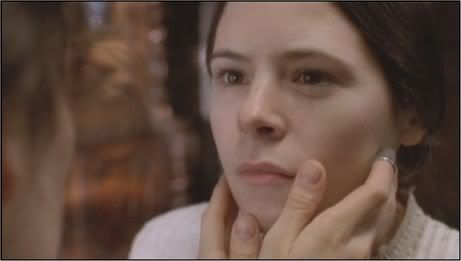
If you are interested in watching the movie or reading the book Fingersmith, you should probably know that there's a big twist and it has to do with exactly what this post is about. I knew the twist beforehand and I still love the book and movie, but if you want to be surprised, you should stop reading here.
Okay. (I'm talking about the book, but the movie doesn't change any of the facts--it just doesn't focus in on Maud's adolescence and sexuality as much as the book.)
So Fingersmith is a gothic novel about a 19th-century teenage pickpocket, Sue, who is hired to scam a sheltered girl named Maud. Maud lives with her uncle in the country and would inherit a lot of money from him if she ever got married--but it seems like she never will get married because she's so isolated. Gentleman, a con artist, is planning on marrying her and then getting her labeled as "mad" and put in an institution so he can have her money.
Sue's job is to be Maud's maid, become friends with her, and do anything possible to get her to fall in love with Gentleman and elope with him. Sue narrates in the movie, "When I saw her I thought: 'This is going to be easy.'" Maud is very stiff and soft-spoken and has nightmares every night (during which she begs Sue not to leave her alone). Sue has grown up taking care of babies and young children, so despite her plans to hurt Maud she has an instinctive protective reaction to Maud's anxious, childlike nature.
Maud is "developmentally delayed"--I don't use this as a euphemism for intellectual disability, but as a term for something that most disabled young adults have, both because of disability and as a result of being sheltered and not learning to be independent. Maud is young for her age. She does not understand how to do a lot of things that most people her age know how to do.
Sue becomes very attached to Maud, and ends up kissing and having sex with her because Maud claims not to know how to have sex. But she doesn't know how to stop what she's doing, and the con continues as planned. In the days after Maud and Gentleman have gotten married, but before Maud is institutionalized, Sue becomes more and more distraught and depressed about betraying someone she loves, someone who is so innocent. Then Maud steals Sue's identity, and Sue is institutionalized as Maud Lilly. Sue realizes that Maud was actually working with Gentleman to scam Sue.
The twist of the story is that Maud isn't a "pigeon," the term Gentleman uses for an easily manipulated person. This is already a "fuck yeah" moment for disabled readers. But what's even cooler is that Maud wasn't faking very much. She really is developmentally delayed and she really does have nightmares, and she really is very stiff and impaired when it comes to other people. Nonetheless, she is calculating and capable of doing evil.
The unevenness of Maud's abilities, the fallacy inherent in categorizing her as "childlike" or "adultlike," is encapsulated by her knowledge of sex. In the second part of the book, which is narrated by Maud, we learn that her uncle collects pornographic writing and images, and she has been his secretary since she was a child. The servants in the house don't know what her uncle's library consists of, and became unsettled by Maud because she would use sexual terms at a young age; this led to her losing their motherly support, after which she began to bully and harass them. Her uncle's friends are attracted to Maud when they visit the house and she reads porn to them--they think of her as sexy, impure, and probably available, though of course she's never even kissed anyone. After Maud has scammed Sue and is living in London, she tries to get help from one of her uncle's friends, but he refuses to associate with her because of her reputation.
Maud can't be categorized as a virgin or a whore; she is physically and emotionally untouched, but seen as damaged goods because of her intellectual knowledge. To me, the most beautiful passages in the book are those describing Maud's attraction to Sue--her surprise at realizing that something she's very intellectually familiar with could actually happen to her; that sexuality isn't the boring, mildly disgusting thing she always thought it was.
After putting Sue in the institution, Maud realizes that she is in love with Sue and wants to save her. But it's very difficult for her to do anything because she has no common sense or understanding of how to move around in a city. I won't summarize the rest of the book, but don't worry, everything turns out awesome and there are some more twists. I basically just want to talk about what a great mind-disabled character Maud is. She comes off at first as being completely guileless and unable to do anything. Then we find out that isn't true at all and she's a force to be reckoned with, but her disability doesn't just disappear; there really are things she can't do. And she's neither good or evil, she's both, just like all the other characters.
The character Maud Lilly, from the book and movie Fingersmith, is the second kind of character; she comes off as being like a person with ASD because of her life experience. Although this isn't the reason I love the book and movie--they're just incredibly fantastic and creative--it is probably the reason I find the love story so affecting, because Maud's experience of infatuation is so much like mine.
If you are interested in watching the movie or reading the book Fingersmith, you should probably know that there's a big twist and it has to do with exactly what this post is about. I knew the twist beforehand and I still love the book and movie, but if you want to be surprised, you should stop reading here.
Okay. (I'm talking about the book, but the movie doesn't change any of the facts--it just doesn't focus in on Maud's adolescence and sexuality as much as the book.)
So Fingersmith is a gothic novel about a 19th-century teenage pickpocket, Sue, who is hired to scam a sheltered girl named Maud. Maud lives with her uncle in the country and would inherit a lot of money from him if she ever got married--but it seems like she never will get married because she's so isolated. Gentleman, a con artist, is planning on marrying her and then getting her labeled as "mad" and put in an institution so he can have her money.
Sue's job is to be Maud's maid, become friends with her, and do anything possible to get her to fall in love with Gentleman and elope with him. Sue narrates in the movie, "When I saw her I thought: 'This is going to be easy.'" Maud is very stiff and soft-spoken and has nightmares every night (during which she begs Sue not to leave her alone). Sue has grown up taking care of babies and young children, so despite her plans to hurt Maud she has an instinctive protective reaction to Maud's anxious, childlike nature.
Maud is "developmentally delayed"--I don't use this as a euphemism for intellectual disability, but as a term for something that most disabled young adults have, both because of disability and as a result of being sheltered and not learning to be independent. Maud is young for her age. She does not understand how to do a lot of things that most people her age know how to do.
Sue becomes very attached to Maud, and ends up kissing and having sex with her because Maud claims not to know how to have sex. But she doesn't know how to stop what she's doing, and the con continues as planned. In the days after Maud and Gentleman have gotten married, but before Maud is institutionalized, Sue becomes more and more distraught and depressed about betraying someone she loves, someone who is so innocent. Then Maud steals Sue's identity, and Sue is institutionalized as Maud Lilly. Sue realizes that Maud was actually working with Gentleman to scam Sue.
The twist of the story is that Maud isn't a "pigeon," the term Gentleman uses for an easily manipulated person. This is already a "fuck yeah" moment for disabled readers. But what's even cooler is that Maud wasn't faking very much. She really is developmentally delayed and she really does have nightmares, and she really is very stiff and impaired when it comes to other people. Nonetheless, she is calculating and capable of doing evil.
The unevenness of Maud's abilities, the fallacy inherent in categorizing her as "childlike" or "adultlike," is encapsulated by her knowledge of sex. In the second part of the book, which is narrated by Maud, we learn that her uncle collects pornographic writing and images, and she has been his secretary since she was a child. The servants in the house don't know what her uncle's library consists of, and became unsettled by Maud because she would use sexual terms at a young age; this led to her losing their motherly support, after which she began to bully and harass them. Her uncle's friends are attracted to Maud when they visit the house and she reads porn to them--they think of her as sexy, impure, and probably available, though of course she's never even kissed anyone. After Maud has scammed Sue and is living in London, she tries to get help from one of her uncle's friends, but he refuses to associate with her because of her reputation.
Maud can't be categorized as a virgin or a whore; she is physically and emotionally untouched, but seen as damaged goods because of her intellectual knowledge. To me, the most beautiful passages in the book are those describing Maud's attraction to Sue--her surprise at realizing that something she's very intellectually familiar with could actually happen to her; that sexuality isn't the boring, mildly disgusting thing she always thought it was.
After putting Sue in the institution, Maud realizes that she is in love with Sue and wants to save her. But it's very difficult for her to do anything because she has no common sense or understanding of how to move around in a city. I won't summarize the rest of the book, but don't worry, everything turns out awesome and there are some more twists. I basically just want to talk about what a great mind-disabled character Maud is. She comes off at first as being completely guileless and unable to do anything. Then we find out that isn't true at all and she's a force to be reckoned with, but her disability doesn't just disappear; there really are things she can't do. And she's neither good or evil, she's both, just like all the other characters.
disabling queerness
People are always talking about queering stuff but I'm interested in disabling stuff. Specifically, mind-disabling it...um, DD-ing it, mainly.
What do I mean?
Well, I guess I have posted a bit about how when I was younger, I saw other people less destroyed by being queer than I was, in similar situations. And I had a feeling of guilt--of not just being able to say, this is awful--because other people were more okay than I was. But I was less socially and emotionally stable than they were, to begin with, so I couldn't just ride it out as easily, if that makes sense.
This is a reason I don't like "strong queer characters" (or strong anything characters, really). They're like the supercrips of queerness. If these people can be so "sassy" and brave and resilient, then "we" (the straight people watching) don't really need to try to make the world safer and more welcoming for them; just tolerating them is enough. And "we" (queer people) don't try that hard to support people, or think that people who are having a really rough time have a right to, because we managed so they should be able to.
I got distracted while I was writing this and now I'm going to take a nap, but I was mainly thinking about Alistair from Huge because he had such a powerful effect on me. He obviously isn't a helpless person--that is not what I mean by saying I want disabledness--but he is not like the other kids for other reasons than being queer/gender-variant. And one imagines that if he was just queer/gender-variant, it wouldn't be as big a deal.
More on this later.
What do I mean?
Well, I guess I have posted a bit about how when I was younger, I saw other people less destroyed by being queer than I was, in similar situations. And I had a feeling of guilt--of not just being able to say, this is awful--because other people were more okay than I was. But I was less socially and emotionally stable than they were, to begin with, so I couldn't just ride it out as easily, if that makes sense.
This is a reason I don't like "strong queer characters" (or strong anything characters, really). They're like the supercrips of queerness. If these people can be so "sassy" and brave and resilient, then "we" (the straight people watching) don't really need to try to make the world safer and more welcoming for them; just tolerating them is enough. And "we" (queer people) don't try that hard to support people, or think that people who are having a really rough time have a right to, because we managed so they should be able to.
I got distracted while I was writing this and now I'm going to take a nap, but I was mainly thinking about Alistair from Huge because he had such a powerful effect on me. He obviously isn't a helpless person--that is not what I mean by saying I want disabledness--but he is not like the other kids for other reasons than being queer/gender-variant. And one imagines that if he was just queer/gender-variant, it wouldn't be as big a deal.
Subscribe to:
Posts (Atom)