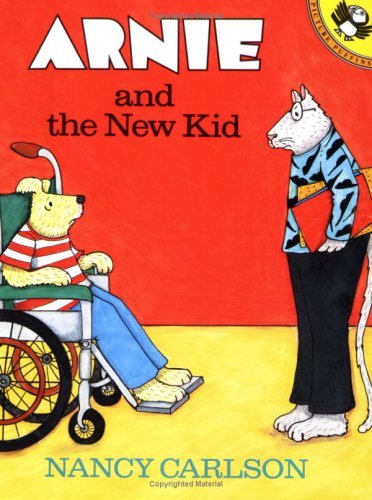
I have so much affection for Arnie and the New Kid by Nancy Carlson, who wrote a ton of books for kids about anthropomorphic animals. I wrote about this on tumblr but I just want to write about it again because it ties into what I've written about disabled queerness. Also, it's incredibly cute.
Arnie is a non-disabled cat who is quick to make fun of Phillip, a dog who uses a wheelchair. (I loved writing this sentence.) One day, Arnie is shambling around pretending to be Phillip, holding his arms up to his chest or whatever in an attempt to look disabled, and instead of getting an Oscar or an Academy Award like if he was a human, he falls down the stairs and injures his leg, wrist, and tail. Cut to Arnie wearing an adorable brace on his tail, using crutches, and needing much more help with things than Phillip ever did.
Like Harry Potter, Phillip has the social grace of a saint and befriends Arnie even though Arnie was a dick to him. Arnie and Phillip start spending all their time together doing the things Phillip likes to do--like playing video games, trading baseball cards, and birdwatching. (I especially love the page that shows them in a theater, watching a horror movie through their paws.) Of course, Arnie recovers from his injuries and goes to play baseball, which was one of the things he originally bullied Phillip for not being able to do. Phillip is worried that their friendship is over, but then Arnie says that Phillip will come along and be the coach.
I've read a review criticizing this book for exactly the reason I like it: Phillip is a loser who needs Arnie's help to be included socially. Well, Phillip is not a loser in my estimation, but he isn't so incredibly cool that he can overcome the stigma of disability, especially when Arnie is constantly drawing attention to everything Phillip can't do. What accounts for this failure of character? PHILLIP IS AN ELEMENTARY SCHOOL KID. Not every kid can go into a new school and have everyone be staring at them and bullying them, and deal with that competently and make a lot of friends.
Phillip is just an ordinary, nerdy kid--and by Arnie's standards, he really is a loser. He takes longer to eat, can't race, and can't play baseball. Basically, Phillip is slow, which dooms him not to be taken seriously by many of the kids.
But then, when Arnie is injured, we learn that Phillip has all these other interests and abilities that don't relate to whether he can walk or perform complex tasks with his hands. Arnie has a great time when he's temporarily disabled, and this, I think, is what keeps Arnie and the New Kid from being a book about charity or pity. Arnie doesn't think, "Wow, being disabled is awful, I should be nicer to Phillip." He learns that Phillip is actually a fun person and a good friend. He learns that his conception of what makes someone a loser was wrong.
When Arnie asks Phillip to be his coach, yes, he is making an effort to include him and maybe Arnie's actions will be the key to Phillip's social success. But Arnie makes the effort because he's grateful to Phillip and likes spending time with him, not because it's the nice thing to do. Arnie's decision is ultimately not about his own good qualities, but Phillip's.
I actually feel really frustrated by the idea that it's offensive to portray a disabled character needing help or being socially isolated. Phillip is not portrayed as weak or unpleasant at all; he's just up against a lot of ableism which, being a child, he can't handle all by himself. If Phillip was some kind of amazing superdog who could play baseball in his wheelchair and advocate for himself to be included in the games and be such an all-around badass that no one even noticed he was disabled, that would be an incredibly unfair image to show to kids. Most disabled kids cannot be that and shouldn't be made to feel that that is what they have to be in order to succeed. Non-disabled kids shouldn't be told that instead of adjusting their ideas of what you can do with a friend, or what qualities make someone cool, they can just wait for a supercrip who forces his way into their world and adjusts to their standards. Because they will be waiting a long time and, while they wait, some of them will be bullying ordinary disabled kids.
I'm thinking of making a series of posts about disability-related children's books, which would hopefully involve a lot of DISCUSSION! I'm wondering if anyone else read this book and what they thought of it. Obviously I am not a wheelchair user so I may have missed something really egregious. (One problem I have with the book is that Phillip obviously needs an aide and doesn't have one, so the nicer kids are always doing stuff for him. Really, really not a good message to send.)
Image description: cover of the book Arnie and the New Kid. On the left side of the picture, Phillip, a yellow dog wearing a t-shirt and jeans, sits in a wheelchair. On the right side, Arnie, a gray cat wearing glasses, black pants, and a shirt with mice on it, is standing and holding some books. Arnie is practically looming over Phillip with a mean look on his face, and Phillip looks scared.
I had the creepiest dream about zombies, you guys. They were pretty out of it, but they could talk so even though you could tell by looking at them that they were dead a lot of people wouldn't read them as zombies. I got on one of those really big elevators with a guy my age and his little son, and then this older guy started to get on who I knew was a zombie. I told the guy my age not to let the guy on the elevator, and he ineffectively tried to stop him but he got on anyway. The whole time we were on this elevator, I was telling the zombie to stay on the other side of the elevator, and picking up this folding chair that was in the elevator and threatening to smash his head. By the time we got to my level (we were in a parking garage) the living guy in the elevator obviously thought there was something wrong with me because I was being so aggressive and rude to this other guy, who seemed really gentle. As I got off the elevator I grabbed the living guy and whispered in his ear, "He's a zombie. He will kill you."
When I got in the car two zombies I knew were just sitting in there like we were friends. Riding shotgun was this really nice female zombie (she reminded me a lot of a particular lady with a disability who I worked with this summer). In the back was the zombie from the elevator who was a little more calculating. I couldn't convince them to get out of the car, so I just started driving. The zombie from the elevator kept saying, "What did you whisper to him in the elevator? He was staying away from me. Why did you do that?"
Finally I was at the end of my rope. "Because if you bite people, they will die," I said. "When you bite people, they die, okay? I didn't want you to bite him."
"Oh, I see why you said that," said the female zombie.
I think this dream was interesting because it was the culmination of a lot of thoughts and feelings I've been having about zombies lately. I've been watching The Walking Dead a lot and obviously--and, yes, this does skeeve me out--pretty much every horror entity can be read as disabled in some way or another. Well, I don't read vampires that way, but lots of supernatural figures and ghosts tend to be creepy because they have nonstandard faces/bodies and/or they move differently. For example, in this completely terrifying short film Mama--which I've never been able to watch all the way through so don't be too hard on yourself. Another example is The Grudge where one of the ghosts often crawls around instead of walking. The Orphanage and Darkness Falls have ghosts that cover their faces because their faces are supposed to be so horrifying.
Recently I saw a YouTube video of people dressing up as and impersonating zombies. One commenter said that "they look like they have cerebral palsy," and was lambasted by other commenters for "making fun of people with special needs." I can't help seeing this as really disingenuous--not that the first commenter was awesome, but are you seriously going to pretend to be some kind of gooey champion of "special needs" when you're into zombies, which resemble disabled people more than any other monster? Like, look at this video of extras in The Walking Dead learning to "walk like zombies":
I mean, without the makeup there is kind of a sketchy feeling in watching this, at least for me. Some of the people still look supernatural, but a lot of them just look like they're doing an awkward impression of a disabled person. (By the way, I'm definitely including people with mind disabilities, including myself, in the "people who zombies movie like" category. For whatever reason, weird gaits tend to be a thing for a lot of people with ASD and ID.)
I think I ended up having a dream where I was kind of friendly with zombies because for the last month I've been developing a sense that I'm basically a zombie. Like, it seems like a pretty simple way to explain stuff. Look at this from the Walking Dead comics Wikipedia page:
Zombies may follow something that has caught their attention for hours, such as a gunshot, after which they may follow in the general direction for days, even if they have forgotten what they originally were pursuing.
From the page describing Romero zombies vs. other kinds of zombies:
The animated dead retain vague impulses derived from former living behavior. For instance, zombies often return to specific locations they frequented when alive...Lacking immediate victims to hunt, zombies will often fumble through crude motions reminiscent of life activities, often when prompted by a familiar artifact such as a telephone or car.
Yeah, pretty much.
I was thinking of writing a story about a person who is bitten by a zombie but thinks she can remain human through willpower. Then I found out from TV Tropes that this is already considered a trope, but I think there would still be mileage in it. Especially because I don't think a zombie apocalypse would happen (can you imagine a bunch of AWVs being powerful enough to destroy society?), I think that the infected person could still be trying to go to school or work or whatever, while losing the cognitive function that enables them to succeed in those environments. And they do a pretty good job, until one day they can't anymore.
(Note: if you found this post when you were googling The Walking Dead or something, please don't start making comments about how I'm too politically correct or whatever. I'm not trying to attack/call out anyone for being into zombies--I mean, I'm into zombies and I obviously am into/am affected by some of the other tropes I'm reading as disability tropes. It's probably kind of fucked up that that's the case, but I'm more interested in reclaiming this stuff and thinking about what it means instead of just saying it needs to go away.)
(Even when you just stay on body language. In my experience it is much more likely to get rejected for your own body language/facial expression/tone--other people read you as a normal person who is sketchy/offensive, or read you as an "other" that they find undesirable, such as disabled/"weird." It actually takes a while to judge how someone else is responding to the way you move and sound--judging the way someone else moves and sounds is much faster. A lot of people with autism could drill themselves forever on how to read other people, and still would regularly get rejected because they haven't changed their own body language.)
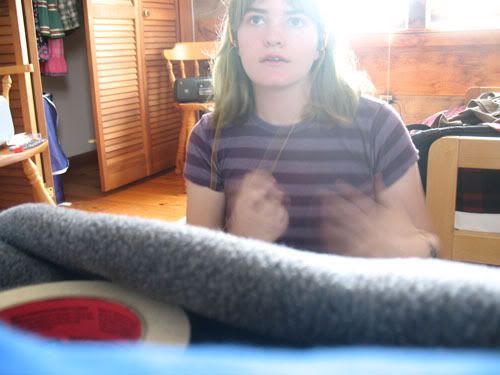
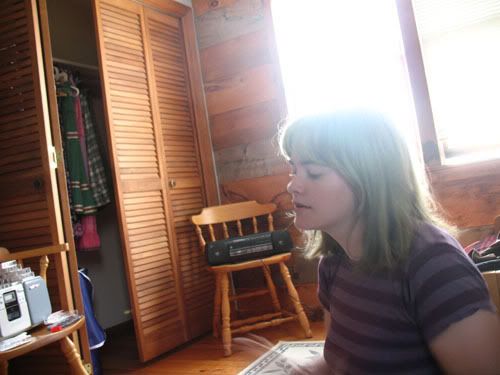
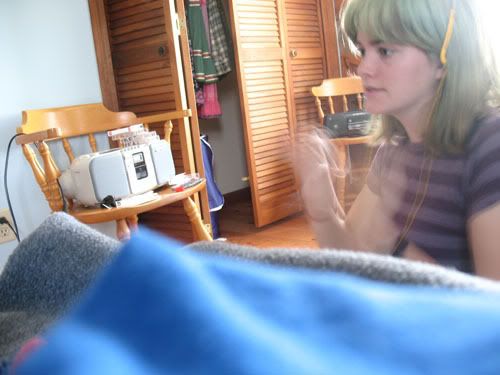
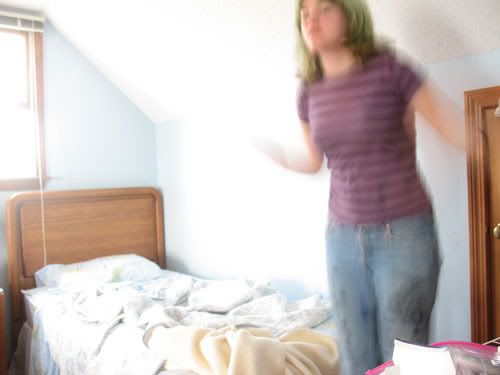
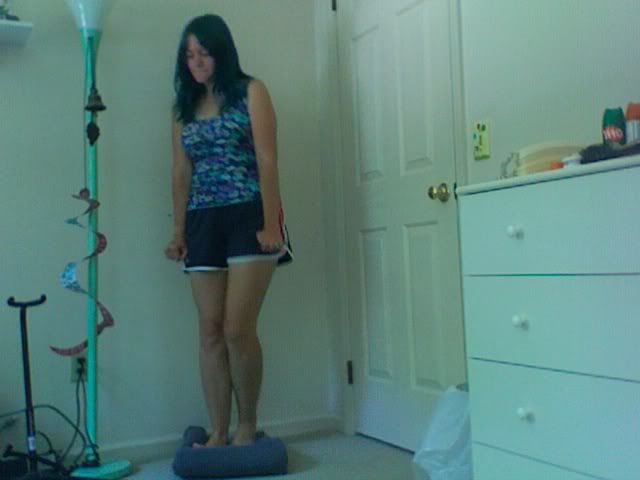
The summer after my freshman year of college I took all these pictures and posted them in the Asperger's LiveJournal community.
I took these pictures because I didn't know what I looked like when I was stimming and I assumed it probably looked scary. As soon as I started taking them, I realized it looked sort of cool, at least in pictures, so I took a lot more.
Before, I didn't have an image of what a person who stimmed could look like. I'm not saying I was raised to feel terrible about stimming because I wasn't really cracked down on by teachers and parents like some people are. But it was sort of similar to how I felt about being queer--I either heard vague negative stuff, or silence.* I saw people on the Internet saying it was okay but I had trouble applying that to my real life.
The next summer, I wrote this piece: Functional Stimming. It was mostly a reaction to anti-stimming attitudes at the school, but I tried to approach the issue of stimming in an objective and accessible way. I took pictures of myself stimming and described how I felt about stimming, and I talked about two people I knew who stimmed, and included pictures of them.
Towards the end, I said:
I don't feel great about the way I stim. I wish I could stim the way Clayton does; it seems so natural and unselfconscious, just an intense expression of his feelings. I feel like I have a stimming habit, like I binge on stimming. It feels like an explosion and I feel worn out afterwards.
I remember other kids making fun of me for shaking my knees back and forth in class and compulsively touching my nose while I was reading. I don't know if that's how my stimming got driven underground. I just very much wish that instead of being this giant, dramatic, embarrassing thing, stimming could just be part of my life...
I just went and walked in circles for a few minutes trying to get my thoughts together. That was really nice. That's the kind of stimming I would like to do--calm. Something that makes my thoughts make more sense instead of ratcheting them up to fever pitch.
That summer I also made some videos like this:
One night I got stuck in the city with a headache and some general spaced-out-ness and was really screwed in terms of finding a quick subway train back to Grand Central. Last summer was the first time I really started understanding subways at all, and I'm still not very good. So I ended up riding around a lot and it was really late at night and I remember being really proud because I knew I would eventually get home even though it was hard, but I also was feeling unpleasant in other ways because it was loud and hot and I had a headache. I was thinking about Danny because I was seeing him every day and he loved subways. Thinking about Danny always made me think about passing and stimming, so I started stimming while I was waiting for the subway and it made me feel better.
And I had a horrible year in general and I became much more conscious of times when I needed to flap my hand by my side or scrape my palms along the edges of tables or step my feet around in circles. It was weird because things were so awful and in many ways I felt scared because I was letting go of many standards for being normal that I'd previously held and I think I worried that if I wasn't holding myself in place, I would somehow wake up one morning and be nonverbal or something like that.
At the same time, when I went back and read Functional Stimming, it seemed that all the problems I'd had were a lot better. Stimming had become something wholly neutral or positive. It wasn't always this full-body thing that exploded out of me unconsciously when I was alone, and hyped me up more than I wanted. It was just a tool and a joy.
I'd also started to feel differently about the way I hold myself. I think it's called posturing because when I say I move stiffly I don't mean I am stiff, or something, but that I find it nice to stick out my arms and legs and hands.
This is an overdramatic version of what I mean, because I'm doing it on purpose, but you get the idea. It especially affects the way I walk when I'm really at all excited or at all nervous. I just move my legs very stiffly, which probably is hard on my feet or something, but it feels really nice. If I try not to look different, it gets even worse because I'm nervous, and it ends up just being in the legs which are moving really mechanically. (One time Amanda Baggs wrote a post which in part was a description of how she notices ASD people based on how they walk. Some of this explains well what I'm trying to talk about.)
I guess this spring it occurred to me that I'm not the only person in the world to ever hold my hands differently and I started thinking about what I was afraid of looking like. There was obviously something I was freaking out about and trying to avoid but when I thought about it I realized it just looked like the way some people with ID and ASD walk and hold themselves all the time, and it also looked like some people with cerebral palsy. Once I started thinking of it that way, it didn't seem like a bad way to hold myself, because I associated it with other people and not just me being different by myself.
Now instead of trying to walk normally and then occasionally walking really stiffly, and also having these huge full-body stim explosions when I'm by myself, I just walk in a way that is more uneven and "posture"-y and I tend to kind of burst into a run more and sort of have stiff legs and move them around in a jumpy way. Not that I don't jump around on my own sometimes when I'm excited, but it doesn't feel like a huge problem that takes up a lot of energy, it just happens from time to time. And I don't feel bad about holding my hands in a stiff/curled-up way that feels good.
Of course I have criticisms of the camp where I worked this summer because you should always be aware of flaws, but it was in many ways very cool and very different from The School, because we weren't encouraged to think of ourselves as socially separate from and superior to the campers. Staff got involved in campers' interests and senses of humor; we weren't trying to get them to copy us. To the extent that we were trying to do stuff, we were trying to make sure they liked us and had a good time with us.
This was apparent before the campers even got there, just from the tone of our training. I was already feeling pretty happy and safe a few days into orientation, when we were going back to our cabins for a break. I felt excited and as often happens I ended up running for no discernible reason. Another counselor saw me and said, "Run Forrest run!"
I have had people make shitty comments about the way I run, and although this person was being friendly I can still imagine that I might have felt embarrassed and angry to have been "caught" doing something like that. But I guess since Forrest Gump is in fact disabled, even though she probably wasn't trying to make a comment about me looking disabled, I just processed it calmly in my head: "Forrest Gump is disabled and I'm disabled and I reminded someone of Forrest Gump. That makes sense." In the moment it made me feel good.
I also just remember dancing a lot (I had never danced before) and being excited and squealing and posturing and tripping over things because I was running around so much, the whole time I was at camp. It wasn't anything to be ashamed of because I was doing my job properly, and there were lots of awesome people around who also squealed and ran around a lot and flapped and made motorboat noises. There was a moment when I remember being really excited and happy in a really disabled-looking way in front of the whole camp, and I felt sort of transcendent and like I was going to cry. It was a weird sensory experience too, and just in a lot of ways one of the best moments of my life.
One time in seventh grade, I remember walking around with my shoes untied and not caring what other kids said until one girl said, "You look like a boy with your shoes untied." Then I immediately tied my shoes. Since then I've gone through periods of really really wanting to look like a boy, and even though I don't feel that way anymore I generally would find it cool to be told that something about my appearance looks like a boy. I tie my shoes now, because I would probably trip over myself when I start RFRing, but I'd like to think I own the possibility of looking like a boy. And I want to also own the possibility of looking disabled.
This is a pretty nice thing actually. I don't enjoy passing. Just kidding, I love passing. Just kidding, I hate passing. I mean I don't know. I am likely to think people who are visibly disabled have it worse, but I sometimes really wish I was visibly disabled and sometimes I feel like the fact that I'm not is what has caused basically all my anxiety/dissociation problems.
I have a lot of what I think are probably normal issues for women my age--basically, thinking that I'm horrible-looking and combing Facebook for pictures of myself and even if it's just a picture of my arm totally flipping out about how my arm looks horrible. Or maybe I have it on a level that isn't normal. I just look at pictures and think I'm smiling differently from everyone else in the picture. My face is bigger or smaller than theirs. I'm holding my legs differently. My hands look stiff. No one in the picture looks like they're my friends. I look like I'm just lurking in the background.
I just engaged in a bunch of this yesterday so I'm certainly not claiming that I feel great about myself now but I think that my feeling shitty about myself has been reduced to a more standard level. I also feel like I have something to move towards the way other people do when I think about how I'd like to look or how I'd like to be. Because I have images of people who look like me.
This is the reason I have trouble identifying as just Autistic instead of developmentally disabled, just because lots of the people who have led to me feeling okay, and feeling like a kind of person instead of just something unclassifiable, have been people with ID and other disabilities. I've talked about this a lot. But I just realized the other day that things are feeling so much better so I wanted to tell you some more.
*I'm sure my parents would take issue with this, especially in terms of queer stuff. I know that most people have it much worse but the thing is that most of the messages I got about queerness and DD were either mildly negative, acted like it didn't exist, or were very long-sufferingly tolerant (like my high school). Which isn't terrible but does make it hard for you to actually form into an adult because you feel uncomfortable/depressed about a lot of the things that you are.
"That's why reading is like sex, because it's like trying to shove your brain through a really small hole."
"I think [our professor] is like the king and I'm like Bisclavret--she's like, 'Aww! It's a beast, but it can show compassion, even though it can't talk or think.'"
30 December, 2009
AV: So, are you like meeting your goals with the political book you're reading? AT: Yeah, I'm almost done with my last chapter for today. AV: You're so much better at everything than I am. AT: (contemptuously) You're really racing through "Invisible Sight" or whatever it's called. AV: Don't be mean. Anyway I finished it. AT: Well, you actually are a faster reader than I am. AV: Well yeah but only when I read books that are for babies and girls. AT: Well, you are both of those things, so it makes sense.
When I was a kid I used to read books constantly. It was a problem. When kids bullied me they would call me "Bookworm," which I know sounds like something out of an adorable after-school special, but it's true. Anyway, I don't read books very much now, especially novels--which is kind of weird, because of my supposed desire to write them. I think part of it is maybe just that I process things a little differently, or that when I was a kid I didn't really think about the social context of reading and tended to approach it more loosely, reading the last half of a book first, or reading the same books over and over. Now I can't seem to get away from thinking of books as work, and I read a lot slower because I am concentrating, which makes me less inclined to start books because it's more of a commitment, etc.
Also, there's just the fact that I am an adult now and I'm not supposed to read novels for children and teenagers, and there's a huge stylistic difference between young adult and adult, I think. Adult books never just say what they mean unless they're really trashy. It's hard to even explain what I mean by this, but I just finished reading a young adult book (the first book I've finished since September) and it is an intelligent and thoughtful book, but the narrator just tells you what he's thinking and what's important. Whereas in adult books--well, I'm not saying this is a bad thing, but they're always trying to do something else. They move slower, they hold more back, or something. This takes me a lot of work so the book has to be worth it.
This is one of those things where I don't know if I should tag it as "asd" or not because maybe it's not related. Maybe I'm just a slow reader. But I don't think this is true because I was reading the New York Times on the computer over A.T.'s shoulder, and I asked her to scroll down, and she was surprised that I had already gotten to the bottom. I think I read fast on the Internet. And I can read magazine articles and stories very fast. It's just different with books, which makes me think it is some kind of anxiety or compulsion or difficulty processing a particular kind of writing. I don't know.
PICTURE NOTE: as a lot of us probably know, Photobucket has recently stopped allowing people to hotlink images. For the first few years I was using this blog, I used Photobucket to host most of the images, so now they will not be visible! Until Photobucket goes under, as I imagine it will, you can at least see the images by opening them in a new tab.