Showing posts with label elementary school. Show all posts

27 February, 2011

Arnie and the New Kid

I have so much affection for Arnie and the New Kid by Nancy Carlson, who wrote a ton of books for kids about anthropomorphic animals. I wrote about this on tumblr but I just want to write about it again because it ties into what I've written about disabled queerness. Also, it's incredibly cute.

Arnie is a non-disabled cat who is quick to make fun of Phillip, a dog who uses a wheelchair. (I loved writing this sentence.) One day, Arnie is shambling around pretending to be Phillip, holding his arms up to his chest or whatever in an attempt to look disabled, and instead of getting an Oscar or an Academy Award like if he was a human, he falls down the stairs and injures his leg, wrist, and tail. Cut to Arnie wearing an adorable brace on his tail, using crutches, and needing much more help with things than Phillip ever did.

Like Harry Potter, Phillip has the social grace of a saint and befriends Arnie even though Arnie was a dick to him. Arnie and Phillip start spending all their time together doing the things Phillip likes to do--like playing video games, trading baseball cards, and birdwatching. (I especially love the page that shows them in a theater, watching a horror movie through their paws.) Of course, Arnie recovers from his injuries and goes to play baseball, which was one of the things he originally bullied Phillip for not being able to do. Phillip is worried that their friendship is over, but then Arnie says that Phillip will come along and be the coach.

I've read a review criticizing this book for exactly the reason I like it: Phillip is a loser who needs Arnie's help to be included socially. Well, Phillip is not a loser in my estimation, but he isn't so incredibly cool that he can overcome the stigma of disability, especially when Arnie is constantly drawing attention to everything Phillip can't do. What accounts for this failure of character? PHILLIP IS AN ELEMENTARY SCHOOL KID. Not every kid can go into a new school and have everyone be staring at them and bullying them, and deal with that competently and make a lot of friends.

Phillip is just an ordinary, nerdy kid--and by Arnie's standards, he really is a loser. He takes longer to eat, can't race, and can't play baseball. Basically, Phillip is slow, which dooms him not to be taken seriously by many of the kids.

But then, when Arnie is injured, we learn that Phillip has all these other interests and abilities that don't relate to whether he can walk or perform complex tasks with his hands. Arnie has a great time when he's temporarily disabled, and this, I think, is what keeps Arnie and the New Kid from being a book about charity or pity. Arnie doesn't think, "Wow, being disabled is awful, I should be nicer to Phillip." He learns that Phillip is actually a fun person and a good friend. He learns that his conception of what makes someone a loser was wrong.

When Arnie asks Phillip to be his coach, yes, he is making an effort to include him and maybe Arnie's actions will be the key to Phillip's social success. But Arnie makes the effort because he's grateful to Phillip and likes spending time with him, not because it's the nice thing to do. Arnie's decision is ultimately not about his own good qualities, but Phillip's.

I actually feel really frustrated by the idea that it's offensive to portray a disabled character needing help or being socially isolated. Phillip is not portrayed as weak or unpleasant at all; he's just up against a lot of ableism which, being a child, he can't handle all by himself. If Phillip was some kind of amazing superdog who could play baseball in his wheelchair and advocate for himself to be included in the games and be such an all-around badass that no one even noticed he was disabled, that would be an incredibly unfair image to show to kids. Most disabled kids cannot be that and shouldn't be made to feel that that is what they have to be in order to succeed. Non-disabled kids shouldn't be told that instead of adjusting their ideas of what you can do with a friend, or what qualities make someone cool, they can just wait for a supercrip who forces his way into their world and adjusts to their standards. Because they will be waiting a long time and, while they wait, some of them will be bullying ordinary disabled kids.

I'm thinking of making a series of posts about disability-related children's books, which would hopefully involve a lot of DISCUSSION! I'm wondering if anyone else read this book and what they thought of it. Obviously I am not a wheelchair user so I may have missed something really egregious. (One problem I have with the book is that Phillip obviously needs an aide and doesn't have one, so the nicer kids are always doing stuff for him. Really, really not a good message to send.)
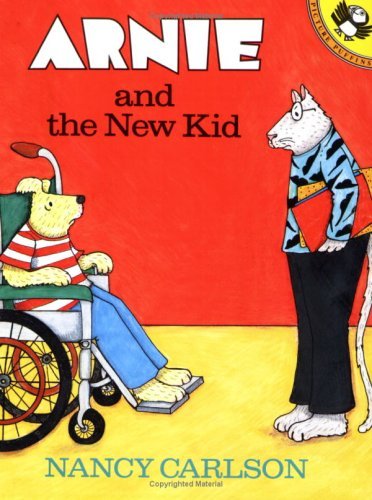


Image description: cover of the book Arnie and the New Kid. On the left side of the picture, Phillip, a yellow dog wearing a t-shirt and jeans, sits in a wheelchair. On the right side, Arnie, a gray cat wearing glasses, black pants, and a shirt with mice on it, is standing and holding some books. Arnie is practically looming over Phillip with a mean look on his face, and Phillip looks scared.


16 April, 2010

briefly, a mystery

because I don't want to bother my parents, because I think they think I bother them a lot about this stuff, and my dad always says he can't find my records from the psychologist I went to when I was in second and third grade, who thought I had experienced some kind of traumatic abuse. At the same time, if someone thought I experienced traumatic abuse, I kind of want to know about it.

The other thing, though, the really weird thing, is the PDD-NOS diagnosis. It was kind of nice to find out about it since I anyway don't think of myself as having "Asperger's" and now I have an excuse for not wanting to describe my disability that way, and just saying ASD which feels truer and simpler. It's nice--but also, I kind of feel like I'm lying, because I've never seen the diagnosis written down, and I found out about it when I was twenty, nine or ten years after the fact.

Yesterday I told someone that I thought I had been sent to a resource room to practice eye contact. But then I didn't even know if I was telling the truth. When I think about it, I know that I went to resource rooms throughout middle school, but I remember very little about what I did. Maybe I just don't remember much about being that age--but although there's stuff I've probably blocked out, I paid attention to stuff that seemed relevant. I think the reason I don't remember about the resource rooms is simply that I didn't know I had a disability, so I didn't think about my life that way, so I didn't exactly realize that I was doing disability things.

I was interested in disabilities. I think I would have been aware if I'd known that's what it was about.

For the years before my AS and NVLD diagnoses (I was diagnosed with both at the same time, which is kind of like diagnosing someone as both homosexual and gay) I was conscious that my parents were worried about me and thought something was wrong with me. They read a lot of books and got me a lot of extra help. This bothered me and I remember the moment in seventh grade when I really sorted it out and realized how incredibly lonely and guilty I felt, and realized that I couldn't be as bad as the situation made me feel I was. My intent isn't to criticize my parents, they were doing what they thought was necessary--but my intent is to criticize my parents, because I can't believe that I was already diagnosed as ASD and they didn't just tell me.

I don't even understand why I got diagnosed again. I'm sort of starting to put together that when my mom would tell people I had PDD-NOS, they'd get really upset, or they'd just tell my mom it couldn't possibly be true because I didn't hit my head on walls. So--maybe--I'm constructing this--my parents wanted me to know I had a disability, because it would influence my actions in some way, or help me understand things, or something--but they didn't want to tell me I had something that was looked at as so dire. And then they found out about this thing called Asperger's which was kind of the same, but new and not as bad and easier to talk about? So they started trying to introduce me to it, and then they got someone to diagnose me with it? Not that they shopped around or something, but that they asked someone "Does Amanda have Asperger's or not?" like there were two options. That's how I think of it.

It's not exactly important. At the same time, I desperately want all my records, and I want to ask my parents a bunch of questions, but I always seem to ask at the wrong time, and I'm probably mean.

10 January, 2010

Two kinds

Do you agree that there are two kinds of disabled people--people who are visibly disabled, and as a result tend have people overestimate their disability, so that they really desperately want people to be less likely to express sympathy for them and offer to do things for them; and people who are invisibly disabled, and have people constantly tell them to apply themselves and tough it out, and therefore really really enjoy it when someone tries to help them, even clumsily?

I find this idea impossible not to think about, just because of the symmetry. This is probably Like a Person Part Four I guess, but whatever. And also, disclaimer, there aren't really only two kinds, it's just that I am talking about two groups of disabled people, but there are other disabled people who aren't in either group, I'm sure.

I feel like--and not to be a dick, my parents are really nice and everything, but anyway--my parents have always made me be both kinds of people at once, meaning that they'd do lots of things for me that I had trouble doing, but they'd never stop reminding me that I should be doing those things, and it was really bad that I wasn't doing them. They did things like making a point of having me go and order food at McDonald's when I was a kid, because they knew that it was hard for me. So even when I was actually doing the things, I didn't feel normal, because it was A Lesson. I'm probably not being coherent. I don't have much time to write this.

Pretty much my only disabled friend (I have some friends who have mental illnesses but don't identify as disabled) is physically disabled, and he is super spoiled just like I am, rarely has a job, executive function skills are possibly worse than mine are, just learned to drive at age 21, last year his roommate would sometimes come up to me and say, "Can you please get FFD to put a sheet on his bed because he's sleeping on a mattress and it's grossing me out?" At the end of first year, his mom told him not to pack or clean his room, he'd worked hard enough, she would do it.

My parents got to school at the end of first year, and I wasn't done packing--I had taken all the paper off my walls, which you can imagine took a long time, and packed some clothes, but my room was very cluttered, when they came in. So my mom had a very negative reaction about how I was disorganized and hadn't done anything.

I'm kind of rambling and maybe shouldn't be posting this because it might be a gender thing instead of a visible/invisible disability thing, or just something completely different. I do think it's interesting, though.

Anyway, when my friend was in school, he was mostly in mainstream school, but at camp, and as a little kid, he was with kids who had severe intellectual and physical disabilities. He has this thing about how teachers would always tie his shoes for him instead of letting him do it, because it took him longer. Also when he was a kid he sometimes fell down and some bystander would make a production out of it even though he was obviously all right.

My teachers basically thought I was a major bitch and in fifth grade my teacher took me on as a project and forced eye contact on me while telling me how self-centered and arrogant I was until I started crying. She would also take books away from me to train me to talk to other kids, etc. etc. and basically snap at me if I said something she considered impossible, like, "I can't tell if I'm joking with someone or bullying them."

So, if a friend and I go to a movie theater or something like that, and my friend automatically does the talking for me, or if a friend brings me along to her boyfriend's house where there are a lot of people, and talks to her boyfriend in an attempt to find out if I could go play with his guitar, this is something that I find hugely touching and wonderful. Whereas, if I get up to plug in FFD's computer, or bring him his shoes or something, it makes him annoyed.

(I should give myself more time to write things, sorry; am I saying anything interesting?)