is something that might someday appear in all its parts and might not. Right now I'm primarily interested in writing about staff infection. Spoiler alert though: the answer to "how did indistinguishability get its groove back?" is exactly that.
Or like I said before: it never really lost it.
I think there are two reasons "staff"--very broadly defined as doctors, teachers, therapists, aides, and a million other people--end up trying to control people with disabilities.
1. They believe people with disabilities inherently need to be controlled.
2. They get in a position of power because of people with disabilities' support needs and/or youth, and have the opportunity to make people with disabilities more convenient to deal with.
Whichever reason is not your reason can be used as a straw reason to support the real reason. I could give examples but basically you know it when you see it. Doing this relates to the Harder Fallacy and Shocking Behavior and things like that.
The way indistinguishability got its groove back is that a person with power looked at a person diagnosed with autism and decided they didn't like the way person's body looked or the way the person felt about things. Or (I say when I get angry) the way the person said no.
The person with power started trying to change the person with autism's body (or whatever). The person with autism couldn't defend themselves because they couldn't talk. Or, if they could, other people felt their beliefs, opinions, and arguments were inherently weaker than those of people without disabilities.
The person with power told their coworkers or their employees or the other people in their field to do the same thing. They by and large did.
Occasionally someone was bothered by it but afraid of losing their job, being seen as a pushover by their coworkers, or not being respected by other autism scientists. But most people weren't bothered. Maybe the original person with power was very charismatic and converted them. Maybe they already didn't like how the person with autism's body looked. Maybe they just didn't think about it, accepted it as part of their job, and eventually came to be a little passionate about its rightness. After all, no one was trying to change their bodies.
When I say this happened once I mean that people in power make this decision about people with autism on a regular basis. Probably as you are reading this a person is deciding to be this way, and their decision will spread because it doesn't occur to many people to question it.
To some extent this is true about any decision within that dynamic. Let's say someone decided that all kids with a certain disability have to play soccer, or read Tarot cards. I think this would actually catch on to a greater degree than you would expect. But indistinguishability is such a historically popular thing for people in power to choose to force on disabled people that it has a kind of momentum. You just think about it and it's already there.
Every person in power who unthinkingly chooses or supports indistinguishability is adding to its mass. It's an army of laziness, an army (usually) of feeling safe in your body. Of being able to talk about how much you love The Office in between sessions of training a kid with autism not to make jokes that don't have an obvious punchline. It's easy to do pretty much anything to people with disabilities but indistinguishability has an army.
The pressure of the army makes room for more soldiers. Obviously. This has all been an excuse for a pun. The way indistinguishability got its groove back is that indistinguishability actually is a groove being worn into the fabric of society by sheer constance and bullheadedness. Have a nice day.
Showing posts with label stimming. Show all posts
Showing posts with label stimming. Show all posts
25 June, 2012

11 January, 2012
The Loud Hands Project
hi guys, it's time for the Loud Hands Blog Tour! are you ready?
The Loud Hands Project is a project by the Autistic Self-Advocacy Network, which is being organized by Julia from Just Stimming. You might have seen the video:
(The YouTube page for the video has a visual transcript in the description section. If you can watch the video but don't want to watch it with sound, it still makes sense with the sound off.)
Julia describes Loud Hands as a transmedia project. Transmedia is a word I was not familiar with, but according to Google it means "storytelling across multiple forms of media," which sounds pretty good. The idea as far as I can simplify it is to communicate the pride of Autistic people and support Autistic people in communicating their own experiences, but there are other facets too and Julia describes her aims much more clearly on the fundraising page for the project.
Loud Hands is trying to raise $10,000 for the launch of its website and its first anthology (if you're thinking of submitting to the anthology, you can learn about that here). $7,500 has already been donated, but they still need to make their goal by March 15. As soon as my theoretical job starts I plan on donating a LOT, and if you support the project and can spare the money, I hope you'll consider donating as well. Even if you are only able to donate a few dollars, it still makes a difference.
If you're not able to donate but you have autism, I still really hope that you will think about contributing to the Loud Hands website, and to this or future Loud Hands anthologies. Whether or not you have autism, please try and support the project by telling other people about it who might be able to contribute money or communication.
No matter what you do, please try and live with loud hands at all times.
Love,
Amanda
(and loud feet)
The Loud Hands Project is a project by the Autistic Self-Advocacy Network, which is being organized by Julia from Just Stimming. You might have seen the video:
(The YouTube page for the video has a visual transcript in the description section. If you can watch the video but don't want to watch it with sound, it still makes sense with the sound off.)
Julia describes Loud Hands as a transmedia project. Transmedia is a word I was not familiar with, but according to Google it means "storytelling across multiple forms of media," which sounds pretty good. The idea as far as I can simplify it is to communicate the pride of Autistic people and support Autistic people in communicating their own experiences, but there are other facets too and Julia describes her aims much more clearly on the fundraising page for the project.
Loud Hands is trying to raise $10,000 for the launch of its website and its first anthology (if you're thinking of submitting to the anthology, you can learn about that here). $7,500 has already been donated, but they still need to make their goal by March 15. As soon as my theoretical job starts I plan on donating a LOT, and if you support the project and can spare the money, I hope you'll consider donating as well. Even if you are only able to donate a few dollars, it still makes a difference.
If you're not able to donate but you have autism, I still really hope that you will think about contributing to the Loud Hands website, and to this or future Loud Hands anthologies. Whether or not you have autism, please try and support the project by telling other people about it who might be able to contribute money or communication.
No matter what you do, please try and live with loud hands at all times.
Love,
Amanda
(and loud feet)
01 December, 2010
Passing as Ethics: a primer
Passing as Ethics
So, passing as ethics is a term I invented and I use it a lot. It’s at the core of a lot of the stuff I write. In retrospect, I wish I had said “passing as functioning” or “passing as cure” because I think that would be more inclusive and cover more ground. Originally I thought that passing as ethics only happened to people with autism, but as I learned more I found out that it was more pervasive than I could ever have imagined.
Here are some passing as ethics values. I’m mostly writing this as if a professional is saying it, but disabled people can totally feel most of this stuff about themselves and I certainly did for a long time. I think it’s a very basic part of life for most people.
1. It is better for a person with a physical disability to walk without any visible mobility aids than it is to use a wheelchair, crutches, or cane--even if the person finds it painful or tiring to walk unaided, and/or is danger of falling.
2. If someone’s disability causes them to have an unusual gait, this is a problem, and it would be an improvement if their gait could be changed to look more normal, even if this didn’t make the person walk any faster or more easily.
3. Habits that mark someone as a person with an intellectual disability or autism, such as flapping hands, are inherently bad, and people who do them should be trained not to do them.
4. If there is a conflict between someone with autism and someone without autism, it’s the person with autism’s fault. If a person with autism gets bullied, this is evidence of why #3 is true; if no one had been able to tell they had autism, this wouldn’t have happened.
5. If someone misunderstands a person with autism, it is because the person with autism didn’t express themselves right.
6. Deaf and hard-of-hearing people should learn to lip-read. Hearing people need not learn sign language.
7. So basically, people with disabilities should always try to communicate in a way that is comfortable for people without disabilities, even if it makes the people with disabilities uncomfortable
8. To sum up, any habit, style of movement, facial expression, interest, feeling, word choice, way of pronouncing words, way of sitting, way of communicating, okay you get the idea, that is commonly associated with disabled people is
a. the opposite of success, and must be destroyed to improve someone’s “functioning”
b. morally wrong in some cases--that is, the person who is doing the behavior that’s associated with disability becomes automatically wrong in any conflict
9. If someone who used to look like they had a disability now doesn’t look like they have a disability (to most people), then they are recovered/cured (no matter how negatively it affects them to hide their disability, and no matter how many less visible aspects of their disability continue to affect them).
10. Don’t kill yourself after reading #1-9 because people will just think you killed yourself because it was so depressing to be disabled.
So, passing as ethics is a term I invented and I use it a lot. It’s at the core of a lot of the stuff I write. In retrospect, I wish I had said “passing as functioning” or “passing as cure” because I think that would be more inclusive and cover more ground. Originally I thought that passing as ethics only happened to people with autism, but as I learned more I found out that it was more pervasive than I could ever have imagined.
Here are some passing as ethics values. I’m mostly writing this as if a professional is saying it, but disabled people can totally feel most of this stuff about themselves and I certainly did for a long time. I think it’s a very basic part of life for most people.
1. It is better for a person with a physical disability to walk without any visible mobility aids than it is to use a wheelchair, crutches, or cane--even if the person finds it painful or tiring to walk unaided, and/or is danger of falling.
2. If someone’s disability causes them to have an unusual gait, this is a problem, and it would be an improvement if their gait could be changed to look more normal, even if this didn’t make the person walk any faster or more easily.
3. Habits that mark someone as a person with an intellectual disability or autism, such as flapping hands, are inherently bad, and people who do them should be trained not to do them.
4. If there is a conflict between someone with autism and someone without autism, it’s the person with autism’s fault. If a person with autism gets bullied, this is evidence of why #3 is true; if no one had been able to tell they had autism, this wouldn’t have happened.
5. If someone misunderstands a person with autism, it is because the person with autism didn’t express themselves right.
6. Deaf and hard-of-hearing people should learn to lip-read. Hearing people need not learn sign language.
7. So basically, people with disabilities should always try to communicate in a way that is comfortable for people without disabilities, even if it makes the people with disabilities uncomfortable
8. To sum up, any habit, style of movement, facial expression, interest, feeling, word choice, way of pronouncing words, way of sitting, way of communicating, okay you get the idea, that is commonly associated with disabled people is
a. the opposite of success, and must be destroyed to improve someone’s “functioning”
b. morally wrong in some cases--that is, the person who is doing the behavior that’s associated with disability becomes automatically wrong in any conflict
9. If someone who used to look like they had a disability now doesn’t look like they have a disability (to most people), then they are recovered/cured (no matter how negatively it affects them to hide their disability, and no matter how many less visible aspects of their disability continue to affect them).
10. Don’t kill yourself after reading #1-9 because people will just think you killed yourself because it was so depressing to be disabled.
01 November, 2010
Autistics Speaking Day post
The other day my mom showed me some articles in the newspaper about autism. Midway through one article (http://www.thestamfordtimes.com/story/492905), I read this:
One of the center's clients, a Rowayton resident who wanted to remain anonymous, said her daughter used to avoid eye contact and, like many autistic kids, repetitively flapped her arms and walked on her toes. The client's daughter has been working with Rohdie for a number of years, and when asked what challenges the behavior analyst and now the Southfield Center has helped her daughter overcome, the client said "Oh my God, everything."
"You would never be able to tell she was autistic," the client said, adding that, with the help of Rohdie and other professionals in the field, avoiding eye contact, flapping and toe walking issues have stopped for her daughter.
This kind of attitude from parents and professionals makes me want to scream.
I generally don't like writing about my disability experience in much detail. I'll just say that a) a lot of important things are hard for me to do consistently and independently, b) I have severe anxiety problems, and c) a and b feed into and increase each other. At this point, my dreams for where I might live and what I might do after college are pretty limited which is depressing (and increases my anxiety, ha ha). I think it would be very easy for me to end up in an emotionally and physically dangerous situation, and I'm working hard to avoid that.
A lot of people with autism spectrum disabilities have it way worse than I do--their opportunities for communication may be very minimal, or they may be so overloaded by sensory or emotional experiences that they self-injure and seriously hurt themselves. Younger people with ASD are often bullied, which can result in various kinds of damage. And all people with developmental disabilities are much more likely to be abused.
People with ASD have real problems. That some of us walk on our toes is not one of them. When I read the above quote, I had several thoughts:
1. Passing as non-disabled is not always a good thing because it means that people don't realize you need help, and won't believe you are disabled even if you tell them, because you look "too normal."
2. The experience of living as a passing person can be really isolating and scary because you are constantly trying to hide your reactions, feelings, and body language. It makes you pretty tense and it makes you feel like the people in your life don't really know you.
3. When "not looking autistic" is equated with "being better," that makes it hard for an ASD person (and their parents and professionals) to develop a good set of goals. Instead of goals like, "This problem is making my life harder--how can it be improved?" the goals are like, "I look autistic--how can I hide it?" In the person's mind, goals that are objectively good (like being a kind person, and trying to be happy and successful) become mixed in with the subjective, energy-consuming goal of "not looking autistic." I am still trying to untangle this crap in myself.
4. Some people "stim" (rock back and forth, toe-walk, hop around, run around, vocalize, flap their hands, etc.) because it helps them deal with overwhelming emotions or sensory information. Some people avoid eye contact because eye contact makes them upset. If they stop stimming and start making eye contact, they may be a lot more stressed.
5. Even if 1-4 weren't true, it's still a waste of resources that would be better spent dealing with the real problems that ASD people have.
6. I could try to give these parents and professionals the benefit of the doubt, and say that they're being thoughtless and inefficient. But when I read this stuff, it doesn't just annoy me, it hurts me. It says to me that these people care more about not having to look at a visibly Autistic person than they care about actually helping people with ASD in meaningful ways; that they would rather ASD people suffer in silence than be happy and loud. That doesn't feel like ignorance, it feels like hate.
One of the center's clients, a Rowayton resident who wanted to remain anonymous, said her daughter used to avoid eye contact and, like many autistic kids, repetitively flapped her arms and walked on her toes. The client's daughter has been working with Rohdie for a number of years, and when asked what challenges the behavior analyst and now the Southfield Center has helped her daughter overcome, the client said "Oh my God, everything."
"You would never be able to tell she was autistic," the client said, adding that, with the help of Rohdie and other professionals in the field, avoiding eye contact, flapping and toe walking issues have stopped for her daughter.
This kind of attitude from parents and professionals makes me want to scream.
I generally don't like writing about my disability experience in much detail. I'll just say that a) a lot of important things are hard for me to do consistently and independently, b) I have severe anxiety problems, and c) a and b feed into and increase each other. At this point, my dreams for where I might live and what I might do after college are pretty limited which is depressing (and increases my anxiety, ha ha). I think it would be very easy for me to end up in an emotionally and physically dangerous situation, and I'm working hard to avoid that.
A lot of people with autism spectrum disabilities have it way worse than I do--their opportunities for communication may be very minimal, or they may be so overloaded by sensory or emotional experiences that they self-injure and seriously hurt themselves. Younger people with ASD are often bullied, which can result in various kinds of damage. And all people with developmental disabilities are much more likely to be abused.
People with ASD have real problems. That some of us walk on our toes is not one of them. When I read the above quote, I had several thoughts:
1. Passing as non-disabled is not always a good thing because it means that people don't realize you need help, and won't believe you are disabled even if you tell them, because you look "too normal."
2. The experience of living as a passing person can be really isolating and scary because you are constantly trying to hide your reactions, feelings, and body language. It makes you pretty tense and it makes you feel like the people in your life don't really know you.
3. When "not looking autistic" is equated with "being better," that makes it hard for an ASD person (and their parents and professionals) to develop a good set of goals. Instead of goals like, "This problem is making my life harder--how can it be improved?" the goals are like, "I look autistic--how can I hide it?" In the person's mind, goals that are objectively good (like being a kind person, and trying to be happy and successful) become mixed in with the subjective, energy-consuming goal of "not looking autistic." I am still trying to untangle this crap in myself.
4. Some people "stim" (rock back and forth, toe-walk, hop around, run around, vocalize, flap their hands, etc.) because it helps them deal with overwhelming emotions or sensory information. Some people avoid eye contact because eye contact makes them upset. If they stop stimming and start making eye contact, they may be a lot more stressed.
5. Even if 1-4 weren't true, it's still a waste of resources that would be better spent dealing with the real problems that ASD people have.
6. I could try to give these parents and professionals the benefit of the doubt, and say that they're being thoughtless and inefficient. But when I read this stuff, it doesn't just annoy me, it hurts me. It says to me that these people care more about not having to look at a visibly Autistic person than they care about actually helping people with ASD in meaningful ways; that they would rather ASD people suffer in silence than be happy and loud. That doesn't feel like ignorance, it feels like hate.
28 August, 2010
stimming photo project idea
(This will be like a million years in the future if I do it, plus there are ethical issues so it might not be possible, but I just thought it was a really good idea so I wanted to share.)
I used to really like to take pictures without flash in dim environments, so that I could do things like make myself have two faces (my ghost pictures). I also liked taking pictures of myself stimming because it looked like I was flying or disappearing. I don’t have much skill but you don’t need it.
I would really like to take pictures of people with developmental disabilities stimming, especially blurry pictures so that the images come off as kind of beautiful and otherworldly. Stimming is always portrayed in a really clinical medicalized context and it’s usually treated as “abnormal” if not outright bad (and it’s usually treated as bad). There are no images of people stimming that portray the people as beautiful. I’d like to take beautiful pictures of stimming for the same reason that people have to take beautiful pictures of queer people, fat people, people with physical disabilities, etc. Mainstream images don’t reflect the actual personalities and feelings of people who are different.
I am really concerned about how to do this though because I don’t want to do the project unless I can include pictures of people who have a range of abilities. People with severe disabilities are the people who are the most vulnerable to being treated horribly for stimming. They are also What Passing People Are Afraid Of when we feel instinctively ashamed about stimming when we’re growing up. Disability is stigmatized and kept out of sight so that people who aren’t obviously disabled are terrified of people who are, and of things that make us look like them. Leaving “those people” out would be hypocritical, and a big loss since some of them are great stimmers.
It would be really easy to take these kinds of pictures of people with more severe disabilities but I guess I’m concerned about making sure the person understands and agrees with the idea of the project and what the project is etc. Lots of people just take pictures of nonverbal people and use them for stuff without asking and I don’t want to do that obviously. I also don't know whether it’s ethical for me to try to recruit people I’m staff for or have been staff for in the past.
I’m not interested in taking pictures that are accurate, I’m interested in taking pictures that make the subject look attractive and cool. I’d like the people in the pictures to pick out the stimming pictures of them that they like the best.
I used to really like to take pictures without flash in dim environments, so that I could do things like make myself have two faces (my ghost pictures). I also liked taking pictures of myself stimming because it looked like I was flying or disappearing. I don’t have much skill but you don’t need it.
I would really like to take pictures of people with developmental disabilities stimming, especially blurry pictures so that the images come off as kind of beautiful and otherworldly. Stimming is always portrayed in a really clinical medicalized context and it’s usually treated as “abnormal” if not outright bad (and it’s usually treated as bad). There are no images of people stimming that portray the people as beautiful. I’d like to take beautiful pictures of stimming for the same reason that people have to take beautiful pictures of queer people, fat people, people with physical disabilities, etc. Mainstream images don’t reflect the actual personalities and feelings of people who are different.
I am really concerned about how to do this though because I don’t want to do the project unless I can include pictures of people who have a range of abilities. People with severe disabilities are the people who are the most vulnerable to being treated horribly for stimming. They are also What Passing People Are Afraid Of when we feel instinctively ashamed about stimming when we’re growing up. Disability is stigmatized and kept out of sight so that people who aren’t obviously disabled are terrified of people who are, and of things that make us look like them. Leaving “those people” out would be hypocritical, and a big loss since some of them are great stimmers.
It would be really easy to take these kinds of pictures of people with more severe disabilities but I guess I’m concerned about making sure the person understands and agrees with the idea of the project and what the project is etc. Lots of people just take pictures of nonverbal people and use them for stuff without asking and I don’t want to do that obviously. I also don't know whether it’s ethical for me to try to recruit people I’m staff for or have been staff for in the past.
I’m not interested in taking pictures that are accurate, I’m interested in taking pictures that make the subject look attractive and cool. I’d like the people in the pictures to pick out the stimming pictures of them that they like the best.
27 August, 2010
Run Forest Run: about movement and love
The summer after my freshman year of college I took all these pictures and posted them in the Asperger's LiveJournal community.
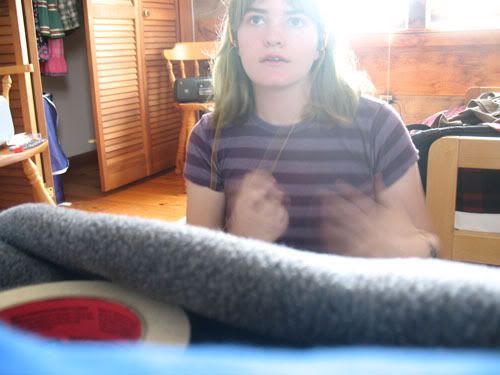
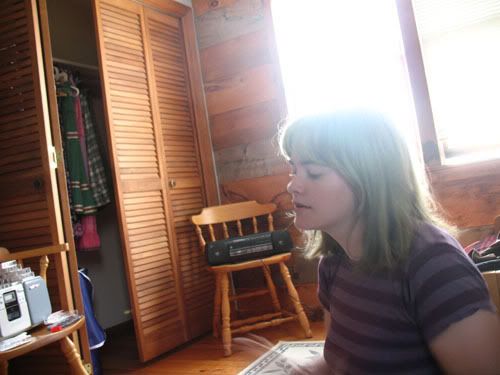
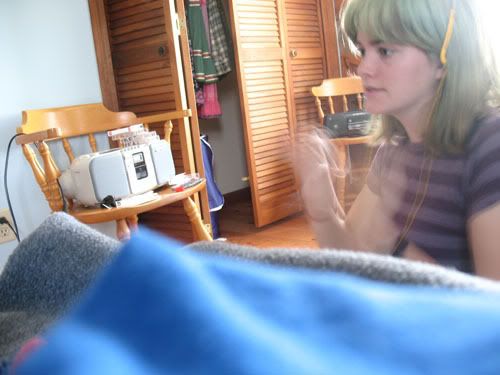
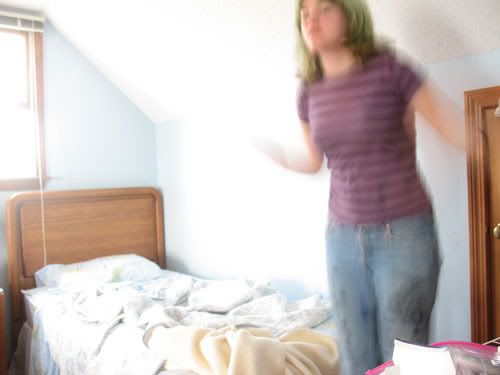
I took these pictures because I didn't know what I looked like when I was stimming and I assumed it probably looked scary. As soon as I started taking them, I realized it looked sort of cool, at least in pictures, so I took a lot more.
Before, I didn't have an image of what a person who stimmed could look like. I'm not saying I was raised to feel terrible about stimming because I wasn't really cracked down on by teachers and parents like some people are. But it was sort of similar to how I felt about being queer--I either heard vague negative stuff, or silence.* I saw people on the Internet saying it was okay but I had trouble applying that to my real life.
The next summer, I wrote this piece: Functional Stimming. It was mostly a reaction to anti-stimming attitudes at the school, but I tried to approach the issue of stimming in an objective and accessible way. I took pictures of myself stimming and described how I felt about stimming, and I talked about two people I knew who stimmed, and included pictures of them.
Towards the end, I said:
I don't feel great about the way I stim. I wish I could stim the way Clayton does; it seems so natural and unselfconscious, just an intense expression of his feelings. I feel like I have a stimming habit, like I binge on stimming. It feels like an explosion and I feel worn out afterwards.
I remember other kids making fun of me for shaking my knees back and forth in class and compulsively touching my nose while I was reading. I don't know if that's how my stimming got driven underground. I just very much wish that instead of being this giant, dramatic, embarrassing thing, stimming could just be part of my life...
I just went and walked in circles for a few minutes trying to get my thoughts together. That was really nice. That's the kind of stimming I would like to do--calm. Something that makes my thoughts make more sense instead of ratcheting them up to fever pitch.
That summer I also made some videos like this:
One night I got stuck in the city with a headache and some general spaced-out-ness and was really screwed in terms of finding a quick subway train back to Grand Central. Last summer was the first time I really started understanding subways at all, and I'm still not very good. So I ended up riding around a lot and it was really late at night and I remember being really proud because I knew I would eventually get home even though it was hard, but I also was feeling unpleasant in other ways because it was loud and hot and I had a headache. I was thinking about Danny because I was seeing him every day and he loved subways. Thinking about Danny always made me think about passing and stimming, so I started stimming while I was waiting for the subway and it made me feel better.
And I had a horrible year in general and I became much more conscious of times when I needed to flap my hand by my side or scrape my palms along the edges of tables or step my feet around in circles. It was weird because things were so awful and in many ways I felt scared because I was letting go of many standards for being normal that I'd previously held and I think I worried that if I wasn't holding myself in place, I would somehow wake up one morning and be nonverbal or something like that.
At the same time, when I went back and read Functional Stimming, it seemed that all the problems I'd had were a lot better. Stimming had become something wholly neutral or positive. It wasn't always this full-body thing that exploded out of me unconsciously when I was alone, and hyped me up more than I wanted. It was just a tool and a joy.
I'd also started to feel differently about the way I hold myself. I think it's called posturing because when I say I move stiffly I don't mean I am stiff, or something, but that I find it nice to stick out my arms and legs and hands.
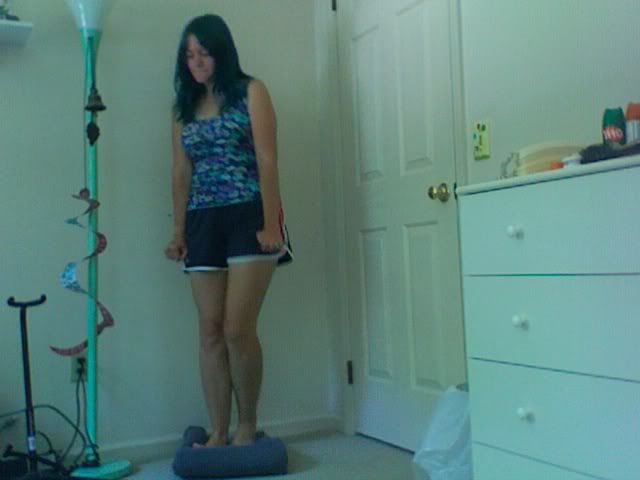
This is an overdramatic version of what I mean, because I'm doing it on purpose, but you get the idea. It especially affects the way I walk when I'm really at all excited or at all nervous. I just move my legs very stiffly, which probably is hard on my feet or something, but it feels really nice. If I try not to look different, it gets even worse because I'm nervous, and it ends up just being in the legs which are moving really mechanically. (One time Amanda Baggs wrote a post which in part was a description of how she notices ASD people based on how they walk. Some of this explains well what I'm trying to talk about.)
I guess this spring it occurred to me that I'm not the only person in the world to ever hold my hands differently and I started thinking about what I was afraid of looking like. There was obviously something I was freaking out about and trying to avoid but when I thought about it I realized it just looked like the way some people with ID and ASD walk and hold themselves all the time, and it also looked like some people with cerebral palsy. Once I started thinking of it that way, it didn't seem like a bad way to hold myself, because I associated it with other people and not just me being different by myself.
Now instead of trying to walk normally and then occasionally walking really stiffly, and also having these huge full-body stim explosions when I'm by myself, I just walk in a way that is more uneven and "posture"-y and I tend to kind of burst into a run more and sort of have stiff legs and move them around in a jumpy way. Not that I don't jump around on my own sometimes when I'm excited, but it doesn't feel like a huge problem that takes up a lot of energy, it just happens from time to time. And I don't feel bad about holding my hands in a stiff/curled-up way that feels good.
Of course I have criticisms of the camp where I worked this summer because you should always be aware of flaws, but it was in many ways very cool and very different from The School, because we weren't encouraged to think of ourselves as socially separate from and superior to the campers. Staff got involved in campers' interests and senses of humor; we weren't trying to get them to copy us. To the extent that we were trying to do stuff, we were trying to make sure they liked us and had a good time with us.
This was apparent before the campers even got there, just from the tone of our training. I was already feeling pretty happy and safe a few days into orientation, when we were going back to our cabins for a break. I felt excited and as often happens I ended up running for no discernible reason. Another counselor saw me and said, "Run Forrest run!"
I have had people make shitty comments about the way I run, and although this person was being friendly I can still imagine that I might have felt embarrassed and angry to have been "caught" doing something like that. But I guess since Forrest Gump is in fact disabled, even though she probably wasn't trying to make a comment about me looking disabled, I just processed it calmly in my head: "Forrest Gump is disabled and I'm disabled and I reminded someone of Forrest Gump. That makes sense." In the moment it made me feel good.
I also just remember dancing a lot (I had never danced before) and being excited and squealing and posturing and tripping over things because I was running around so much, the whole time I was at camp. It wasn't anything to be ashamed of because I was doing my job properly, and there were lots of awesome people around who also squealed and ran around a lot and flapped and made motorboat noises. There was a moment when I remember being really excited and happy in a really disabled-looking way in front of the whole camp, and I felt sort of transcendent and like I was going to cry. It was a weird sensory experience too, and just in a lot of ways one of the best moments of my life.
One time in seventh grade, I remember walking around with my shoes untied and not caring what other kids said until one girl said, "You look like a boy with your shoes untied." Then I immediately tied my shoes. Since then I've gone through periods of really really wanting to look like a boy, and even though I don't feel that way anymore I generally would find it cool to be told that something about my appearance looks like a boy. I tie my shoes now, because I would probably trip over myself when I start RFRing, but I'd like to think I own the possibility of looking like a boy. And I want to also own the possibility of looking disabled.
This is a pretty nice thing actually. I don't enjoy passing. Just kidding, I love passing. Just kidding, I hate passing. I mean I don't know. I am likely to think people who are visibly disabled have it worse, but I sometimes really wish I was visibly disabled and sometimes I feel like the fact that I'm not is what has caused basically all my anxiety/dissociation problems.
I have a lot of what I think are probably normal issues for women my age--basically, thinking that I'm horrible-looking and combing Facebook for pictures of myself and even if it's just a picture of my arm totally flipping out about how my arm looks horrible. Or maybe I have it on a level that isn't normal. I just look at pictures and think I'm smiling differently from everyone else in the picture. My face is bigger or smaller than theirs. I'm holding my legs differently. My hands look stiff. No one in the picture looks like they're my friends. I look like I'm just lurking in the background.
I just engaged in a bunch of this yesterday so I'm certainly not claiming that I feel great about myself now but I think that my feeling shitty about myself has been reduced to a more standard level. I also feel like I have something to move towards the way other people do when I think about how I'd like to look or how I'd like to be. Because I have images of people who look like me.
This is the reason I have trouble identifying as just Autistic instead of developmentally disabled, just because lots of the people who have led to me feeling okay, and feeling like a kind of person instead of just something unclassifiable, have been people with ID and other disabilities. I've talked about this a lot. But I just realized the other day that things are feeling so much better so I wanted to tell you some more.
I took these pictures because I didn't know what I looked like when I was stimming and I assumed it probably looked scary. As soon as I started taking them, I realized it looked sort of cool, at least in pictures, so I took a lot more.
Before, I didn't have an image of what a person who stimmed could look like. I'm not saying I was raised to feel terrible about stimming because I wasn't really cracked down on by teachers and parents like some people are. But it was sort of similar to how I felt about being queer--I either heard vague negative stuff, or silence.* I saw people on the Internet saying it was okay but I had trouble applying that to my real life.
The next summer, I wrote this piece: Functional Stimming. It was mostly a reaction to anti-stimming attitudes at the school, but I tried to approach the issue of stimming in an objective and accessible way. I took pictures of myself stimming and described how I felt about stimming, and I talked about two people I knew who stimmed, and included pictures of them.
Towards the end, I said:
I don't feel great about the way I stim. I wish I could stim the way Clayton does; it seems so natural and unselfconscious, just an intense expression of his feelings. I feel like I have a stimming habit, like I binge on stimming. It feels like an explosion and I feel worn out afterwards.
I remember other kids making fun of me for shaking my knees back and forth in class and compulsively touching my nose while I was reading. I don't know if that's how my stimming got driven underground. I just very much wish that instead of being this giant, dramatic, embarrassing thing, stimming could just be part of my life...
I just went and walked in circles for a few minutes trying to get my thoughts together. That was really nice. That's the kind of stimming I would like to do--calm. Something that makes my thoughts make more sense instead of ratcheting them up to fever pitch.
That summer I also made some videos like this:
One night I got stuck in the city with a headache and some general spaced-out-ness and was really screwed in terms of finding a quick subway train back to Grand Central. Last summer was the first time I really started understanding subways at all, and I'm still not very good. So I ended up riding around a lot and it was really late at night and I remember being really proud because I knew I would eventually get home even though it was hard, but I also was feeling unpleasant in other ways because it was loud and hot and I had a headache. I was thinking about Danny because I was seeing him every day and he loved subways. Thinking about Danny always made me think about passing and stimming, so I started stimming while I was waiting for the subway and it made me feel better.
And I had a horrible year in general and I became much more conscious of times when I needed to flap my hand by my side or scrape my palms along the edges of tables or step my feet around in circles. It was weird because things were so awful and in many ways I felt scared because I was letting go of many standards for being normal that I'd previously held and I think I worried that if I wasn't holding myself in place, I would somehow wake up one morning and be nonverbal or something like that.
At the same time, when I went back and read Functional Stimming, it seemed that all the problems I'd had were a lot better. Stimming had become something wholly neutral or positive. It wasn't always this full-body thing that exploded out of me unconsciously when I was alone, and hyped me up more than I wanted. It was just a tool and a joy.
I'd also started to feel differently about the way I hold myself. I think it's called posturing because when I say I move stiffly I don't mean I am stiff, or something, but that I find it nice to stick out my arms and legs and hands.
This is an overdramatic version of what I mean, because I'm doing it on purpose, but you get the idea. It especially affects the way I walk when I'm really at all excited or at all nervous. I just move my legs very stiffly, which probably is hard on my feet or something, but it feels really nice. If I try not to look different, it gets even worse because I'm nervous, and it ends up just being in the legs which are moving really mechanically. (One time Amanda Baggs wrote a post which in part was a description of how she notices ASD people based on how they walk. Some of this explains well what I'm trying to talk about.)
I guess this spring it occurred to me that I'm not the only person in the world to ever hold my hands differently and I started thinking about what I was afraid of looking like. There was obviously something I was freaking out about and trying to avoid but when I thought about it I realized it just looked like the way some people with ID and ASD walk and hold themselves all the time, and it also looked like some people with cerebral palsy. Once I started thinking of it that way, it didn't seem like a bad way to hold myself, because I associated it with other people and not just me being different by myself.
Now instead of trying to walk normally and then occasionally walking really stiffly, and also having these huge full-body stim explosions when I'm by myself, I just walk in a way that is more uneven and "posture"-y and I tend to kind of burst into a run more and sort of have stiff legs and move them around in a jumpy way. Not that I don't jump around on my own sometimes when I'm excited, but it doesn't feel like a huge problem that takes up a lot of energy, it just happens from time to time. And I don't feel bad about holding my hands in a stiff/curled-up way that feels good.
Of course I have criticisms of the camp where I worked this summer because you should always be aware of flaws, but it was in many ways very cool and very different from The School, because we weren't encouraged to think of ourselves as socially separate from and superior to the campers. Staff got involved in campers' interests and senses of humor; we weren't trying to get them to copy us. To the extent that we were trying to do stuff, we were trying to make sure they liked us and had a good time with us.
This was apparent before the campers even got there, just from the tone of our training. I was already feeling pretty happy and safe a few days into orientation, when we were going back to our cabins for a break. I felt excited and as often happens I ended up running for no discernible reason. Another counselor saw me and said, "Run Forrest run!"
I have had people make shitty comments about the way I run, and although this person was being friendly I can still imagine that I might have felt embarrassed and angry to have been "caught" doing something like that. But I guess since Forrest Gump is in fact disabled, even though she probably wasn't trying to make a comment about me looking disabled, I just processed it calmly in my head: "Forrest Gump is disabled and I'm disabled and I reminded someone of Forrest Gump. That makes sense." In the moment it made me feel good.
I also just remember dancing a lot (I had never danced before) and being excited and squealing and posturing and tripping over things because I was running around so much, the whole time I was at camp. It wasn't anything to be ashamed of because I was doing my job properly, and there were lots of awesome people around who also squealed and ran around a lot and flapped and made motorboat noises. There was a moment when I remember being really excited and happy in a really disabled-looking way in front of the whole camp, and I felt sort of transcendent and like I was going to cry. It was a weird sensory experience too, and just in a lot of ways one of the best moments of my life.
One time in seventh grade, I remember walking around with my shoes untied and not caring what other kids said until one girl said, "You look like a boy with your shoes untied." Then I immediately tied my shoes. Since then I've gone through periods of really really wanting to look like a boy, and even though I don't feel that way anymore I generally would find it cool to be told that something about my appearance looks like a boy. I tie my shoes now, because I would probably trip over myself when I start RFRing, but I'd like to think I own the possibility of looking like a boy. And I want to also own the possibility of looking disabled.
This is a pretty nice thing actually. I don't enjoy passing. Just kidding, I love passing. Just kidding, I hate passing. I mean I don't know. I am likely to think people who are visibly disabled have it worse, but I sometimes really wish I was visibly disabled and sometimes I feel like the fact that I'm not is what has caused basically all my anxiety/dissociation problems.
I have a lot of what I think are probably normal issues for women my age--basically, thinking that I'm horrible-looking and combing Facebook for pictures of myself and even if it's just a picture of my arm totally flipping out about how my arm looks horrible. Or maybe I have it on a level that isn't normal. I just look at pictures and think I'm smiling differently from everyone else in the picture. My face is bigger or smaller than theirs. I'm holding my legs differently. My hands look stiff. No one in the picture looks like they're my friends. I look like I'm just lurking in the background.
I just engaged in a bunch of this yesterday so I'm certainly not claiming that I feel great about myself now but I think that my feeling shitty about myself has been reduced to a more standard level. I also feel like I have something to move towards the way other people do when I think about how I'd like to look or how I'd like to be. Because I have images of people who look like me.
This is the reason I have trouble identifying as just Autistic instead of developmentally disabled, just because lots of the people who have led to me feeling okay, and feeling like a kind of person instead of just something unclassifiable, have been people with ID and other disabilities. I've talked about this a lot. But I just realized the other day that things are feeling so much better so I wanted to tell you some more.
*I'm sure my parents would take issue with this, especially in terms of queer stuff. I know that most people have it much worse but the thing is that most of the messages I got about queerness and DD were either mildly negative, acted like it didn't exist, or were very long-sufferingly tolerant (like my high school). Which isn't terrible but does make it hard for you to actually form into an adult because you feel uncomfortable/depressed about a lot of the things that you are.
06 June, 2010
Hugging problems
Recently I was thinking about hugging and remembering what physical affection was like at the ASD school where I interned last summer.
I remember the last day I was there I asked my favorite kid, R.D., if I could hug him. He said yes, but when I put my arms around him he didn't put his arms around me. I remember that this was something I did at his age, and it was because I saw hugs as an opportunity to get my whole body squeezed tightly. But I also wonder if, given the culture of the school, R.D. felt that he had the right to say he didn't want to hug.
There was a lot of hugging going on. Some kids would ask for tickling or hugging as their reward for doing work. There was also a lot of teachers hugging, tickling, and grabbing kids without being asked--and the way I feel about this is complicated. I mean, it's inarguable that people with sensory issues need to learn to put up with annoying and borderline painful sensations at least some of the time. And I also think it's the case that some people who don't like physical contact will come to like it better if they put up with it for a while. But...I mean, I already feel kind of gross writing those sentences, and it makes me nervous to think of anyone taking that idea and running with it--the idea that forcing physical affection on ASD kids is good for them.
There was a boy named J.S. in R.D.'s class, who I remember as being sort of prim and serious. He would occasionally become smiley about something he really liked, such as his baby sister, but usually he looked pretty dour and complained about everything. The teachers would always grab, chase, and tickle J.S. and I'm not sure how I feel about that. J.S. would giggle so I think maybe he was learning that these things can be fun. But he never looked like he was luxuriating in being grabbed or tickled, like kids who had asked for it; his smile was always kind of wincing, his body was always stiff.
J.S. embodies how conflicted I feel about the benefits and drawbacks of being aggressively physically affectionate with ASD kids. But there was a third kind of affection at that school, and that was affection that was not supposed to happen. Twice, I remember R.D., in some sort of squeaky, wordy paroxysm, throwing an arm around me and squeezing me, to which he was told, "Keep your hands to yourself" or "Don't be silly." I've also mentioned a few times when kids would take the initiative in making a joke or game with an authority figure they liked, and be reprimanded for misbehavior (for example, turning off the lights in a room). This isn't ambiguous to me at all, it was a flat-out wrong way to do things. If R.D. wasn't allowed to impulsively hug someone else, then his teachers shouldn't be allowed to do that to him. "Can you be flexible?" was a constant question when kids who'd been expecting one thing had to accept a different result, and the only right answer was "Yes." But the teachers didn't show flexibility when a kid had an idea for how to do something, even something as small as an affectionate interaction.
There's a reason this makes me very upset, and the reason is abuse. I think I've linked multiple times to Dave Hingsburger's post The Good Girl, about a teenager with Down Syndrome who explained that if anyone abused her, she'd "understand" and wouldn't tell anyone because she wouldn't want her abuser to get in trouble. I think the attitudes at R.D. and J.S.'s school are perfectly suited to screwing up kids just that way.
I felt gross saying that sometimes having to put up with uncomfortable physical affection can be good for a kid. But at least I felt gross, at least I'm speaking from my experience as an ASD person, and at least I think it's an incredibly complex and difficult issue. The teachers at the school did not seem to think this was a complex issue, which is horribly dangerous. It makes me very nervous to think of J.S. getting older and eventually ceasing to complain about discomfort. It makes me nervous to think how R.D. will handle friendships and relationships as an adult, when he's been taught to accept contact he doesn't like and discouraged from initiating the kind of contact he does like.
But the prospect of unequal relationships seems almost jolly when compared to the possibility that one of these kids could be abused by an adult. Being trained to accept physical contact that you don't like, and being discouraged from complaining, being "inflexible," and expressing unpopular opinions, are things that could set up a child to not report being abused.
The connotations of this are horrible. They are connotations that exist in many of the attitudes at that school. Stimming is bad because it looks weird and can lead to discrimination--stimming is the enemy, not discrimination. Special interests are bad because they aren't considered normal--special interests are the enemy, not illogical constructions of what is normal. And, somehow, people who could hurt these kids are not as big an enemy as the kids themselves; teaching them power and independence is not worth it if it would mean letting them say, "I don't want a hug right now."
I remember the last day I was there I asked my favorite kid, R.D., if I could hug him. He said yes, but when I put my arms around him he didn't put his arms around me. I remember that this was something I did at his age, and it was because I saw hugs as an opportunity to get my whole body squeezed tightly. But I also wonder if, given the culture of the school, R.D. felt that he had the right to say he didn't want to hug.
There was a lot of hugging going on. Some kids would ask for tickling or hugging as their reward for doing work. There was also a lot of teachers hugging, tickling, and grabbing kids without being asked--and the way I feel about this is complicated. I mean, it's inarguable that people with sensory issues need to learn to put up with annoying and borderline painful sensations at least some of the time. And I also think it's the case that some people who don't like physical contact will come to like it better if they put up with it for a while. But...I mean, I already feel kind of gross writing those sentences, and it makes me nervous to think of anyone taking that idea and running with it--the idea that forcing physical affection on ASD kids is good for them.
There was a boy named J.S. in R.D.'s class, who I remember as being sort of prim and serious. He would occasionally become smiley about something he really liked, such as his baby sister, but usually he looked pretty dour and complained about everything. The teachers would always grab, chase, and tickle J.S. and I'm not sure how I feel about that. J.S. would giggle so I think maybe he was learning that these things can be fun. But he never looked like he was luxuriating in being grabbed or tickled, like kids who had asked for it; his smile was always kind of wincing, his body was always stiff.
J.S. embodies how conflicted I feel about the benefits and drawbacks of being aggressively physically affectionate with ASD kids. But there was a third kind of affection at that school, and that was affection that was not supposed to happen. Twice, I remember R.D., in some sort of squeaky, wordy paroxysm, throwing an arm around me and squeezing me, to which he was told, "Keep your hands to yourself" or "Don't be silly." I've also mentioned a few times when kids would take the initiative in making a joke or game with an authority figure they liked, and be reprimanded for misbehavior (for example, turning off the lights in a room). This isn't ambiguous to me at all, it was a flat-out wrong way to do things. If R.D. wasn't allowed to impulsively hug someone else, then his teachers shouldn't be allowed to do that to him. "Can you be flexible?" was a constant question when kids who'd been expecting one thing had to accept a different result, and the only right answer was "Yes." But the teachers didn't show flexibility when a kid had an idea for how to do something, even something as small as an affectionate interaction.
There's a reason this makes me very upset, and the reason is abuse. I think I've linked multiple times to Dave Hingsburger's post The Good Girl, about a teenager with Down Syndrome who explained that if anyone abused her, she'd "understand" and wouldn't tell anyone because she wouldn't want her abuser to get in trouble. I think the attitudes at R.D. and J.S.'s school are perfectly suited to screwing up kids just that way.
I felt gross saying that sometimes having to put up with uncomfortable physical affection can be good for a kid. But at least I felt gross, at least I'm speaking from my experience as an ASD person, and at least I think it's an incredibly complex and difficult issue. The teachers at the school did not seem to think this was a complex issue, which is horribly dangerous. It makes me very nervous to think of J.S. getting older and eventually ceasing to complain about discomfort. It makes me nervous to think how R.D. will handle friendships and relationships as an adult, when he's been taught to accept contact he doesn't like and discouraged from initiating the kind of contact he does like.
But the prospect of unequal relationships seems almost jolly when compared to the possibility that one of these kids could be abused by an adult. Being trained to accept physical contact that you don't like, and being discouraged from complaining, being "inflexible," and expressing unpopular opinions, are things that could set up a child to not report being abused.
The connotations of this are horrible. They are connotations that exist in many of the attitudes at that school. Stimming is bad because it looks weird and can lead to discrimination--stimming is the enemy, not discrimination. Special interests are bad because they aren't considered normal--special interests are the enemy, not illogical constructions of what is normal. And, somehow, people who could hurt these kids are not as big an enemy as the kids themselves; teaching them power and independence is not worth it if it would mean letting them say, "I don't want a hug right now."
01 June, 2010
About Kenny
I want to tell you about Kenny. He went to my high school, which I might somewhat flamboyantly refer to as undercover special ed--but it would be more accurate to say that it was a nominal prep school that was not at all difficult to get into, with very small classes, where no one would stop you from lying down on the floor. If you had a kid who, like me or my fake friend Joan, or like Dana or Connor, was obviously not going to cut it in an ordinary school, and if you had a certain amount of money, my school offered an option besides a school specifically for kids with disabilities/mental illnesses/a history of trouble. But there were kids who didn't have any of those things, and just hadn't been able to get into a better prep school. I feel a strange loyalty to the place, although I was incredibly lonely for my last two years due to being a sexual minority who couldn't compensate. It was probably the only school where a person like me could have had close relationships with teachers, learned to succeed academically, and been involved in theater and music; so I'm grateful for that.
During my tenth-grade year they built a new arts building and from then until I graduated that's where I spent most of my time. The whole building was carpeted and there were different hallways where I liked to sit on the floor, against the wall, and write in a notebook or read. I liked the halls in the basement, near the practice rooms, or near the room where my Latin classes were. I also liked the ground floor--I liked to wedge myself in next to the radiator, or maybe on top of the radiator, I forget, but so I could see out the window. There was an anemic field between the arts building and the main high school building, which had been built when my school had less money, and was uglier.
The Dean of Students moved to the arts building and she would let some of us hang out in her office; in twelfth grade I started spending a lot of time sleeping and doing work on her couch. That is also the year that a certain group of ninth- and tenth-grade boys, who kept their guitars in her office, would sit out by the radiator where I had spent most of my time the year before. They would play songs by Pink Floyd, the Beatles, and the Who. Kenny was one of the better guitarists and he had a haunting, pale voice, that sounded like a girl's when I was asleep.
I only spoke to Kenny a few times but he is one of the reasons I became interested in meeting other people with ASD--although he didn't say he had it, he only didn't deny. I was asking him a lot of questions one day while he played "I Can See for Miles" in the Dean's office by himself:
"Hey, do you have anything wrong with you?"
"No."
"I mean, I was wondering if you had Asperger's"
"Oh yeah, well, that."
Kenny had words he liked to use, and his face was always scrunched up in a way that looked like he was in pain. One reason I enjoyed talking to him was that I would start out just seeing the way his face looked on the surface, and thinking that he must be scared, or concentrating, or something; but then I could almost see through the surface of his face, and see that he had all kinds of feelings like everyone else. And then also, of course, the more Kenny played, the more his hands scrambled along the fretboard, the more his face loosened up.
Kenny was a nice kid but what I have to say isn't really about Kenny; it's about Mrs. C., the chorus teacher, and it's about the other boys who played guitar. Kenny was just himself. The words he used were the words that the boys who played guitar would say with him, in between songs. It's about all the kids who were in chorus, because--well, I have to explain about Kenny's stimming. Kenny played a lot of instruments, although I'm pretty sure he stimmed more instruments than he played. What I mean is that while Kenny flapped and stuff, the major things he did with his hands when they were not on a real-life guitar or piano were to manically play imaginary guitars, pianos, basses, violas, and saxophones. The saxophone was the one that got the most positive response, when Kenny got so explosive in chorus one day that no other instrument was good enough and he raised his hands to his face and pressed with stunning accuracy the invisible keys, and blew. The kids in chorus came close to applauding, while Mrs. C. laughed delightedly.
Before you ask, I know what it is like when people are laughing at the way someone moves. That is not what this was. Kenny's words, his stim-instruments, and his more standard flapping and jumping were considered interesting, impressive, and cool. They were not "meaningless repetitive behaviors"--everyone could see what they were about. Backstage before a performance, Kenny flapped at the people around him and we indicated we were nervous, and excitable, too.
Not everyone gets what Kenny got--I didn't get what Kenny got, and I had the same disability at the same school--but I still like thinking about him and explaining it to myself. I think this is pretty much a beacon of how things can be, proof that a person who's different can be seamlessly integrated into the whole without smashing himself into a normal shape, and without anyone else thinking they're doing him a favor. No one was doing Kenny a favor; Kenny was awesome.
One time Kenny did Mrs. C. a favor. He and a few of the other boys were going to sing a special song in the spring concert--I think it was "My Girl," something with very close harmony. It was a small school, meaning teachers did what they could with the talent they had, and I'm guessing Kenny with his incredible precision was going to be the rock who stayed in place when other boys muddled up and down. Kenny's singing was accompanied always by, at the very least, very stiff, sharp, tall conducting movements, his hands pinched together like beaks. At the very least. On the day of the last rehearsal, Mrs. C. said, "Kenny--for the actual concert, can you tone it down? Can you keep it in?" Kenny agreed. Whenever someone tries to explain to me that people make fun of kids who stim in public, as a way of proving that such and such ableist and abusive policy is okay...I just want to show those people Mrs. C.
Mrs. C. liked Kenny's stimming.
She knew that he had to do it.
She didn't think he did it to be annoying or to make people laugh or to get attention. At the same time, if people did laugh or pay attention, she didn't think that was inappropriate; Kenny's stimming wasn't an embarrassment, it was cool.
Mrs. C. knew that some parents would be distracted by Kenny's stimming and that it wasn't part of what was considered to be appropriate behavior for a concert. So she asked Kenny not to do it--in a way that made it obvious he was doing something difficult as a favor to everyone else, not in a way that implied this was a reasonable thing to expect from him all the time.
Kenny worked hard; he sang well and stayed still for the whole set of songs and then he and his friends dashed to their seats, coming down from the risers; Kenny was grinning at his friends, rolling his eyes to show how exhausted he was, wringing the hell out of his hands.
During my tenth-grade year they built a new arts building and from then until I graduated that's where I spent most of my time. The whole building was carpeted and there were different hallways where I liked to sit on the floor, against the wall, and write in a notebook or read. I liked the halls in the basement, near the practice rooms, or near the room where my Latin classes were. I also liked the ground floor--I liked to wedge myself in next to the radiator, or maybe on top of the radiator, I forget, but so I could see out the window. There was an anemic field between the arts building and the main high school building, which had been built when my school had less money, and was uglier.
The Dean of Students moved to the arts building and she would let some of us hang out in her office; in twelfth grade I started spending a lot of time sleeping and doing work on her couch. That is also the year that a certain group of ninth- and tenth-grade boys, who kept their guitars in her office, would sit out by the radiator where I had spent most of my time the year before. They would play songs by Pink Floyd, the Beatles, and the Who. Kenny was one of the better guitarists and he had a haunting, pale voice, that sounded like a girl's when I was asleep.
I only spoke to Kenny a few times but he is one of the reasons I became interested in meeting other people with ASD--although he didn't say he had it, he only didn't deny. I was asking him a lot of questions one day while he played "I Can See for Miles" in the Dean's office by himself:
"Hey, do you have anything wrong with you?"
"No."
"I mean, I was wondering if you had Asperger's"
"Oh yeah, well, that."
Kenny had words he liked to use, and his face was always scrunched up in a way that looked like he was in pain. One reason I enjoyed talking to him was that I would start out just seeing the way his face looked on the surface, and thinking that he must be scared, or concentrating, or something; but then I could almost see through the surface of his face, and see that he had all kinds of feelings like everyone else. And then also, of course, the more Kenny played, the more his hands scrambled along the fretboard, the more his face loosened up.
Kenny was a nice kid but what I have to say isn't really about Kenny; it's about Mrs. C., the chorus teacher, and it's about the other boys who played guitar. Kenny was just himself. The words he used were the words that the boys who played guitar would say with him, in between songs. It's about all the kids who were in chorus, because--well, I have to explain about Kenny's stimming. Kenny played a lot of instruments, although I'm pretty sure he stimmed more instruments than he played. What I mean is that while Kenny flapped and stuff, the major things he did with his hands when they were not on a real-life guitar or piano were to manically play imaginary guitars, pianos, basses, violas, and saxophones. The saxophone was the one that got the most positive response, when Kenny got so explosive in chorus one day that no other instrument was good enough and he raised his hands to his face and pressed with stunning accuracy the invisible keys, and blew. The kids in chorus came close to applauding, while Mrs. C. laughed delightedly.
Before you ask, I know what it is like when people are laughing at the way someone moves. That is not what this was. Kenny's words, his stim-instruments, and his more standard flapping and jumping were considered interesting, impressive, and cool. They were not "meaningless repetitive behaviors"--everyone could see what they were about. Backstage before a performance, Kenny flapped at the people around him and we indicated we were nervous, and excitable, too.
Not everyone gets what Kenny got--I didn't get what Kenny got, and I had the same disability at the same school--but I still like thinking about him and explaining it to myself. I think this is pretty much a beacon of how things can be, proof that a person who's different can be seamlessly integrated into the whole without smashing himself into a normal shape, and without anyone else thinking they're doing him a favor. No one was doing Kenny a favor; Kenny was awesome.
One time Kenny did Mrs. C. a favor. He and a few of the other boys were going to sing a special song in the spring concert--I think it was "My Girl," something with very close harmony. It was a small school, meaning teachers did what they could with the talent they had, and I'm guessing Kenny with his incredible precision was going to be the rock who stayed in place when other boys muddled up and down. Kenny's singing was accompanied always by, at the very least, very stiff, sharp, tall conducting movements, his hands pinched together like beaks. At the very least. On the day of the last rehearsal, Mrs. C. said, "Kenny--for the actual concert, can you tone it down? Can you keep it in?" Kenny agreed. Whenever someone tries to explain to me that people make fun of kids who stim in public, as a way of proving that such and such ableist and abusive policy is okay...I just want to show those people Mrs. C.
Mrs. C. liked Kenny's stimming.
She knew that he had to do it.
She didn't think he did it to be annoying or to make people laugh or to get attention. At the same time, if people did laugh or pay attention, she didn't think that was inappropriate; Kenny's stimming wasn't an embarrassment, it was cool.
Mrs. C. knew that some parents would be distracted by Kenny's stimming and that it wasn't part of what was considered to be appropriate behavior for a concert. So she asked Kenny not to do it--in a way that made it obvious he was doing something difficult as a favor to everyone else, not in a way that implied this was a reasonable thing to expect from him all the time.
Kenny worked hard; he sang well and stayed still for the whole set of songs and then he and his friends dashed to their seats, coming down from the risers; Kenny was grinning at his friends, rolling his eyes to show how exhausted he was, wringing the hell out of his hands.
04 May, 2010
No One's Ever Going to be Endlessly Alive
When I was younger (i.e. until like a year ago, let's be totally honest) I used to think that I should become a rock star because then I could move as much as I want and no one would notice. But then when I make videos like this I spend the entire time being like "STOP TOE-WALKING YOU LITTLE CREEP!" Because unfortunately it turns out there is some sort of divide between what looks DD and what looks like someone who just really likes music (and is awesome).
Disclaimer: I know that if you're a Diagnosis Police Officer you will be like, "There isn't any toe-walking in this video! You're the most made-up Autistic person ever!" That's because I'm trying not to. I mean, I know I shouldn't try not to, but I do, and maybe as I get older I'll be less of a twerp about this stuff.
I think I can't stand the way I feel
I can smash in all the doors but it's not real
And I know, I know, I know, I know how you feel
I know, I know, I know, I know it's not real
I think I can't help the way I am
You can hate it all you want but it's the same
And I know, I know, I know it's just how I am
I know, I know, I know we're not the same
I'm not real and that's okay
I'm really calm with my place
Remember, you are always tender
Remember, it doesn't mean what you think
Because no one's ever going to be endlessly alive
If my palms are the only sensitive parts
I have left I will scrape them on all the doors
'Cause I know, I know I've got to squeeze it out
The rest of me, I'll use it till it stops
I'm not real and that's okay
I'm really calm with my place
Remember, you are always tender
And remember, it doesn't mean what you think
Because no one's ever going to be endlessly alive
I think I can't stand the way I feel
I can smash in all your doors but it's not real
And I know, I know, I know, I know how you feel
But I know, I know, I know, I know it's not real
Disclaimer: I know that if you're a Diagnosis Police Officer you will be like, "There isn't any toe-walking in this video! You're the most made-up Autistic person ever!" That's because I'm trying not to. I mean, I know I shouldn't try not to, but I do, and maybe as I get older I'll be less of a twerp about this stuff.
I think I can't stand the way I feel
I can smash in all the doors but it's not real
And I know, I know, I know, I know how you feel
I know, I know, I know, I know it's not real
I think I can't help the way I am
You can hate it all you want but it's the same
And I know, I know, I know it's just how I am
I know, I know, I know we're not the same
I'm not real and that's okay
I'm really calm with my place
Remember, you are always tender
Remember, it doesn't mean what you think
Because no one's ever going to be endlessly alive
If my palms are the only sensitive parts
I have left I will scrape them on all the doors
'Cause I know, I know I've got to squeeze it out
The rest of me, I'll use it till it stops
I'm not real and that's okay
I'm really calm with my place
Remember, you are always tender
And remember, it doesn't mean what you think
Because no one's ever going to be endlessly alive
I think I can't stand the way I feel
I can smash in all your doors but it's not real
And I know, I know, I know, I know how you feel
But I know, I know, I know, I know it's not real
22 April, 2010
Stimming people
I'm a stimming person. It's one of the things I hate the most about myself.
It's also one of the deepest things in me and one of my easiest ways of loving and understanding people. I like meeting severely disabled people and being at a loss as to what they are feeling, and then being able to notice what kind of stimming they are interested in.
My friend Mike, who I used to see a lot and now don't see very much and probably will see a lot again--Mike set me on the path of being deeply altered, and it's sad because I can never explain it to him, not just because he maybe doesn't have the words, but because he doesn't understand the hate. Mike lives his life with a completely unselfconscious relationship to his stimming. It is just his body.
I hate the way I walk when people can't see me. Sometimes I get caught because I didn't realize someone was there. I also hate the way I walk when people can see me. My walk is the walk of a person who's terrified of running, jumping, bouncing--it's terribly, leadenly stiff, like my joints are made of wood.
At the school where I interned I remember (I think I've mentioned it before--I think about it frequently when I'm walking) this teacher grabbing a boy by his shoulders again and again, trying to get him to walk stiffly instead of bouncily. He couldn't keep it up and I couldn't not see it as violence. I am not very political or very educated or very confident, but I believe in stimming. I don't want people to be the way I am; I want them to be the way Mike is.
It's hard to even explain to people the way I feel about the way I move. First of all, it's hard to even show it to people at all. But then even if I can get across what I'm talking about, it seems like it's just an action, it seems like something anyone could do, and it's like--what are you talking about? Jumping up and down has ruined your life? You don't think you can ever get married because you turn around a lot when you get excited?
Then it's like something I don't even know how to say. I'm scared. I'm so scared of looking a certain way, because some of the people who can't turn it off get hurt for looking like this. Looking like this, not acting like this--being like this, not looking like this, I mean. I like calling myself a stimming person because it's not an action, it's a kind of person. It's a kind of person I still am, the deepest thing.
It's also one of the deepest things in me and one of my easiest ways of loving and understanding people. I like meeting severely disabled people and being at a loss as to what they are feeling, and then being able to notice what kind of stimming they are interested in.
My friend Mike, who I used to see a lot and now don't see very much and probably will see a lot again--Mike set me on the path of being deeply altered, and it's sad because I can never explain it to him, not just because he maybe doesn't have the words, but because he doesn't understand the hate. Mike lives his life with a completely unselfconscious relationship to his stimming. It is just his body.
I hate the way I walk when people can't see me. Sometimes I get caught because I didn't realize someone was there. I also hate the way I walk when people can see me. My walk is the walk of a person who's terrified of running, jumping, bouncing--it's terribly, leadenly stiff, like my joints are made of wood.
At the school where I interned I remember (I think I've mentioned it before--I think about it frequently when I'm walking) this teacher grabbing a boy by his shoulders again and again, trying to get him to walk stiffly instead of bouncily. He couldn't keep it up and I couldn't not see it as violence. I am not very political or very educated or very confident, but I believe in stimming. I don't want people to be the way I am; I want them to be the way Mike is.
It's hard to even explain to people the way I feel about the way I move. First of all, it's hard to even show it to people at all. But then even if I can get across what I'm talking about, it seems like it's just an action, it seems like something anyone could do, and it's like--what are you talking about? Jumping up and down has ruined your life? You don't think you can ever get married because you turn around a lot when you get excited?
Then it's like something I don't even know how to say. I'm scared. I'm so scared of looking a certain way, because some of the people who can't turn it off get hurt for looking like this. Looking like this, not acting like this--being like this, not looking like this, I mean. I like calling myself a stimming person because it's not an action, it's a kind of person. It's a kind of person I still am, the deepest thing.
11 April, 2010
A flawed but I think useful model of ASD
I want to make a post about being intellectually disabled without the intellectual disability. Which is related to my whole thing of preferring to call myself developmentally disabled instead of any autism-related word.
This is partly, as I said, because I hate the word autism. Sometimes I wonder what is wrong with me that no one else seems to hate it as much as I do. I feel like the word is very intimately tied in with the kind of mistreatment that ASD people receive from professionals. If despite all evidence to the contrary people continue to think of autism as primarily a social disability--a disability of dislocation and indifference--then the obvious way to treat people with autism is to MAKE THEM SOCIAL! But how do you do that? How do you look at a person and make them social?
Well, you try to make them act more normal. You make a list of normal things to do. And then you try to train the person with autism to do those things.
You also make a list of things not to do, like moving wrong. And if you know any people with intellectual disabilities, maybe a bit of doubt is starting to creep in, because...don't a lot of intellectually disabled people move wrong, too? NO NO NO NO. Autism is not about that! Autism is about BEING OBSESSED WITH YOURSELF! Kids with autism just move wrong because--well, it's like, the whole thing where they flap their hands over and over is kind of like how they have really strong interests! It's basically the same thing, because they don't...because they don't switch from one thing to another, they just always do the same thing!
(Except some intellectually disabled people have really strong interests. Shit.)
When I started realizing I wanted to work with DD people--I mean, not when I started wanting to do it, but when I became sure that I was going to do it--it was mainly because I realized that I'm not a person who can batter through a lot of really exhausting things, like moving right, and trying to pick up on things really fast, and then, when it still doesn't work and everyone rolls their eyes or gets mad at me or thinks I'm a lot younger than I am, then, pretending that I don't even care--it was mainly because I realized that for my own health I needed to aspire to a career where I would be spending a lot of time with people whose ways of moving and thinking were not extremely different from my own.
And eventually I narrowed that down to wanting to work with intellectually disabled people, not ASD people--not because of any particular difference between ID and ASD people, but because of the extremely different attitude in the staff who work with them. A particular ID guy, who I think and write about a lot, likes to collect fliers. The people who work at his workshop and group home try to keep him from grabbing entire stacks of fliers and putting them in a bag, but the general reaction to his excitement about fliers is amusement and affection. He was recently Consumer of the Month at his workshop; if you mention him to a staff person, they light up and say, "Oh, he's hilarious, he's great. Did he show you his fliers?"
Think about what would happen if an ASD person, in a school, group home, or workshop specifically for ASD people, expressed that level of excitement about collecting a certain kind of object. And flapped their hands and jumped around (which he also does). The reaction would not be "you're great" because ASD is conceptualized as a disorder that has to do with not caring about people or not knowing how to be with them. So the reaction would be, "There you go, doing your repetitive, antisocial behaviors."
This is why I can't work in most places for ASD people because I can't really suppress my positive reaction to "repetitive, antisocial behaviors" like stimming and being really interested in things. Also, I am prone to such behaviors myself, so it would just fuck me up spiritually and in terms of self-esteem.
I know this is a total crock of shit, what I'm about to say, because some ASD people aren't like this. But this is how I think of ASD in myself: intellectual disability without the intellectual disability. Which means, a lot of the same movements and emotional reactions as ID people, and a similar way of being slow to pick up on things and sometimes slow to get out the words I want to say, and trouble with looking after my best interests in various ways. But academically, when all the other stuff doesn't get in the way, I'm not actually intellectually disabled.
Or you can say it like this: I have an anti-learning disability. Instead of being affected only in terms of academics, I'm affected only in terms of everything else.
For a while, weren't they mostly calling us PDD instead of ASD? I really like that better. ASD is so focused, just because of the name, on this ONE THING. And I feel like sometimes I understate the social stuff, because it does exist probably, but I feel like it's not that much more social trouble than a lot of people with intellectual disabilities experience, just by virtue of being different and maybe not picking up on things as fast. It's definitely not the core issue in my experience, I don't think.
I feel like if autism wasn't thought of as being this inherent state of selfishness and indifference, life would be totally different and better for people who have it. There is a tremendous and awful amount of prejudice directed at people who have intellectual disabilities, but I feel like it isn't quite as acceptable to say that it's "heartbreaking" or "a nightmare" to raise a child with an ID. And I'm not being disingenuous because I seriously think that a lot of people with ASD are loving in a lot of ways, but people don't see it because that's not what they're taught to expect. And they also don't see joy and nonverbal communication and stuff when they look at stimming because they've been taught what to believe stimming is.
ETA: I guess I feel required to state once again that I think this characterization of autism is totally full of holes--however, I do sometimes want to wrench out some kind of narrative that will fit me, and it does fit me, even though there are lots of ASD people it doesn't fit. Rather than putting out this model to be judged as correct or incorrect, when it's clearly somewhat incorrect, I'm more trying to stake out an opposite pole from the selfishness model of autism, to turn that model on its head. I believe the anti-learning disability model makes more sense than the selfishness model, and is somewhat closer to whatever the truth is.
This is partly, as I said, because I hate the word autism. Sometimes I wonder what is wrong with me that no one else seems to hate it as much as I do. I feel like the word is very intimately tied in with the kind of mistreatment that ASD people receive from professionals. If despite all evidence to the contrary people continue to think of autism as primarily a social disability--a disability of dislocation and indifference--then the obvious way to treat people with autism is to MAKE THEM SOCIAL! But how do you do that? How do you look at a person and make them social?
Well, you try to make them act more normal. You make a list of normal things to do. And then you try to train the person with autism to do those things.
You also make a list of things not to do, like moving wrong. And if you know any people with intellectual disabilities, maybe a bit of doubt is starting to creep in, because...don't a lot of intellectually disabled people move wrong, too? NO NO NO NO. Autism is not about that! Autism is about BEING OBSESSED WITH YOURSELF! Kids with autism just move wrong because--well, it's like, the whole thing where they flap their hands over and over is kind of like how they have really strong interests! It's basically the same thing, because they don't...because they don't switch from one thing to another, they just always do the same thing!
(Except some intellectually disabled people have really strong interests. Shit.)
When I started realizing I wanted to work with DD people--I mean, not when I started wanting to do it, but when I became sure that I was going to do it--it was mainly because I realized that I'm not a person who can batter through a lot of really exhausting things, like moving right, and trying to pick up on things really fast, and then, when it still doesn't work and everyone rolls their eyes or gets mad at me or thinks I'm a lot younger than I am, then, pretending that I don't even care--it was mainly because I realized that for my own health I needed to aspire to a career where I would be spending a lot of time with people whose ways of moving and thinking were not extremely different from my own.
And eventually I narrowed that down to wanting to work with intellectually disabled people, not ASD people--not because of any particular difference between ID and ASD people, but because of the extremely different attitude in the staff who work with them. A particular ID guy, who I think and write about a lot, likes to collect fliers. The people who work at his workshop and group home try to keep him from grabbing entire stacks of fliers and putting them in a bag, but the general reaction to his excitement about fliers is amusement and affection. He was recently Consumer of the Month at his workshop; if you mention him to a staff person, they light up and say, "Oh, he's hilarious, he's great. Did he show you his fliers?"
Think about what would happen if an ASD person, in a school, group home, or workshop specifically for ASD people, expressed that level of excitement about collecting a certain kind of object. And flapped their hands and jumped around (which he also does). The reaction would not be "you're great" because ASD is conceptualized as a disorder that has to do with not caring about people or not knowing how to be with them. So the reaction would be, "There you go, doing your repetitive, antisocial behaviors."
This is why I can't work in most places for ASD people because I can't really suppress my positive reaction to "repetitive, antisocial behaviors" like stimming and being really interested in things. Also, I am prone to such behaviors myself, so it would just fuck me up spiritually and in terms of self-esteem.
I know this is a total crock of shit, what I'm about to say, because some ASD people aren't like this. But this is how I think of ASD in myself: intellectual disability without the intellectual disability. Which means, a lot of the same movements and emotional reactions as ID people, and a similar way of being slow to pick up on things and sometimes slow to get out the words I want to say, and trouble with looking after my best interests in various ways. But academically, when all the other stuff doesn't get in the way, I'm not actually intellectually disabled.
Or you can say it like this: I have an anti-learning disability. Instead of being affected only in terms of academics, I'm affected only in terms of everything else.
For a while, weren't they mostly calling us PDD instead of ASD? I really like that better. ASD is so focused, just because of the name, on this ONE THING. And I feel like sometimes I understate the social stuff, because it does exist probably, but I feel like it's not that much more social trouble than a lot of people with intellectual disabilities experience, just by virtue of being different and maybe not picking up on things as fast. It's definitely not the core issue in my experience, I don't think.
I feel like if autism wasn't thought of as being this inherent state of selfishness and indifference, life would be totally different and better for people who have it. There is a tremendous and awful amount of prejudice directed at people who have intellectual disabilities, but I feel like it isn't quite as acceptable to say that it's "heartbreaking" or "a nightmare" to raise a child with an ID. And I'm not being disingenuous because I seriously think that a lot of people with ASD are loving in a lot of ways, but people don't see it because that's not what they're taught to expect. And they also don't see joy and nonverbal communication and stuff when they look at stimming because they've been taught what to believe stimming is.
ETA: I guess I feel required to state once again that I think this characterization of autism is totally full of holes--however, I do sometimes want to wrench out some kind of narrative that will fit me, and it does fit me, even though there are lots of ASD people it doesn't fit. Rather than putting out this model to be judged as correct or incorrect, when it's clearly somewhat incorrect, I'm more trying to stake out an opposite pole from the selfishness model of autism, to turn that model on its head. I believe the anti-learning disability model makes more sense than the selfishness model, and is somewhat closer to whatever the truth is.
16 March, 2010
Slightly Happier Math Exercise
As you might but probably don't remember, because you weren't here (except Ari who creepily went back and started arguing with me about my calculations), I one time wrote this really complicated post called the Sad Math Exercise about how I can never get married because I only want to date people with ASD, plus I'm gay, and ASD and gayness are both more common in boys which I am not, THE MISERY!
I guess it sounds like this might be a lead-in to a post about me announcing I'm in a relationship, but don't worry, that will never happen. I was just thinking today when I was at work that maybe the Sad Math Exercise doesn't have to be quite as sad as it is because I think I could date a regular person if they had cerebral palsy.
Like, I think the main issue is really my physicality--okay, part one, I think it's harder to communicate with someone who is not a stimming person, but part two, it's just very uncomfortable to be a woman who moves like I do and I spend a huge amount of time feeling jealous of guys for being allowed to move stiffly or bouncily when I have to constantly feel terrible about myself because of the way I walk and feel like I'm so much worse than practically everyone I know just because I'm stimmy and sometimes trying not to be stimmy and my proprioception is terrible so all my movements are very dramatic. I think that it would be nice to have a relationship with a person with CP because I would be able to go places with them without unfavorably comparing my movements to theirs.
However, while I was thinking this when I was at work, I was sort of backing it up by being like, "the one person in the world I feel terribly, easily close to is a person with CP, so maybe there's actually a specific body language overlap," and then I got all excited and was drawing ASD + CP = true love forever on the imaginary tree in my head
but then I was in class and my friend called me like eleven times, it was really awkward, and when I called him during the class break he started yammering about how he took the Simon Baron-Cohen test and I was like, "buddy, you don't need to have autism, I still like you," but then he started listing the billions of things that he read that prove his ASD, and telling me about his mom's problems when she was a kid, la la la, and I started, somewhat gloomily, to sink into the belief that there was no magical ESP connection between our disabilities and that the reason I like him so much is just that he's really been like me all along.
It's sort of depressing. I'd like to believe in fluidity, or love or something. This doesn't really discount my Math Exercise though, it still makes sense even without this particular experience to back it up.
I guess it sounds like this might be a lead-in to a post about me announcing I'm in a relationship, but don't worry, that will never happen. I was just thinking today when I was at work that maybe the Sad Math Exercise doesn't have to be quite as sad as it is because I think I could date a regular person if they had cerebral palsy.
Like, I think the main issue is really my physicality--okay, part one, I think it's harder to communicate with someone who is not a stimming person, but part two, it's just very uncomfortable to be a woman who moves like I do and I spend a huge amount of time feeling jealous of guys for being allowed to move stiffly or bouncily when I have to constantly feel terrible about myself because of the way I walk and feel like I'm so much worse than practically everyone I know just because I'm stimmy and sometimes trying not to be stimmy and my proprioception is terrible so all my movements are very dramatic. I think that it would be nice to have a relationship with a person with CP because I would be able to go places with them without unfavorably comparing my movements to theirs.
However, while I was thinking this when I was at work, I was sort of backing it up by being like, "the one person in the world I feel terribly, easily close to is a person with CP, so maybe there's actually a specific body language overlap," and then I got all excited and was drawing ASD + CP = true love forever on the imaginary tree in my head
but then I was in class and my friend called me like eleven times, it was really awkward, and when I called him during the class break he started yammering about how he took the Simon Baron-Cohen test and I was like, "buddy, you don't need to have autism, I still like you," but then he started listing the billions of things that he read that prove his ASD, and telling me about his mom's problems when she was a kid, la la la, and I started, somewhat gloomily, to sink into the belief that there was no magical ESP connection between our disabilities and that the reason I like him so much is just that he's really been like me all along.
It's sort of depressing. I'd like to believe in fluidity, or love or something. This doesn't really discount my Math Exercise though, it still makes sense even without this particular experience to back it up.
14 January, 2010
I'm officially Pop Culture Normal
okay, so I just finished giving myself the Adult Asperger Assessment and would like to share that as I expected, I am Pop Culture Normal, i.e. I don't have Pop Culture Asperger's Syndrome.
Before you suggest that maybe I just don't have AS at all and this whole blog is a ridiculous lie, I would like to remind you that as a kid I was mistakenly thought to have been molested because I was such a weirdo, and sent to a psychologist who told my mom, "It's almost like autism, but autistic children can't talk," then diagnosed with PDD-NOS at age ten, then diagnosed with Asperger's at age 14, and went to a psychiatrist when I was 16 who casually confirmed that I seemed AS to him (I was there for other reasons--basically a less competent psychiatrist had put me on antipsychotics because I talked too much, then put me on Adderall because like most people who are taking unnecessary antipsychotics, I was really depressed and listless). To be 100% honest, I also got kicked out of a study for AS kids when I was 16 because I was too good at reading facial expressions, but they didn't actually say I wasn't AS, just that I was either not impaired enough or already too good at coping in that particular area to be helped by the product they were testing. So like a lot of women I compensate too well to be considered legit, but there has been lots of professional opinion my whole life that I am ASD.
But let's see what Simon Baron Cohen says! I'm not posting my whole comments about the AAA, but just the ones that I think are striking.
Social Impairments
2--failure to develop peer relationships appropriate to developmental level. This is an example of how dumb Simon Baron-Cohen is! When I was 18 my relationships were way behind but now that I’m 21 they’re not so behind. That’s because once you’re an adult, the kind of relationships you’re expected to have stays the same, so if you have ASD, you get a chance to catch up. If this is supposed to be an assessment for adults, SBC should realize that developmental level is a really weird idea to apply to adults, and he should think about whether ASD people can catch up or not. My opinion is that some ASD people can catch up in many ways, and be completely happy socially with normal people, but they’re not going to socialize in exactly the same way as normal people. I think it would be smarter for SBC to see if someone socializes in an atypical way, instead of only counting someone as AS if they’re actually bad at socializing.
This section has a lot of silly symptoms that are hard to understand, like “does not enjoy social situations.” What does that mean? I don’t like parties. I don’t like being with people I don’t know. Yesterday I watched Battlestar Galactica with my roommate, then went to visit my friend Gabe while talking to FFD on the phone, and stayed at Gabe’s apartment for several hours, talking and reading. I enjoyed all these experiences a lot. Aren’t they social? I guess if you put me with a lot of really normal people, and expected certain kinds of socialization, I would do really badly, like I did in the UK. I go to a school that fits me like a glove, socially, as much as any school can fit a person like me like a glove. I guess I had all these symptoms when I was in the UK, so we can say yes on “failure to develop peer relationships appropriate to developmental level.” At least, I think we can.
4--lack of social or emotional reciprocity. Here SBC says a lot of stuff that is really insulting, like, “is not concerned if late when meeting a friend.” That isn’t social, it’s just a rule. Everyone is taught as a kid that you shouldn’t be late. So if someone doesn’t care about being late, it’s because they’re being a jerk, not because they’re impaired. SBC just thinks that AS is the same as being a jerk. Also, “does not spot when someone in a group is feeling awkward or uncomfortable,” is funny, because if normal people were good at identifying and helping awkward people, then Simon Baron-Cohen would be out of a job. I do think comforting people is scary (but interesting), so I guess I could say I have some of this. And “is not upset by seeing people cry” is technically true; I like seeing people cry because it makes it easier to figure out what they’re feeling. But the person described in this section is just such an asshole that I’ll go ahead and say I don’t have #4.
Stereotypy/Obsessions/Rituals
3--stimming, which for some reason he gives no examples of like he does the other symptoms. People try to leave stimming out of pop culture AS because it doesn’t fit into the brilliant jerk scientist stereotype. Anyway, I stim of course.
4--persistent preoccupation with parts of objects/systems. #4 is weird. When I first read it it didn’t seem like me at all. Then when I actually looked at the examples, some were things like “usually concentrates on the small details rather than the whole picture.” Wouldn’t it make more sense to describe #4 as “having trouble generalizing” or “having trouble seeing the whole picture or the ‘gist’ or the socially important part of a situation?” SBC makes it sound like this is all about some weird interest in license plates or something, instead of a learning impairment. Well, by his standards, I don’t have #4.
Communication
2--marked impairment in the ability to initiate or sustain a conversation with others. I feel the same way about #2 as #1 (turning conversations back to yourself/your interests)--sort of, a little, but not to the extent that he’s implying. I don’t like parties because they feel unpredictable and I feel like no one says or does anything important and I feel lost and anxious and like I should be doing something else. But I like just talking to one or two other people for hours, and don’t consider that a waste of time at all.
4--inability to recognize when the listener is interested or bored. Oh look SBC has actually taken into account that ASD people adjust their behavior: “Even if the person has been told not to talk about their particular obsessive topic for too long, this difficulty may be evident if other topics arise.” GOOD JOB SBC!! Anyway, I guess I have #4, I have no idea whether people are interested in what I’m saying a lot. I check a lot verbally, and basically assume that if someone is my friend, they think I’m interesting, and I try to make the other person talk from time to time, and I don’t really talk about my obsessions at all, and I just assume that all of those coping mechanisms result in me not talking too much to people who are uninterested.
5--frequent tendency to say things without considering the emotional impact on the listener. I guess. Sort of. I’m just having trouble not saying “sort of” to all of these communication ones. But I feel like even normal people would say “sort of” to some of them.
Impairments in imagination
1--lack of spontaneous make-believe play appropriate to developmental level. No. Also! The symptom “finds it difficult now to play games with children that involve pretending” doesn’t make any sense because if the person isn’t at an appropriate developmental level, then wouldn’t this mean that they would actually enjoy being with children? NO IT WOULDN’T BECAUSE PEOPLE WITH ASPERGER’S HATE FEELINGS AND ANYTHING GIRLY.
Prerequisites
2--clinically significant impairment in social, occupational, or other important areas of functioning. Does executive function count? Wait I didn’t realize that SBC never talked about executive function at all! Executive dysfunction is even more uncool from a Pop Culture AS perspective than stimming.
4--no clinically significant delay in cognitive development or self-help skills or adaptive behavior. Dude! He just kicked out executive function problems altogether because he think AS people only have problems with things “linked to social awareness e.g. personal hygiene.” I don’t understand why SBC even claims to be studying AS at all because he’s just studying “people with bad social skills.” That’s all he thinks it is.
Social Impairments--3/5 required, I got 3, but only because I was stretching it; only "difficulties in understanding social situations and other people’s thoughts and feelings" was inarguably true about me.
Stereotypy/Obsessions/Rituals--3/5 required, I got 3 without trying, but had trouble judging the other two.
Communication--3/5 required, I had a lot of trouble judging this. Somewhere between 1 and 5.
Impairments in imagination--1/3 required, I got 0 BECAUSE THIS IS COMPLETELY STUPID AND HAS NOTHING TO DO WITH AS. If AS gets remade as something about being a particular kind of nerd who likes taking apart machines, I just don't see what the point of the AS diagnosis is anyway. SBC isn't trying to identify a collection of impairments that people need help and support with, he's just listing a bunch of stereotypes. How is preferring nonfiction to fiction an impairment? How is not liking to play with children an impairment? Is one ASD person better-functioning than another simply because they like reading fiction? How does this make any sense?
Before you suggest that maybe I just don't have AS at all and this whole blog is a ridiculous lie, I would like to remind you that as a kid I was mistakenly thought to have been molested because I was such a weirdo, and sent to a psychologist who told my mom, "It's almost like autism, but autistic children can't talk," then diagnosed with PDD-NOS at age ten, then diagnosed with Asperger's at age 14, and went to a psychiatrist when I was 16 who casually confirmed that I seemed AS to him (I was there for other reasons--basically a less competent psychiatrist had put me on antipsychotics because I talked too much, then put me on Adderall because like most people who are taking unnecessary antipsychotics, I was really depressed and listless). To be 100% honest, I also got kicked out of a study for AS kids when I was 16 because I was too good at reading facial expressions, but they didn't actually say I wasn't AS, just that I was either not impaired enough or already too good at coping in that particular area to be helped by the product they were testing. So like a lot of women I compensate too well to be considered legit, but there has been lots of professional opinion my whole life that I am ASD.
But let's see what Simon Baron Cohen says! I'm not posting my whole comments about the AAA, but just the ones that I think are striking.
Social Impairments
2--failure to develop peer relationships appropriate to developmental level. This is an example of how dumb Simon Baron-Cohen is! When I was 18 my relationships were way behind but now that I’m 21 they’re not so behind. That’s because once you’re an adult, the kind of relationships you’re expected to have stays the same, so if you have ASD, you get a chance to catch up. If this is supposed to be an assessment for adults, SBC should realize that developmental level is a really weird idea to apply to adults, and he should think about whether ASD people can catch up or not. My opinion is that some ASD people can catch up in many ways, and be completely happy socially with normal people, but they’re not going to socialize in exactly the same way as normal people. I think it would be smarter for SBC to see if someone socializes in an atypical way, instead of only counting someone as AS if they’re actually bad at socializing.
This section has a lot of silly symptoms that are hard to understand, like “does not enjoy social situations.” What does that mean? I don’t like parties. I don’t like being with people I don’t know. Yesterday I watched Battlestar Galactica with my roommate, then went to visit my friend Gabe while talking to FFD on the phone, and stayed at Gabe’s apartment for several hours, talking and reading. I enjoyed all these experiences a lot. Aren’t they social? I guess if you put me with a lot of really normal people, and expected certain kinds of socialization, I would do really badly, like I did in the UK. I go to a school that fits me like a glove, socially, as much as any school can fit a person like me like a glove. I guess I had all these symptoms when I was in the UK, so we can say yes on “failure to develop peer relationships appropriate to developmental level.” At least, I think we can.
4--lack of social or emotional reciprocity. Here SBC says a lot of stuff that is really insulting, like, “is not concerned if late when meeting a friend.” That isn’t social, it’s just a rule. Everyone is taught as a kid that you shouldn’t be late. So if someone doesn’t care about being late, it’s because they’re being a jerk, not because they’re impaired. SBC just thinks that AS is the same as being a jerk. Also, “does not spot when someone in a group is feeling awkward or uncomfortable,” is funny, because if normal people were good at identifying and helping awkward people, then Simon Baron-Cohen would be out of a job. I do think comforting people is scary (but interesting), so I guess I could say I have some of this. And “is not upset by seeing people cry” is technically true; I like seeing people cry because it makes it easier to figure out what they’re feeling. But the person described in this section is just such an asshole that I’ll go ahead and say I don’t have #4.
Stereotypy/Obsessions/Rituals
3--stimming, which for some reason he gives no examples of like he does the other symptoms. People try to leave stimming out of pop culture AS because it doesn’t fit into the brilliant jerk scientist stereotype. Anyway, I stim of course.
4--persistent preoccupation with parts of objects/systems. #4 is weird. When I first read it it didn’t seem like me at all. Then when I actually looked at the examples, some were things like “usually concentrates on the small details rather than the whole picture.” Wouldn’t it make more sense to describe #4 as “having trouble generalizing” or “having trouble seeing the whole picture or the ‘gist’ or the socially important part of a situation?” SBC makes it sound like this is all about some weird interest in license plates or something, instead of a learning impairment. Well, by his standards, I don’t have #4.
Communication
2--marked impairment in the ability to initiate or sustain a conversation with others. I feel the same way about #2 as #1 (turning conversations back to yourself/your interests)--sort of, a little, but not to the extent that he’s implying. I don’t like parties because they feel unpredictable and I feel like no one says or does anything important and I feel lost and anxious and like I should be doing something else. But I like just talking to one or two other people for hours, and don’t consider that a waste of time at all.
4--inability to recognize when the listener is interested or bored. Oh look SBC has actually taken into account that ASD people adjust their behavior: “Even if the person has been told not to talk about their particular obsessive topic for too long, this difficulty may be evident if other topics arise.” GOOD JOB SBC!! Anyway, I guess I have #4, I have no idea whether people are interested in what I’m saying a lot. I check a lot verbally, and basically assume that if someone is my friend, they think I’m interesting, and I try to make the other person talk from time to time, and I don’t really talk about my obsessions at all, and I just assume that all of those coping mechanisms result in me not talking too much to people who are uninterested.
5--frequent tendency to say things without considering the emotional impact on the listener. I guess. Sort of. I’m just having trouble not saying “sort of” to all of these communication ones. But I feel like even normal people would say “sort of” to some of them.
Impairments in imagination
1--lack of spontaneous make-believe play appropriate to developmental level. No. Also! The symptom “finds it difficult now to play games with children that involve pretending” doesn’t make any sense because if the person isn’t at an appropriate developmental level, then wouldn’t this mean that they would actually enjoy being with children? NO IT WOULDN’T BECAUSE PEOPLE WITH ASPERGER’S HATE FEELINGS AND ANYTHING GIRLY.
Prerequisites
2--clinically significant impairment in social, occupational, or other important areas of functioning. Does executive function count? Wait I didn’t realize that SBC never talked about executive function at all! Executive dysfunction is even more uncool from a Pop Culture AS perspective than stimming.
4--no clinically significant delay in cognitive development or self-help skills or adaptive behavior. Dude! He just kicked out executive function problems altogether because he think AS people only have problems with things “linked to social awareness e.g. personal hygiene.” I don’t understand why SBC even claims to be studying AS at all because he’s just studying “people with bad social skills.” That’s all he thinks it is.
Social Impairments--3/5 required, I got 3, but only because I was stretching it; only "difficulties in understanding social situations and other people’s thoughts and feelings" was inarguably true about me.
Stereotypy/Obsessions/Rituals--3/5 required, I got 3 without trying, but had trouble judging the other two.
Communication--3/5 required, I had a lot of trouble judging this. Somewhere between 1 and 5.
Impairments in imagination--1/3 required, I got 0 BECAUSE THIS IS COMPLETELY STUPID AND HAS NOTHING TO DO WITH AS. If AS gets remade as something about being a particular kind of nerd who likes taking apart machines, I just don't see what the point of the AS diagnosis is anyway. SBC isn't trying to identify a collection of impairments that people need help and support with, he's just listing a bunch of stereotypes. How is preferring nonfiction to fiction an impairment? How is not liking to play with children an impairment? Is one ASD person better-functioning than another simply because they like reading fiction? How does this make any sense?
08 January, 2010
Language as maintenance
So basically, I think there are ways of being with people that don't involve exchanging strings of words, or are about something besides or more than words. I was thinking about this because I was trying to explain to myself in my head, in an objective way, why flapping your hands is not the same as masturbating in public or asking repetitive questions. Which means explaining exactly why it is that those other two things are invasive.
Hopefully we know why masturbating in public is invasive--you should only have sex with yourself or other people who have agreed to have sex with you; if you masturbate in public you are, on a mild level, performing a nonconsensual sexual act. The reason asking repetitive questions is invasive is because you are forcing another person to apply themselves to the task of trying to answer you, for no reason, because you don't actually stand to gain anything from their answer. It's like asking someone to tie your shoe when you can tie your own shoe. Of course I'm not trying to say that a person who does either of those things is intentionally trying to be invasive; especially if they're disabled or ill, they might not understand the context of what they're doing. I'm just saying that those two acts are objectively hurtful to other people, and I don't see how flapping your hands is in the same league.
But then, while I was thinking about repetitive questions, I immediately thought of situations where it seems perfectly okay to ask repetitive questions. A long time ago I made a post where I said that when I was really overloaded, I talked to my friend "in a way that was like holding hands." What I meant by this is that what I said didn't have a lot of content, and I was just saying it as a way of being with my friend. Also, last spring when I was volunteering a lot with intellectually disabled people, I developed a habit of just saying "hi" to people a lot in the middle of conversations. This is because I had started saying "hi" a lot to people with intellectual disabilities who couldn't speak or process language that well. When we kept saying "hi," looking at each other, and smiling, we were maintaining a connection over a period of time in a different way than the conventional method, exchanging information, which doesn't work for everyone.
So in this case, the word "hi" is not really a greeting, just maintenance, and it becomes something more/other than language. Another example of language as maintenance is something that A.T. did a lot in the last few days of the year. She made a cover for a book with an embarrassing title she was reading, and I wrote on the cover, "Dragon Love: A Romance Novel About Dragons." Over the next few days, when we were sitting quietly on a bus, or walking around, A.T. would sing in an odd, spooky-sounding melody, "dra-gon-love." I would laugh when she did this, so I guess you could call it an inside joke, but I feel like she wasn't doing it because she thought, "This will make Amanda laugh," but was just saying it without thinking of it, the way you would scratch your nose or put your hand in your pocket. Of course, I could be wrong, and I hesitate to say this because A.T. isn't a very affectionate person, but I have a theory that when she was singing "dra-gon-love," it was like how other people might hold hands with their friend or say something conventionally affectionate. It was a way of saying "even though we're not talking I'm still here with you."
Hopefully we know why masturbating in public is invasive--you should only have sex with yourself or other people who have agreed to have sex with you; if you masturbate in public you are, on a mild level, performing a nonconsensual sexual act. The reason asking repetitive questions is invasive is because you are forcing another person to apply themselves to the task of trying to answer you, for no reason, because you don't actually stand to gain anything from their answer. It's like asking someone to tie your shoe when you can tie your own shoe. Of course I'm not trying to say that a person who does either of those things is intentionally trying to be invasive; especially if they're disabled or ill, they might not understand the context of what they're doing. I'm just saying that those two acts are objectively hurtful to other people, and I don't see how flapping your hands is in the same league.
But then, while I was thinking about repetitive questions, I immediately thought of situations where it seems perfectly okay to ask repetitive questions. A long time ago I made a post where I said that when I was really overloaded, I talked to my friend "in a way that was like holding hands." What I meant by this is that what I said didn't have a lot of content, and I was just saying it as a way of being with my friend. Also, last spring when I was volunteering a lot with intellectually disabled people, I developed a habit of just saying "hi" to people a lot in the middle of conversations. This is because I had started saying "hi" a lot to people with intellectual disabilities who couldn't speak or process language that well. When we kept saying "hi," looking at each other, and smiling, we were maintaining a connection over a period of time in a different way than the conventional method, exchanging information, which doesn't work for everyone.
So in this case, the word "hi" is not really a greeting, just maintenance, and it becomes something more/other than language. Another example of language as maintenance is something that A.T. did a lot in the last few days of the year. She made a cover for a book with an embarrassing title she was reading, and I wrote on the cover, "Dragon Love: A Romance Novel About Dragons." Over the next few days, when we were sitting quietly on a bus, or walking around, A.T. would sing in an odd, spooky-sounding melody, "dra-gon-love." I would laugh when she did this, so I guess you could call it an inside joke, but I feel like she wasn't doing it because she thought, "This will make Amanda laugh," but was just saying it without thinking of it, the way you would scratch your nose or put your hand in your pocket. Of course, I could be wrong, and I hesitate to say this because A.T. isn't a very affectionate person, but I have a theory that when she was singing "dra-gon-love," it was like how other people might hold hands with their friend or say something conventionally affectionate. It was a way of saying "even though we're not talking I'm still here with you."
so, I'm looking for summer jobs
and I want to work at this camp for ASD people (I wanted to last year, but didn't get it; hopefully this year I have a better chance because I'm applying earlier and have more experience). Anyway, look at this charming passage from their website:
Behaviors may by inappropriate (e.g., asking repetitive questions, flapping ones' hands, attempting to masturbate in public, etc.),
yeah you guys
those are all the SAME KIND OF THING
Behaviors may by inappropriate (e.g., asking repetitive questions, flapping ones' hands, attempting to masturbate in public, etc.),
yeah you guys
those are all the SAME KIND OF THING
23 December, 2009
One Stop Disclaimer Shop
1. ABA works. Sometimes if a person is very far into their own world*, it's the only thing that works. Especially with kids who are very difficult to communicate with and understand, I think you need to take dramatic, systematic action so that they can have a variety of life experiences and be able to ask for what they need.
I am religious. Lots of religious organizations and people do things that I think are bad. If I write a post illuminating some of these things, I am not making a post about how religion is bad. I shouldn't have to bend over backwards saying that I think ABA is good, if I am writing a post about a particular ABA therapist doing something that I think is wrong.
2. *I know this is a politically incorrect thing to say, but I've experienced it myself and I'm not the only one. It's nice to have my own world, but I don't like to fall into it unintentionally, or spend more time there than I'd like to. It seems to me that this is what happens to some severely autistic people and I can only imagine that a lot of them are frustrated by it because it frustrates me when it happens to me.
3. Here's what I think about passing:
A. "Sometimes you have to lie. But to yourself you must always tell the truth."--Harriet the Spy. Passing should not be about making anyone feel ashamed of being disabled. It should be a tool that the disabled person uses to avoid discrimination. If you're teaching your kid about "bad behavior" instead of "behavior that can make people treat you badly," you're doing it wrong.
B. Some people literally can't pass, because they have Down Syndrome, or they're not verbal, or they can't modulate their voice right. You have no excuse to be bullying that kid about things like stimming, because it doesn't matter. No one ever decided not to attack a developmentally disabled person because the person wasn't stimming.
C. Some people can't pass because it's too much work and stress and it leads to exhaustion depression shutdown fury etc. If your kid is like that, you should not think that looking normal is more important than feeling okay.
I know what happens when you don't pass. I know better than you do, so quit telling me. If you feel the need to do something as counterintuitive as telling disabled people about ableism, it makes you seem pretty shifty, like maybe you're just pulling out that excuse to justify treating your kid in a messed-up way.
4. Just like I don't think it is good for an ABA therapist to treat a kid badly, but I still support ABA, I don't think it is good if a person's stim involves bashing their head against a brick wall, but I still support stimming. If you don't understand these things, you just shouldn't have arguments because you don't know what logic is and you are making other people tired for no reason.
I am religious. Lots of religious organizations and people do things that I think are bad. If I write a post illuminating some of these things, I am not making a post about how religion is bad. I shouldn't have to bend over backwards saying that I think ABA is good, if I am writing a post about a particular ABA therapist doing something that I think is wrong.
2. *I know this is a politically incorrect thing to say, but I've experienced it myself and I'm not the only one. It's nice to have my own world, but I don't like to fall into it unintentionally, or spend more time there than I'd like to. It seems to me that this is what happens to some severely autistic people and I can only imagine that a lot of them are frustrated by it because it frustrates me when it happens to me.
3. Here's what I think about passing:
A. "Sometimes you have to lie. But to yourself you must always tell the truth."--Harriet the Spy. Passing should not be about making anyone feel ashamed of being disabled. It should be a tool that the disabled person uses to avoid discrimination. If you're teaching your kid about "bad behavior" instead of "behavior that can make people treat you badly," you're doing it wrong.
B. Some people literally can't pass, because they have Down Syndrome, or they're not verbal, or they can't modulate their voice right. You have no excuse to be bullying that kid about things like stimming, because it doesn't matter. No one ever decided not to attack a developmentally disabled person because the person wasn't stimming.
C. Some people can't pass because it's too much work and stress and it leads to exhaustion depression shutdown fury etc. If your kid is like that, you should not think that looking normal is more important than feeling okay.
I know what happens when you don't pass. I know better than you do, so quit telling me. If you feel the need to do something as counterintuitive as telling disabled people about ableism, it makes you seem pretty shifty, like maybe you're just pulling out that excuse to justify treating your kid in a messed-up way.
4. Just like I don't think it is good for an ABA therapist to treat a kid badly, but I still support ABA, I don't think it is good if a person's stim involves bashing their head against a brick wall, but I still support stimming. If you don't understand these things, you just shouldn't have arguments because you don't know what logic is and you are making other people tired for no reason.
21 December, 2009
OF COURSE I UNDERSTAND THE IMPORTANCE OF PASSING
Today my dad brought me to meet his friend who is on the board of a Down Syndrome organization and a music school for people with developmental disabilities (mostly Williams, I am sort of obsessed with Williams thanks to my crush on Jeremy Vest from How's Your News). It was really great to talk to her about disability stuff, and as with most things that are great there's not much to say about our conversation.
However, one thing kind of struck me (not really her fault, but it just struck me and made me think about a particular DD strawman). Basically I was talking about my experience at The School and how alienating it was for me as a person with ASD to see kids being corrected for stimming, talking weird, etc. I wasn't censoring myself because she mostly works with intellectual disability stuff, and that culture is much more comfortable with people looking and acting weird. (I think this is tied in with the whole privileging of ASD among developmental disabilities, and is an interesting example of how having higher status can make things worse for you in some regards; but I have a thousand words to say about that topic, so I'll save it for another post.) My frustrated spiel about The School kind of built and culminated in, "So, the thing is I'm interested in ABA, but if I'm applying to work at a school, how am I supposed to tell if they stop kids from flapping their hands or if they care about things that are actually important?"
My dad laughed. "Well, you certainly have an opinion," said my dad's friend.
She didn't seem offended or anything. But then she started telling me how they work on teaching the students at the music school to behave in a socially acceptable way. She said for example that when they have jam sessions at school, it's okay for the students to clap their hands and cheer for each other in the middle of performances; but when they go and play in other venues, they're not supposed to do that. The school tries to train DD people for careers in music and that kind of behavior will get in their way.
This seemed legit, but I didn't know how to process it as a response to what I had been saying about The School. Finally, I said, "Well, I feel like there's a difference between teaching someone to self-monitor, and just saying, 'You're not allowed to do this thing that you like to do,' because that just makes them dependent," and she said "exactly, self-monitoring is really important."
Right.
When I was at The School, I helped organize this directory of New York autism resources that they were hoping to give out to parents. When I printed out the final document (as Danny would say), I put an image on the title page, something I had found on Google which represents a computer term I don't understand:
When I look at this picture, it makes me incredibly emotional. It's so beautiful and that's just what I want for Danny and myself and other people with DDs. This picture makes me think of a time this summer when I got really lost in the subway system at night and I ended up having to ride all the way out to the Brooklyn Bridge and then come back. (I live in Connecticut so I was trying to get to Grand Central or 125th Street so I could go home). My phone was dead so I couldn't call my mom, and every stranger who attempted to give me advice made things worse, so I stopped asking and just gave up and decided to do things the longest way possible.
So I'm waiting for the train to take me back to Grand Central, and it's been a really hot day and I haven't had much water and in addition to screwing up my processing and getting me lost in the first place, this is causing me to have a headache. And I'm just standing on the platform at eleven or twelve. And I start moving my hand down by my side, back and forth, hard, really swinging it around. And the pain in my head goes away.
And I am thinking of Danny of course, because I saw him today; and I've been thinking how Danny will never get lost in the subway system because he knows it all. But also, as the pain stops, something I've only learned recently, that it really is okay to move my hands sometimes, and that it helps me a lot--I just think, shit, I hope that Danny figures out that it really is okay to move his hands, no matter what they tell him.
I don't have time to finish writing this and it's kind of fucking me up but basically the thing is, I'm a passing person with a DD so it just doesn't make sense to imagine that I don't understand the value of learning socially acceptable behavior and that I think it's a cool idea to encourage DD people to go around vocalizing and rocking back and forth in job interviews or at the movies. If/when I have a kid with a DD, I will of course advise my kid on what is prudent behavior.
But telling someone not do things that are good and/or fun for them, things they usually end up sometimes doing anyway, is just sort of ridiculous! And mean. And impractical. And if you have a school that is built on the principle that completely ordinary but odd-looking things are a Big Problem, then I have to imagine that you just don't think about developmental disabilities in a very practical way, and I have no idea what you would make of a person like me.
However, one thing kind of struck me (not really her fault, but it just struck me and made me think about a particular DD strawman). Basically I was talking about my experience at The School and how alienating it was for me as a person with ASD to see kids being corrected for stimming, talking weird, etc. I wasn't censoring myself because she mostly works with intellectual disability stuff, and that culture is much more comfortable with people looking and acting weird. (I think this is tied in with the whole privileging of ASD among developmental disabilities, and is an interesting example of how having higher status can make things worse for you in some regards; but I have a thousand words to say about that topic, so I'll save it for another post.) My frustrated spiel about The School kind of built and culminated in, "So, the thing is I'm interested in ABA, but if I'm applying to work at a school, how am I supposed to tell if they stop kids from flapping their hands or if they care about things that are actually important?"
My dad laughed. "Well, you certainly have an opinion," said my dad's friend.
She didn't seem offended or anything. But then she started telling me how they work on teaching the students at the music school to behave in a socially acceptable way. She said for example that when they have jam sessions at school, it's okay for the students to clap their hands and cheer for each other in the middle of performances; but when they go and play in other venues, they're not supposed to do that. The school tries to train DD people for careers in music and that kind of behavior will get in their way.
This seemed legit, but I didn't know how to process it as a response to what I had been saying about The School. Finally, I said, "Well, I feel like there's a difference between teaching someone to self-monitor, and just saying, 'You're not allowed to do this thing that you like to do,' because that just makes them dependent," and she said "exactly, self-monitoring is really important."
Right.
When I was at The School, I helped organize this directory of New York autism resources that they were hoping to give out to parents. When I printed out the final document (as Danny would say), I put an image on the title page, something I had found on Google which represents a computer term I don't understand:
When I look at this picture, it makes me incredibly emotional. It's so beautiful and that's just what I want for Danny and myself and other people with DDs. This picture makes me think of a time this summer when I got really lost in the subway system at night and I ended up having to ride all the way out to the Brooklyn Bridge and then come back. (I live in Connecticut so I was trying to get to Grand Central or 125th Street so I could go home). My phone was dead so I couldn't call my mom, and every stranger who attempted to give me advice made things worse, so I stopped asking and just gave up and decided to do things the longest way possible.
So I'm waiting for the train to take me back to Grand Central, and it's been a really hot day and I haven't had much water and in addition to screwing up my processing and getting me lost in the first place, this is causing me to have a headache. And I'm just standing on the platform at eleven or twelve. And I start moving my hand down by my side, back and forth, hard, really swinging it around. And the pain in my head goes away.
And I am thinking of Danny of course, because I saw him today; and I've been thinking how Danny will never get lost in the subway system because he knows it all. But also, as the pain stops, something I've only learned recently, that it really is okay to move my hands sometimes, and that it helps me a lot--I just think, shit, I hope that Danny figures out that it really is okay to move his hands, no matter what they tell him.
I don't have time to finish writing this and it's kind of fucking me up but basically the thing is, I'm a passing person with a DD so it just doesn't make sense to imagine that I don't understand the value of learning socially acceptable behavior and that I think it's a cool idea to encourage DD people to go around vocalizing and rocking back and forth in job interviews or at the movies. If/when I have a kid with a DD, I will of course advise my kid on what is prudent behavior.
But telling someone not do things that are good and/or fun for them, things they usually end up sometimes doing anyway, is just sort of ridiculous! And mean. And impractical. And if you have a school that is built on the principle that completely ordinary but odd-looking things are a Big Problem, then I have to imagine that you just don't think about developmental disabilities in a very practical way, and I have no idea what you would make of a person like me.
30 November, 2009
hey wait
when normal people stub their toe or whatever, don't they usually shake their hands and jump all over the place? Why do they think it's weird for us to do it then?
21 November, 2009
They hate you. Yes, you.
I always think about Danny, who was not really named Danny. It's too bad I can't use his real name because it's one of my favorite names. I'm sure he's forgotten me but I can remember his name, his face, his favorite subway train, and the words he made up.
He was a kid I met this summer at the school where I interned. I have written about him several times, sometimes at length. And although he was my favorite kid at the school, that isn't why Danny is always surfacing in my mind, tiny in his big t-shirts, flinging himself around and reciting things.
It's through Danny that I found out for sure, this stuff is about me.
Because the first thing people use on us is always, "It's not about you." When I was a kid, when I first started reading about autism rights, it was so instinctive: of course it's wrong to say "cure autism now." Of course it's wrong to say autism is a tragedy, a disease, it's wrong to give kids electric shocks, it's wrong to say you thought about killing your kid in a video about eliminating autistic people from the gene pool. Like Sinclair says it's wrong to mourn for a living person. All this stuff was plain and clear and bright, and I was autistic, and I was being attacked.
Right?
Well, not to anyone else.
Because, of course, if I told anyone I was autistic, they said I was lying, or I had a different kind of autism that made me smart and talented, so I wasn't like Those Kids, the kids who needed to be cured. And that I should think about their parents, about the money and time to care for a person like that, about the dreams that are shattered when your kid is really autistic, not smart autistic, the real kind. So in my late teens when I put myself through my paces, when I figured out my deficiencies and set myself to systematically eradicating them, one of the deficiencies I eradicated was my use of the word autistic. Because you shouldn't use words people don't understand. And you shouldn't use words that will make someone feel bad, someone who has a kid who's Really Bad, Really Disabled. Because you're not that.
And I met some autistic kids and they were not much like me, and I didn't know to apply what I knew about myself to them, because I couldn't see what they were feeling inside. But I liked them. Then I met some people with intellectual disabilities and I liked them too; after a brief nervousness because some of them looked so different from me, and made noises I didn't understand, it was easy to like them. They were people who liked things, some of them the same things I liked. I could see that they weren't on the surface very similar to me, but I liked being around them almost more because of that, because it made me feel happy and chastened to misjudge them again and again. To be proven wrong when I thought I could quantify them just because I knew more words.
So by this point, I was pretty much sold, even if I wasn't Really Autistic, on the idea that people with developmental disabilities matter. Because I was around them all the time and it was obvious they mattered. But still, I felt my position was that of an outsider, an ally. I had opinions but I didn't necessarily feel that I had much right to talk about them; I didn't feel I had as much right as the parents or teachers of people with developmental disabilities.
And then I interned at this school.
And I started out thinking: wow, ABA is so cool. I've heard negative things about it from other Not Really Autistic people, but who am I to talk about what these Really Autistic kids need? They can't even talk. They might bite themselves or something. What the hell do I know about that?
And then I met Danny and the other kids in his class. High-functioning kids. Verbal kids.
Tony, who had been nonverbal a few years before, was incredibly hardworking and sweet. When he went into the school director's office and turned out the lights as a joke, I laughed, but she said, "Tony. Look at my face. How do you think that made me feel?" She stood there looking grim until he apologized.
James was stressed out and upset; one of his teachers leaned towards him, staring fiercely into his eyes, talking with cold, strained-sounding words, the kind of voice I called "static" when I was a kid. James looked scaredly back at her, wriggling his hands around in his lap. "James," she said. "I know you're upset. But what you're doing with your hands looks silly." This boy, all the tension in him being channeled into something harmless, something she had to look under the table to see. His tension was silly. His discomfort was an inconvenience. He was eight or nine years old.
And Danny with his words. "Danny's an interesting kid," the school director told me. "He likes to be in charge." Danny and I were walking, holding hands, and when I responded with concern when he told me he was tired, another teacher told me, "He's playing you." It's true that Danny was a bossy little boy; when we played restaurant, he replied, "No, we're out of that" again and again until I ordered the food he wanted to pretend to make. And his love of subway trains spilled out everywhere. He was supposed to write a story about a sad princess, and he did, but half the story was about the princess's friends taking her on the subway to cheer her up. He was supposed to write a crossword puzzle and the clues were things like, "Transfer is available to _____ North." The school was full of subway maps, since many field trips involved subways, and Danny would sometimes just lean over a desk, pressing his face into the shapes and colors, whispering his favorite schedules to himself.
Danny just liked words. When he was using his special words, the weird words he scrounged for or made up himself, he would find himself jerkily hopping across the room, speaking in a squeaky voice, his small face tense with excitement. "Presentation" was a weird word for movie, "document" was a way to talk about the letter he had typed on the computer for his parents. "I went to the barber," he said when I commented on his newly short hair, and then, with a rush of joy, "but I like to call it the hair shop!"
I like words too. It was hard to watch Danny's teachers nudge him, sit down with him, say, "Danny, the word 'presentation' is a little weird; you need to say 'movie.'" It was hard to watch the way they looked at him, pointedly, until he stilled his hopping and lowered his voice to a more standard pitch. When Danny found out my middle name is Wood, he completely tripped out on it, hammering pretend nails into my stomach and giggling, "I'm gonna build something out of you!" "Danny," a teacher said, "don't be weird. You and Amanda were talking about names."
It was the word weird. Nothing foreign my whole life. Tracing words and shapes in the air, crossing myself, my mom asking me a lot of questions, "Have you been feeling the urge to do that lately? Why do you do that?" with so much static it was clear I'd better keep my hands as still as possible when she was around. Running jerkily up the stairs at school, I couldn't help myself until I was fifteen or sixteen, despite the older boys laughing to each other--"is she trying to race you?" Movement just consumed me that way. And being a thirteen-year-old who said "suppose" and "quite" when no other kids did. Just loving words too much, finding it hard to stay away from the strange ones. And getting too excited. Being weird is not that alien for me.
So my divisions broke down a little, because I was watching a kid just like me, and I was learning, in very specific, qualitative terms, what they thought of people like me. I was so nervous about keeping myself still and using the right words because I thought they wouldn't let me intern there if they knew I was actually like Danny, that I didn't think he was weird at all. All of Danny's teachers had been taught to grimace and say how annoying it was when he talked about trains. They watched The Office, but they never ever laughed when Danny told flat, self-referential jokes on purpose, twisting the ones he had been trained to say. I thought Danny was funny. Every time I talked to him I felt nervous about doing something that his teachers would think was wrong, and I also felt bad about perpetuating the attitude he was being taught, that none of the things he loved mattered.
So from specific to general, from Danny to James and Tony, to Max and John. John's teacher made him walk, in stiff, clean steps, and if he started doing anything that looked like skipping or jumping, she grabbed his arm, said "No," forced him again and again. Max liked to move his arm in circles while he was watching TV, so he was hauled off into an office, pushed down into a chair, had mouthwash forced into his mouth while he cried. They told me they were narrowing it down, he was moving less and less. Max and John didn't talk. James and Tony didn't talk as well as I do. But I move too much, and I move wrong, especially when I was a kid, and in that school I saw what they do to kids who move wrong.
I realized that, actually, a lot of it was about moving wrong. Or talking wrong, if you could talk. Or just taking too much initiative--wanting to make up songs, like Danny did, or playing a practical joke, like Tony did. That these kids looked and acted different and the school wanted to control them and make them as still and docile as they could possibly be. Watching them treat hopping, rocking, and neologisms like you'd treat a bomb on an airplane--it was like being at summer camp with a kid from the south, sitting in a car uncomfortably while he said he'd kill a gay person if they ever came near him. Wanting to say, no, it's not anything important; I'm like that, see? But I didn't talk in the car and I didn't talk in the school.
This is too long. It's hard to even explain it. I just have to say, for the millionth time, that this whole functioning level thing--yes, it matters in certain ways. I can buy and cook food for myself, while a severely autistic person probably can't. I can hide the way I move and talk better than other people can. But this doesn't really have much to do with politics, because when people claim that "cure autism now" and the disease and the Judge Rotenberg Center are not about me, well I beg to differ. The only reason they're not about me is that I'm old and verbal enough to not be vulnerable to that kind of abuse. They would be all too happy to practice it on me if they could. Autistic people do not get abused because they are low-functioning, they get abused because they do weird things.
So, the old-school ABA trials? With Lovaas?
This is a kid getting an electric shock:
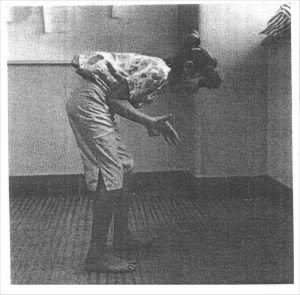
This is why:
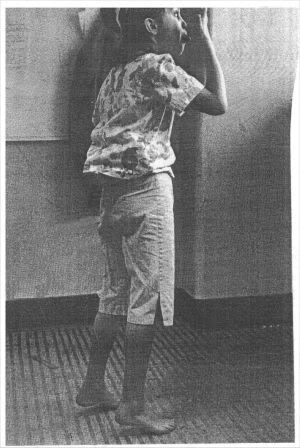
If you were in the wrong place at the wrong time, the wrong age, the wrong functioning level, this could be your life. This what people like them think about people like us.
He was a kid I met this summer at the school where I interned. I have written about him several times, sometimes at length. And although he was my favorite kid at the school, that isn't why Danny is always surfacing in my mind, tiny in his big t-shirts, flinging himself around and reciting things.
It's through Danny that I found out for sure, this stuff is about me.
Because the first thing people use on us is always, "It's not about you." When I was a kid, when I first started reading about autism rights, it was so instinctive: of course it's wrong to say "cure autism now." Of course it's wrong to say autism is a tragedy, a disease, it's wrong to give kids electric shocks, it's wrong to say you thought about killing your kid in a video about eliminating autistic people from the gene pool. Like Sinclair says it's wrong to mourn for a living person. All this stuff was plain and clear and bright, and I was autistic, and I was being attacked.
Right?
Well, not to anyone else.
Because, of course, if I told anyone I was autistic, they said I was lying, or I had a different kind of autism that made me smart and talented, so I wasn't like Those Kids, the kids who needed to be cured. And that I should think about their parents, about the money and time to care for a person like that, about the dreams that are shattered when your kid is really autistic, not smart autistic, the real kind. So in my late teens when I put myself through my paces, when I figured out my deficiencies and set myself to systematically eradicating them, one of the deficiencies I eradicated was my use of the word autistic. Because you shouldn't use words people don't understand. And you shouldn't use words that will make someone feel bad, someone who has a kid who's Really Bad, Really Disabled. Because you're not that.
And I met some autistic kids and they were not much like me, and I didn't know to apply what I knew about myself to them, because I couldn't see what they were feeling inside. But I liked them. Then I met some people with intellectual disabilities and I liked them too; after a brief nervousness because some of them looked so different from me, and made noises I didn't understand, it was easy to like them. They were people who liked things, some of them the same things I liked. I could see that they weren't on the surface very similar to me, but I liked being around them almost more because of that, because it made me feel happy and chastened to misjudge them again and again. To be proven wrong when I thought I could quantify them just because I knew more words.
So by this point, I was pretty much sold, even if I wasn't Really Autistic, on the idea that people with developmental disabilities matter. Because I was around them all the time and it was obvious they mattered. But still, I felt my position was that of an outsider, an ally. I had opinions but I didn't necessarily feel that I had much right to talk about them; I didn't feel I had as much right as the parents or teachers of people with developmental disabilities.
And then I interned at this school.
And I started out thinking: wow, ABA is so cool. I've heard negative things about it from other Not Really Autistic people, but who am I to talk about what these Really Autistic kids need? They can't even talk. They might bite themselves or something. What the hell do I know about that?
And then I met Danny and the other kids in his class. High-functioning kids. Verbal kids.
Tony, who had been nonverbal a few years before, was incredibly hardworking and sweet. When he went into the school director's office and turned out the lights as a joke, I laughed, but she said, "Tony. Look at my face. How do you think that made me feel?" She stood there looking grim until he apologized.
James was stressed out and upset; one of his teachers leaned towards him, staring fiercely into his eyes, talking with cold, strained-sounding words, the kind of voice I called "static" when I was a kid. James looked scaredly back at her, wriggling his hands around in his lap. "James," she said. "I know you're upset. But what you're doing with your hands looks silly." This boy, all the tension in him being channeled into something harmless, something she had to look under the table to see. His tension was silly. His discomfort was an inconvenience. He was eight or nine years old.
And Danny with his words. "Danny's an interesting kid," the school director told me. "He likes to be in charge." Danny and I were walking, holding hands, and when I responded with concern when he told me he was tired, another teacher told me, "He's playing you." It's true that Danny was a bossy little boy; when we played restaurant, he replied, "No, we're out of that" again and again until I ordered the food he wanted to pretend to make. And his love of subway trains spilled out everywhere. He was supposed to write a story about a sad princess, and he did, but half the story was about the princess's friends taking her on the subway to cheer her up. He was supposed to write a crossword puzzle and the clues were things like, "Transfer is available to _____ North." The school was full of subway maps, since many field trips involved subways, and Danny would sometimes just lean over a desk, pressing his face into the shapes and colors, whispering his favorite schedules to himself.
Danny just liked words. When he was using his special words, the weird words he scrounged for or made up himself, he would find himself jerkily hopping across the room, speaking in a squeaky voice, his small face tense with excitement. "Presentation" was a weird word for movie, "document" was a way to talk about the letter he had typed on the computer for his parents. "I went to the barber," he said when I commented on his newly short hair, and then, with a rush of joy, "but I like to call it the hair shop!"
I like words too. It was hard to watch Danny's teachers nudge him, sit down with him, say, "Danny, the word 'presentation' is a little weird; you need to say 'movie.'" It was hard to watch the way they looked at him, pointedly, until he stilled his hopping and lowered his voice to a more standard pitch. When Danny found out my middle name is Wood, he completely tripped out on it, hammering pretend nails into my stomach and giggling, "I'm gonna build something out of you!" "Danny," a teacher said, "don't be weird. You and Amanda were talking about names."
It was the word weird. Nothing foreign my whole life. Tracing words and shapes in the air, crossing myself, my mom asking me a lot of questions, "Have you been feeling the urge to do that lately? Why do you do that?" with so much static it was clear I'd better keep my hands as still as possible when she was around. Running jerkily up the stairs at school, I couldn't help myself until I was fifteen or sixteen, despite the older boys laughing to each other--"is she trying to race you?" Movement just consumed me that way. And being a thirteen-year-old who said "suppose" and "quite" when no other kids did. Just loving words too much, finding it hard to stay away from the strange ones. And getting too excited. Being weird is not that alien for me.
So my divisions broke down a little, because I was watching a kid just like me, and I was learning, in very specific, qualitative terms, what they thought of people like me. I was so nervous about keeping myself still and using the right words because I thought they wouldn't let me intern there if they knew I was actually like Danny, that I didn't think he was weird at all. All of Danny's teachers had been taught to grimace and say how annoying it was when he talked about trains. They watched The Office, but they never ever laughed when Danny told flat, self-referential jokes on purpose, twisting the ones he had been trained to say. I thought Danny was funny. Every time I talked to him I felt nervous about doing something that his teachers would think was wrong, and I also felt bad about perpetuating the attitude he was being taught, that none of the things he loved mattered.
So from specific to general, from Danny to James and Tony, to Max and John. John's teacher made him walk, in stiff, clean steps, and if he started doing anything that looked like skipping or jumping, she grabbed his arm, said "No," forced him again and again. Max liked to move his arm in circles while he was watching TV, so he was hauled off into an office, pushed down into a chair, had mouthwash forced into his mouth while he cried. They told me they were narrowing it down, he was moving less and less. Max and John didn't talk. James and Tony didn't talk as well as I do. But I move too much, and I move wrong, especially when I was a kid, and in that school I saw what they do to kids who move wrong.
I realized that, actually, a lot of it was about moving wrong. Or talking wrong, if you could talk. Or just taking too much initiative--wanting to make up songs, like Danny did, or playing a practical joke, like Tony did. That these kids looked and acted different and the school wanted to control them and make them as still and docile as they could possibly be. Watching them treat hopping, rocking, and neologisms like you'd treat a bomb on an airplane--it was like being at summer camp with a kid from the south, sitting in a car uncomfortably while he said he'd kill a gay person if they ever came near him. Wanting to say, no, it's not anything important; I'm like that, see? But I didn't talk in the car and I didn't talk in the school.
This is too long. It's hard to even explain it. I just have to say, for the millionth time, that this whole functioning level thing--yes, it matters in certain ways. I can buy and cook food for myself, while a severely autistic person probably can't. I can hide the way I move and talk better than other people can. But this doesn't really have much to do with politics, because when people claim that "cure autism now" and the disease and the Judge Rotenberg Center are not about me, well I beg to differ. The only reason they're not about me is that I'm old and verbal enough to not be vulnerable to that kind of abuse. They would be all too happy to practice it on me if they could. Autistic people do not get abused because they are low-functioning, they get abused because they do weird things.
So, the old-school ABA trials? With Lovaas?
This is a kid getting an electric shock:
This is why:
If you were in the wrong place at the wrong time, the wrong age, the wrong functioning level, this could be your life. This what people like them think about people like us.
20 November, 2009
Okay
so maybe it is not the country.
I had to do a presentation in my art history tutorial and I was able to more or less bullshit my way through it and exploit my general medieval and church history obsession and my very messy (but better than my classmates') understanding of Islam, and my tutorial teacher joked with me and stuff. Now I'm in a good mood. I think the problem here, though it does stem from how anonymous UK education is, is not really about the UK in itself; it's more just that I feel like I'm not really expressing myself or connecting with anyone.
Part of this is the lack of snow, and feeling embarrassed whenever I open my mouth and say everything wrong--my church history teacher pronounces controversy "con-TRA-vussy," how beautiful is that? But it's also just how the school is. People skip classes all the time and never ever seem excited about things. But they don't even seem like they hate class either, which would be something. They're just there like they work in an office.
The other day I dreamed I was home. It was pretty cool. But hopefully I will continue to talk in art history tutorials in the future, which feels like wiggling my toes, helping myself concentrate on reading by slamming my hand through the air, spelling out words with my fingers when I was a kid. Movement wakes up my brain.
I had to do a presentation in my art history tutorial and I was able to more or less bullshit my way through it and exploit my general medieval and church history obsession and my very messy (but better than my classmates') understanding of Islam, and my tutorial teacher joked with me and stuff. Now I'm in a good mood. I think the problem here, though it does stem from how anonymous UK education is, is not really about the UK in itself; it's more just that I feel like I'm not really expressing myself or connecting with anyone.
Part of this is the lack of snow, and feeling embarrassed whenever I open my mouth and say everything wrong--my church history teacher pronounces controversy "con-TRA-vussy," how beautiful is that? But it's also just how the school is. People skip classes all the time and never ever seem excited about things. But they don't even seem like they hate class either, which would be something. They're just there like they work in an office.
The other day I dreamed I was home. It was pretty cool. But hopefully I will continue to talk in art history tutorials in the future, which feels like wiggling my toes, helping myself concentrate on reading by slamming my hand through the air, spelling out words with my fingers when I was a kid. Movement wakes up my brain.
Subscribe to:
Posts (Atom)