Showing posts with label cerebral palsy. Show all posts

22 July, 2014

Why I Published A Picture of a 24-Year-Old Looking Bored With a Stuffed Dragon

Like many people, I recently saw a picture of a disabled teenage boy in his underwear. I'm not going to post the picture since I don't find it appropriate or appealing to distribute near-naked pictures of minors. If you don't know about the picture, it was the main picture on an NPR article about the boy's parents and their experiences taking care of him. Now you have enough information to find this picture--and what 16-year-old wouldn't be thrilled if the entire Internet community could find a picture like this of them?

It's true that most 16-year-olds wouldn't like it at all, but almost no one considers your perspective if you have a severe disability.  When disabled people complained about the picture, NPR ran another piece defending their decision and a bunch of non-disabled people made comments about how beautiful and important and meaningful the picture was.  All these people--the author of the new piece, the photographer, and most of the commenters--failed to comprehend any of the complaints that had been made. It is amazing how much people just refuse to hear information that has to do with disabled people having a perspective.

To hear them talk, the only people who had problems with the picture were just weenies who were shocked to see an image that refers to personal care.  The commenters especially seemed to feel that they were crusading for great justice, shutting down a bunch of Cloudcuckoolanders who want to remain unaware of the fact that some people need this kind of care and it can take a physical toll on their family members. The popular phrase was, "When I look at the picture I don't see all the stuff you're complaining about, I just see LOVE."

Most importantly, this is bullheaded ignorance of the fact that a)disabled people have opinions, b)most people would not like a picture like this to be distributed of themselves so it's a double standard, and c)no reference was ever made to the boy, Justin, being asked his opinion, nor whether he was able to give his opinion.

But on another note, I'd like to put forth my disabled opinion that this simply isn't a very good picture and that it represents neither love nor the real experience of caring for a severely disabled person. I'm not a parent, nor do I expect to ever be able to be one because of my disability; but my job is taking care of a severely disabled person, who I happen to love. My job involves personal care sometimes (how shocking), but also endless attempts to take good pictures of Anna. She doesn't care about pictures, but her dad is a photographer, her mom is an artist, and I am a member of the Selfie Generation, so we feel compelled to document every adorable and interesting thing that Anna does. Since Anna is quite adorable and interesting, she has to contend with this kind of thing pretty often.

Here are some of my pictures that I consider bad:


I consider them bad because they don't do what a picture should do--show who a person is. In the first picture, Anna is not looking at the camera and her face isn't visible. In the second picture, she is visible, but she is tired or lost in thought, so her personality is not portrayed in the picture. Actually it's not a great example of a really bad picture, because she sort of has an expression. The point is that in many candid pictures of Anna, she looks very blank and much more like a stereotype of a severely disabled person than she does in real life.

Here are some pictures I'm proud of, because they show Anna's personality.


I'm not a very good photographer, but I can sometimes get accurate pictures of Anna just by choosing the right time and talking to her while I'm taking the picture so she is interacting with me instead of hiding from the camera. Or I might take a picture of her while she is doing something she really likes to do or interacting with someone else. This seems pretty obvious, yet Andrew Nixon of NPR did not seem to think doing this was important. If you cut out the "shocking" part of the picture (that the boy is almost naked and his dad is carrying him) this is the supposedly loving image that you get.


I feel he could have taken a better picture of the dad too, but the most obvious problem is that you can't see the son's face. He might be smiling back at his dad, but you really can't tell because of the angle, and you have to work hard to even guess what his expression might be. I don't see the love or realism in this picture because I can't see the connection and interaction between the father and son. Some people think that taking care of a severely disabled person is just a heroic task where you cart around someone who doesn't even know you're there, but that's not reality. It's not unrequited love.

Andrew Nixon took a picture of two people, and failed to take it from an angle that included both of the people in the picture.  Without the "shocking" parts, it's obviously a bad picture. Rather than people not liking the picture because it's too shocking, it seems to me that people who like this picture like it only because they find it shocking.

The article includes another picture, where Justin is getting physical therapy. No one has much of an expression, and Justin especially almost looks like he is asleep. I don't really mind this one too much though, since it was not used to illustrate the article and everyone is fully clothed. Finally, at the end of the article, is an actually good picture of Justin. It looks to me like someone who Justin actually relates to (i.e., not the photographer who obviously doesn't know how to interact with him) has stepped in between him and Nixon.


Justin is at his birthday party, and clearly interested in what's going on. I think he's not looking at his cupcake as you might expect, but at a person he likes. Anna's dad also thought this was the best picture in the article and should have been highlighted because, "he's with it; he's paying attention."

There were a few comments on the article from people who thought Justin had, and I quote, "no cognition" and therefore his life was meaningless. His mother contacted some commenters to explain that of course he has cognition, which I am glad she did. But she could have done something better if she had demanded better pictures to be used in the article than ones that did not show Justin's face, or where he looked blank, which play right into the idea that severely disabled people don't think and disabled people in general don't have perspectives.

I'm not saying it is the parents' or Andrew Nixon's fault that people make those kind of assumptions about someone with severe disabilities, but they all could have fought against those assumptions by making an effort to include better pictures of Justin that portray his personality and inner life. Apparently none of them realized why it was important to do this, and they unintentionally advanced the idea that what's important about severely disabled people is the physical support they need, and not that they have personalities like everyone else.

05 October, 2011

Armchair Farmhouse #1: Clayton

I'm starting a podcast called Armchair Farmhouse and in it I interview people about why they do or don’t identify as disabled and what their history is with that identity. I only want to interview people in real life so I’m mostly going to stick to RL friends but if anyone reading this is near Cincinnati, you should totally let me interview you! I’m especially interested in talking to people who have diagnosed mental or physical health conditions but don’t consider themselves disabled.

My first interview is with my friend Clayton who has CP, ADHD, and general bad brains, and recently identifies as disabled but didn’t for a long time. You can listen to it here or read a transcript of it here.

20 June, 2011

Fallacy Week: The Harder Fallacy & The Uncomfortable Fallacy

Hi guys it's FALLACY WEEK! Every day you get some fallacy action from a post I made a super long time ago at LOVE-NOS.

A lot of the time, when you are having a conversation about disability and/or ableism, the person you are arguing with will make a fallacious argument. Most of the fallacies I’m describing in this post are fallacies of relevance. Wikipedia describes fallacies of relevance as “presenting an argument that may in itself be valid, but does not address the issue in question.”

Fallacies of relevance can be very difficult to respond to for several reasons.

1. They involve an abrupt change of subject, which can confuse and distract you, causing you to lose your train of thought. Depending on your disability, this can have the effect of making you have to quit the conversation altogether.
2. Often the change of subject isn’t obvious–it may even be unintentional on the part of the person who’s using the fallacy, if they are responding emotionally rather than logically. You may end up feeling that something isn’t right about what they said, but unable to identify exactly what it is.
3. A lot of these fallacies involve stating something irrelevant that is true. You may become confused and think you are wrong because the other person said something true.
4. A lot of these fallacies involve stating something irrelevant that is related to violence, the speaker’s personal feelings, or other emotionally powerful themes. You may become uncomfortable and think that it would be wrong to disagree, because you might be implying that you don’t care about violence, people’s feelings, etc.

I have experienced 1, 2, 3, and 4 in real-life and online conversations, and as a result I’ve become super interested in sitting around by myself and deconstructing what happened–why did I feel like I was wrong even as I sensed that the other person wasn’t being fair?

In these examples, John is a disabled self-advocate, while Mary is using various fallacies to oppose him. From example to example John and Mary are different people and have different relationships with each other. I tried to give John a few different disabilities, since most of these fallacies are fairly universal. But I felt awkward doing this, because I was mostly writing from my own experience; I hope I haven’t stuck in disabilities that don’t fit the example.

The Harder Fallacy

JOHN: I didn’t like the story we read in class. It was told from everyone’s point of view but the son with CP, and whenever it talked about the disabled son, it would just list everything he couldn’t do. We never learned about his personality or how he felt about anything. I thought it was an offensive portrayal of a disabled character.
MARY: Come on! Are you saying it’s not harder to have a kid with cerebral palsy? That’s a ridiculous thing to say.

Rebuttal:
John wasn’t talking about whether it’s harder to have a disabled kid than a non-disabled kid. He just wanted the disabled kid to have a point of view and a personality, like the other characters. If someone wanted, they could easily write a story that portrayed a family having a very hard time coping with their son’s disability, while still portraying the son as a well-rounded character and not a plot device.
Mary was responding to a totally different statement, which she made up in her head and is pretending (or actually thinks) is what John was saying. The way the harder fallacy works is that when someone makes any comment about disability being portrayed offensively or inaccurately, you respond to the following imaginary statement: “It isn’t harder to be disabled and it isn’t harder to live or work with a disabled person.”

(Fun fact: some people use a form of the harder fallacy to defend statements like, “This weather is retarded.” Their argument is that having an intellectual disability is harder than not having one, so therefore intellectual disabilities are bad, and words relating to them can be used to mean “bad.” I guess this is a legit argument, except that most people who make the argument don’t apply their “harder life=synonym for ‘bad’” rule consistently, and only apply it to stigmatized groups.)

The Uncomfortable Fallacy

MARY: Wow John, it’s so nice of you that you do that program where you go bowling with people who have special needs. I really admire you because I’m not the kind of person who can talk to special needs people.
JOHN: Well, they’re just people. I’m sure you could come bowling with us and it would be fine.
MARY: No I can’t. When I’m around special needs people, I feel really uncomfortable and don’t know what to say.

Rebuttal:
This is a less classic fallacy, and not quite an argument; but I think it’s worth exposing. Mary is confusing a feeling with a fact. She interprets her discomfort with “special needs people” to mean that they are a homogeneous group which one needs certain skills to interact with–skills which, she concludes, she must not have.
If Mary always feels uncomfortable around an entire minority group, it’s probably because she hasn’t been around people from that group very much, or has heard a lot of bad things about them. There is no way an entire group of people could be so similar that one person possesses the ability to either get along, or not get along, with all of them. The uncomfortable fallacy is when you think that being uncomfortable around another person necessarily indicates something about the person.

(Fun fact: You may be wondering why John considers this an argument, when Mary just told him he has admirable skills and is nice. Remember, John is disabled. From Mary’s attitude towards disability, we can guess that she probably doesn’t know John is disabled. But John knows that John is disabled, so he’s probably thinking, “I wonder how Mary would feel about me if she knew I was disabled. Or if she does know, why is she talking to me and why did she tell me she’s uncomfortable around other disabled people? Does she think I’m not really disabled?” And so on. Although Mary meant to compliment John, she simultaneously insulted him which makes him feel, well, uncomfortable.)

27 February, 2011

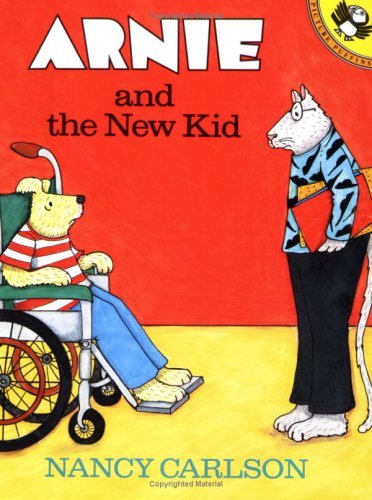
Arnie and the New Kid

I have so much affection for Arnie and the New Kid by Nancy Carlson, who wrote a ton of books for kids about anthropomorphic animals. I wrote about this on tumblr but I just want to write about it again because it ties into what I've written about disabled queerness. Also, it's incredibly cute.

Arnie is a non-disabled cat who is quick to make fun of Phillip, a dog who uses a wheelchair. (I loved writing this sentence.) One day, Arnie is shambling around pretending to be Phillip, holding his arms up to his chest or whatever in an attempt to look disabled, and instead of getting an Oscar or an Academy Award like if he was a human, he falls down the stairs and injures his leg, wrist, and tail. Cut to Arnie wearing an adorable brace on his tail, using crutches, and needing much more help with things than Phillip ever did.

Like Harry Potter, Phillip has the social grace of a saint and befriends Arnie even though Arnie was a dick to him. Arnie and Phillip start spending all their time together doing the things Phillip likes to do--like playing video games, trading baseball cards, and birdwatching. (I especially love the page that shows them in a theater, watching a horror movie through their paws.) Of course, Arnie recovers from his injuries and goes to play baseball, which was one of the things he originally bullied Phillip for not being able to do. Phillip is worried that their friendship is over, but then Arnie says that Phillip will come along and be the coach.

I've read a review criticizing this book for exactly the reason I like it: Phillip is a loser who needs Arnie's help to be included socially. Well, Phillip is not a loser in my estimation, but he isn't so incredibly cool that he can overcome the stigma of disability, especially when Arnie is constantly drawing attention to everything Phillip can't do. What accounts for this failure of character? PHILLIP IS AN ELEMENTARY SCHOOL KID. Not every kid can go into a new school and have everyone be staring at them and bullying them, and deal with that competently and make a lot of friends.

Phillip is just an ordinary, nerdy kid--and by Arnie's standards, he really is a loser. He takes longer to eat, can't race, and can't play baseball. Basically, Phillip is slow, which dooms him not to be taken seriously by many of the kids.

But then, when Arnie is injured, we learn that Phillip has all these other interests and abilities that don't relate to whether he can walk or perform complex tasks with his hands. Arnie has a great time when he's temporarily disabled, and this, I think, is what keeps Arnie and the New Kid from being a book about charity or pity. Arnie doesn't think, "Wow, being disabled is awful, I should be nicer to Phillip." He learns that Phillip is actually a fun person and a good friend. He learns that his conception of what makes someone a loser was wrong.

When Arnie asks Phillip to be his coach, yes, he is making an effort to include him and maybe Arnie's actions will be the key to Phillip's social success. But Arnie makes the effort because he's grateful to Phillip and likes spending time with him, not because it's the nice thing to do. Arnie's decision is ultimately not about his own good qualities, but Phillip's.

I actually feel really frustrated by the idea that it's offensive to portray a disabled character needing help or being socially isolated. Phillip is not portrayed as weak or unpleasant at all; he's just up against a lot of ableism which, being a child, he can't handle all by himself. If Phillip was some kind of amazing superdog who could play baseball in his wheelchair and advocate for himself to be included in the games and be such an all-around badass that no one even noticed he was disabled, that would be an incredibly unfair image to show to kids. Most disabled kids cannot be that and shouldn't be made to feel that that is what they have to be in order to succeed. Non-disabled kids shouldn't be told that instead of adjusting their ideas of what you can do with a friend, or what qualities make someone cool, they can just wait for a supercrip who forces his way into their world and adjusts to their standards. Because they will be waiting a long time and, while they wait, some of them will be bullying ordinary disabled kids.

I'm thinking of making a series of posts about disability-related children's books, which would hopefully involve a lot of DISCUSSION! I'm wondering if anyone else read this book and what they thought of it. Obviously I am not a wheelchair user so I may have missed something really egregious. (One problem I have with the book is that Phillip obviously needs an aide and doesn't have one, so the nicer kids are always doing stuff for him. Really, really not a good message to send.)


Image description: cover of the book Arnie and the New Kid. On the left side of the picture, Phillip, a yellow dog wearing a t-shirt and jeans, sits in a wheelchair. On the right side, Arnie, a gray cat wearing glasses, black pants, and a shirt with mice on it, is standing and holding some books. Arnie is practically looming over Phillip with a mean look on his face, and Phillip looks scared.

09 December, 2010

Shelly was still thirteen years old

In 1981, I was employed to teach a sailing course for individuals with disabilities. In an attempt to recruit new students, we visited several segregated living accommodations for people with physical disabilities. When we entered one "facility," I recognized a young woman whom I shall refer to as Shelly. Shelly and I had come to know each other while we were in a segregated public school and had become close friends. She had cerebral palsy. and was an intelligent, perceptive girl who had a dry and biting sense of humor. Together we had talked about what it was like to be handicapped, we laughed about how people reacted to us and shared many of the common ironies and frustrations.

After completing Grade Seven, I was integrated into a regular school and from there continued on into a secondary school, and then entered University. Shelly had continued her education in various segregated settings, eventually moving into a segregated residence. Shelly and I had parted when we were both thirteen years old. I had not seen Shelly for ten years since that time. Consequently, I was overjoyed to see Shelly again. I sat down and began talking with her. In five minutes, I painfully realized that Shelly was still thirteen years old.

At that moment, the connection between segregation and death became apparent.


--Norman Kunc, Integration: Being Realistic Isn't Realistic

Generally I don't like the idea of mental age, and I certainly don't think that someone should be said to have "the mental age of a child" because of their IQ score or their interests or anything. But I find this passage to be really striking. This summer when I was in Vermont--which is a place where a lot of disabled people go to mainstream schools, hardly anyone seems to live in group homes, and there are no sheltered workshops--I started to feel a difference that often existed between middle-aged and elderly people with intellectual disabilities, and people in their teens, twenties, and early thirties. It didn't have to do with how well someone could talk or something like that. Though there were many outliers in both groups, younger people overall seemed less "compliant" and seemed to have stronger interests. I discussed these two kinds of people in my Mark and David post, although in that post the two examples were the same age.

Maybe the more compliant people with less strong personalities were not exactly like children. Maybe mental age is the wrong word to use. But there is a sense of something missing. I don't mean to talk tragically about those people; many of them are great. But I think some people with intellectual disabilities must have certain experiences when they are growing up, and you can feel the distance between them and people with ID who have simply grown up.

01 December, 2010

Finding it (well, sort of)

So I've read the piece Hell-Bent on Helping: Benevolence, Friendship, and the Politics of Help (which is a really great piece about how inclusion doesn't work if you always put the non-disabled students in the position of giving charity to disabled students, because they can't develop real friendships) and I realized maybe I should actually go to the domain it's at and see what kind of website it is. It's pretty great! It's a guy with CP and his wife, who do training and speaking about including people with disabilities at school work etc. And some other stuff.

So (I'm still on the same topic, you guys) there used to be this post at an "autistic" blog, which doesn't seem to be there anymore, and this post was saying something like, "I don't like when people compare the Deaf and autistic communities, because being Deaf vs. being deaf is about using sign language, so being Deaf instead of deaf is a decision, but there isn't a language that autistic people can decide to use and there aren't two ways of being autistic like being Deaf and deaf are two different ways of being deaf." I'm not naming the blog because I think I may be oversimplifying the post, and I don't want to attribute statements to them that they might not have said, or might no longer agree with since they apparently deleted the post.

But based on my reading of the post? I could not disagree more. My understanding of Deaf culture is very basic, but it seems parallel to Autistic culture for reasons I will discuss below. I don't use a capital A specifically to reference Deaf culture; but I think my reasons for using capital A are because I think there's a big difference between the identity I have now, and the identity (or non-identity) I used to have and the one some people still have.

For people with autism, it's not as simple as sign language vs. lip-reading and speech as a mode of communication. But it is the case, just like for deaf people historically, that lots of people with autism grow up with parents and professionals trying to teach them to communicate in a "normal" way, and just as it is often unpleasant and difficult for a deaf or hard-of-hearing person to have to communicate only through lip-reading and speaking, it is unpleasant and difficult for someone with autism to have to always express themselves exactly as someone without autism would, and understand exactly the things that someone without autism would. (Plus of course there are people in both groups who can't even reach the point that is deemed to be "success," even mediocre success. And those people, from that perspective, are just doomed.)

Here's a simple way of putting, in my mind, what constitutes the difference between being only a person with an autism spectrum disability, and being a person with ASD who is also Autistic.

I used to think of myself as being like a mosaic. I was very smart, I thought, so the mosaic was very complicated--the squares were getting smaller and smaller, and to most people, the mosaic looked like it was an ordinary picture. But it was really just a calculation, and there would always be things that looked a little too sharp or disjointed, parts of the image that required soft curved lines; so occasionally, my mosaic would fail as an image. It would get to be more and more like a real picture, but it would never get all the way there; if you zoomed in close enough there would always be squares.

When I thought of this, less than two years ago, I just thought it was an interesting way of explaining why some things were hard for me. It didn't occur to me how incredibly sad it was that I thought I wasn't a real picture.

Now I know that I'm a real picture, and I live as a real picture. As I've discussed, this is both more and less self-centered than the way I used to live. In one way, the things that I think are appealing and cool and smart, or the things that I'm naturally moved to do, now form the center of my experience in a way they didn't before. I make all my decisions as myself. However, this leads to a calmness and makes me more open to other people (whereas I used to sort of hate most people because I was constantly thinking, "they get to just be themselves and that's allowed").

I could go into a bunch of detail about what "living as a real picture" looks like for me in real life, but that isn't really the point of what I'm saying. What I'm saying is that I imagine a person with autism choosing to live as a real picture (i.e. to be Autistic) is comparable to a deaf or hard-of-hearing person choosing to communicate primarily in a way that is comfortable for them, instead of in a way that is comfortable for other people and difficult for them (i.e. choosing to be Deaf).

To cycle way way way back, I have really enjoyed reading Norman Kunc and Emma van der Klift's website, because they are very smart, but one thing that struck me was Kunc's description of his childhood and adolescence. He went to various types of therapy where he was constantly encouraged to change the way he walked, talked, etc. As a teenager, he tried to keep track of and control situations (like eating and moving in front of people) so that his cerebral palsy would be less obvious. As a young adult, he suddenly realized that, as he puts it, "I had the right to be disabled."

I don't exactly want to say I think it's cool to read about Kunc's awful childhood experiences or deaf students historically being forbidden to use sign language, or the article I linked to a few days ago about someone with CP being forced to get a painful, useless operation because it might make her walk more normally--but there is something extremely powerful in seeing that passing as ethics and passing as cure have been used to hurt so many different people with such different disability experiences. I guess I can say it's sort of a relief. Parents and professionals who support passing as ethics/passing as cure for people with my disability will end up saying, "Oh well autism is different." They basically defend their obsession with passing on the basis that autism is a "social disability," or whatever.

And while I don't think that "autism is different," I think when I started figuring out passing as ethics, I thought I was almost the first person to start figuring out these things, and I thought it mainly related to autism and maybe intellectual disabilities. There's something really deep and lovely--they're not lovely facts, but it's a lovely feeling--about realizing how many different kinds of people have had to put up with this exact same thing, and that people have been fighting it for much longer than the twenty years Autistic culture has been around.

22 November, 2010

from Ragged Edge Magazine May/June 1999

Playing Cards at Boston Children's Hospital by Lisa Blumberg was linked in a blog I was looking at and it's a really good and important piece. It made me really upset to read it.

It was striking to me how much I related as an Autistic person to the professional attitudes that Blumberg experienced, since she has cerebral palsy and no mind disabilities. I'm kind of leery about doing this because I don't want to give the impression of appropriating someone else's very different experience, but I want to quote some of the lines that really resonated with me:

Once Matty [her physical therapist] watched me walk and said, "You don't concentrate. You just go--like you think you walk normally or something."

I tried to explain it to my mother: "They exalt form over substance." I didn't have the right words...


When Blumberg was in her first year of college, a doctor spent months pressuring her and her mother to agree to a surgery that involved cutting into Blumberg's muscles, even though Blumberg really, really didn't want it. The doctor constantly told them that if she didn't get the surgery, her hips would dislocate by the time she was forty (then he kept lowering the age at which this would supposedly happen). As an adult, she found out that there was no way this would have happened before she was very old.

By Monday, after five days without movement, both my legs were sticks. I screamed when Matty touched them. She sat me up. I fell over. "You make me sick," I said to Pan later. That was obviously an understatement...Matty said I was being terrible to Dr. Pan. She said he knew I didn't like him.

Nine days after surgery, I went home and that was when the fun really began. There was a problem with pain management. The problem was that Pan was not interested. He said his concern was with correcting my leg, not with how I felt while he was doing it. Both my legs now hurt everywhere, but he had only cut one muscle on one leg, so I could not blame all this on him, no indeed. Anyway, I was just faking.

... Throughout July and August, while the pain turned into aches, I had therapy. My hamstrings and some of my hip muscles were doing weird things. I couldn't straighten out my legs the way I used to. My left leg--the leg that was supposed to be untouched--was turning in.

At first Matty pretended things had been this way all along but then finally said, "When you cut a muscle, every other muscle reacts. When you do something to one leg, the other changes."

No one had told me. I had not been playing with a full deck.

"Why did he do it?" I screamed.

"If you don't take risks, you don't do anything," Matty said crossly. "It's not like you had a great walk to begin with."

So it was spoken, so it was said. I had a disability to begin with. It was all right for other people to take risks with me.

...By 1979 I had oozed into the disability rights movement and for the first time met other adults with disabilities. Many of these people had been "treated" at a local pediatric orthopedic hospital I'll call Newcastle, since this article really isn't about Newcastle. The first thing I heard about was the amphitheater where the kids were examined in front of students and whoever. This was a new one on me.

Then I heard about the surgery--lots of it. As someone said, "surgery was all there was." Three, five, seven, eighteen operations on one person. Sometimes one surgery would be successful and then, well, the next one would be sort of a mistake.

I asked Bette what the hell was going on. She said that kids at Newcastle were looked at from an orthopedic perspective but did not necessarily get rehab. For kids who had lasting disabilities rather than, say, a club foot, that was a problem. People did not understand that. Even most primary physicians did not recognize this...It occurred to me that if your focus is on a fix, working with individuals with lifelong disabilities must be aggravating--aggravating enough to make you swear or become a gambling man.


(emphasis mine)